

Who is your ideal customer? If your answer is a vague “everyone,” stop right there. It’s the single most common-and costly-mistake a startup can make. Trying to appeal to the masses is a fast track to a burned-out budget with zero results. The secret to smart, efficient growth isn’t a bigger megaphone; it’s a laser-focused definition of your perfect target market.
But where do you even start? Forget the overwhelming jargon and the fear of choosing the wrong group. We’ve stripped away the complexity to give you what you actually need: a fast, simple 4-step process to identify your ideal customers. No more guessing. Just a clear, actionable plan.
In the next few minutes, you’ll learn how to build a customer definition that gives you the confidence to write your business plan and make every marketing dollar count. Ready to stop wasting money and start growing? Let’s begin.
What Is a Target Market? (And Why It’s Your Startup’s Secret Weapon)
Let’s cut through the jargon. A target market is the specific group of consumers most likely to buy your product or service. That’s it. Many founders make the classic mistake of saying, “My product is for everyone!” but this is a fast track to burning cash and getting zero traction. For a formal breakdown, you can explore the academic view on What Is a Target Market?, but for your startup, think of it this way: marketing to “everyone” is like using a shotgun. You spray your message everywhere and hope something hits. Defining your group is like using a sniper rifle-every shot is precise, efficient, and far more effective.
This precision isn’t just marketing theory; it’s a core business strategy that saves you time and money. When you know exactly who you’re talking to, you unlock powerful benefits:
- Better Marketing ROI: Stop wasting ad spend on people who will never buy. Reach the right customers on the right channels, instantly.
- Stronger Product Development: Build features your customers actually want because you understand their specific pain points.
- Clearer Messaging: Craft marketing copy that resonates deeply and drives action because it speaks directly to their needs.
Target Market vs. Target Audience: What’s the Difference?
These terms are often confused, but the distinction is simple and crucial. Your target market is the broad group you want to sell to. Your target audience is the specific, smaller segment of that market you target with a particular ad or message. For example, a sustainable apparel brand’s market might be eco-conscious millennials. Their audience for a new Instagram ad could be female remote workers, aged 25-34, living in major US cities. You must define your market first to know which audiences to pursue.
The Cost of Not Having a Target Market
Ignoring this step isn’t just inefficient-it’s expensive. Flying blind with your marketing and product strategy leads to predictable and costly problems:
- ✗ Wasted Spend: Pouring money into ads on platforms your ideal customer never uses.
- ✗ Vague Messaging: Creating content so generic that it fails to connect with anyone.
- ✗ Useless Features: Wasting development hours on product updates nobody asked for.
- ✗ Losing to Competitors: Getting outmaneuvered by rivals who have a laser-focus on their niche.
The 4 Core Ways to Segment Your Market (The Building Blocks)
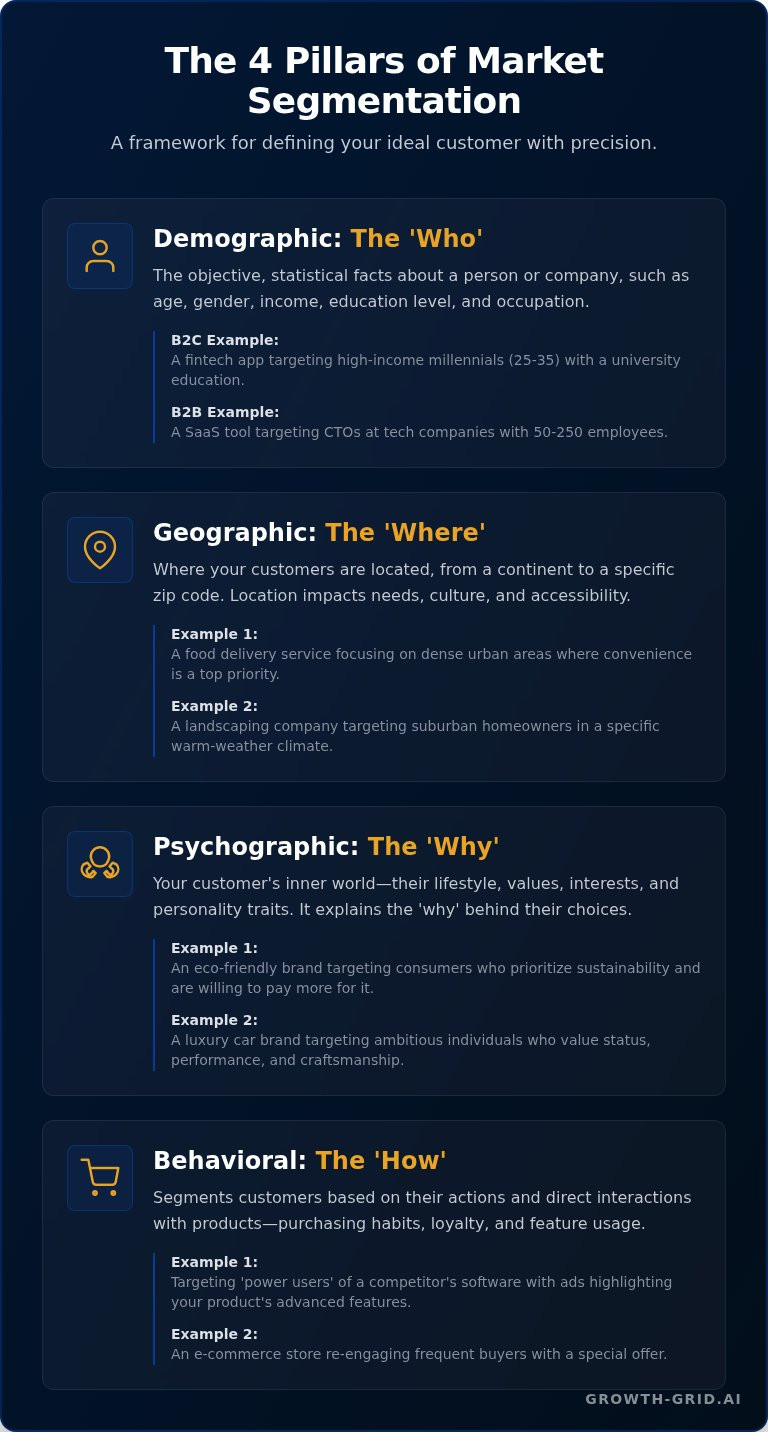
Stop guessing who your customers are. To define your target market with precision, you first need to break the broad, messy market into clear, understandable groups. This is called market segmentation.
Think of these four types as essential building blocks. Mastering them is the core of effective market research. In fact, government resources like the U.S. Small Business Administration outline a similar approach in their guide on Your 4-Step Process to Define Your Target Market, because it’s a proven framework for getting fast results. These are the four lenses to view your potential customers through.
| Segmentation Type | What It Answers |
|---|---|
| Demographic | The ‘Who’ 👤 |
| Geographic | The ‘Where’ 📍 |
| Psychographic | The ‘Why’ 🧠 |
| Behavioral | The ‘How’ 🛒 |
Demographic Segmentation: The ‘Who’
This is the most straightforward data. It covers the objective, statistical facts about a person or company, such as age, gender, income, education level, and occupation. It’s the fastest way to get a baseline understanding of your audience.
- B2C Example: A fintech app targeting high-income millennials (age 25-35) with a university education.
- B2B Example: A cybersecurity SaaS tool targeting CTOs at tech companies with 50-250 employees.
Geographic Segmentation: The ‘Where’
This is simply about where your customers are located. It can be as broad as a continent or as specific as a zip code. Location impacts needs, culture, and accessibility, making this a critical filter for many businesses.
- Example: A food delivery service that focuses exclusively on dense urban areas where convenience is a top priority.
- Example: A landscaping company that targets suburban homeowners in a specific warm-weather climate.
For businesses that depend on a specific location, leveraging local online strategies is crucial. Expert agencies like Local Biz Growth can help companies connect with their geographic target market and dominate their local area.
Psychographic Segmentation: The ‘Why’
Now we get personal. This segment is about your customer’s inner world-their lifestyle, values, interests, and personality traits. It’s often the most powerful because it explains why they make the choices they do, but it’s also the hardest to define instantly.
- Example: An eco-friendly cleaning brand that targets consumers who prioritize sustainability and are willing to pay more for it.
- Example: A luxury car brand that targets ambitious individuals who value status, performance, and craftsmanship.
- Example: A business with an AI homeschooling lesson planner that targets “worldschooling” families who value travel and adaptive education over traditional schooling.
Behavioral Segmentation: The ‘How’
This is all about action. It segments customers based on their direct interactions with products and brands-their purchasing habits, brand loyalty, feature usage, and overall engagement. It’s based on what they do, not just who they are.
- Example: Targeting ‘power users’ of a competitor’s software with ads that highlight your product’s advanced features.
- Example: An e-commerce store re-engaging customers who frequently purchase a specific product type with a special offer.
Remember, these segments aren’t standalone options. The most powerful customer profiles are created by combining all four. A demographic profile is a good start, but a profile that blends demographics, values, location, and buying habits creates an unbeatable, actionable picture of your ideal customer.
Your 4-Step Process to Define Your Target Market Today
Forget month-long research projects and expensive consultants. You can get a powerful, working definition of your target market in under an hour. This isn’t about perfection; it’s about progress. Grab a notebook or open a new document. Let’s build your customer profile right now. ✨
Step 1: Look Inward-Analyze Your Product & Customers
Start with what you already know. The fastest path to your ideal customer is through the problem you solve. Answer these simple questions:
- What specific problem does my product fix? (e.g., “Saves small businesses time on invoicing.”)
- Who feels this pain most acutely? (e.g., “Freelancers and solo entrepreneurs who hate admin work.”)
- If you have customers, who are your best ones? Look for common threads in their job titles, industries, or the feedback they give.
If you’re just starting, describe the person you envision getting the most value from your offer. This is your starting point.
Step 2: Spy on the Competition (Ethically)
You don’t need to reinvent the wheel. Your competitors have already spent time and money figuring out their audience. Pick 2-3 direct competitors and quickly analyze who they are targeting. Look at their website messaging, their social media followers, and the language used in their customer reviews. The goal isn’t to copy them-it’s to find a niche they might be overlooking or underserving.
Step 3: Build Your Customer Persona 🧑💻
Now, let’s turn that research into a real person. A customer persona is a semi-fictional profile that represents your ideal buyer. This process, often detailed in government guides on how to identify your target market, turns abstract data into a relatable character. Give them a name, a job title, goals, and frustrations. For example:
- Name: “Freelance Fiona”
- Job: Graphic Designer, 5 years in business.
- Goal: Spend more time on creative work and less on admin.
- Pain Point: Hates chasing invoices and tracking payments.
Step 4: Test, Learn, and Refine 🧪
Your first draft is a powerful hypothesis, not a permanent rule. The market changes, and so will your customers. This is an iterative process. Test your assumptions with simple, low-cost methods like sending a quick survey to your email list, running a small social media ad campaign, or just having conversations with potential customers. Use the data and feedback you gather to constantly refine your persona. A well-defined target market is a living document, not a static one.
Putting It All Together: Your Target Market in Your Business Plan
You’ve done the hard work of identifying your ideal customer. Now, it’s time to make it official and put it to work. The Market Analysis section of your business plan is where all your research shines. This isn’t just filler content; it’s the core evidence that proves your business is viable and has massive potential. Investors and lenders don’t just glance at this section-they scrutinize it to see if you truly understand your target market and the scale of the opportunity.
A well-defined market analysis demonstrates you have a clear, efficient plan to acquire customers instead of just hoping they show up. It’s your roadmap to predictable revenue and sustainable growth.
What to Include in the Market Analysis Section
A professional market analysis is more than a simple description. It’s a data-backed argument for your business. To be taken seriously, ensure your plan includes these four critical components:
- Detailed Customer Persona(s): Go beyond demographics. Showcase their goals, pain points, and motivations to prove you know who you’re selling to.
- Market Size (TAM, SAM, SOM): Quantify your opportunity. Show investors the total available market and the realistic portion you can capture.
- Evidence of Need: Use data, surveys, or competitor analysis to prove your target market is actively looking for a solution like yours.
- Go-to-Market Strategy: Detail the specific channels and messaging you’ll use to reach, engage, and convert your ideal customers efficiently.
Generate Your Full Market Analysis in Minutes
The old way? 😰 Spending days, or even weeks, buried in spreadsheets, wrestling with financial models, and struggling to format everything perfectly. The smart way? Let AI do the heavy lifting in minutes.
Instead of starting from a blank page, an AI-powered tool can instantly organize your research and customer insights into a professional, lender-ready format. GrowthGrid’s platform is specifically designed to build this entire section for you, transforming your core business idea into a compelling analysis with just a few simple inputs.
Stop stressing over formatting and complex calculations. Why waste 40+ hours when the work can be done for you? Let AI write your complete business plan, including market analysis, instantly. You’ll get a comprehensive, data-driven plan ready for investors in minutes, not weeks.
Your Target Market: The First Step to a Winning Business Plan
You now have the framework to stop guessing and start knowing exactly who your customers are. Following the 4-step process isn’t just an exercise-it’s how you build a solid foundation for your startup. A well-defined target market transforms your marketing from a shot in the dark into a precision-guided strategy that drives real growth.
The next step? Turning that powerful insight into an actionable business plan that investors and banks will love. Don’t let the old way slow you down. Why spend weeks stressing when you can have a professional plan in minutes?
Join thousands of entrepreneurs and create your 40+ page, 72-section business plan instantly. Stop stressing and generate your professional business plan in 8 minutes. Get started now! You’ll love your plan, or your money back-that’s our 100% Satisfaction Guarantee.
You’ve identified your customer. Now go build the business they’re waiting for.
Frequently Asked Questions
What’s the difference between a target market and a customer persona?
Think of it this way: a target market is the broad group of people you want to reach (e.g., small business owners in the US). A customer persona is a detailed, fictional character representing your ideal customer *within* that market (e.g., “Startup Sarah,” a 30-year-old founder who needs funding). The market defines the “who,” while the persona adds the “why” and “how,” making your marketing instantly more personal and effective.
How many target markets should a small business have?
Start with just one. Seriously. Spreading your limited time and budget across multiple markets is the fastest way to get zero results. Focus all your energy on dominating a single, well-defined target audience first. Once you have a proven process and are seeing consistent growth, you can strategically expand to a second or third. Efficiency is your most valuable asset-use it wisely and stay focused.
What are some free tools I can use for target market research?
You don’t need a huge budget to get powerful insights fast. Use Google Trends to see what people are searching for. Dive into your social media analytics (like Facebook Audience Insights) to see who already follows you. Check out AnswerThePublic to find the exact questions your audience is asking online. These free tools give you professional-grade data in minutes, not weeks, helping you make smart decisions quickly.
What if I get my target market wrong?
Don’t stress-it happens! Getting your market wrong isn’t a failure; it’s a data point. The key is to recognize it quickly and pivot. Listen to your early customer feedback, watch your sales data, and don’t be afraid to adjust your strategy. The “wrong” market often points you directly to the right one. The smart approach is to test, learn, and adapt fast without losing momentum.
How do I define a target market for a completely new product that doesn’t exist yet?
Start with the problem your product solves. Who feels that pain most acutely? That’s your starting point. Next, look at competitors or businesses offering adjacent solutions-who are they talking to? Combine these insights to build a hypothetical market profile. The final step is crucial: test it. Run small ad campaigns or surveys to validate your assumptions before you go all-in on your marketing spend.
Can my target market change over time?
Absolutely. In fact, it *should* evolve as your business grows. You might launch new products, or market trends might shift customer needs. Your initial market could become saturated, prompting you to find a new niche. Regularly reviewing and refining your target audience isn’t a sign of indecision-it’s a sign of a smart, adaptive business that’s built for long-term success and profitability.