
Feeling overwhelmed by business planning? If the thought of creating a strategy from scratch feels like a 40-hour task you don’t have, you’re not alone. Complex frameworks can leave you guessing what’s truly important. The good news? You don’t need weeks to get clarity. You need a fast, effective SWOT analysis.
While these self-guided methods are powerful, implementing a full-scale growth plan across global markets often requires expert guidance. This is where a dedicated strategic consultancy like Sustrategy can help turn your analysis into a professionally executed strategy.
This simple but powerful tool is your shortcut to smarter decision-making. It’s designed to cut through the noise, instantly highlighting your company’s Strengths, Weaknesses, Opportunities, and Threats. Think of it as a strategic map that shows you exactly where you are and the best path forward-in minutes, not days.
In this 5-minute guide, we’ll show you how to turn that analysis into an actionable plan. You’ll learn to identify the best opportunities to pursue right now and spot risks before they become problems. Get ready to build a winning strategy without the stress. ✨
What is a SWOT Analysis? (The 60-Second Breakdown)
Struggling to see the big picture for your business? A SWOT analysis is the simple, fast, and powerful framework you need. It’s a strategic planning tool designed to give you an instant snapshot of where your business stands, what’s working, and what isn’t. The acronym stands for:
- Strengths
- Weaknesses
- Opportunities
- Threats
Forget the idea that this is just for giant corporations. For startups and small businesses, it’s a game-changer for making smarter, faster decisions without spending weeks on complex strategy sessions.
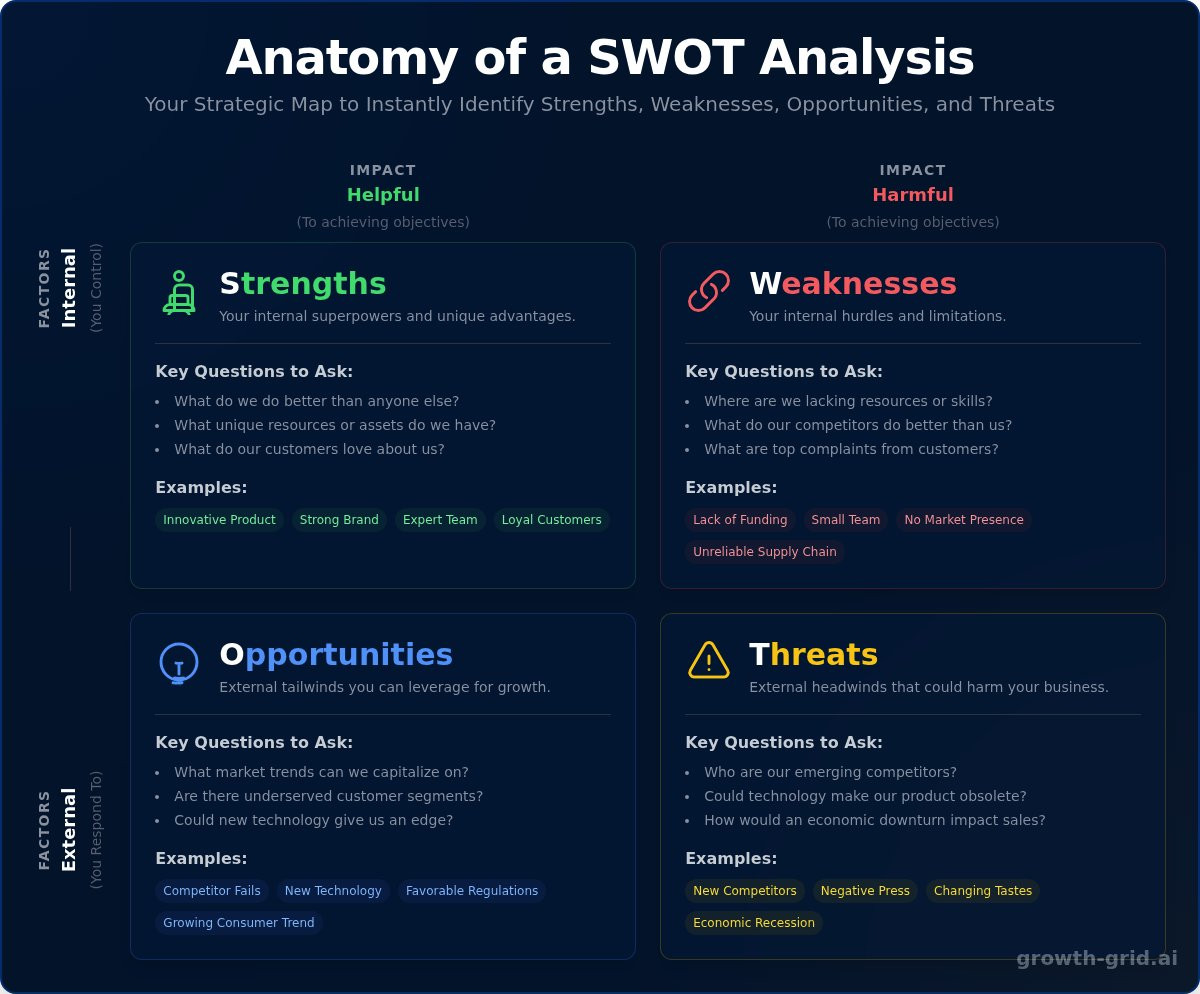
The magic is in its simplicity. The framework organizes these four elements into a simple 2×2 grid, giving you a visual map of your business landscape. This effective framework, known as a SWOT analysis, divides your evaluation into two key dimensions: internal factors you can control and external factors you must respond to. Let’s break that down.
Internal Factors: What You Can Control
This is your internal reality-the good and the bad that exist inside your company. These are the elements you have direct influence over, like your team, your intellectual property, and your brand reputation.
- Strengths: Your unique advantages. What do you do better than anyone else? This could be a killer product, a highly skilled team, or strong brand loyalty.
- Weaknesses: Your internal limitations. Where are you falling short? This might be a lack of funding, an inefficient process, or a gap in your team’s expertise.
External Factors: What You Must Respond To
This is the world outside your doors-the market forces you can’t control but must navigate to succeed. Your job is to react strategically to market trends, your competition, and the broader economy.
- Opportunities: Favorable external trends you can leverage for growth. Think of a new market opening up, a competitor failing, or a new technology you can adopt.
- Threats: External factors that could harm your business. This includes new, aggressive competitors, negative market trends, or changing regulations that increase your costs.
The 4 Quadrants of SWOT: Questions to Ask & Examples
A successful swot analysis hinges on asking the right questions. The framework is simple: four quadrants designed to organize your thinking. It’s a proven strategic planning tool that separates internal factors (what you can control) from external factors (what you must respond to). Don’t overthink it at first-the goal is to brainstorm freely. Aim for 3-5 of your most impactful points in each category to keep your analysis focused and actionable.
S – Strengths (Your Internal Superpowers)
Strengths are the internal, positive attributes of your business. These are the advantages you have over your competition. Be honest and confident here.
Key questions to ask:
- What do we do better than anyone else?
- What unique resources or assets do we have (skills, tech, cash)?
- What do our customers love about us?
Examples: An innovative, patented product; a strong, recognizable brand; an expert engineering team; a loyal customer base with high repeat business.
W – Weaknesses (Your Internal Hurdles)
Weaknesses are the internal factors that place you at a disadvantage. Acknowledging them is the first step to overcoming them. Don’t be afraid to be critical.
Key questions to ask:
- Where are we lacking resources, skills, or technology?
- What do our competitors do better than us?
- What are the top complaints from our customers or team?
Examples: Lack of startup funding; a small, overworked team; no market presence in key regions; unreliable supply chain partners.
O – Opportunities (External Tailwinds)
Opportunities are external factors in your market or environment that you can leverage for growth. These are the favorable winds you can catch.
Key questions to ask:
- What market trends can we capitalize on right now?
- Are there underserved customer segments or needs?
- Could new technology or regulations give us an edge?
Examples: A competitor going out of business; new technology that lowers production costs; favorable government regulations for your industry; a growing consumer trend toward sustainable products.
T – Threats (External Headwinds)
Threats are external factors that could harm your business. Identifying them early allows you to build a defense before they hit.
Key questions to ask:
- Who are our emerging competitors?
- Could changes in technology make our product obsolete?
- How would an economic downturn impact our sales?
Examples: A new, well-funded competitor entering the market; negative press or social media trends; changing customer tastes away from your product category; rising material costs or an economic recession.
How to Conduct a SWOT Analysis: The Fast & Effective Method
Forget the old way of doing a SWOT analysis-dreaded all-day meetings, bloated documents, and zero action. 😰 That’s the slow, frustrating path. The smart way is about speed, clarity, and immediate results. The goal isn’t a perfect 50-page report; it’s a powerful, one-page snapshot you can create in minutes and use today. This method is designed to cut through the noise and deliver actionable insights, fast.
Step 1: Set a Timer (15 Minutes)
Yes, just 15 minutes. Grab your team (or just a pen) and set a timer. This isn’t a mistake; it’s a core part of the strategy. The time constraint forces everyone to focus only on the most significant, top-of-mind points. It eliminates overthinking and analysis paralysis, getting the most important ideas on the page instantly. Think of it as a strategic sprint, not a marathon.
Step 2: Brainstorm Each Quadrant
Tackle one quadrant at a time to maintain focus and avoid getting overwhelmed. The rule is simple: no bad ideas. Don’t filter, debate, or judge anything yet-just list every point that comes to mind using quick bullet points. While many academic guides show you how to conduct a SWOT analysis in great detail, this rapid-fire method prioritizes capturing raw, unfiltered ideas first.
- Strengths: What internal advantages do you have? (e.g., expert team, strong brand)
- Weaknesses: Where are you falling short internally? (e.g., outdated tech, cash flow issues)
- Opportunities: What external factors can you capitalize on? (e.g., new market trends, competitor weakness)
- Threats: What external factors could harm your business? (e.g., changing regulations, negative press)
Step 3: Prioritize and Refine
Now, look at your messy lists. This is where chaos becomes clarity. Review each quadrant and circle or highlight the top 3-5 most critical points-the items with the biggest potential impact, positive or negative. Combine similar ideas and make vague points more specific. For example, change “bad marketing” to “low engagement on Instagram.” In just a few minutes, you’ve transformed a brain dump into a focused strategic tool ready for action. ✨
From Analysis to Action: Turning Your SWOT into a Strategy
You’ve filled the four boxes. Great. Now for the most crucial step: making it useful. A list of points is just data; a strategy is a plan for growth. Don’t let your hard work sit in a folder. The real value of a swot analysis comes from connecting the quadrants to create clear, actionable goals.
A simple and highly effective way to do this is through a method called TOWS Analysis, which focuses on matching and converting. This turns your static list into a dynamic roadmap.
Matching: Connecting Strengths to Opportunities
This is where you build your ‘Growth’ strategies. Look at your list of strengths and compare it against your opportunities. The question is simple: How can we use our internal strengths to take advantage of external opportunities? This proactive approach helps you prioritize your most promising initiatives for maximum impact.
- Example: You have a strong, trusted brand (Strength) and see an emerging market for eco-friendly products (Opportunity). Your strategy: Launch a new sustainable product line under your trusted brand name.
Converting: Addressing Weaknesses and Threats
This is where you build your ‘Defensive’ strategies. The goal is to minimize risk and fortify your business. Ask two key questions: How can we convert a weakness into a strength? and How can we use a strength to neutralize a threat? This turns potential problems into plans for improvement.
- Example: A new competitor enters the market (Threat). You can use your loyal customer base (Strength) to launch a loyalty program that makes it harder for them to switch.
The Next Step: Integrating SWOT into Your Business Plan
Your completed swot analysis isn’t the final document-it’s a critical input for your real business plan. The growth and defensive strategies you just created directly inform your marketing objectives, sales targets, product development, and operational priorities. They provide the “why” behind the “what” in your plan.
Your SWOT is done. The strategic thinking is complete. Ready to turn these powerful insights into a professional, bank-ready document? Let AI build these strategies into a full business plan now.
SWOT Analysis Examples: From a Startup to Starbucks
Theory is great, but seeing a swot analysis in action provides instant clarity. The framework’s real power is its universal application-it works just as well for a solo entrepreneur as it does for a global giant. It’s a fast way to get a 360-degree view of your strategic position.
Let’s break down three distinct examples to see how this simple grid translates into a smart action plan.
Example 1: A Local Coffee Shop
Imagine a small, independent coffee shop planning its next quarter. The goal is to protect its market share and grow steadily.
- Strengths: Prime downtown location with heavy foot traffic; strong, loyal customer base.
- Weaknesses: Limited marketing budget; reliant on a small, core team.
- Opportunities: Growing local demand for specialty coffee; potential to host community events.
- Threats: A major coffee chain is opening two blocks away next month.
Actionable Strategy: Leverage the Strength of a loyal customer base to capitalize on the Opportunity for community. Launch a customer loyalty program (S+O) to defend against the new competitor (T).
Example 2: A SaaS Tech Startup
Now, consider a new software-as-a-service startup trying to break into a crowded market. They need to find a foothold and prove their value quickly.
- Strengths: A unique, proprietary algorithm that solves a specific problem 10x faster.
- Weaknesses: Low brand recognition; small team with limited resources.
- Opportunities: A clear market need for automation in a niche industry (e.g., legal tech).
- Threats: Large, well-funded incumbent competitors dominate the broader market.
Actionable Strategy: Use their proprietary algorithm (S) to target a specific niche market (O) that is underserved by the large, slower-moving competitors (T). Focus all marketing on becoming the #1 solution for that single vertical.
Example 3: A Global Brand (Starbucks)
Even massive companies like Starbucks constantly use strategic analysis to navigate the global market. Their challenges are complex, but the framework remains the same.
- Strengths: Massive global brand recognition and loyalty; extensive retail footprint.
- Weaknesses: High price point compared to competitors; operational complexity.
- Opportunities: Growing consumer wellness trend; expansion into premium at-home coffee products.
- Threats: Global supply chain disruptions; intense competition from local, artisanal cafes.
Actionable Strategy: Use their powerful brand recognition (S) to launch a new line of wellness-focused beverages and at-home premium products (O), diversifying revenue streams to hedge against supply chain risks (T).
These examples show how a well-executed swot analysis moves you from just listing facts to building a focused, intelligent strategy. Ready to get this clarity for your own business? The right tools can turn this process into a matter of minutes. Get started with your own plan at growth-grid.ai.
From Analysis to Action: Your Winning Plan Awaits
You now have the framework to quickly identify your Strengths, Weaknesses, Opportunities, and Threats. A powerful swot analysis is the first, most critical step-it’s the map for your entire business strategy. You’ve done the hard work of uncovering insights. Now, it’s time to turn that map into a professional, actionable plan that gets results.
Don’t let that momentum stall. Join 10,000+ entrepreneurs who are building their future the smart way. You’ve mapped your strategy. Now, let’s write the plan. Generate Your AI Business Plan in 8 Minutes! Instantly create a 40+ page, bank-ready document backed by our 100% Satisfaction Guarantee. Your next big move is just a click away.
Frequently Asked Questions
How often should I do a SWOT analysis?
A SWOT analysis isn’t a one-and-done task. For most businesses, conducting one annually is a smart baseline. However, in fast-paced industries, a quarterly review keeps you agile. You should also perform a quick SWOT whenever a major event occurs-like a new competitor launch, a shift in technology, or a change in your business model. This ensures your strategy is always current and results-oriented, not based on outdated information.
Who should be involved in a SWOT analysis?
For the most powerful insights, gather a diverse team. While leadership should guide the process, including voices from different departments is crucial. Your sales team knows customer objections, marketing understands brand perception, and customer support hears direct feedback. Involving multiple perspectives gives you a 360-degree view, leading to a more accurate and actionable plan in less time. Don’t limit your insights to the boardroom-tap into your entire team’s expertise.
What are the most common mistakes to avoid when doing a SWOT?
Avoid these common time-wasting mistakes. First, don’t be vague; use specific data instead of generic statements like “good marketing.” Second, be brutally honest about your weaknesses-this isn’t the time for ego. Another pitfall is confusing internal factors (Strengths/Weaknesses) with external ones (Opportunities/Threats). Finally, the biggest mistake is not creating an action plan. A SWOT without follow-through is just a document that collects dust. Make your analysis count.
Can I use SWOT for personal career planning?
Absolutely! A personal SWOT analysis is a powerful tool for career planning. Your Strengths could be your skills (e.g., coding, public speaking), while Weaknesses might be areas for improvement (e.g., time management). Opportunities could be a new industry trend or a networking connection, and Threats might include automation in your field. It’s a fast and effective way to build a clear, actionable roadmap for your professional growth and stay ahead.
What’s the difference between a SWOT and a PESTLE analysis?
Think of it this way: SWOT looks both inside and outside your business. Strengths and Weaknesses are internal factors you control. Opportunities and Threats are external. A PESTLE analysis, on the other hand, is exclusively focused on the big-picture external environment (Political, Economic, Social, etc.). A smart strategy often uses a PESTLE analysis to better inform the Opportunities and Threats sections of a SWOT, giving you a more complete strategic view.
Is a SWOT analysis still relevant for a modern tech startup?
Yes, it’s more critical than ever. For a fast-moving tech startup, a SWOT analysis provides essential focus and clarity in minutes. It helps you quickly identify your competitive advantage (Strengths), pinpoint where to invest resources (Weaknesses), capitalize on market gaps (Opportunities), and prepare for potential disruptors (Threats). In a landscape that changes daily, this simple framework is an incredibly efficient tool for making smart, agile decisions and staying ahead of the curve.