

Are sales booming, but your bank account is shrinking? It’s a stressful-and surprisingly common-problem for founders. You see revenue on paper, but you’re constantly worried about making payroll or paying the next bill. This gap between profit and actual cash is where many promising businesses fail. The solution isn’t just more sales; it’s clarity. A simple cash flow analysis is the tool that gives you that clarity, transforming confusing numbers into a clear map of your company’s financial health.
Forget the complex accounting jargon. This guide is built for speed and results. We’ll show you exactly how to perform a cash flow analysis to understand where every dollar is coming from and where it’s going. You’ll gain the confidence to make smarter decisions about spending and growth, create accurate financial projections for your business plan, and finally secure the long-term stability your startup needs to thrive. Let’s get started.
What Is Cash Flow Analysis (And Why It’s Not the Same as Profit)
At its core, cash flow analysis is the simple but critical process of tracking all the money moving into and out of your business over a specific period. It’s the real-time financial pulse of your company, showing exactly what you can afford to do right now. This vital information is often summarized in a key financial report called the cash flow statement, which gives you a clear picture of your liquidity.
But isn’t that the same as profit? Absolutely not. Confusing the two is one of the most common-and dangerous-financial mistakes an entrepreneur can make.
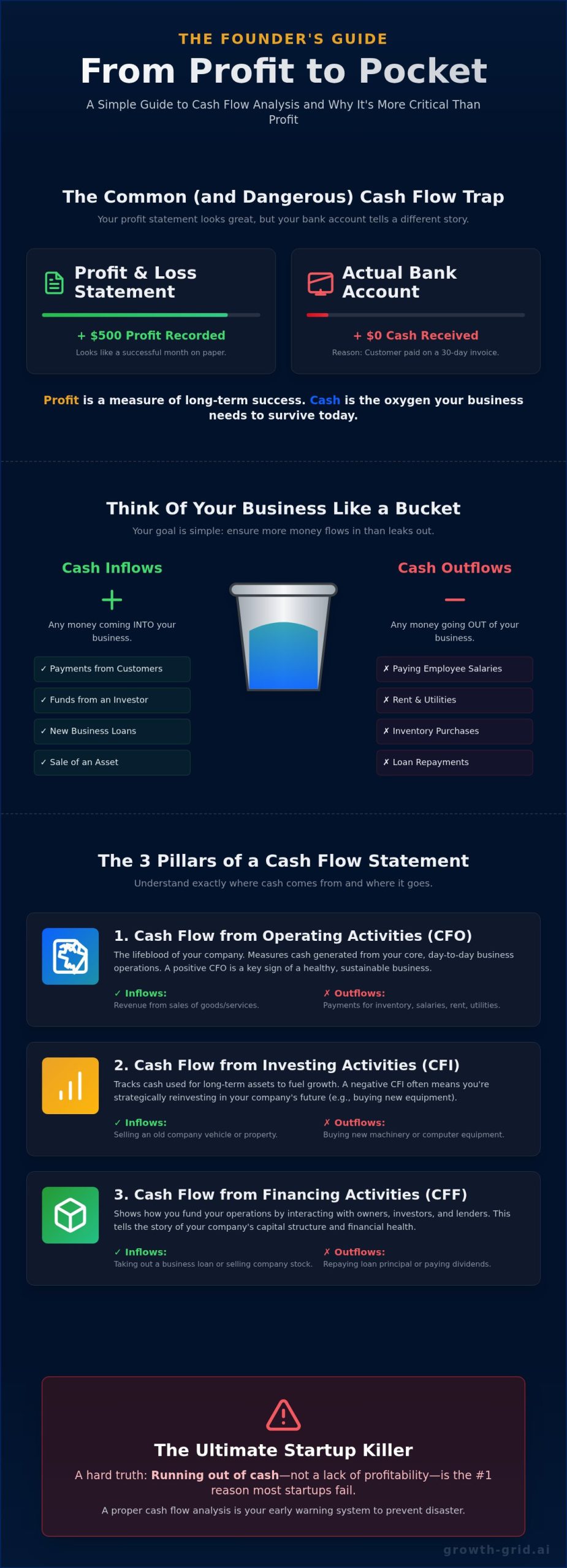
Ever looked at your profit and loss statement, seen a healthy profit, but then checked your bank account to find it nearly empty? 😰 You’re not alone. This is the classic cash flow trap. Imagine you run a lemonade stand and sell $500 of product to a local office for an event. Your books show a $500 profit. But they paid on a 30-day invoice. You have a recorded profit, but you have zero cash in hand to buy more lemons and sugar for tomorrow’s customers. That’s the difference in a nutshell.
Profit is a long-term measure of your business model’s success, but cash is the oxygen your business needs to breathe day-to-day. It is the #1 indicator of your company’s immediate operational health.
Cash Inflows vs. Cash Outflows
Think of your business bank account like a bucket. Your goal is to keep it from running dry by ensuring more money flows in than leaks out. It’s a straightforward concept:
- Cash Inflows: This is any money coming into your business. The most common inflow is direct payments from customers, but it also includes cash from a new loan, funds from an investor, or asset sales.
- Cash Outflows: This is any money going out of your business. Common outflows include paying rent, employee salaries, inventory purchases, software subscriptions, loan repayments, and marketing costs.
The Dangers of Ignoring Cash Flow
Here’s a hard truth: running out of cash-not a lack of profitability-is the top reason most startups fail. Poor cash flow grinds your business to a halt. Suddenly, you can’t make payroll, you can’t buy essential inventory, and all your growth plans are frozen. A proper cash flow analysis acts as an early warning system. It helps you anticipate shortfalls weeks or months in advance, giving you precious time to secure a line of credit, chase down late payments, or cut costs before it becomes a full-blown crisis.
The 3 Core Components of a Cash Flow Statement
To perform an effective cash flow analysis, you need the right tool. That tool is the Cash Flow Statement. Forget intimidating spreadsheets; think of this statement as the clear, simple story of your company’s money. It’s broken into three main sections that show you exactly where your cash came from and where it went over a specific period. A solid grasp of Understanding Cash Flow Analysis reveals that this structure isn’t just for accountants-it’s a powerful diagnostic tool for making smart decisions and reporting to investors with confidence.
By separating your cash into these three buckets, you get a complete picture of your financial health, fast.
Cash Flow from Operating Activities (CFO)
This is the money your business generates from its core, day-to-day activities. It’s the lifeblood of your company. CFO measures the cash that comes in from sales minus the cash that goes out for operational expenses. A consistently positive CFO is a powerful indicator of a healthy, sustainable business model because it shows your primary operations can fund themselves without relying on outside capital.
- Inflows ✓: Revenue from sales of goods or services.
- Outflows ✗: Payments for inventory, employee salaries, rent, and utilities.
Cash Flow from Investing Activities (CFI)
This section tracks the cash used for or generated from your long-term assets. Think bigger picture: property, vehicles, or major equipment. While a negative CFI might seem alarming, it often means you’re strategically reinvesting in your company’s future by purchasing assets that will fuel growth. Conversely, a positive CFI could mean you’re selling off assets to generate cash.
- Inflows ✓: Selling an old company vehicle or property.
- Outflows ✗: Buying new machinery or computer equipment.
Cash Flow from Financing Activities (CFF)
Financing activities show how you fund your operations and growth by interacting with owners, investors, and lenders. This section tells the story of your capital structure. It includes the money you borrow, the funds you raise from investors, and the cash you pay back to them. Monitoring CFF is crucial for managing debt and maintaining good relationships with your financial backers.
- Inflows ✓: Taking out a business loan or selling company stock.
- Outflows ✗: Repaying loan principal or paying dividends to shareholders.
How to Perform a Simple Cash Flow Analysis in 4 Steps
Forget complex accounting software and confusing jargon. Performing a basic cash flow analysis doesn’t require an accounting degree. The goal is to get a fast, clear picture of how cash moved through your business over a specific period, like the last quarter. This simple, backward-looking review is the essential foundation for building accurate financial projections you can trust.
Ready? Let’s get it done in four straightforward steps.
Step 1: Choose Your Time Period & Gather Documents
First, decide on the timeframe. For most startups and small businesses, looking at your finances on a monthly or quarterly basis is ideal. Once you’ve chosen your period, gather these three key documents. Your starting and ending cash balances from your bank statement are your ultimate reference points to check your work.
- Bank statements for the period
- Your income statement (or P&L)
- Your balance sheet
Step 2: Calculate Cash Flow from Operations (CFO)
This is the cash your core business activities generated or used. It’s the most critical part of your analysis. Start with the net income from your income statement for the period. Then, simply add back any non-cash expenses like depreciation. Finally, adjust for changes in working capital-for example, add cash that came in from customers paying old invoices (a decrease in accounts receivable).
Step 3: Add Cash Flow from Investing and Financing
Next, account for cash that wasn’t part of your daily operations. Create two separate lists. For Investing (CFI), list any cash used to buy assets (like a new computer) or cash received from selling them. For Financing (CFF), list cash from external sources, like taking out a new loan, receiving funds from an investor, or making loan repayments. Sum each category to get a total for CFI and CFF.
Step 4: Calculate Net Cash Flow & Analyze
This is the final, satisfying step where it all comes together. Use this simple formula: Cash from Operations + Cash from Investing + Cash from Financing = Net Change in Cash. The result should exactly match the change in your bank account balance from the start to the end of your chosen period. If it matches, you’ve successfully completed your cash flow analysis! This final number tells you, without a doubt, whether your business gained or lost cash overall.
Interpreting Your Results: What the Numbers Actually Mean
You’ve run the numbers. Now what? A statement of cash flows isn’t just a list of figures; it’s a strategic map of your business’s health. The real power comes from understanding how the numbers relate to each other. A single negative number isn’t automatically a disaster. A proper cash flow analysis reveals the story behind your balance.
This is where you translate data into business intelligence to answer critical questions: Are we growing sustainably? Can we afford to hire? Are we ready for the next round of funding?
Positive vs. Negative Cash Flow: A Quick Guide
Context is everything. A negative number in one area can be a positive sign, depending on your business stage:
- Positive Cash Flow from Operations (CFO): ✅ Excellent! This means your core business activities are generating more cash than they consume. You are self-sustaining.
- Negative Cash Flow from Investing (CFI): 📈 Often a great sign for startups. It means you’re investing in your future by buying assets like new equipment or technology.
- Negative Cash Flow from Financing (CFF): 👍 Can be very positive. This shows you’re paying back debt or distributing dividends, strengthening your balance sheet.
Key Ratios for a Quick Health Check
Want a faster way to check your pulse? These two simple ratios cut through the noise without needing a finance degree:
- Operating Cash Flow Ratio: Put simply, does your business make enough cash to pay its current bills? A ratio above 1.0 means you can cover your short-term debts. It’s a direct measure of your operational health.
- Cash Flow Margin: This tells you how much cash you generate for every dollar in sales. A higher margin means you are efficient at converting sales into real cash in the bank.
Common Cash Flow Red Flags 😰
Your cash flow analysis can also wave a red flag before a small problem becomes a crisis. For startups, watch out for these warning signs:
- Consistently Negative CFO: This is a major warning. If your core business can’t generate cash, it’s not sustainable long-term.
- Relying on Loans for Payroll: Using financing (CFF) to cover operating losses is like using a credit card to pay your mortgage. It’s a dangerous cycle.
- Growing Accounts Receivable: Sales look great, but if customers aren’t paying you on time, you don’t actually have the cash.
Feeling overwhelmed by the numbers? You don’t have to be an expert to get it right. Generate your financial projections with AI in minutes.
The Smart Way: Automating Cash Flow Projections for Your Business Plan
You now understand the critical role of cash flow. But knowing is only half the battle. To secure funding, you must project your future cash flow accurately. For years, this meant the ‘Old Way’: wrestling with complex spreadsheets, a process that is not only frustrating but also dangerously prone to error.
While manual analysis looks backward at past performance, investors and lenders need to see a clear, forward-looking vision. They require professional cash flow projections in your business plan to feel confident in your company’s future. Getting this right is non-negotiable for planning, fundraising, and securing loans.
Why Spreadsheets Aren’t Enough 😰
The traditional spreadsheet method is a major bottleneck for entrepreneurs. It’s slow, stressful, and often produces results that don’t impress the people who matter most.
- Time-Consuming & Error-Prone: One broken formula or typo can invalidate your entire financial model. Finding that single mistake can take hours, or even days, of frustrating work.
- Difficult to Update: Want to create a best-case and worst-case scenario? With spreadsheets, that means manually duplicating and adjusting complex formulas, which dramatically increases the risk of inconsistencies.
- Can Look Unprofessional: To a seasoned investor or loan officer, a basic, self-made spreadsheet can signal a lack of preparation and undermine your credibility before you even walk in the door.
How AI Tools Streamline Financial Planning ✨
The ‘Smart Way’ leverages technology to do the heavy lifting for you, delivering professional results in a fraction of the time. AI-powered platforms are designed to eliminate manual work and produce financials that get you funded.
- Generate Projections Instantly: Simply enter your core business assumptions, and AI can automatically generate a complete set of financial documents, including your income statement, balance sheet, and cash flow statement.
- Investor-Ready in Minutes: Stop spending weeks building financial models. Create a complete, professional-grade cash flow analysis and full projections in less than 15 minutes.
- Ensure Consistency & Accuracy: AI guarantees that all your numbers add up and are consistent across every document, presenting a coherent and trustworthy financial story.
Your business plan deserves financial projections that are as ambitious and professional as your vision. Don’t let outdated tools create a roadblock to your funding. Let AI build your complete business plan, including cash flow analysis.
From Manual Analysis to Automated Success
Understanding your cash flow is more than just knowing your profit-it’s the lifeblood of your startup. Mastering a manual cash flow analysis gives you a clear snapshot of your financial health, but looking backward is only half the battle. The real power lies in accurately predicting where you’re headed, without spending days buried in complex spreadsheets.
Why struggle with the old way? You can skip the tedious calculations and potential errors. It’s time to work smarter, not harder.
GrowthGrid empowers you to create 3-year financial projections in under 15 minutes. Join thousands of entrepreneurs worldwide who have built a complete, 72-section business plan with our AI platform. Stop stressing over spreadsheets. Generate your investor-ready business plan with AI now!
Take control of your financial future today. Your next big move is just a few clicks away.
Frequently Asked Questions
What’s the difference between a cash flow statement and a cash flow forecast?
Think of it as past vs. future. A cash flow statement is a historical record that shows exactly how cash moved in and out of your business over a previous period (like last quarter). A cash flow forecast, or projection, is your educated guess about how cash will move in the future. The statement tells you where you’ve been; the forecast helps you plan where you’re going and avoid potential shortfalls. Both are essential for smart financial management.
Can a company be profitable but still have negative cash flow?
Yes, and it’s a common trap for new businesses. Profit is the money you’ve earned on paper (revenue minus expenses), but cash flow is the actual cash in your bank account. For example, you could make a $50,000 sale (profitable!) but if the client has 90 days to pay, you don’t have that cash yet. Meanwhile, you still have to pay rent and salaries, creating negative cash flow. This is why profit alone doesn’t tell the whole story.
How often should a small business perform a cash flow analysis?
For most small businesses, a monthly cash flow analysis is the minimum standard. This gives you a regular, up-to-date picture of your financial health. However, if you are a startup, in a high-growth phase, or navigating a tight financial period, we recommend running one weekly. This frequency allows you to spot potential issues instantly and make fast, data-driven decisions to keep your business on track and avoid surprises. Don’t wait until it’s too late.
What is free cash flow (FCF) and why does it matter?
Free cash flow is the cash a company has left over after paying for all its operating expenses and capital expenditures (like new equipment or technology). It’s a crucial metric because it shows the real amount of cash available to pay back debt, issue dividends to investors, or reinvest in the business for growth. Strong FCF is a key indicator of a healthy, efficient, and valuable company that isn’t just surviving, but thriving.
Is negative cash flow always a bad sign for a startup?
Not necessarily. For startups, negative cash flow is often a planned part of a growth strategy. You might be investing heavily in product development, marketing campaigns, or building inventory before you have significant revenue. This is called cash burn. The key question is whether this spending is controlled and leading toward future profitability. Investors will look for a clear plan showing how and when the business will become cash-flow positive.
How does cash flow analysis fit into my business plan’s financial section?
It’s absolutely critical. Your financial section needs to prove your business is viable, and a cash flow analysis is the proof. A historical cash flow statement shows your track record, while your cash flow projections demonstrate to investors and lenders that you have a realistic plan for managing money. It proves you understand the difference between profit on paper and the actual cash needed to operate and grow your company day-to-day.