

Let’s be direct: your business plan is the first real test an investor gives you. But staring at a blank page while trying to translate your vision into a 40-page document is overwhelming. The confusing financials, the endless writing, and the fear of getting it wrong-it’s enough to stop brilliant ideas dead in their tracks before they even start.
Beyond just a template, ensuring your financial strategy is robust and compelling is crucial. If you’re looking for professional support to strengthen your projections and overall financial narrative, you can find out more about Funding and investment guidance through specialized consulting platforms.
But it doesn’t have to take weeks or cost a fortune. You can create a professional business plan for investors pdf that commands attention and makes a powerful case for funding, fast. This guide cuts through the noise and gives you the exact blueprint investors want to see in 2025. We’ll break down every essential section, demystify the numbers, and show you how to build a polished, persuasive plan that saves you time, removes the guesswork, and gets you ready to pitch with total confidence.
Key Takeaways
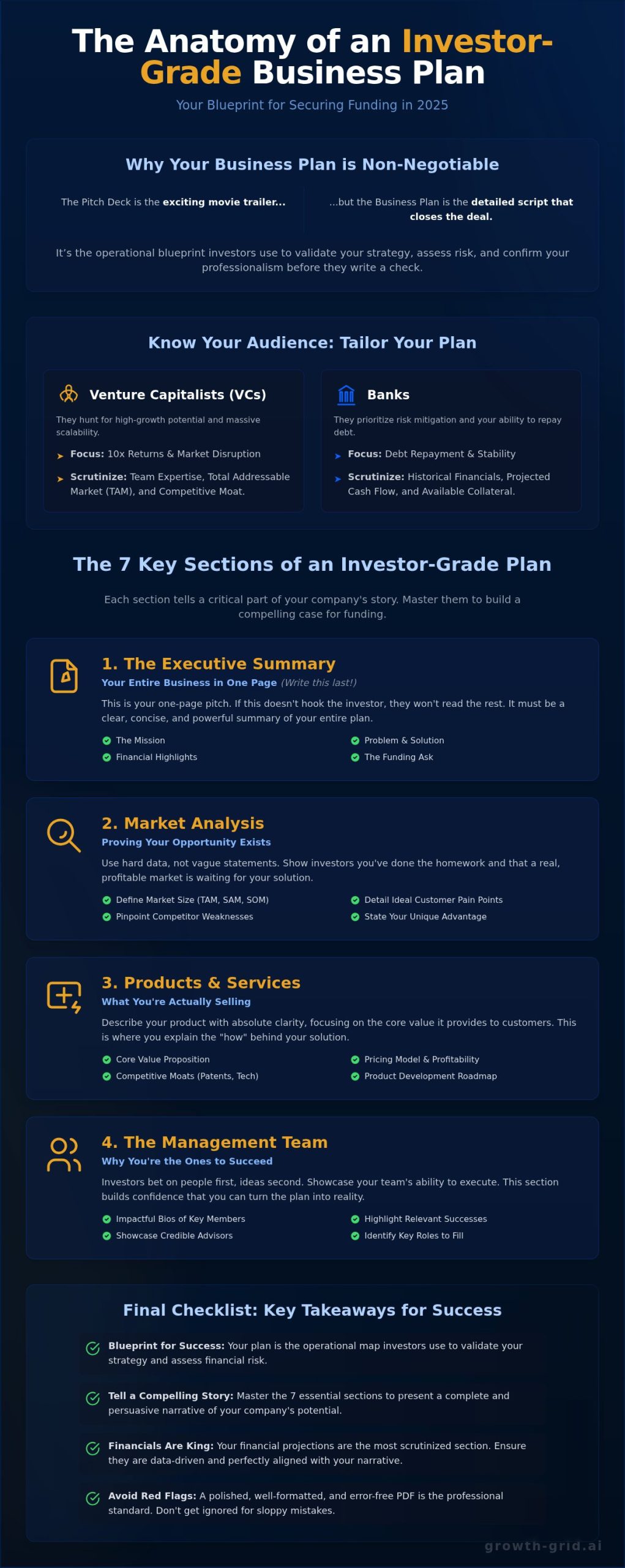
- A business plan is more than a formality; it’s the operational blueprint investors use to validate your strategy and assess financial risk.
- Master the 7 essential sections of an investor-grade plan to tell a compelling and complete story about your company’s potential.
- Your financial projections are the most scrutinized section-ensure they are data-driven and perfectly aligned with your narrative to build credibility.
- Instantly increase your chances of securing a meeting by avoiding the common red flags that get a typical business plan for investors pdf ignored.
Why Investors Demand a Business Plan (And Why the PDF Format Is Crucial)
Your pitch deck might get you in the door, but a powerful business plan is what closes the deal. Think of it this way: the pitch is the exciting movie trailer, while the business plan is the detailed script. It’s your operational blueprint, proving you have a concrete strategy to turn your vision into a profitable reality. Investors use this document to go beyond the hype and validate your thinking process. A well-structured Business Plan is the foundational document they rely on to assess risk and opportunity.
Investors are in the business of managing risk. They need to see that you’ve done the homework-that you understand your market, your customers, your competition, and your numbers inside and out. A comprehensive plan demonstrates your professionalism and meticulous attention to detail. It answers the tough questions before they’re even asked, showing that you’re prepared for the challenges ahead. This is why a professional business plan for investors pdf is non-negotiable; it’s the ultimate proof of your competence and readiness.
What VCs Look For vs. What Banks Look For
While both want to see a solid plan, their focus differs dramatically. Understanding this distinction is key to tailoring your document for the right audience.
- Venture Capitalists (VCs): They hunt for high-growth potential and massive scalability. VCs scrutinize your team’s expertise, the total addressable market (TAM), and your unique competitive advantage. They’re betting on market disruption and a 10x return.
- Banks: They prioritize risk mitigation and your ability to repay debt. Banks focus heavily on historical financial data, projected cash flow, and available collateral. Their primary question is: “Can you make your loan payments?”
The Psychology of the First Impression
Your business plan is often reviewed long before you get a meeting. A clean, well-formatted document makes an immediate positive impression, signaling that you are serious, organized, and respect the investor’s time. Typos, inconsistent formatting, or a messy layout are major red flags. A polished business plan for investors pdf is the professional standard because it’s secure, universally readable, and non-editable, ensuring your document looks exactly as you intended on any device. Including a clickable table of contents and clear headings isn’t just a courtesy-it’s a strategic move that makes your plan easy to navigate and digest.
The Anatomy of an Investor-Grade Business Plan: 7 Key Sections
Your business plan is more than a document; it’s the story of your company’s future. Investors see hundreds of plans, so yours must be sharp, data-driven, and compelling from the first page to the last. Each section has a specific job. Get them right, and you’ll have a powerful tool to secure funding. Let’s break down the core components you’ll find in any professional business plan for investors pdf.
1. The Executive Summary: Your Entire Business in One Page
This is your one-page pitch and the most critical section. Always write it last. It must instantly grab an investor’s attention by summarizing your entire plan. If this page doesn’t hook them, they won’t read the rest. Focus on clarity and impact.
- The Mission: What is your ultimate goal?
- Problem & Solution: The pain you solve and how your product fixes it.
- Financial Highlights: Top-line revenue projections and key metrics.
- The Ask: How much funding you need and what you’ll use it for.
2. Market Analysis: Proving Your Opportunity
Here, you prove a real, profitable opportunity exists. Go beyond vague statements and use hard numbers to define your market size (TAM, SAM, SOM) and detail your ideal customer’s pain points. This section requires thorough research, and you can find excellent guidance from the SBA on structuring your analysis. Pinpoint your competitors’ weaknesses and clearly state your unique advantage.
3. Products & Services: What You’re Actually Selling
What are you actually selling? Describe your product or service with absolute clarity, focusing on its core value proposition. Explain your pricing model and how it delivers value to the customer while ensuring profitability. Detail any competitive moats like patents or proprietary technology. Finish by outlining your product development roadmap to show investors where you’re headed next.
4. The Management Team: Why You’re the Ones to Succeed
Investors bet on people first and ideas second. This section is where you sell them on your team’s ability to execute. Provide short, impactful bios for key members, highlighting relevant experience and past successes. Showcase credible advisors or board members. Don’t be afraid to identify key roles you still need to fill-it shows self-awareness and strategic planning.
Financial Projections: The Section Investors Scrutinize Most
Let’s be direct: this is the make-or-break section of your plan. When an investor opens your file, they often flip straight to the financials. Why? Because numbers tell the real story. Your narrative about a massive market opportunity is compelling, but your financial projections are the proof that you can capture it profitably. If your story says “rapid growth” but your numbers show thin margins and slow customer acquisition, your credibility is gone.
This is where most entrepreneurs stumble-relying on vague, optimistic guesses instead of hard data. Every number in your forecast must be backed by clear, defensible assumptions. Our template guides you through creating a professional 3- to 5-year forecast, with the first year broken down month-by-month for granular detail. This structured approach ensures your financial model is not just a spreadsheet, but a core component of a winning business plan for investors pdf.
Essential Financial Statements to Include
Your financial story is told through three core statements that must be perfectly interconnected. For example, the net income from your Income Statement flows into the equity on your Balance Sheet and impacts your Cash Flow Statement. A professional financial section includes:
- Income Statement (P&L): This shows your revenues, costs, and ultimate profitability over a specific period (e.g., monthly, quarterly, annually). It answers the question, “Is this business profitable?”
- Cash Flow Statement: This tracks the actual cash moving in and out of your business. It proves you can manage liquidity to pay bills and stay solvent-a critical concern for investors.
- Balance Sheet: This provides a snapshot of your company’s financial health, detailing what you own (assets) and what you owe (liabilities) at a single point in time.
Key Metrics and Assumptions
Your projections are only as credible as the assumptions they’re built on. Don’t bury them in a footnote; list them upfront. As the Harvard Business Review’s guide on great business plans emphasizes, the quality of your assumptions underpins your entire argument. Be prepared to defend your:
- Key assumptions: Clearly state your Customer Acquisition Cost (CAC), customer lifetime value (LTV), conversion rates, and pricing strategy.
- Break-even analysis: Show the exact point at which your total revenues equal your total costs and you become profitable.
- Funding request: State the exact amount you are seeking and provide a detailed use-of-funds table showing how every dollar will be spent.
- Industry-specific metrics: Demonstrate your expertise by including relevant KPIs, like Monthly Recurring Revenue (MRR) for a SaaS business or Average Order Value (AOV) for e-commerce.
Common Mistakes That Get Your Business Plan Ignored
Investors see thousands of business plans. They have minutes, not hours, to decide if yours is worth a deeper look. This means they’ve become experts at spotting red flags that send a plan straight to the “no” pile. These errors often signal a lack of preparation, research, or realism.
The good news? Avoiding these common mistakes is simple. A polished, professional plan instantly stands out from the amateurish majority and dramatically increases your chances of getting noticed. When an investor opens your business plan for investors pdf, make sure it communicates competence from the very first page.
Unrealistic Projections and ‘Hockey Stick’ Growth
Nothing screams “inexperienced founder” like a financial chart that shoots straight up without justification. This “hockey stick” growth is a major red flag. Instead of presenting a fantasy, build credibility with a well-reasoned forecast. Show your work and base your numbers on market data, capacity, and a clear sales strategy. Acknowledging risks shows you’re a grounded, realistic leader an investor can trust.
Ignoring the Competition
Claiming you have “no competitors” is an instant deal-breaker. It tells an investor one of two things: you haven’t done your research, or you’re arrogant. Every business has competitors, direct or indirect. A strong plan includes a detailed competitive analysis that shows you understand the landscape. More importantly, it clearly articulates your unique value proposition and explains why customers will choose you.
Poor Formatting, Typos, and Generic Language
Your business plan is a direct reflection of your professionalism. A document filled with typos, grammatical errors, or walls of text is unreadable and signals carelessness. A generic, unedited business plan for investors pdf template is just as bad. To ensure your plan gets taken seriously:
- Proofread meticulously. Use a robust proofreading tool or have a professional review it.
- Write clearly. Avoid buzzwords and industry jargon. Use simple, direct language.
- Make it scannable. Use headings, bullet points, charts, and graphs to break up text.
A polished, customized plan doesn’t have to take weeks. Smart tools like GrowthGrid use AI to help you generate a professional, investor-ready plan in minutes, ensuring you avoid these critical errors.
How to Create Your Investor-Ready PDF in Minutes (The Smart Way)
You have a brilliant idea and you’ve downloaded a template. Now comes the hard part: writing. The traditional path to creating a comprehensive business plan for investors pdf is filled with obstacles. You can either spend 40+ hours wrestling with writer’s block or spend thousands of dollars hiring a consultant. There’s a better way.
Modern AI-powered tools like GrowthGrid eliminate the stress and expense, delivering a professional, investor-grade plan in a fraction of the time. Stop guessing and start generating.
The Old Way vs. The GrowthGrid Way
Why waste time and money when you can work smarter? The difference is clear:
- ✗ Weeks of stress and research
- ✗ Guessing what investors want to see
- ✗ High costs ($2,000+ for consultants)
- ✗ Risk of an unprofessional final document
- ✓ A complete plan in under 15 minutes
- ✓ A structure designed for investor approval
- ✓ Save 90% on costs
- ✓ Professional quality, guaranteed
From Idea to Investor-Ready PDF in 3 Steps
Our platform was built for speed and quality. Forget complex software and blank pages. You can generate your custom plan instantly with this simple process:
- Tell our AI about your business. Simply answer a series of straightforward questions about your company, vision, and market. No business jargon required.
- Let the AI do the heavy lifting. Our system instantly writes all 72 sections of your business plan, from the Executive Summary to detailed 3-year financial forecasts.
- Review and download instantly. Make any final edits you need, then download your complete business plan for investors pdf or DOC file, ready to send to stakeholders.
Ready to skip the hassle and get funded faster? Stop staring at a blank page and let our AI build the plan that will impress investors.
Generate Your Custom Business Plan PDF Now →
Your Next Step: From Plan to Pitch-Ready ✨
Securing funding in 2025 hinges on more than just a great idea-it requires a flawless presentation. As we’ve explored, this means mastering the seven key sections, delivering undeniable financial projections, and sidestepping the common mistakes that land most plans in the trash. A professional and comprehensive business plan for investors pdf is your non-negotiable tool for opening doors and getting taken seriously.
But the old way of building one is slow, expensive, and stressful. Why lose weeks to writer’s block and spreadsheet formulas when you could be pitching? It’s time to choose the smart way. GrowthGrid empowers you to generate a complete, investor-grade business plan using AI in just minutes. Join over 15,000+ startups who have already accelerated their journey.
Our platform includes all 72 comprehensive sections investors demand, and you can download your final document as a polished PDF or DOC instantly. Your funding is closer than you think. Stop Stressing. Generate Your Investor-Ready Business Plan in 8 Minutes →
Frequently Asked Questions
How long should a business plan for investors be?
Investors are busy. They want critical information, fast. Aim for a concise and powerful plan of 20-40 pages. The goal isn’t to write a novel; it’s to secure a meeting. A strong executive summary is your most important section, as it might be the only part an investor reads initially. Focus on clarity, compelling data, and a story that grabs their attention from the first page.
What’s the difference between a business plan for a bank loan versus a venture capitalist?
Think of it this way: banks want security, while VCs want massive scale. A plan for a bank loan must prove your ability to repay debt. It emphasizes stable cash flow, collateral, and low-risk operations. In contrast, a plan for a VC sells a high-growth vision. It focuses on a huge market opportunity, your unique competitive advantage, and the team that can deliver a 10x or greater return on investment.
Should I include an appendix in my business plan PDF?
Yes, absolutely. An appendix is the perfect place for supporting documents that would otherwise clutter the main body of your plan. Use it for detailed financial spreadsheets, key team member résumés, product mockups, market research data, or permits and licenses. This keeps your core business plan lean, readable, and focused on the strategic narrative while providing all the proof an investor needs.
Is it okay to send a business plan as a Word document instead of a PDF?
Never. Always send your plan as a PDF. No exceptions. A PDF preserves your formatting, looks professional on any device, and prevents accidental edits. A Word document can appear unfinished and is prone to formatting errors when opened on different computers. Your business plan for investors pdf is a critical first impression-make sure it’s polished and secure.
How much detail should I include in the financial projections?
Investors expect to see 3-5 years of detailed financial projections. This should always include three core statements: the Income Statement, Cash Flow Statement, and Balance Sheet. For the first 12-24 months, provide a month-by-month breakdown to show you understand your operational costs and sales cycle. For the remaining years, quarterly or annual summaries are sufficient. Be prepared to defend your assumptions.
Can I use an AI-generated business plan to apply for an SBA loan?
Yes, using an AI tool is a smart way to create a professional, SBA-compliant business plan in minutes instead of weeks. Think of AI as an expert assistant that handles the heavy lifting of writing and structuring. However, you must still review, edit, and personalize the plan. Ensure the financial projections are based on your own thorough research to demonstrate you are in full command of your business.
What if my business is pre-revenue? How do I create financial projections?
For a pre-revenue business, your financial projections are all about well-researched assumptions. Don’t just guess. Build a bottom-up forecast based on market data, competitor analysis, and your planned marketing activities. How many leads will your ad spend generate? What is a realistic conversion rate? What is your pricing model? Investors know it’s a forecast, but they need to see that your logic is sound and your numbers are grounded in reality.