

Staring at the ‘Market Analysis’ section of your business plan and feeling completely stuck? You’re not alone. It’s often the most intimidating part-a mountain of data, competitor research, and vague requirements. You’re worried it won’t be convincing enough for investors, and you have no idea how to turn raw numbers into a compelling story without spending weeks on it. 😰
Stop the stress and the guesswork. This guide provides a complete market analysis for business plan example designed to give you clarity and confidence. We’ll walk you through a professional, data-driven sample, breaking down every essential component from market size and trends to competitive landscape and target audience. Forget the overwhelm. Follow our template to create a powerful analysis that strengthens your entire business plan in a fraction of the time. Let’s get it done. ✨
Key Takeaways
- Your market analysis is the most critical section for proving your business idea is viable and securing funding.
- Learn the five essential components every professional market analysis must include to convince investors.
- See how these components work in the real world with our complete market analysis for business plan example.
- Stop wasting hours on manual research-discover the smart way to gather accurate market data in minutes.
What Is a Market Analysis (And Why It’s the Most Important Section)
Think of the market analysis as the ultimate reality check for your business idea. It’s the section that moves your concept from a simple “what if” to a data-backed “this will work.” While there are formal definitions for what is a market analysis, at its core, it’s the process of gathering information to prove your business is not just a passion project, but a viable, profitable venture.
This isn’t just about filling a chapter in your business plan. It’s about convincing investors-and yourself-that a real opportunity exists. It transforms raw data into a compelling story about your customers, the market’s potential, and your unique place within it. More than any other section, this is where you prove there’s a hungry audience waiting for your solution.
Skip this, and you’re flying blind. 😰 You risk launching a product or service into a market that doesn’t exist, doesn’t care, or is already saturated. It’s the fastest way to waste your time and money. A strong analysis is your roadmap, guiding your strategy and preventing costly mistakes.
The Three Questions Your Market Analysis Must Answer
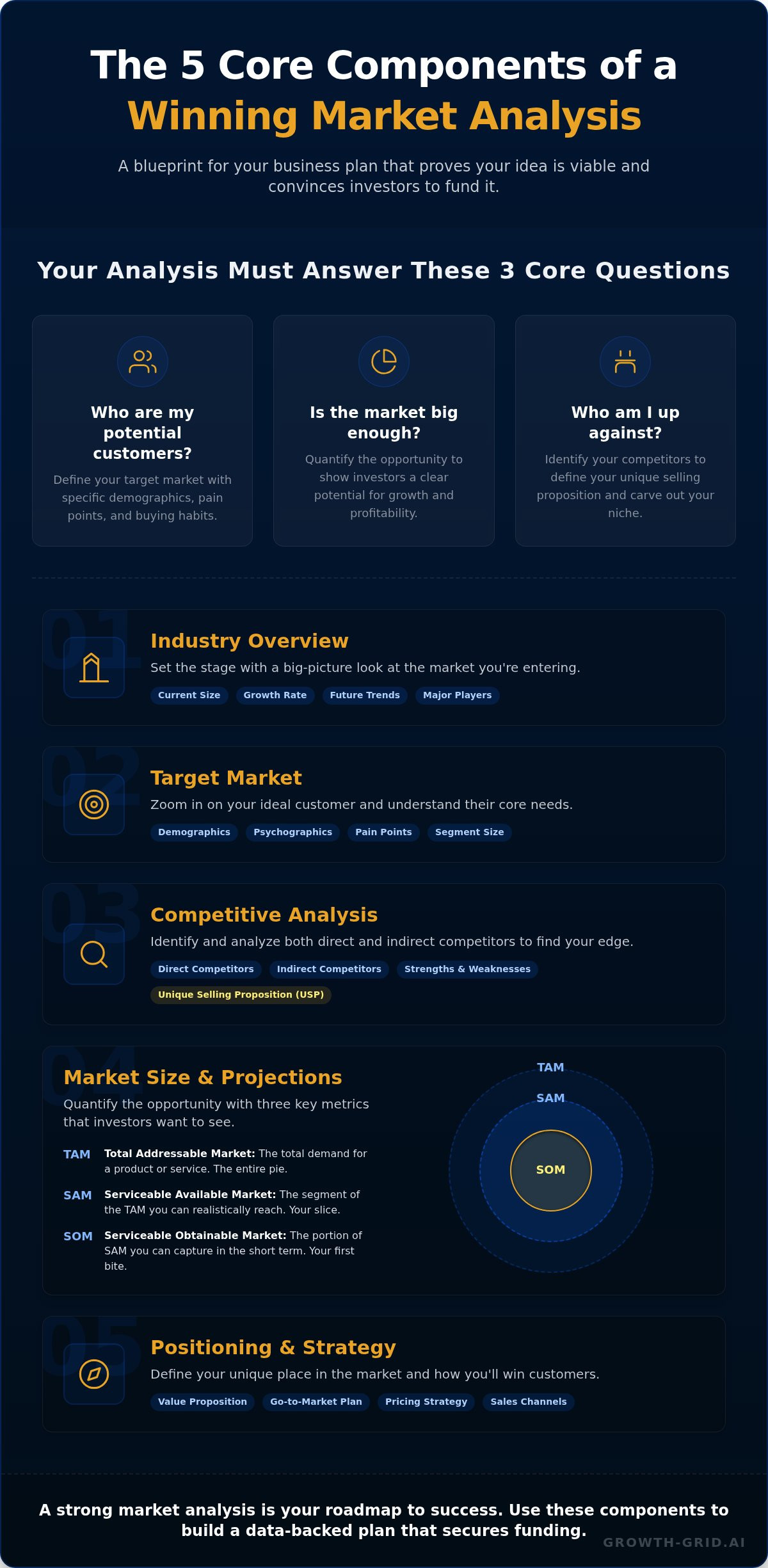
Your research should be laser-focused on answering three fundamental questions. Get these right, and you’ve built the foundation for a winning business plan.
- Who are my potential customers? (Target Market) You must define exactly who you’re selling to. What are their pain points, demographics, and buying habits? A vague audience is a red flag.
- Is this market big enough to be profitable? (Market Size) Investors want to see potential for growth. You need to quantify the opportunity and show a clear path to capturing a valuable slice of the pie.
- Who am I up against? (Competitive Landscape) Every business has competitors. Identifying them allows you to define your unique selling proposition (USP) and create a strategy to win.
Traditional Plan vs. Lean Startup: Does it Differ?
Yes and no. A traditional business plan for a bank loan will demand deep, detailed, and formal analysis. In contrast, a lean startup plan often uses a more concise, “good enough” version to validate assumptions quickly. But here’s the key: the core data is identical. Both versions must prove the same thing-that a market exists and you know how to reach it. A great market analysis for business plan example will always contain this essential data, regardless of its length.
The 5 Core Components of a Winning Market Analysis
Think of this section as your blueprint. Before we dive into a complete market analysis for business plan example, you need to understand the five building blocks that create a powerful and convincing report. Each component logically builds on the last, taking you from a high-level industry view down to your specific place within it.
Get these five parts right, and you’ll have an analysis that proves to investors-and yourself-that you have a viable business idea. This is your checklist for a complete and professional analysis.
Component 1: Industry Overview
First, set the stage. The industry overview provides a big-picture look at the market you’re entering. You need to present key statistics on its current size, recent growth rate, and future trends. Finding this data can feel like a huge task, but there are excellent free resources. For instance, the U.S. Small Business Administration offers a detailed guide on how to conduct market research to help you source credible stats. Mention the major players to show you understand the landscape.
Component 2: Target Market
Now, zoom in on your customer. Who are you actually selling to? Define your ideal customer with specific details, including demographics (age, location, income) and psychographics (lifestyle, values, habits). Most importantly, identify their core needs and pain points. Your analysis must clearly state how your product or service solves a real problem for this specific group. Finish by estimating the size of this target segment.
Component 3: Competitive Analysis
Every business has competition. Your job is to identify and analyze it. List your direct competitors (those offering a similar product) and indirect competitors (those solving the same customer problem with a different solution). Briefly analyze their strengths and weaknesses. This research is critical for defining your unique selling proposition (USP)-the clear, specific benefit that makes you the better choice.
For a more rigorous approach, especially in high-stakes markets, deep-dive competitive intelligence is key. This can involve verifying competitor claims or uncovering vulnerabilities through professional due diligence. In these situations, firms like the International Investigative Group can provide a critical advantage by uncovering information not available through standard research.
Component 4: Market Size and Projections
This is where you quantify the opportunity with numbers. Investors want to see the potential for growth. You’ll do this by calculating three key metrics:
- Total Addressable Market (TAM): The total demand for a product or service. The whole pie.
- Serviceable Available Market (SAM): The segment of the TAM you can realistically reach. Your slice.
- Serviceable Obtainable Market (SOM): The portion of the SAM you can capture. Your first bite.
Market Analysis Example: ‘Urban Roast’ Coffee Shop
Theory is great, but seeing it in action is better. To make this tangible, let’s build a market analysis for a fictional business: ‘Urban Roast,’ a specialty coffee shop. We will apply the core components of a market analysis to show you how data and narrative work together. Use this structure as a fast, effective template for your own plan.
This detailed market analysis for business plan example shows investors you’ve done your homework and understand exactly where you fit in the landscape.
Example: Industry Overview
The U.S. specialty coffee shop market is a robust and growing industry, valued at over $45 billion. Projections show a steady compound annual growth rate (CAGR) of 5%, driven by increasing consumer demand for premium products and experiences. Two dominant trends shape the industry: sustainability, with customers prioritizing ethically sourced beans, and digital integration, including mobile ordering and loyalty programs. Urban Roast is positioned to capitalize on both trends by partnering with local, sustainable roasters and implementing a seamless digital ordering system from day one.
Example: Target Market for Urban Roast
Our customer focus is precise and targeted to solve a specific need in our local area. We’ve identified two key segments:
- Primary Target: Remote workers, freelancers, and university students aged 22-35. Their key pain point is the lack of a comfortable, quiet “third place” with reliable high-speed Wi-Fi and ample power outlets to work for extended periods.
- Secondary Target: Local office workers (ages 30-50) seeking a high-quality, convenient coffee option during their morning commute or for midday meetings.
Example: Competitive Analysis
While the market has existing players, Urban Roast has a clear unique selling proposition (USP). Our analysis identifies two main competitor types:
- Direct Competitor: A Starbucks located two blocks away. While it has immense brand recognition, it suffers from inconsistent product quality and a noisy, crowded atmosphere.
- Indirect Competitor: Local diners and fast-food chains. They offer low-priced coffee but fail to provide a premium product or a welcoming, professional environment.
Our USP: Urban Roast will differentiate itself by offering a superior product (locally-roasted, single-origin beans) in a quiet, modern, and work-friendly environment designed for productivity and comfort.
Example: Market Size and Projections
Our market potential is quantified using the TAM-SAM-SOM model to create realistic financial projections:
- Total Addressable Market (TAM): The total coffee expenditure in our city is estimated at $50 million annually.
- Serviceable Available Market (SAM): The segment of the market within a 1-mile radius of our location, which we can realistically serve, is estimated at $5 million.
- Serviceable Obtainable Market (SOM): Our initial goal is to capture 5% of our SAM within the first year of operation, representing a revenue target of $250,000.
How to Find Data for Your Market Analysis (The Smart Way)
You know what you need for your market analysis, but now comes the hard part: finding the actual data. A market analysis without solid numbers is just an opinion. Quality data is the foundation of a believable business plan that lenders and investors take seriously. But getting it doesn’t have to be a nightmare.
Let’s compare the old, painful way with the new, smart way.
The Old Way: Traditional Research Methods
This is the manual-labor approach. It works, but it costs you your most valuable asset: time. You could spend weeks or even months chasing down stats from scattered sources, a major reason why building a market analysis for business plan example feels so overwhelming.
- Government Data Dives: Sifting through dense reports from the SBA, Census Bureau, and Bureau of Labor Statistics. The data is reliable but often hard to pinpoint and apply directly. 😰
- Expensive Industry Reports: Subscriptions to services like Gartner, Forrester, or IBISWorld provide excellent data, but a single report can easily cost $1,000 or more.
- Time-Consuming Fieldwork: Manually conducting customer surveys, physically observing competitors, and digging through local Chamber of Commerce data. Coordinating a team for this kind of fieldwork, often using apps like Go Crew for location sharing, is valuable but incredibly slow.
The Smart Way: Using AI for Instant Insights
Why spend 40+ hours on research when an AI can do it in 40 seconds? The smart way is about leveraging technology to get better results, faster. It’s about working smarter, not harder.
GrowthGrid’s AI platform was built to solve this exact problem. Here’s how it works:
- ✓ Scans Vast Databases Instantly: Our AI pulls the latest statistics from thousands of current market reports, financial databases, and industry publications in seconds. No more manual searching.
- ✓ Synthesizes Data For You: It doesn’t just dump raw numbers on you. The AI analyzes the data and writes it directly into the correct sections of your business plan, complete with citations.
- ✓ Get Bank-Ready Stats: You get the credible, verifiable data that investors demand, formatted professionally and ready to go. No more research headaches.
The choice is clear. You can spend weeks stressing over spreadsheets and expensive reports, or you can get a complete, data-backed market analysis done in minutes. Ready to build your plan the smart way? Generate your plan with AI now and save weeks of work.
Generate Your Complete Market Analysis in Under 3 Minutes
You’ve seen the essential components and a detailed market analysis for business plan example. Now, it’s time to build your own. But what if you could skip the hardest parts?
The traditional method is a grind. Manually researching industry data, sizing up competitors, and defining your target market takes an average of 15-20 hours. That’s valuable time you could be spending on your actual business.
GrowthGrid’s AI turns that week-long headache into an instant result. Forget the spreadsheets and endless searching. Just answer a few simple questions about your business idea, and our platform handles the complex research and writing for you.
How the GrowthGrid AI Works
Our AI doesn’t just fill in a template; it builds a custom analysis from the ground up, tailored specifically to your venture. The process is fast, simple, and efficient:
- You provide the basics: Simply describe your business, industry, and location.
- AI identifies key players: It instantly pinpoints your ideal target market and top competitors.
- AI gathers the data: It pulls the latest industry statistics, market size figures, and relevant growth trends from reliable sources.
- AI writes the narrative: It crafts everything into a professional, compelling narrative that’s ready for your business plan.
From Blank Page to Full Plan: The Final Step
A powerful market analysis is crucial, but it’s just one piece of the puzzle. Your GrowthGrid market analysis for business plan example is just one of 72 comprehensive sections our AI generates to build your complete, investor-ready business plan. From financial projections to your marketing strategy, everything is covered.
Once generated, you can instantly download your 40+ page plan as a PDF or an editable DOC file to make any final tweaks. Stop staring at a blank page and get a professional plan today.
Stop stressing. Generate your business plan now. →
Turn Your Market Analysis Into Your Competitive Edge
You now have the complete blueprint for a powerful market analysis. From understanding the five core components investors look for to seeing a complete market analysis for business plan example with ‘Urban Roast’, you know what it takes to prove your idea has potential. The key takeaway is simple: a data-driven market analysis isn’t just a section in your plan-it’s the foundation of your entire business strategy and the key to securing funding.
But let’s be realistic. Gathering all that data, analyzing competitors, and writing it professionally takes an average of 40+ hours. That’s time you could be spending building your actual business. Why choose the slow, stressful path when there’s a smarter way?
That’s why over 50,000 startups trust GrowthGrid. Our AI platform transforms your ideas into a complete, bank-ready business plan in just 8 minutes. You save weeks of work and get a professional document designed to impress. It’s all backed by our 100% Satisfaction Guarantee-you’ll love your plan, or it’s on us.
Generate Your Bank-Ready Business Plan in 8 Minutes →
Your brilliant idea is ready. Let’s give it the plan it deserves.
Frequently Asked Questions
How long should the market analysis section of a business plan be?
Stop worrying about page count-focus on quality. A powerful market analysis is typically 3-5 pages long. The goal is to be concise yet comprehensive. Focus on delivering the essential data: your total addressable market (TAM), a clear profile of your ideal customer, and a sharp competitor analysis. Investors want to see that you’ve done your homework, not read a novel. Get straight to the point and back it up with solid data to prove your viability.
What is the difference between a market analysis and a marketing plan?
Think of it as research vs. action. Your market analysis is the research phase where you identify your target audience, market size, and competitors. It’s about understanding the landscape. Your marketing plan is the action phase. It details *how* you will reach that audience and beat those competitors using specific strategies like pricing, promotions, and advertising. You can’t build a smart marketing plan without a solid market analysis first.
Can I write my own market analysis without hiring an expensive consultant?
Absolutely. The days of spending thousands on consultants are over. With access to online data sources like government statistics, industry reports, and powerful AI tools, you can build a professional-grade analysis yourself. This smart approach not only saves you over 90% on costs but also gives you a deeper understanding of your own market. Why pay a fortune when you can get the same results faster and more affordably? It’s the efficient way to plan.
How do I conduct a market analysis for a completely new or niche product?
When there’s no direct data, get creative. Start by analyzing ‘proxy’ markets-industries that solve a similar problem or serve a similar audience. Conduct surveys and interviews with your potential target customers to validate the problem you’re solving. This primary research is gold. Focus on the pain points your product eliminates. Your analysis will be less about existing market size and more about proving the *need* and potential for a new market to emerge.
What are the most common mistakes people make in their market analysis?
The biggest mistake is ‘wishful thinking’-overestimating market size and ignoring real threats. Another common pitfall is using outdated data, which makes your entire plan look unprofessional. Finally, many entrepreneurs underestimate their competition or claim they have none. A strong market analysis for a business plan example will always be realistic, data-driven, and honest about the competitive landscape. Avoid these errors to build a plan that wins trust.
How up-to-date does my market data need to be?
Your data needs to be fresh to be credible. Aim for statistics and reports from the last 12-24 months. For fast-moving industries like tech, the more recent, the better. Using five-year-old data signals to investors that you haven’t done your due diligence. Prioritize government statistics, recent industry publications, and reputable market research firms to ensure your analysis is both accurate and impressive. This is key for building a plan that gets results.