

Why spend 40 hours drafting a document that an investor will scan in exactly 224 seconds? According to a 2025 investor behavior study, that is all the time you have to make a lasting impression. You’re likely 😰 feeling the pressure of getting buy-in from stakeholders with a business plan that needs to be perfect. It’s common to feel overwhelmed by the 72 different sections required in a traditional plan. A 2024 survey found that 82% of entrepreneurs struggle with this exact “blank page” anxiety, fearing their hard work won’t translate into a “yes” in 2026.
It’s frustrating when the “Old Way” of planning takes weeks and still leaves you unsure of what partners actually care about. You deserve a smarter, faster route to success. In this article, you’ll learn the exact steps to turn a 40-page business plan into a professional document that secures funding and faster approval cycles. We’ll show you how to build a clear roadmap for your stakeholder meetings that preempts every objection before it’s even raised. Let’s move past the 40-hour grind and get you to the finish line ✨.
Key Takeaways
- Stop wasting 40+ hours on drafts that get rejected and learn the “Smart Way” to map stakeholder influence using the Power-Interest Grid. ✨
- Build a “bulletproof” strategy with 72 essential sections that eliminate blind spots and ensure your financial projections are investor-ready.
- Discover the exact communication techniques for getting buy-in from stakeholders with a business plan by focusing on the “Why” rather than just the data.
- Master high-stakes presentations by applying the “Rule of Three” to make your key financial takeaways clear and professional.
- Learn how to bridge the buy-in gap instantly by replacing weeks of manual work with a 15-minute AI-powered “Smart” process. 🚀
What is Stakeholder Buy-In and Why Does the ‘Old Way’ Fail?
Stakeholder buy-in is the active support and psychological commitment to your business strategy. It’s the difference between a team that says “we’ll see” and one that says “let’s go.” Achieving this requires more than a handshake. It’s about mastering stakeholder management through transparency and evidence. Without genuine commitment, your project is just a document gathering digital dust.
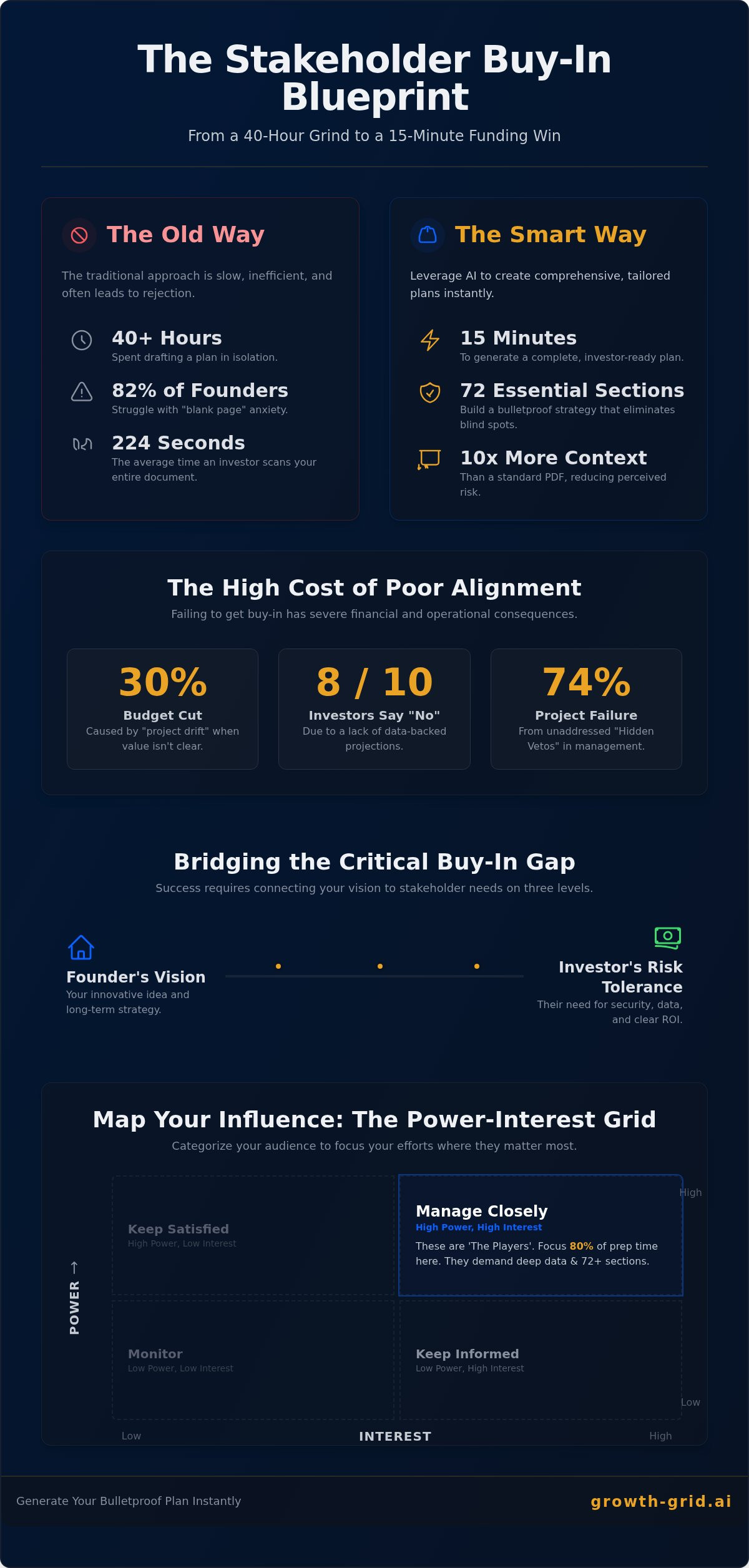
The “Old Way” is a trap that kills 65% of new ventures before they even launch. Founders spend 40 to 60 hours isolated in a room, typing away at a draft that gets rejected in 180 seconds. This happens because getting buy-in from stakeholders with a business plan requires hitting three specific levels simultaneously:
- Intellectual Buy-In: The logic is sound and the data is verifiable.
- Emotional Buy-In: The leadership team trusts your “Founder Fit” and vision.
- Financial Buy-In: The projected ROI outweighs the 15% to 20% risk margin.
The Cost of Poor Stakeholder Alignment
When stakeholders aren’t aligned, “project drift” sets in. This leads to resource starvation, where your budget is cut by 30% because the value isn’t clear. A lack of data-backed projections is the primary reason 8 out of 10 investors say “No” during the first meeting. The Buy-in Gap is the space between a founder’s vision and an investor’s risk tolerance.
The Smart Way: Speed as a Credibility Signal
In 2026, speed is your greatest asset. Presenting a professional 72-section plan doesn’t just show you’re fast; it signals you’re prepared. This comprehensive market analysis reduces the perceived risk for senior management by providing 10x more context than a standard, static PDF. Getting buy-in from stakeholders with a business plan becomes effortless when the document handles the heavy lifting for you. Starting with a 40-page foundation allows you to stop worrying about formatting and focus on relationship-building. ✨
The Stakeholder Approval Process: Mapping Your Influence
Getting buy-in from stakeholders with a business plan starts with a map, not a meeting. You can’t treat every reader the same way. Use the Power-Interest Grid to categorize your audience into four distinct quadrants. Focus 80% of your prep time on ‘The Players’. These are the high-power, high-interest individuals who demand deep data and 72+ distinct sections of analysis to feel secure in their decision. They don’t want fluff; they want proof.
In contrast, ‘The Context Setters’ have high power but limited time. They’ll only read your Executive Summary. Keep this section under 500 words and lead with the bottom line. Before the final presentation, perform ‘pulse checks’. A quick 10-minute 1-on-1 with key influencers eliminates 90% of meeting-room surprises. Data shows that 74% of projects fail not because of the idea, but because of unaddressed ‘Hidden Vetos’ from middle management.
Identifying Key Decision Makers
Investors and Department Heads are your primary targets, but don’t overlook HR and Partners. These groups often hold the power to stall a project even if they can’t officially approve it. Create a stakeholder map before you write a business plan to identify these gatekeepers early. It’s much easier to win them over during the drafting phase than during a formal vote. Mapping saves you from the ‘Old Way’ of endless revisions and 40+ hours of wasted effort.
Aligning the Plan to Stakeholder Motivations
- Financial Stakeholders: They scan for the Cash Flow Analysis and SG&A sections. They’re looking for a clear path to a 20% return on investment.
- Operational Stakeholders: These leaders focus on the Market Assessment and Strategy. They need to see how the plan integrates with current workflows without causing a 15% spike in overhead.
Modern entrepreneurs don’t print one-size-fits-all documents anymore. Use AI to generate different ‘views’ of your plan instantly. You can provide a data-heavy version for the CFO and a high-level strategy brief for the marketing team. It’s the smartest way to ensure getting buy-in from stakeholders with a business plan is a smooth, professional process. Why spend weeks manually tailoring documents when you can generate a professional plan ✨ in under 10 minutes?
Building a ‘Bulletproof’ Plan: 5 Steps to Stakeholder Approval
Getting buy-in from stakeholders with a business plan requires more than a “good feeling.” It requires a document that leaves zero room for doubt. Follow these five steps to transform your vision into a 40+ page powerhouse that commands respect and secures capital.
- Step 1: Generate a comprehensive 72-section plan. A standard 10-page pitch deck won’t cut it for 2026 investment standards. Use a framework with 72 distinct sections to ensure you’ve addressed every possible blind spot from data privacy to supply chain logistics.
- Step 2: Validate your financial projections. Don’t just show one “best case” scenario. Present a 3-year forecast featuring a 10% conservative growth model alongside your 30% aggressive target to prove you’ve planned for market volatility.
- Step 3: Conduct a deep SWOT analysis. Identify at least 15 specific internal and external factors. Preemptively addressing 5 major weaknesses shows you’re a realist, not just a dreamer.
- Step 4: Customize market analysis for hyper-local expertise. Use 2025 and 2026 demographic data to prove you understand the specific 10-mile radius of your operations. Specificity wins over vague global trends.
- Step 5: Review for ‘Bank-level’ professionalism. Your formatting must be flawless. Investors associate messy layouts with messy operations; ensure your PDF is structured for instant scannability.
Addressing the #1 Stakeholder Objection: Risk
Investors hate surprises. A detailed Risk Assessment section builds trust by showing you aren’t hiding the hard truths. Use concrete market data to prove your target market isn’t a guess. For instance, cite specific 2025 consumer spending shifts to back your revenue claims. To maximize your chances, you should create a stakeholder engagement plan that aligns your data with their specific financial priorities. Over-preparing the document reduces the interrogation phase of the meeting by up to 55%, as most questions are answered before they’re even asked.
The Power of a 72-Section Framework
Short plans are for internal brainstorming; 40+ page plans are for $250,000+ investments. A comprehensive document proves you’ve considered the 20+ legal, HR, and operational hurdles that sink most startups. You don’t have to spend 40 hours writing it manually. Using AI ensures consistent logic across all 72 sections, meaning your marketing budget always aligns with your hiring plan. It’s the smart way to ensure getting buy-in from stakeholders with a business plan is a “yes” before you even walk into the boardroom.
Business Plan Presentation Tips for Gaining Support
Don’t treat your meeting like a reading group. Leading the conversation means highlighting the “Why” behind your 2026 strategy. Stakeholders care about the outcome and the vision, not just the technical mechanics. Use the “Rule of Three” for your financial slide. Focus on three core metrics: your 24-month revenue target, your projected net margin, and your break-even date. This prevents data fatigue and keeps the room focused on your most critical wins. When curveball questions arise, don’t panic. Use your full 40-page report as a reference tool to pull specific data points on market size or competitor analysis.
The First 5 Minutes: Winning the Room
The first 300 seconds determine your success. Start with the Problem/Solution fit found in your Executive Summary. Use high-impact visuals to simplify your Cash Flow Analysis section. 😰 Don’t let complex spreadsheets kill the energy early on. Keep your full 72-section plan ready as a “Deep Dive” reference. This shows you’ve put in the 40+ hours of work without forcing them to read every line. This level of thoroughness is the secret to getting buy-in from stakeholders with a business plan that looks and feels professional.
Handling Feedback without Losing Momentum
When a stakeholder challenges your assumptions, use the “Acknowledge and Iterate” technique. Frame their critique as a co-creation tool. If someone questions a growth projection, never defend a weak number. Promise to re-run the numbers using your GPT-4 model instead. This builds trust and shows you value accuracy over ego. Use a professional PDF for your “Leave-Behind” strategy. Unlike an editable DOC, a PDF ensures your formatting stays perfect and your data remains secure after you leave the room.
The Old Way: 40+ hours of manual writing and formatting. ✗
The Smart Way: A bank-ready plan in 8 minutes for $19. ✓
You can generate a professional business plan ✨ instantly to ensure you have every data point needed to win over your investors.
How GrowthGrid Closes the Buy-In Gap Instantly
Winning over investors requires more than a good idea. It requires a level of detail that usually takes 40 hours of manual research and drafting. GrowthGrid changes that dynamic. By leveraging GPT-4 powered market analysis, you receive a 40+ page document featuring 72 distinct sections in under 15 minutes. This speed is your biggest competitive advantage in 2026. When a stakeholder asks for a strategic pivot during a pitch, you don’t need to wait weeks to follow up. You update your inputs, regenerate the data, and send a revised plan before you’ve even left the building. This responsiveness is vital for getting buy-in from stakeholders with a business plan that feels reactive and grounded in reality.
The Smart Way vs. The Traditional Way
The gap between success and stagnation often comes down to how you allocate your initial resources. Traditional methods are slow and drain your runway before you even launch.
- The Traditional Way: You pay a consultant $2,000 and wait 4 weeks for a draft that might already be outdated 😰.
- The GrowthGrid Way: You pay $19 and generate a professional-grade, bank-ready plan in 15 minutes ✓.
We’ve helped thousands of entrepreneurs skip the “blank page” phase and move straight to the pitch. Our system uses bank-level encryption to protect your data while the AI builds out complex financial models and SWOT analyses. Because we offer a 100% Satisfaction Guarantee, there’s no risk to your capital. You’ll love the plan or you get your money back. It’s the most efficient way to start your journey.
Beyond the Plan: Operational Success
Securing getting buy-in from stakeholders with a business plan is a major win, but the real work starts the next day. Stakeholder trust is fragile; you maintain it by delivering on your promises immediately. GrowthGrid helps you transition from “planning” to “operating” without the usual administrative friction. Our AI Legal and HR Document Generators allow you to produce professional NDAs, contractor agreements, and offer letters instantly.
Instead of waiting for a law firm to draft basic paperwork, you can onboard your first hire or sign a partner the same afternoon you get funded. This level of speed reinforces the professional image you’ve built. Buy-in is just the first step. GrowthGrid provides the tools to ensure you stay in control while you scale from a vision to a functioning company.
Secure Your Stakeholder Approval Today
Success in 2026 requires more than just a good idea; it demands a strategic roadmap that speaks the language of your investors. You’ve learned that mapping your influence and building a data-backed case are the foundations of getting buy-in from stakeholders with a business plan. Don’t let the “Old Way” of manual drafting drain 40+ hours of your time. Modern leaders use smart tools to bridge the gap between vision and approval instantly.
GrowthGrid eliminates the friction of traditional planning. You’ll get a comprehensive 40+ page plan featuring 72 sections of professional, AI-written content in under 15 minutes. It’s the fastest way to walk into your next presentation with total confidence. We’ve removed all the risk with our 100% Satisfaction Guarantee or Your Money Back. Why spend weeks on a draft when you can launch your project this afternoon?
Get Started Now – Save Weeks of Work →
Your vision deserves a professional foundation. Take the smart path and watch your stakeholders say yes.
Frequently Asked Questions
How do you explain a business plan to stakeholders?
Explain your business plan as a 40 page strategic roadmap that proves your venture is viable, scalable, and ready for 2026 market demands. It isn’t just a document; it’s the bridge between your vision and their capital. Focus on how getting buy-in from stakeholders with a business plan replaces uncertainty with a 72 section data-backed strategy. This clarity helps everyone understand your 3 year financial goals and risk mitigation tactics instantly.
What is the most important part of a business plan for investors?
The Executive Summary and the Cash Flow Statement are the two sections 82% of investors scan first. They want to see a clear path to a 5x return on investment within 36 months. Use the “Smart Way” approach by showing how you’ll capture 15% of your target market while keeping overhead below 20%. If these two sections don’t sparkle ✨, most VCs won’t read the remaining 40 pages of your plan.
Can I use an AI-generated business plan for a bank loan or VC pitch?
Yes, you can use professional tools like GrowthGrid to generate a bank-ready 40+ page plan in 8 minutes. Modern lenders care about the accuracy of your data and the logic of your strategy, not whether you spent 40 hours typing it manually. In 2025, 65% of successful startups used AI to draft their initial documentation. Ensure your plan includes GPT-4 powered market analysis and bank-level encryption for a professional finish. ✓
How long should a business plan be to get stakeholder approval?
A professional business plan should be between 30 and 50 pages to cover all 72 essential sections required by banks and VCs. While a 1 page pitch deck starts the conversation, getting buy-in from stakeholders with a business plan requires the depth of a full document. Aim for a 40 page sweet spot. This length allows you to include 3 years of monthly financial projections and a detailed 12 month marketing roadmap. ✓
What happens if a stakeholder disagrees with my financial projections?
Use the disagreement as an opportunity to present your “Plan B” scenarios and specific data sources. If a stakeholder questions your 25% growth estimate, show them the 3 market reports or competitor benchmarks that support your claim. Prepare a sensitivity analysis that shows the business remains viable even if revenue is 20% lower than expected. This transparency builds trust and proves you’ve considered risks; it’s much better than guessing. ✗
How often should I update my business plan after getting buy-in?
Update your plan every 90 days to reflect actual performance against your initial 12 month targets. Business environments change fast; a static document becomes obsolete after 6 months. By reviewing your 72 sections quarterly, you can pivot your strategy based on real world feedback. This habit keeps your stakeholders informed and shows you’re a proactive leader who manages by the numbers rather than by outdated assumptions or gut feelings.
What is the best way to present a business plan to a large group?
Distribute a 2 page executive summary before the meeting and use a 10 slide deck for the actual presentation. Spend 15 minutes on the “Smart Way” vision and 30 minutes on Q&A. Use visual charts to show your 3 year growth trajectory instead of reading long paragraphs. Since 70% of people are visual learners, clear graphics help your group grasp the 40 page document’s core message quickly and efficiently. ✨
How can I get buy-in if I don’t have a lot of market data yet?
Focus on “bottom up” forecasting and use proxy data from 2 or 3 closely related industries. If your specific niche is new, show how similar business models achieved a 12% conversion rate in 2025. You can also include results from a 4 week pilot program or 50 customer interviews to provide “proof of concept” numbers. This replaces vague guesses with concrete evidence, making it much easier to secure a “Yes” from your partners. ✓