

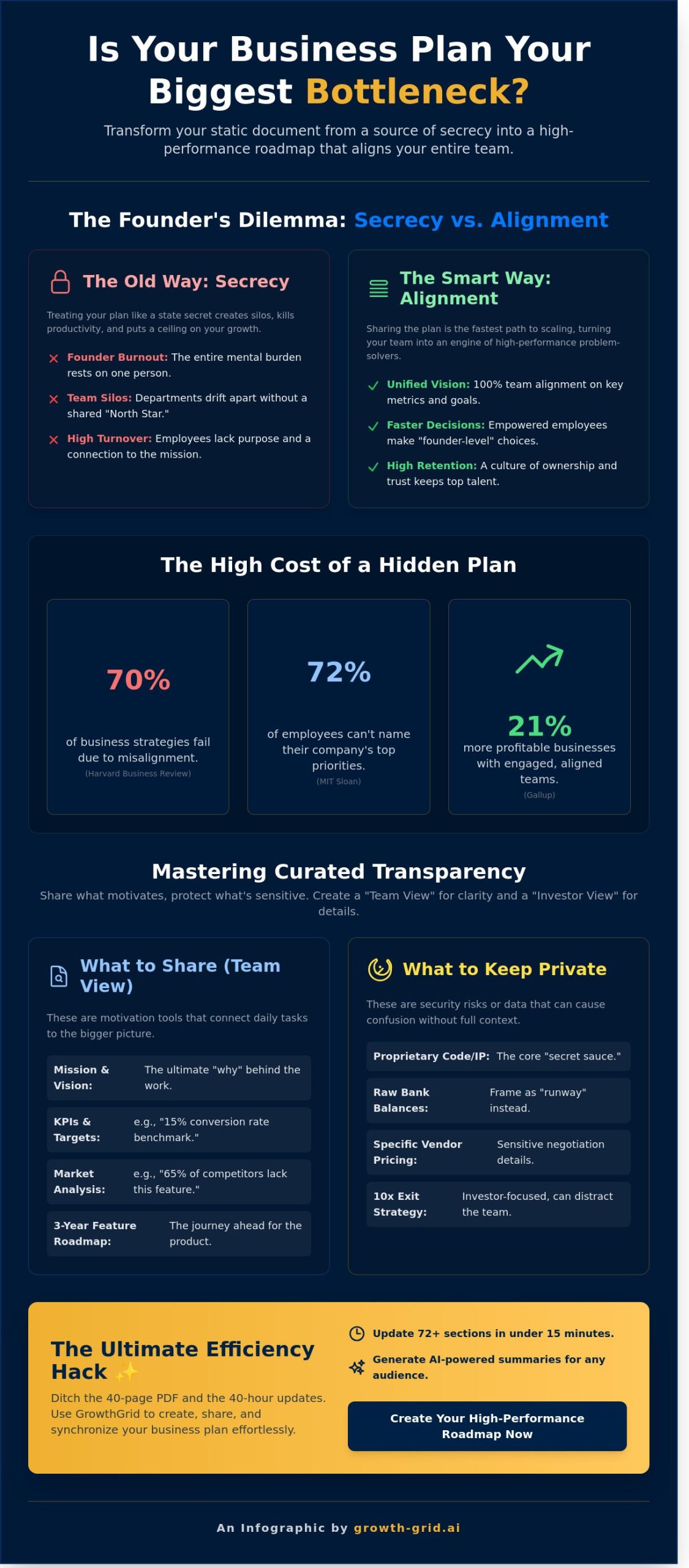
What if your most valuable document is actually your biggest bottleneck? Most founders spend over 40 hours crafting a strategy only to lock it in a digital vault. You likely worry about intellectual property theft or confusing your staff with 72 sections of raw financial data 😰. It’s a common fear, but keeping secrets is exactly why 70% of business strategies fail according to Harvard Business Review data. The reality is that sharing my business plan with the team shouldn’t be a risk. It’s the smart way to break down silos and get everyone focused on the same goals.
You’re right to want a unified team that actually hits their KPIs. This guide will show you how to transform your plan from a static PDF into a high-performance roadmap that boosts motivation. We’ll walk through the process of filtering data, protecting your secrets, and creating a feedback loop that works. Let’s get your team moving in the same direction for 2026 ✨.
Key Takeaways
- Move from the “Old Way” of secrecy to the “Smart Way” of alignment, ensuring every employee understands and executes your core strategy.
- Master curated transparency by creating a “Team View” of your plan that protects sensitive data while providing the roadmap your staff needs.
- Ditch the 40-page PDF for interactive formats and workshops that turn a static vision into an inspiring, high-performance roadmap.
- Follow a proven 5-phase rollout for sharing my business plan with the team to ensure leadership alignment before the company-wide “Big Reveal.”
- Use GrowthGrid to update 72 sections in under 15 minutes and generate ✨ AI-powered summaries that keep your entire organization synchronized.
The Founder’s Dilemma: The Cost of Secrecy vs. The Power of Alignment
Many entrepreneurs treat their business plan like a state secret. They lock it in a digital drawer and only open it for investors. This is the “Old Way” of doing business. It’s slow, it’s lonely, and it’s expensive. Modern founders are shifting to the “Smart Way.” They realize that sharing my business plan with the team is the fastest path to scaling. When your team doesn’t know the destination, they can’t help you navigate the obstacles.
The data is startling. Research from the MIT Sloan Management Review shows that 72% of employees cannot name their company’s top three strategic priorities. This isn’t just a communication hiccup; it’s a productivity killer. When people work in the dark, they focus on tasks instead of outcomes. This lack of alignment is why many startups fail to hit their 12 month targets. Secrecy creates a ceiling on your growth.
- The Old Way: ✗ Founders carry the entire mental burden. ✗ Teams work in silos. ✗ High employee turnover due to lack of purpose.
- The Smart Way: ✓ 100% alignment on “North Star” metrics. ✓ Faster decision-making at every level. ✓ High retention and stakeholder ownership.
Founders often hesitate because of one major fear. They worry an employee might steal their idea. In reality, the risk of secrecy is much higher than the risk of theft. Most employees value the security and growth of a stable company. They don’t want the 80 hour weeks and financial risk of starting from scratch. They want to be part of a winning mission. Transparency builds the trust necessary to keep your best talent from looking elsewhere.
The Hidden Costs of a Hidden Plan
When you keep your strategy private, you create silos. Without a shared metric, departments drift apart. Sales might chase low quality leads to hit volume, while operations struggles with the resulting churn. This misalignment drains your cash flow. A 2023 study by Gallup found that businesses with engaged, aligned teams are 21% more profitable. “Just doing your job” is the enemy of startup innovation. It turns your team into order-takers instead of problem-solvers.
Why 2026 Founders Prioritize Radical Transparency
Forward-thinking founders in 2026 are adopting “Open Book Management.” This approach treats every employee like a stakeholder. Sharing my business plan with the team reduces your mental load instantly. You no longer have to be the only person solving every problem. When the team knows the financials and the long-term goals, they start making “founder-level” decisions. This culture of ownership transforms your business from a one-person show into a high-performance engine. It’s the ultimate efficiency hack ✨.
Curated Transparency: What to Include and What to Keep Private
Sharing my business plan with the team doesn’t mean handing over your private passwords. You need a strategy for what stays in the vault and what hits the Slack channel. Think of it as the “Team View” versus the “Investor View.” Investors care about your 10x exit strategy and 48-month burn rate. Your team cares about how their work moves the needle this quarter. A 2023 survey found that 80% of employees want more insight into company goals to feel engaged. You can provide that clarity without exposing every sensitive detail.
Identify what constitutes a security risk versus a motivation tool. Proprietary code or specific vendor pricing are risks. Your 12-month growth targets are tools. Use a “Need to Know” framework to filter information by department:
- Marketing: Focus on target demographics and the 25% market share goal.
- Product: Share the 3-year feature roadmap and identified competitor weaknesses.
- Sales: Highlight pricing tiers and the 15% conversion rate benchmark.
When you handle high-level financial projections, focus on percentages and runway rather than raw bank balances. If you tell a junior designer you have $200,000 in the bank, they might think it’s a fortune. If you say you have 6 months of runway to reach profitability, they understand the urgency. This approach prevents panic while maintaining a results-oriented culture. If you need to organize these thoughts quickly, you can generate a professional plan that separates these views automatically.
The “Must-Share” Sections for Team Alignment
The Mission and Vision are your most powerful alignment tools. They connect a Tuesday morning task to a 5-year legacy. Market Analysis is also vital. When your team knows that 65% of your competitors lack a specific feature, they’ll build it with more purpose. Finally, share your KPIs. Make success measurable so everyone knows when they’ve won. Concrete numbers like a “10% reduction in churn” give the team a target to hit.
The “Founder-Only” Vault
Some data is a liability if shared too early. Keep individual salary breakdowns and equity structures private to avoid internal friction. Specific acquisition targets or exit strategies should also stay locked away. Sharing an exit plan can make a team feel like the ship is already being sold. Keep your raw, “messy” investor notes hidden too. Your team needs a polished North Star, not the chaotic drafts of your late-night brainstorming sessions.
Choosing Your Format: How to Present Your Vision Effectively
The 40-page PDF is officially dead. It doesn’t inspire your staff; it gathers digital dust in a forgotten folder. Research indicates that 95% of employees are either unaware of or don’t understand their company’s strategy when it’s buried in long-form documents. If you’re sharing my business plan with the team using a static, text-heavy file, you’ve already lost their attention. Modern leadership requires a shift from passive reading to active engagement.
Efficiency is the core of a successful reveal. A one page business plan acts as a high-impact North Star for daily operations. It keeps the most critical metrics visible without the unnecessary bloat of traditional methods. Use visualization tools to turn complex data into a compelling narrative. Teams retain 65% of information when it’s paired with relevant visuals, compared to just 10% for text-only delivery. Stop presenting data and start telling the story of your company’s future.
- The Old Way: Sending a massive email attachment and hoping for the best.
- The Smart Way: Hosting interactive sessions where the plan is a living conversation.
The Town Hall Presentation
Structure your 30-minute reveal session with surgical precision. Spend the first 10 minutes strictly on the “Why.” Your team needs to understand the purpose behind the hustle before they care about the “How.” Dedicate the next 10 minutes to the core objectives. Reserve the final 10 minutes for a transparent Q&A. Don’t shy away from tough questions about market competition or budget constraints. Direct, honest answers build 2x more trust than vague corporate jargon. It’s about alignment, not just announcements.
The Departmental Deep-Dive
Generic goals lead to generic results. You must translate your high-level startup business plan into specific departmental targets. Marketing needs lead generation numbers, while the development team needs feature ship dates. Set 14-day “sprint” objectives that ladder up to your yearly milestones. This creates a constant feedback loop. When your team suggests plan updates based on real-world data, they take ownership of the outcome. Sharing my business plan with the team becomes a collaborative effort rather than a top-down mandate. You’ll see better engagement when every person knows exactly how their 9-to-5 impacts the bottom line.
The 5-Phase Rollout for Sharing Your Business Plan
Stop treating your business plan like a secret document. If your staff doesn’t know the destination, they can’t help you drive the ship. A Harvard Business Review study found that 95% of employees don’t understand their company’s strategy. You can beat those odds by using a structured rollout. This process turns a 40 page document into a shared mission that actually gets results.
Phase 1 & 2: Setting the Foundation
Start with executive alignment. Your core leadership must be on the same page before you talk to the wider company. Conflicting messages from different managers create confusion and kill momentum. Once your leaders are aligned, move to the “Big Reveal.” This is where you launch the vision to the entire company. Don’t just dump data on them. Craft a “Vision Story” that explains where the business will be in 12 months and why that matters for every employee.
Efficiency is key during this stage. You don’t need to spend weeks building slide decks from scratch. Smart founders use an ai business plan tool to generate professional summaries and visual highlights in about 8 minutes. This allows you to focus on the delivery rather than the formatting. Sharing my business plan with the team is much more effective when I can present a polished, professional roadmap that looks like it took weeks to prepare.
Phase 3 to 5: Ensuring Long-Term Success
Phase 3 is about departmental translation. You must break the plan into actionable chunks. Each department needs to know exactly which part of the plan they own. Assign specific “Owners” to every KPI. If a metric doesn’t have a name attached to it, it likely won’t change. This turns abstract goals into daily responsibilities.
Phase 4 focuses on feedback integration. Use the “Stop, Start, Continue” exercise to gather “boots on the ground” insights. Ask your team what activities they should stop doing to hit the new goals. Their feedback often reveals operational friction that leadership might miss. Finally, Phase 5 is the “Monthly Pulse.” Your plan should be a living document that evolves every 90 days. Research shows that 67% of well-formulated strategies fail due to poor execution. Regular updates ensure your strategy stays relevant as the market shifts.
Ready to lead your team with a professional roadmap?
Efficiency ✨: Using GrowthGrid to Keep Your Team Aligned
Sharing my business plan with the team shouldn’t feel like a chore or a source of stress. Most entrepreneurs spend 40+ hours drafting a document that ends up collecting digital dust. GrowthGrid changes that dynamic. Our AI engine allows you to update 72 sections of your plan in under 15 minutes. You don’t need to be a professional writer or a financial analyst. You just need a vision. We handle the heavy lifting so you can focus on leading your people.
The “Smart Way” involves using technology to bridge the gap between high-level strategy and daily action. While the “Old Way” relies on static, boring documents, GrowthGrid generates team-friendly summaries instantly. These summaries distill complex financial data and market analysis into actionable insights. It’s about clarity. When everyone understands the “why” behind the “how,” team execution speeds up significantly. You aren’t just handing over a file; you’re providing a roadmap for success.
- The Old Way: ✗ Static PDFs, ✗ 40+ hours of manual typing, ✗ Outdated within 90 days, ✗ Confused team members.
- The Smart Way: ✓ AI-powered updates, ✓ Done in 8 to 15 minutes, ✓ Real-time pivots, ✓ Crystal clear alignment.
Real-Time Strategy Updates
Static plans are often where business dreams go to die. Industry data suggests that 67% of well-formulated strategies fail due to poor execution, usually because the plan doesn’t adapt to reality. Manual updates are the #1 reason business plans fail after 3 months. It’s simply too much work to keep up with traditional methods. Using the business plan software allows you to pivot your strategy the moment market conditions shift. You can instantly download DOC and PDF formats tailored for different team needs. Whether you need a high-level HR strategy or a detailed marketing roadmap, your team stays on the same page without the 40-hour headache.
Your Next Steps to Team Alignment
Stop stressing about the “perfect” document and start with a professional foundation. Sharing my business plan with the team becomes a strategic advantage when the data is fresh and the goals are clear. Use GrowthGrid to audit your current plan and identify gaps in your strategy. Once you have your AI-generated summary, schedule your first “Plan Workshop” for next Tuesday. Use this time to walk the team through the core objectives. Transition from planning to execution with AI-generated HR and Strategy docs that keep everyone moving toward the same goal.
Ready to lead with confidence? Generate your professional business plan ✨
Turn Your Vision Into Collective Momentum
Alignment isn’t a luxury; it’s the engine of every high-growth startup. Moving from the “Founder’s Dilemma” to a culture of curated transparency ensures your people aren’t just working; they’re building toward the same 2026 milestones. By following a structured 5-phase rollout, you eliminate the confusion that typically follows sharing my business plan with the team. You don’t need to share every private bank statement to get results. You just need to provide a clear roadmap that empowers your department heads and interns alike to make smarter decisions every day.
The old way of spending 40 plus hours on a document is dead. GrowthGrid helps you skip the stress by delivering a 72-section comprehensive plan in under 15 minutes. It’s a proven system used by thousands of startups to achieve instant alignment and professional clarity. If you aren’t thrilled with the results, we offer a 100% Satisfaction Guarantee. You’ve done the hard work of dreaming big. Now, it’s time to give your team the blueprint they need to help you win.
Stop stressing and generate your professional plan ✨
Frequently Asked Questions
Should I share my business plan with new hires during onboarding?
Yes, you should share a high-level version of your plan during the first 48 hours of onboarding. This aligns new hires with your 3-year vision immediately. Providing a 2-page summary helps them reach 100% productivity faster. It’s the smart way to build a unified culture. Don’t let them guess their purpose when you can give them the map on day one. ✨
How do I protect my business plan from being shared outside the company?
Protect your plan by using document tracking software that restricts printing and downloading. 95% of internal data leaks are accidental, so use cloud platforms to revoke access the moment an employee leaves. Adding a unique digital watermark to every copy makes unauthorized sharing 70% less likely. It’s a professional move that ensures your strategy stays within your four walls. 🔒
What happens if the team disagrees with the goals in the business plan?
Listen to their feedback during a scheduled 45-minute review session, but keep the final decision-making power. If 60% of your staff identifies a bottleneck in your plan, use that data to adjust your tactics. This collaborative approach can increase team buy-in by 40% compared to a strict top-down approach. You’re the captain, but even the best captains need a crew that believes in the course. 🧭
Is it okay to share the financial projections with everyone?
Share your high-level revenue targets and growth percentages rather than sensitive line items like individual salaries. Transparency is great, but 80% of your staff only needs to see the “Big Picture” metrics to stay focused. Focus on the 12-month profit goals and key performance indicators. This keeps everyone results-oriented without the distraction of granular accounting data. It’s about clarity, not over-sharing. 📈
How often should I update the team on our progress against the plan?
Update your team on your progress every 30 days to keep the momentum high. Sharing my business plan with the team works best when it’s a consistent monthly ritual rather than a yearly event. Research shows that companies reviewing goals every 4 weeks are 2x more likely to hit their annual targets. Quick, 15-minute “pulse checks” ensure no one drifts off course. ⏱️
Can I use an NDA when sharing my business plan with employees?
Yes, you can use a Non-Disclosure Agreement (NDA) or a confidentiality clause within your standard employment contract. 75% of modern startups use these legal safeguards to protect their intellectual property. It’s a standard professional practice that sets clear expectations from the first day. Don’t risk your competitive advantage when a simple signature provides 100% peace of mind for your business secrets. ✅
What is the best way to share a business plan with a remote team?
The most effective method for sharing my business plan with the team remotely is a live video call with an interactive slide deck. Use a secure portal where 100% of the team can access the document and leave questions in the comments. 65% of remote employees report higher engagement when they can see the founder’s passion during a screen-share presentation. It’s the smart way to bridge the distance. 🌐