

Did you know that 67% of well-crafted strategies fail because they never leave the paper? It’s a staggering figure from the Harvard Business Review that highlights the “Strategy-Execution Gap” most entrepreneurs face. You’ve likely felt that sting before. You spend 40+ hours building a vision, only to see it sit on a digital shelf while your team remains unsure of their next move. It’s frustrating, it’s expensive, and it’s the old way of doing business.
This level of automation is particularly valuable in specialized sectors; for example, private medical practices can explore Brigid AI options to manage their clinical workflows and reduce the time spent on administrative bureaucracy.
We agree that a plan is useless if it doesn’t drive real-world results. That’s why you need a modern business plan implementation strategy designed for the high-speed demands of 2026. This guide promises to bridge the gap between your written goals and your actual results using a lean execution framework. You’ll learn how to stop guessing and start growing with a smart approach to resource management that eliminates wasted time and unnecessary stress ✨.
We’re providing a clear roadmap for your first 90 days, including measurable KPIs to track every win. It’s time to move from planning to performing and turn your vision into a results-driven reality.
Key Takeaways
- Stop losing momentum to the strategy-execution gap by ditching manual tracking for a high-speed execution framework.
- Deploy a modern business plan implementation strategy that converts broad objectives into specific, actionable milestones.
- Align your cash flow with your launch timeline to identify hidden costs and ensure your team has the resources to win.
- Master the difference between leading and lagging indicators to manage risks before they impact your bottom line.
- Use AI to gain a massive head start, generating a 72-section plan and key operational documents in under 15 minutes. ✨
The Strategy-Execution Gap: Why Most Business Plans Fail
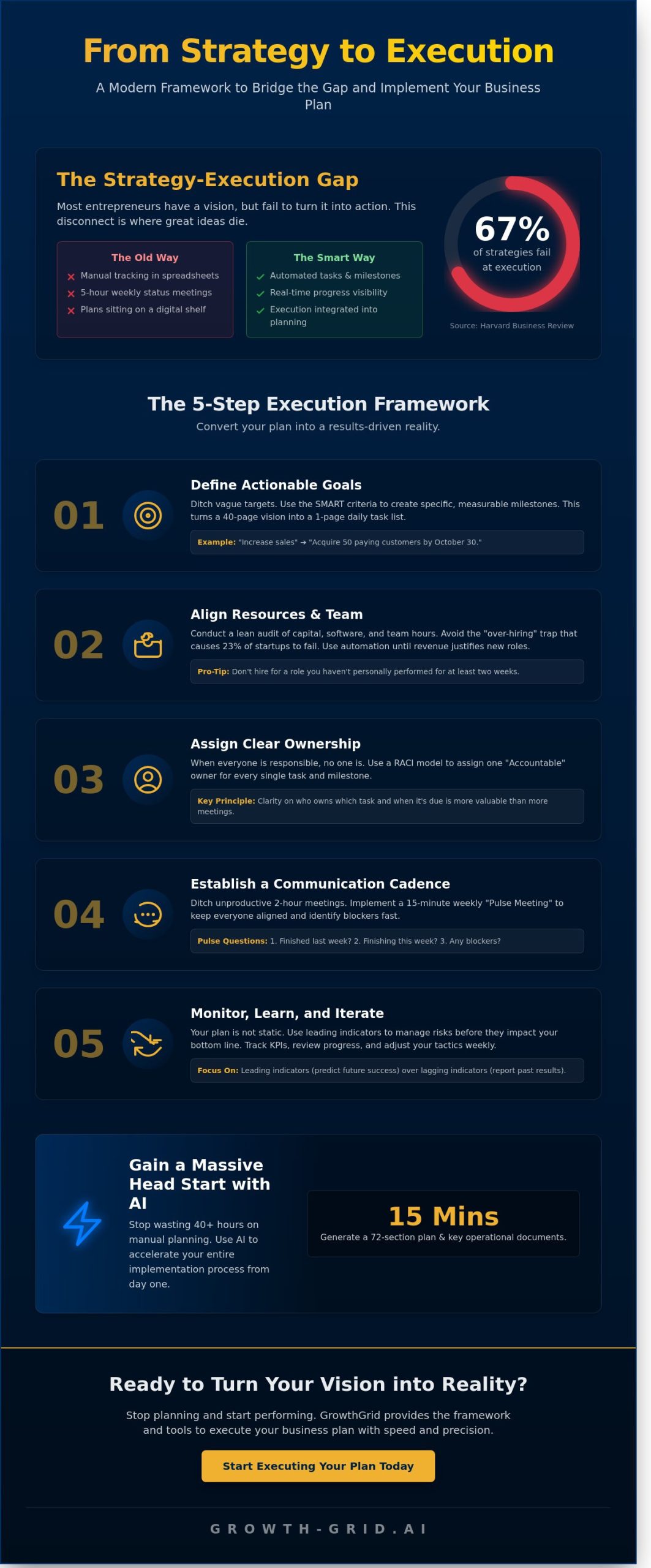
A staggering 67% of well-formulated strategies fail during the execution phase. You might spend weeks crafting a perfect vision, but the results often fail to materialize. This disconnect is the strategy-execution gap. It’s the distance between your high-level goals and the actual work your team performs every Monday morning. Without a concrete business plan implementation strategy, even the most brilliant ideas remain trapped on the page. Success isn’t about having the best ideas; it’s about having the best process for acting on them.
The Old Way vs. The Smart Way
- The Old Way: Manual tracking in cluttered spreadsheets. Fragmented communication via endless email threads. Status meetings that burn 5 hours of productivity every week. ✗
- The Smart Way: Integrating execution into the planning process from day one. Automated task assignments. Real-time visibility into every milestone. ✓
Your business plan is only as good as its first 30 days of action. If the wheels don’t start turning immediately, the momentum dies. Execution shouldn’t be an afterthought. It must be the core of your planning process. When you treat implementation as a separate stage that happens “later,” you’ve already increased your risk of failure by 50%.
The Psychology of Implementation Paralysis
Analysis paralysis is a silent killer for startup founders. You get lost in 40-page visions and complex 5-year forecasts. This leads to a frozen state where no one knows what to do first. To break the cycle, you must move from a 40-page vision to a 1-page daily task list. Focus on “Quick Wins” to build team confidence. Seeing a 12% boost in lead generation or landing that first pilot client in week two creates a psychological ripple effect. Small victories fuel the long-term business plan implementation strategy.
Strategy vs. Implementation: Knowing the Difference
Strategy is the “What” and “Why” of your business. It involves the strategic planning process to identify market gaps and competitive advantages. Implementation is the “Who,” “How,” and “When.” It’s the tactical engine that drives your daily operations. Your strategic plan needs a tactical counterpart to survive the reality of the marketplace. Implementation is the bridge between vision and revenue. You don’t need more meetings; you need more clarity on who owns which task and when it’s due.
The 5-Step Framework for a Successful Implementation Strategy
Execution is the bridge between a great idea and a profitable business. Most entrepreneurs fail because they stop at the planning phase. Research from Harvard Business School suggests that 60% to 90% of strategic plans never reach full execution. To beat these odds, your business plan implementation strategy must be built on speed and precision, not just optimism.
Step 1 & 2: Goals and Resources
Stop setting vague targets. Use the SMART criteria to turn your startup business plan into a roadmap of specific, measurable milestones. If your goal is “increase sales,” change it to “acquire 50 paying customers by October 30.” This clarity allows you to conduct a lean resource audit in under 30 minutes. List your current software, available capital, and team hours.
Avoid the “over-hiring” trap. Data shows that 23% of startups fail because they don’t have the right team or burn through cash too early. Don’t hire for a role you haven’t personally performed for at least two weeks. Use tools and automation to bridge the gap until your revenue justifies a new salary. This keeps your burn rate low and your focus sharp.
Step 3 & 4: Ownership and Communication
When everyone is responsible, no one is responsible. You need a clear RACI model. For every task in your business plan implementation strategy, assign one person who is Accountable. This “owner” is the single point of contact for that result. This guide to successful strategy implementation highlights how clear levers of control help managers maintain focus during high-growth phases.
Ditch the two-hour status meetings. They kill productivity. Instead, implement a 15-minute weekly “Pulse Meeting.” Each owner answers three questions:
- What did you finish last week?
- What are you finishing this week?
- What is blocking your progress?
Step 5: Iterative Review
Your plan is a living document, not a static script. Set a monthly review date to compare your actual performance against your projections. If the market gives you feedback that contradicts your plan, pivot. Adjust your tactics based on real-world data rather than sticking to a flawed original concept. Speed beats perfection every time in the startup world.
Ready to move faster? You can generate a professional plan and start your implementation in minutes instead of weeks.
Aligning Your Resources: The Budget and Team Reality Check
Execution isn’t free. Your business plan implementation strategy will stall without a hard look at the numbers. Most startups fail because they run out of cash, not ideas. You must align your cash flow analysis with your specific execution timeline. If your strategy requires a $10,000 marketing push in month three, but your cash reserves won’t hit that until month six, your plan is broken before it starts. Don’t guess with your future. Use real data to drive your decisions.
Financial Alignment: Funding Your Strategy
A budget is just a strategy expressed in numbers. To succeed, you need to calculate the “burn rate” associated with your new strategy. This is the amount of capital you spend each month to keep operations running before you turn a profit. Stop wasting money on low-impact activities like expensive office decor or premium subscriptions you don’t use. Reallocate those funds to core strategic pillars that drive growth.
- ✗ The Old Way: Spending $5,000 on branding before making a single sale.
- ✓ The Smart Way: Investing in lead generation that pays for itself in 30 days.
- ✗ The Old Way: Hiring full-time legal counsel for $150,000 a year.
- ✓ The Smart Way: Using AI to draft HR and legal documents in minutes for almost nothing.
Don’t ignore the hidden costs of execution. Implementation often requires new software, increased marketing spend, and legal compliance fees. These administrative burdens can eat 15% to 20% of your budget if you aren’t careful. Focus on revenue-generating activities first to create a self-funding loop that keeps your business plan implementation strategy alive ✨.
Building the Implementation Team
You need doers, not just dreamers. When hiring, look for an “execution mindset” rather than just a “planning mindset.” These are people who focus on finishing tasks rather than just discussing them. You don’t need a massive payroll to start. Use freelancers and AI tools to fill skill gaps without the overhead of full-time salaries. Following a practical implementation blueprint ensures your team stays focused on the right metrics at the right time.
Align individual incentives with your company goals. If your team wins when the strategy succeeds, they’ll work harder to make it happen. Use AI to generate performance review templates and incentive structures instantly. This saves you 10+ hours of administrative work every month. Stop stressing over the paperwork and start building your business. Get started now and save weeks of work →.
Monitoring Progress: KPIs and Risk Management
Execution without measurement is just guessing. A successful business plan implementation strategy requires a high-definition view of your progress. You can’t manage what you don’t measure. You need to distinguish between leading and lagging indicators to keep your growth on track. Relying only on lagging indicators is like driving a car while only looking in the rearview mirror. Smart founders use both to adjust their course in real-time.
- Leading Indicators: These are predictive metrics. Think website traffic, sales qualified leads (SQLs), or trial signups. They tell you what’s coming next.
- Lagging Indicators: These are reflective. Net profit, churn rate, and annual revenue tell you how you performed in the past.
The KPI Dashboard for Startups
Don’t drown in raw data. Focus on the five metrics that actually move the needle for your implementation. A visual dashboard keeps the whole team aligned and moving fast. It turns abstract goals into concrete targets that everyone can see.
- Customer Acquisition Cost (CAC): The total cost to earn one new customer.
- Lifetime Value (LTV): The total revenue a single customer generates. A healthy LTV is typically 3x your CAC.
- Burn Rate: The amount of venture capital you’re spending each month before reaching positive cash flow.
- Monthly Recurring Revenue (MRR): Your predictable, stable income stream.
- Conversion Rate: The percentage of prospects who take a specific action.
Establish “Red Flag” thresholds for these metrics. If your burn rate spikes by 15% without a corresponding jump in MRR, your dashboard should trigger an immediate strategy review. This prevents small leaks from sinking the ship before you even realize there’s a problem.
Proactive Risk Management
Risk isn’t the enemy; unplanned risk is. Conduct a “Pre-Mortem” before you launch. Imagine it’s one year from now and your plan has failed. Ask why. Research from CB Insights shows that 42% of startups fail because there was no market need. Identify these roadblocks now so you can build detours into your business plan implementation strategy before you spend a dollar.
Stop relying on “gut feelings” for major pivots. Data-driven decisions are 5% to 6% more profitable than those based on intuition alone. When the market shifts, your data will tell you exactly when to change course and when to double down on your current path. This objective approach removes the emotional stress of leadership.
Protect your strategic data like it’s cash in a vault. Your implementation details are your competitive advantage. Use platforms that offer Bank-level encryption, specifically AES-256 standards, to ensure your growth roadmap stays private. Security isn’t just an IT issue; it’s a core part of your business survival in a digital economy.
Stop guessing and start growing with a plan built for success. Generate your professional business plan ✨
Scaling Faster: Using AI to Execute Your Business Plan
Execution is where most founders stumble. You’ve likely spent weeks on a document that now sits in a digital drawer while you drown in administrative “busy work.” A modern AI business plan changes that dynamic instantly. Instead of starting from zero, you get a 72-section head start that covers every tactical detail of your business plan implementation strategy. This isn’t just a template; it’s a comprehensive engine for growth.
Traditional planning is notoriously slow. The Old Way involves 40+ hours of manual research, expensive consultants, and constant 😰 stress over whether you’ve missed a critical detail. The Smart Way uses advanced AI to generate a professional, bank-ready plan in just 8 minutes. This massive jump in speed isn’t just about convenience. It’s about getting your product to market months before your competition even finishes their first draft.
Automating the Paperwork of Implementation
Founders often lose momentum because they get trapped in legal and HR tasks. You need NDAs, service contracts, and operational roadmaps to hire your first employee or sign your first partner. Hiring a consultant for every draft is a budget killer, but doing it yourself takes forever. GrowthGrid’s AI Strategy Document Generator produces these essential files in under 15 minutes. By replacing human consultants with AI precision, you can save 90% on administrative costs while ensuring your documents meet professional standards.
Stop wasting your creative energy on generic templates. Use AI to create tactical roadmaps that your team can actually follow. This approach keeps your business plan implementation strategy focused on high-leverage growth rather than soul-crushing bureaucracy. You’ll spend your time closing deals instead of formatting spreadsheets.
Your First 90 Days with GrowthGrid
The first three months determine your company’s long-term trajectory. GrowthGrid helps you move through this phase with total clarity. Here is how you use AI to dominate your first quarter:
- Day 1-7: Generate your full 40+ page plan and key strategy documents. Finalize your executive summary and financial projections to secure funding or internal buy-in.
- Day 8-30: Align your team. Use the AI-generated roadmap to set your first 3 major milestones. Everyone knows their role because the strategy is documented and accessible.
- Day 31-90: Monitor your KPIs closely. Scale revenue-producing activities and use AI-driven insights to pivot your strategy as you gather real-world market data.
Don’t let bureaucracy slow your vision. You’ll love your plan or your money back. Start Saving Time Now ✨ Generate Your Plan
Master Your Execution for 2026
Bridging the gap between high-level vision and daily operations is what separates successful ventures from the 67% of businesses that fail to meet their strategic goals. Your business plan implementation strategy for 2026 must prioritize resource alignment and real-time KPI tracking to stay agile in a shifting market. By integrating AI-driven tools, you can bypass the traditional 40-hour planning grind and focus on what actually matters: scaling your impact. You’ve learned how to identify risks and align your team; now it’s time to put those insights into a professional format that investors and banks respect.
Joining over 50,000 entrepreneurs who’ve ditched the old way means you’re choosing efficiency over frustration. You don’t need weeks of stress to build a professional foundation. You need a roadmap that works as hard as you do. GrowthGrid delivers 72-section comprehensive plans generated in minutes, ensuring your strategy is both professional and actionable. It’s the smart way to launch, backed by a 100% Satisfaction Guarantee. Stop overthinking and start building your future today. Your success is waiting for you to take the first step.
Generate ✨ [Create your implementation-ready business plan in 8 minutes]
Frequently Asked Questions
What is the difference between a business plan and an implementation strategy?
A business plan outlines your vision and goals, while an implementation strategy provides the tactical steps to achieve them. Think of the plan as your destination and the strategy as your GPS. According to Harvard Business Review, 90% of organizations fail to execute their strategies successfully because they lack this practical bridge. Your strategy must include specific deadlines and assigned owners for every task to avoid becoming a static document.
How long should a business plan implementation strategy take to create?
Creating a business plan implementation strategy used to take 40+ hours of manual labor. With modern AI tools, you can now generate a professional framework in under 15 minutes. This speed allows you to move from theory to action instantly. Instead of spending 3 weeks drafting, you can start hitting your first 30-day milestones by tomorrow morning with a clear, actionable roadmap.
Who is responsible for the implementation strategy in a startup?
The founder or CEO is ultimately responsible for the implementation strategy in a startup environment. While teams execute tasks, the founder must ensure resources align with the 12-month vision. Data from the Small Business Administration shows that startups with active founder involvement in the first 180 days have a 25% higher survival rate. You’re the captain, so you need to set the pace and clear roadblocks.
What are the 5 key components of a successful implementation plan?
A successful plan requires five components: clear objectives, resource allocation, a timeline, key performance indicators, and an accountability matrix. You need 3 to 5 core goals with specific due dates. Assign every task to a specific person to ensure ownership. Without these five pillars, 60% of businesses find their plans stall within the first quarter. Use a simple checklist to keep your team focused on results.
Why do most business plan implementations fail within the first six months?
Most implementations fail because they lack flexibility and clear accountability in the first 6 months. Research indicates that 67% of strategies fail due to poor communication between leadership and staff. If your team doesn’t know their specific 90-day targets, they’ll revert to old habits. Rigid plans that don’t allow for monthly adjustments often break when they hit real-world market shifts or unexpected costs.
Can AI help with the implementation phase of a business plan?
AI can dramatically accelerate the business plan implementation strategy by automating data analysis and task scheduling. Tools using GPT-4 technology can generate a 40-page roadmap with 72 distinct sections in minutes. This cuts your administrative workload by 90%, leaving you more time to focus on growth. It’s the smart way to handle complex documentation without the stress of starting from a blank page.
How do you measure the success of an implementation strategy?
Success is measured by tracking specific KPIs against your 30, 60, and 90-day milestones. You should monitor your burn rate, customer acquisition cost, and monthly recurring revenue targets. If you’re hitting 85% of your scheduled milestones on time, your strategy is working. Regular audits every 14 days ensure you stay on track and catch small errors before they become expensive problems for your startup.
What should I do if my implementation strategy isn’t meeting its KPIs?
If you aren’t meeting your KPIs, you must analyze your data every 7 days and pivot your tactics immediately. Don’t wait for the quarter to end to make changes. If a specific channel isn’t performing after 30 days, reallocate that budget to a proven area. Successful entrepreneurs use a 14-day feedback loop to adjust their course. This agile approach prevents you from wasting resources on a failing direction.