
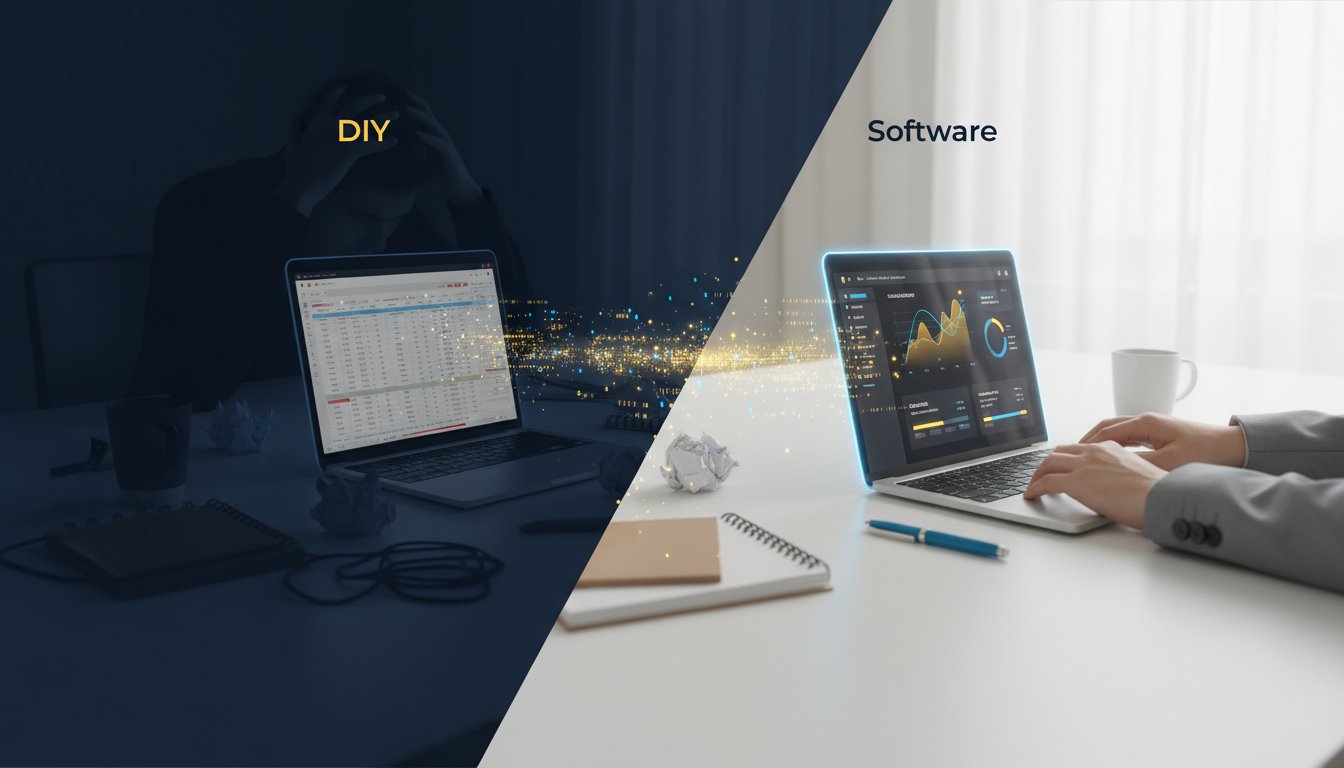
Starting your business with a “free” DIY template seems like the logical choice, but it often becomes the most expensive mistake a founder can make. When you calculate the 40+ hours of research and writing required, the diy business plan vs software comparison reveals a hidden cost that stalls your launch by weeks. You didn’t start a company to become a formatting expert in Microsoft Word or a part-time accountant struggling with broken Excel formulas.
We know the pressure of staring at a blank page while fearing that a single projection error could sink your chances with investors. You deserve a professional document that matches your vision without the 😰 of formatting hell. This guide shows you how to switch to “The Smart Way” and generate ✨ a bank-ready, 72-section plan in under 15 minutes. You’ll learn how to save weeks of work and walk into your next bank meeting with 100% confidence in your financial models.
Key Takeaways
- Stop trading weeks of growth for manual formatting and learn why the “free” DIY route actually costs you 40+ hours of high-value selling time.
- Compare the diy business plan vs software approach to see how smart founders are slashing planning time from 4 weeks down to just 15 minutes.
- Discover why 2026 investors value your strategic vision over the “suffering” of manual writing while maintaining bank-ready professional standards.
- Evaluate if building complex 3-year financial models from scratch is worth the stress or if an AI-powered solution is your secret shortcut to success.
- Learn how to turn an 8-minute questionnaire into a professional 72-section business plan that saves you 90% on traditional costs ✨.
The Hidden Cost of the DIY Business Plan: Why ‘Free’ Isn’t Free
Most founders start their journey with a blank Word document and a generic Excel template. This is the traditional DIY business plan. It looks free on the surface, but the true cost is hidden in the weeks of lost productivity. When comparing a diy business plan vs software, the most expensive resource you have is your own time. Every hour you spend wrestling with document margins or fixing a broken cell in a spreadsheet is an hour you aren’t talking to customers or closing sales.
Before you dive into the writing process, it’s helpful to understand the foundational elements of What is a Business Plan? and why it matters for your specific industry. In 2026, the stakes are higher than ever. Investors and banks no longer accept “best guess” estimates. They demand sophisticated, data-driven projections that reflect a volatile global economy. Starting from scratch often leads to “Blank Page Syndrome,” a common psychological hurdle that stalls startup momentum for 65% of first-time entrepreneurs.
Where the 40+ Hours Actually Go
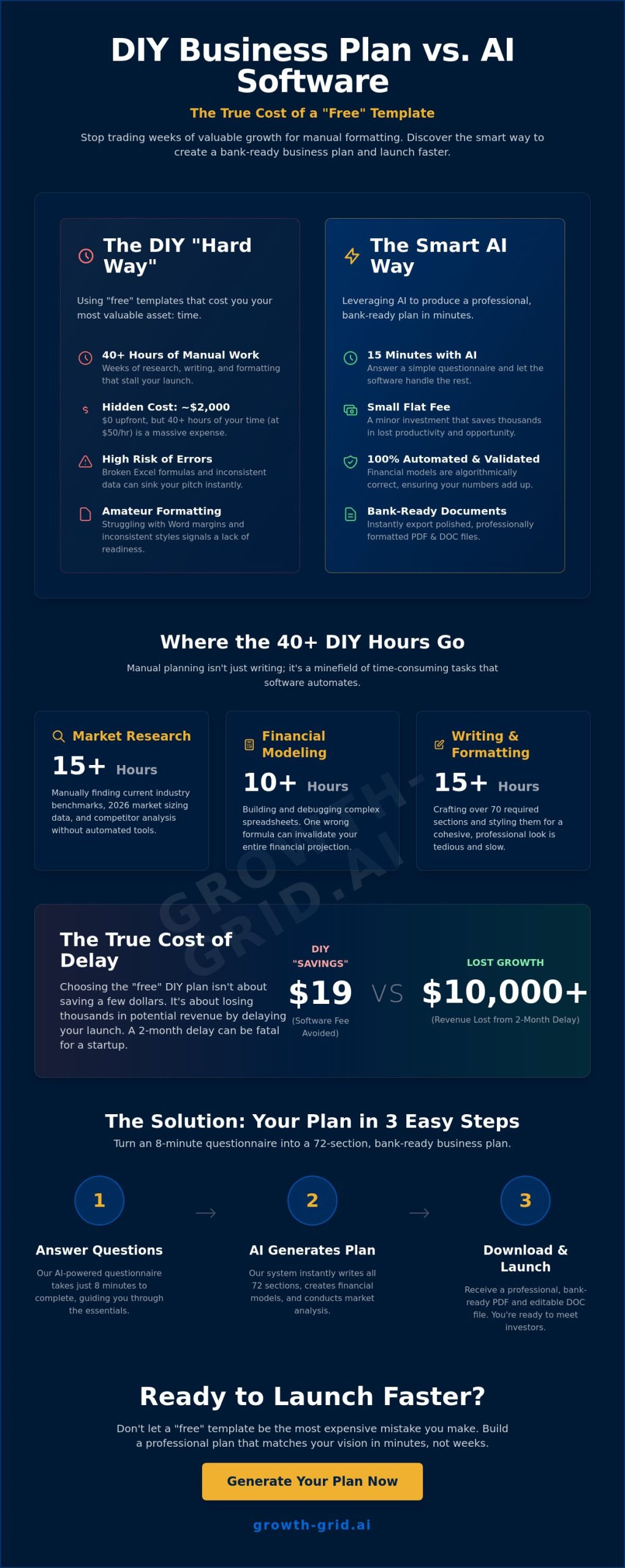
- Market Research (15+ hours): You have to find current industry benchmarks, analyze 2026 market sizing data, and track competitor movements without the help of automated tools.
- Financial Engineering (10+ hours): Building and debugging complex financial spreadsheets is a minefield. One wrong formula in your cash flow statement can invalidate your entire pitch.
- Writing and Formatting (15+ hours): Professional plans require at least 70 specific sections. Manually styling these for a cohesive look takes days of tedious work.
The Quality Gap: Professionalism vs. Amateurism
A DIY plan often suffers from a “Quality Gap” that investors spot instantly. Common mistakes include inconsistent tone, broken internal links, and outdated market data from 2023 or 2024. These errors signal a lack of operational readiness to lenders. If you can’t manage a document, they won’t trust you to manage a million-dollar credit line.
The psychological toll is just as heavy. Planning paralysis occurs when the sheer volume of work leads to burnout before the business even opens its doors. Choosing a diy business plan vs software isn’t just about the $19 you might save today; it’s about the $10,000 in growth you lose by delaying your launch by two months. Professional software ensures your plan is bank-ready in minutes, not weeks. Don’t let a “free” template be the reason your startup never leaves the ground.
DIY vs. Software: A Head-to-Head Comparison
Choosing between a diy business plan vs software determines whether you launch your startup this afternoon or next month. The “Old Way” relies on sheer willpower and a lot of coffee. The “Smart Way” uses automation to bypass the friction. Here is how the two methods stack up when you look at the raw data:
- Speed: 2 to 4 weeks of manual drafting vs. 15 minutes with AI software.
- Cost: $0 upfront but 40+ hours of lost labor vs. a flat $19 investment.
- Accuracy: High risk of broken Excel formulas vs. 100% automated financial logic.
- Formatting: A constant struggle with Word margins vs. instant, professional PDF and DOC exports.
If you value your time at just $50 per hour, a “free” DIY plan actually costs you $2,000 in lost productivity. For most founders in 2026, that is a price too high to pay. You can start building your plan right now and save those 40 hours for actual business growth.
Financial Projections: Excel Hell vs. Automated Models
Most entrepreneurs find themselves trapped in “Excel Hell” within hours of starting. The biggest danger is hard-coding numbers into a spreadsheet. If you change your projected sales price in month three, a manual sheet won’t always update your tax obligations or cash flow buffers automatically. This leads to balance sheets that don’t balance. While guidance from the SBA highlights the necessity of detailed financial projections, doing this manually is risky. Modern software links your P&L, Balance Sheet, and Cash Flow statement instantly. When one number moves, the entire model adjusts without errors.
Market Analysis: Manual Googling vs. AI-Powered Insights
Finding specific, niche market data for 2026 is a massive hurdle for the DIY route. Manual research often results in outdated statistics from 2022 or 2023. Software powered by models like GPT-4 synthesizes current market trends and consumer behavior data in seconds. Instead of spending 10 hours hunting for CAGR percentages, the software generates a grounded assessment analysis tailored to your specific zip code and industry. This ensures your strategy isn’t just a guess, but a data-backed roadmap. It’s the difference between hoping there is a market and knowing exactly where your customers are hiding. 😰 Why stress over data mining when the heavy lifting is already done? ✨
Will Investors and Banks Accept a Software-Generated Plan?
The short answer? Yes. In 2026, the myth that you must “suffer” through weeks of manual typing to prove your worth is dead. Investors don’t reward you for the hours spent formatting margins; they reward you for the quality of your strategy. When weighing a diy business plan vs software, the deciding factor for a lender is clarity and professional standards. They want to see that you’ve mastered your numbers, not your word processor.
Many founders fear software creates “generic” content. That’s a misunderstanding of how modern tools work. While the SBA’s guide to writing a business plan outlines the essential components every plan needs, software ensures you don’t miss a single one. A plan with 72 standardized sections is actually preferred by bank managers. It allows them to find your “Cash Flow Statement” or “Market Analysis” in seconds. Speed is the new currency in due diligence. If it takes a VC ten minutes to find your exit strategy, you’ve already lost them.
What VCs and Banks Actually Look For
Financial institutions and VCs have moved past flowery language. They want hard data and logic. A professional plan must include:
- ✓ Clear Value Proposition: Can you explain your “why” in two sentences?
- ✓ Realistic YOY Growth: Projections showing 15% to 25% annual growth backed by actual market trends.
- ✓ Risk Assessment: A detailed SWOT analysis that doesn’t ignore the competition.
Banks prioritize “Bank-level” presentation. If your DIY plan looks like a messy Word document, it signals a lack of professionalism. Software guarantees your formatting is crisp, consistent, and ready for a $500,000 loan application ✨.
The Role of AI in Modern Business Strategy
Think of AI as a sophisticated co-writer, not a replacement for your brain. The “Smart Way” involves using frameworks that have already worked for thousands of startups. Why reinvent the wheel? When comparing a diy business plan vs software, remember that banks care about the 72-section standard, not how much you sweated over the font choice. Using AI to iterate on your strategy lets you move 10x faster than competitors still stuck in the “Old Way.”
The Old Way vs. The Smart Way
- ✗ Staring at a blank page for 40+ hours 😰.
- ✓ Generating a 40-page plan in 8 minutes ✨.
- ✗ Guessing what a bank wants to see.
- ✓ Using a proven 72-section framework.
Smart entrepreneurs use these tools to build, test, and refine. If your data is solid, the software simply packages it into a format that speaks the language of capital. It’s about working on your business, not just in it. You’ll love your plan because it’s built to get a “Yes” from the people holding the checks.
How to Choose the Right Business Planning Path
Choosing between a diy business plan vs software depends on four critical factors that will define your startup’s trajectory. First, look at your budget through a professional lens. A standard, bank-ready business plan takes roughly 40 to 100 hours to write from scratch. If your time is valued at $50 per hour, a DIY plan costs you up to $5,000 in lost productivity. Compare that to a $19 software solution that delivers the same result in a fraction of the time. It’s a simple math problem.
Next, be honest about your technical expertise. Can you build a 3-year financial model that accounts for CAGR, burn rates, and EBITDA? Investors expect these numbers to be accurate and logically linked. If you don’t have a background in corporate finance, software handles this heavy lifting automatically. You also need to consider your deadline. The debate over a diy business plan vs software usually ends when you look at your calendar. If you have a meeting with a lender tomorrow, you don’t have the luxury of manual formatting.
Before you decide, ask yourself these questions:
- Is your time worth more than the software cost? Most founders find that saving 40+ hours is worth much more than a small one-time fee.
- Can you handle 72 sections? A professional plan isn’t just a summary. It requires deep dives into market analysis, operational risks, and personnel plans.
- Do you have the data? Software often provides industry benchmarks that would take you days to find through manual research.
When DIY Might (Rarely) Make Sense
Creating a plan from scratch is usually a mistake, but three specific scenarios exist where it works. If you’re building a highly non-standard business model with no existing market data, you might need to build a custom framework from the ground up. Former strategy consultants who already own high-end proprietary templates might also prefer the manual route. Lastly, if your project is just a personal hobby with no intention of seeking outside funding or scaling, a simple notebook entry is enough.
When Software is the Only Logical Choice
For 95% of modern startups, software is the only path that makes sense. If you’re applying for a startup loan or pitching venture capital, your plan needs a professional structure. Banks often reject plans that look “homemade” or lack standard financial statements. Using a tool powered by the GPT-4 model ensures your language is sharp and your data is formatted for bank-level scrutiny.
If you’re launching your business while working a full-time job, you’re already time-crunched. You can’t afford to spend three weeks on a Word document. Modern software allows you to generate a 40+ page plan in about 8 to 15 minutes. It also integrates essential legal and HR documents alongside your strategy, ensuring your startup is compliant from day one. It’s the difference between struggling with “The Old Way” and embracing the efficiency of the smart way.
GrowthGrid: The Smart Way to Generate a Business Plan ✨
Stop wasting weeks staring at a blinking cursor. The debate between a diy business plan vs software usually ends the moment you see how fast AI works. GrowthGrid replaces 40 hours of manual research and writing with a streamlined 8-minute questionnaire. It’s the end of the “blank page syndrome” that kills so many startups before they even launch.
Our platform uses the GPT-4 model to build professional, 72-section plans that cover every metric investors actually care about. This isn’t a generic template; it’s a custom strategy tailored to your specific market. While a traditional consultant might charge $2,000 for a similar document, GrowthGrid delivers the same professional quality for just $19. You save over 90% on costs while securing a document that looks like it came from a high-end firm.
GrowthGrid also builds your entire operational foundation. Beyond the core plan, you can generate NDAs, employment contracts, and detailed strategy docs. It’s a complete ecosystem for the modern founder who values speed over ceremony.
The GrowthGrid Process: From Idea to PDF
We’ve simplified the most daunting task in entrepreneurship into three manageable stages. The process is designed to be stress-free and remarkably fast.
- Step 1: Answer simple questions. You provide the vision. Tell us about your business model, your target audience, and your goals through our intuitive interface.
- Step 2: AI generation. Our engine processes your data to create a comprehensive, formatted 40+ page plan. It handles the complex financial modeling and market analysis automatically.
- Step 3: Download and present. Export your plan as a polished PDF. You’ll have the data-backed confidence needed to walk into any investor meeting or bank presentation.
Why 20,000+ Entrepreneurs Love GrowthGrid
Efficiency is the new competitive advantage. More than 20,000 founders have already used GrowthGrid to move their ideas from the napkin to the boardroom. Our users frequently report saving weeks of administrative work, allowing them to focus on product development and sales instead. If you’re still deciding on a diy business plan vs software, remember that time is your most limited resource.
We stand by our results with a “Love Your Plan or Your Money Back” guarantee. This removes the risk, letting you focus entirely on your launch. You can write your startup business plan fast by leveraging our advanced AI tools today.
Ready to stop stressing and start building? Don’t let a document hold your vision back for another month.
Launch Your Startup Faster Than the Competition
The choice between a diy business plan vs software comes down to how much you value your time. Spending 40+ hours staring at a blank document isn’t just exhausting; it’s an expensive opportunity cost for any founder. Industry standards in 2026 demand professional formatting and data-backed projections that manual templates often fail to deliver. You don’t need to waste weeks on a draft when modern technology handles the heavy lifting for you.
GrowthGrid has already empowered 20,000+ entrepreneurs to skip the traditional stress. You’ll receive a professional 40+ page plan tailored for banks and investors. Why struggle with “The Old Way” when you can secure a comprehensive roadmap for just $19? It’s the most efficient move you’ll make for your business this year. We back every plan with a 100% Satisfaction Guarantee so you can move forward without any risk.
Generate ✨ Your Business Plan in 8 Minutes
Your vision deserves a professional foundation. Take the shortcut to success today and turn your startup idea into a reality with absolute confidence.
Frequently Asked Questions
Is it better to write a business plan myself or use a generator?
Using a generator is the smart way to ensure professional results without the 40 hour time sink. While a DIY approach allows for deep customization, it often leads to formatting errors and missed sections that stall your progress. According to a 2024 study, businesses with a written plan grow 30% faster than those without. A generator helps you hit that milestone in minutes.
Do investors reject business plans made with AI or software?
Investors don’t reject plans because of the tool; they reject them for poor data and unrealistic projections. Most venture capitalists focus on the 5 core pillars of your business model rather than whether you used a template or AI. A professional generator ensures your 40 page plan follows industry standards, making it easier for 85% of lenders to find the information they need quickly.
How much does business plan software typically cost in 2026?
Professional business plan software in 2026 typically costs between $15 and $100 depending on the features included. GrowthGrid offers a full, bank ready plan for $19, which is a fraction of the $500 to $2,500 fees charged by traditional consultants. This affordable price point makes it easy for startups to get professional results without draining their initial seed capital.
Can business plan software help with financial projections?
Yes, modern software automates complex financial projections to eliminate the 88% error rate found in manual spreadsheets. You don’t need to be an accountant to generate profit and loss statements or cash flow forecasts. The software uses your inputs to calculate 3 year or 5 year projections instantly, ensuring your numbers are mathematically sound and ready for bank review.
How long does it take to create a business plan with software vs. DIY?
Creating a plan with software takes about 8 to 15 minutes, while the DIY method usually consumes over 40 hours of work. The diy business plan vs software debate often comes down to how you value your time as a founder. By choosing the smart way, you save 90% of the effort required to research market trends and structure your executive summary from scratch.
What are the disadvantages of a DIY business plan?
The main disadvantages of a DIY business plan are the high risk of structural gaps and the massive time commitment required. Founders often spend 2 to 3 weeks struggling with formatting and financial formulas instead of building their product. Without a professional framework, you might miss one of the 72 critical sections that banks and investors expect to see in a modern startup document.
Is GrowthGrid’s AI business plan generator bank-ready?
GrowthGrid’s AI generator creates bank-ready plans that meet SBA requirements and include 72 professional sections. Every plan uses GPT-4 technology to ensure the content is high quality and relevant to your specific industry. It includes bank-level encryption to keep your data safe, providing a result that looks and feels like it was written by a high priced consultant.
Can I edit the plan after the software generates it?
You can absolutely edit every part of your plan once the AI finishes the initial generation. The software provides a flexible document that you can refine to match your unique brand voice or specific operational details. This hybrid approach gives you the speed of automation with the precision of a personalized touch, ensuring your final 40 page document is perfect for your needs.