

Did you know that 67% of well-formulated strategies fail simply because they aren’t executed? “The Old Way” involves spending 40+ hours on a 40-page document that immediately becomes shelfware. It’s frustrating to feel like your growth is stalled because you’re drowning in data overload. We agree that staring at 50 different metrics is a waste of your time. You need clarity, not a spreadsheet that gives you a headache. 😰
This 2026 guide is your shortcut to the “Smart Way” of growth. You’ll learn the exact process for tracking kpis from business plan documents without the manual stress. We’ll show you how to extract and automate the 5 to 7 metrics that actually move the needle for your startup. 🚀
By the end of this article, you’ll have a roadmap to build a real-time dashboard that aligns your team and secures your cash flow. We’re moving from static strategy to high-speed execution in minutes, not weeks. ✨
Key Takeaways
- Identify your “North Star” metric instantly by extracting high-impact data from your Executive Summary and sales strategy.
- Bridge the gap between strategy and reality by tracking kpis from business plan projections through weekly performance targets.
- Prioritize survival and growth with a simplified, “Smart Way” approach to real-time cash flow analysis.
- Replace manual “Old Way” spreadsheets with an automated 2026 tech stack for instant visibility into your performance.
- Learn how GrowthGrid’s AI-driven planning eliminates 40+ hours of research, turning 72 sections of strategy into actionable results ✨.
From Document to Dashboard: Why Tracking KPIs from Your Business Plan is the “Smart Way” to Lead
Most business plans die the moment they’re saved as a PDF. It’s a massive waste of energy. Real leadership means turning that static document into a living, breathing dashboard. Think of a Performance indicator as the bridge between your big strategic intent and your daily operational reality. Tracking KPIs from your business plan creates a feedback loop that transforms “I hope this works” into “I know this works.”
The Old Way vs. The Smart Way
- The Old Way: Write a 40-page plan, file it in a drawer, and check it once a year. ✗
- The Smart Way: Extract 5-7 core metrics and track them on a weekly dashboard. ✓
This shift gives you “Bank-level” certainty in your decision making. You aren’t guessing about your next move; you’re executing based on hard data. For founders, high-quality startup business plans aren’t just for internal use. They’re a signal to investors that you have a map and a compass. When you show that you’re actively tracking kpis from business plan targets, investor confidence skyrockets because you’ve proven you can manage what you measure.
The “Shelfware” Risk: Why Plans Fail Without Tracking
Psychology plays a trick on entrepreneurs. Once the plan is finished, your brain feels “done.” 😰 This is a dangerous trap. In 2026, market conditions shift in days, not quarters. Static plans become “shelfware” within a month if they aren’t monitored. If you aren’t tracking, you’re flying blind. Roughly 70% of strategic initiatives fail due to poor execution rather than poor ideas. Without real-time data, you can’t pivot fast enough to survive a volatile market. You need to see the red flags before they become disasters.
The ROI of KPI Visibility
Visibility saves time. It instantly stops the “busy work” that doesn’t move the needle. When every team member sees the numbers, accountability happens naturally. You can scale 2x faster because you’re only fueling the strategies that show results. Using modern business plan software simplifies this entire process. It helps you set professional targets in 8 minutes rather than weeks of manual spreadsheet setup. Clear KPIs act as a North Star, ensuring every hour spent by your team contributes directly to your bottom line. Stop guessing and start growing.
Identifying Your “North Star”: How to Extract High-Impact KPIs from Your Strategic Sections
Your Executive Summary isn’t just a teaser for investors. It’s the foundation of your business and the primary source of your North Star metric. This single indicator tells you if the ship is moving in the right direction. For a subscription service, it might be Net Revenue Retention. For a local bakery, it’s likely Daily Foot Traffic. Successful founders in 2025 identify this metric early to align their entire team around one clear goal. You can’t improve what you don’t measure. 📈
Effective tracking kpis from business plan requires ruthless prioritization. Don’t drown in a sea of 50 metrics. Focus on 5 to 7 high-impact indicators. Industry data from the 2024 Performance Management Report shows that 64% of high-growth companies focus on fewer than 10 core metrics to maintain clarity. Anything more leads to data fatigue and decision paralysis. Your dashboard should be a snapshot of health, not a confusing spreadsheet of noise.
Extracting KPIs from the Marketing Plan
Stop treating brand awareness as a vague concept. Turn it into trackable data. If your plan targets a 20% increase in market share, your KPIs should be Reach and Engagement Rate. 💡
- The Old Way: Tracking “Lead Quantity” while ignoring the actual sales outcome. ❌
- The Smart Way: Tracking “Lead-to-Customer” conversion rates and Lead Quality Scores. ✓
Set targets for Customer Lifetime Value (CLV) immediately. If your market analysis shows a 3-year customer lifecycle, your CLV must exceed your Customer Acquisition Cost (CAC) by at least 3:1 to remain profitable. You can generate a professional plan that calculates these benchmarks for you in minutes. This ensures your marketing spend isn’t just a cost; it’s an investment with a 300% return target.
Operational and Product KPIs
Your operations section contains the “How” of your business. Translate those production goals into “Unit Cost” or “Output per Hour.” If your strategy relies on being the low-cost leader, even a 5.2% increase in raw material waste is a major red flag. 🚩
Map your product development milestones to Time-to-Market KPIs. In late 2025, the average tech startup aimed for a 14-week development cycle for new features. If your quality control strategy mandates a 99.9% defect-free rate, that’s your KPI. Don’t guess; pull the exact numbers from your strategic text. This makes tracking kpis from business plan a concrete daily habit rather than a monthly chore. Every operational metric should directly support the 15% efficiency gain promised in your original strategy.
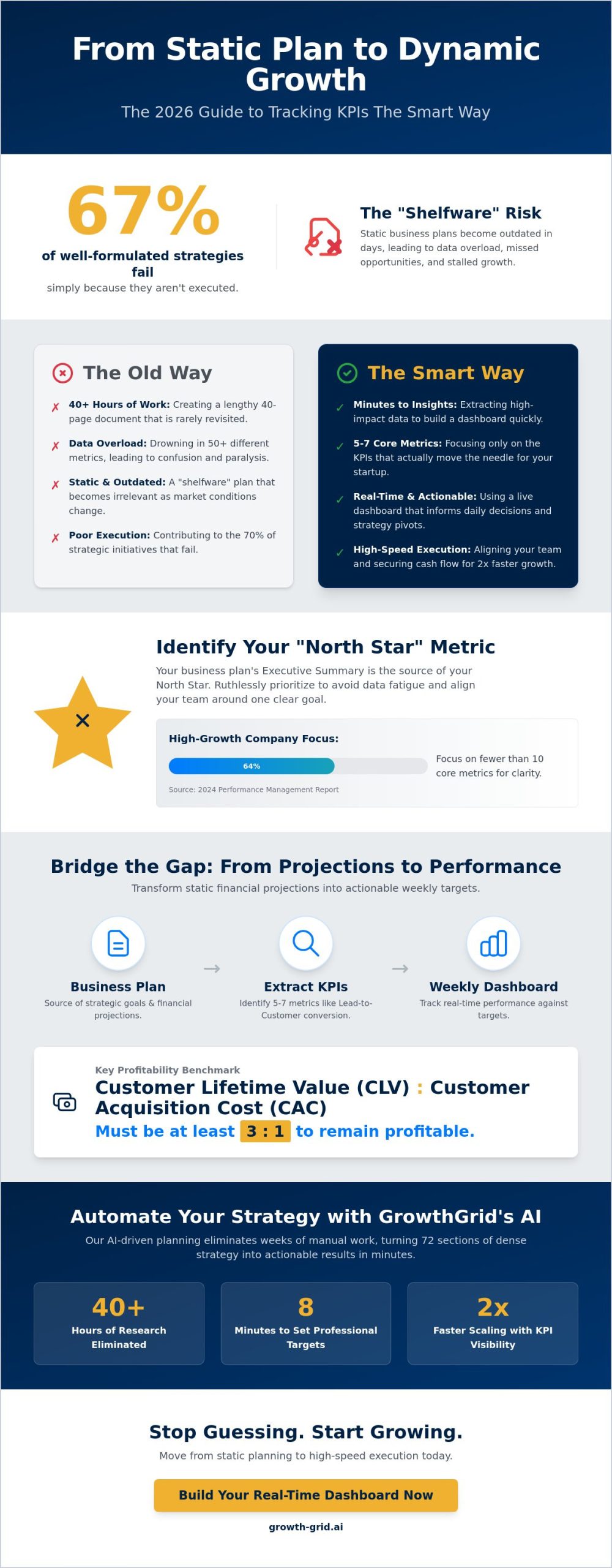
Bridging the Gap: Transforming Financial Projections into Weekly Performance Targets
Your business plan shouldn’t sit on a shelf. It’s a living map for your success. Most founders fail because they look at an annual revenue goal and hope for the best. The Smart Way requires a continuous process of governing-for-results where you deconstruct that $1 million target into 52 manageable weekly milestones. Tracking kpis from business plan documents means moving from “what if” to “what now” with absolute clarity.
Revenue and Profitability Metrics
Stop treating your revenue as a single, immovable block. You need to break it down into actionable parts to see what’s actually driving growth. If your goal is $80,000 in monthly sales, you must know your Average Order Value (AOV) and Sales Volume. If your AOV is $200, you need 400 sales. If it’s $400, you only need 200. This clarity changes your daily marketing focus instantly.
- Gross Margin vs. Net Margin: Tracking these ensures you aren’t just growing, but growing sustainably. A 60% gross margin is great, but it’s irrelevant if your net margin is negative due to high overhead costs.
- Validating the “Guesses”: The top objection from new founders is “My numbers are just guesses.” Tracking validates them. Within 60 days, those guesses transform into data-backed benchmarks that are 90% more reliable for future scaling.
The Cash Flow Early Warning System
Revenue is vanity, but cash is sanity. A robust cash flow analysis serves as your ultimate survival KPI. You can’t manage what you don’t measure, and for startups, measuring the “Burn Rate” is non-negotiable. Burn Rate is the speed at which a company consumes its capital before generating positive cash flow. If your monthly burn is $15,000 and you have $90,000 in the bank, you have exactly 6 months of runway. That’s your “drop dead” date.
Set “Trigger Points” based on your business plan. If your cash reserves dip below 3 months of runway, your plan should dictate an immediate shift in strategy. Don’t ignore your Accounts Receivable (AR) aging. If 25% of your invoices are over 30 days past due, your operational health is failing even if your sales look strong on paper.
Finally, embrace Variance Analysis. This is the core of tracking kpis from business plan projections. Compare your “Smart Way” projections against actual results every Friday afternoon. If you projected a 10% growth rate but hit 4%, you don’t panic; you identify the gap and fix it before Monday morning.
Building Your 2026 KPI Tech Stack: Tools for Instant Visibility
Stop drowning in manual data entry. By 2026, the gap between your strategy and your results closes with the right tech stack. Tracking kpis from business plan shouldn’t feel like a second job. If you’re still copy-pasting numbers from a CRM into a spreadsheet, you’re losing 10 to 15 hours of high-level strategy time every month. It’s time to upgrade from static documents to live data feeds.
- The Old Way: ✗ Manual Excel updates, ✗ 40% risk of human error (based on University of Hawaii research), ✗ Data that’s 30 days old by the time you see it.
- The Smart Way: ✓ Automated AI dashboards, ✓ Real-time API syncing, ✓ Instant anomaly detection that pings your phone.
Modern no-code tools like Fathom or Geckoboard now integrate directly with your accounting software. They pull data from QuickBooks or Xero automatically, so your financial health is always visible. In 2026, AI goes beyond just showing numbers; it predicts them. These tools use predictive modeling to tell you if you’ll hit your year-end targets based on current momentum. When connecting your financial data, ensure the platform uses AES-256 bank-level encryption. Your data security is just as important as your data accuracy.
Automation for the Solo Entrepreneur
You don’t need a data science degree to build a professional dashboard. Many affordable tools now offer an 8-minute setup for basic KPI tracking. Use native integrations or Zapier to feed data from your CRM directly into your view. If a new lead closes, your “Customer Acquisition Cost” updates instantly. Mobile-first tracking is essential for founders. You should be able to check your burn rate or conversion speed on your phone between meetings. It’s about having total control without being tied to a desk.
Visualizing Success: Dashboards That Actually Work
Clean design is your best friend. A cluttered dashboard is a useless dashboard. Stick to the principle that “less is more” and limit your main view to 5 or 7 core metrics. Use a simple color-coded system: Green for on track, Yellow for caution, and Red for urgent attention. This “traffic light” approach allows you to spot a crisis before it ruins your quarter. Set up automated weekly reports that arrive in your inbox every Monday morning. These reports keep your daily actions aligned with the goals you set in your business plan, ensuring you never drift off course.
Ready to stop guessing and start growing? Generate your automated execution strategy ✨
Automating Strategy: How GrowthGrid Turns Planning into Performance
Stop wasting 40+ hours on manual market research and complex spreadsheet formulas. Most founders get stuck in the planning phase because the gap between a vision and a functional document feels impossible to bridge. GrowthGrid eliminates this friction. By utilizing advanced GPT-4 models, the platform transforms your basic ideas into a comprehensive 72-section business plan in just 8 minutes. This isn’t just a document; it’s a high-performance engine that makes tracking kpis from business plan a seamless part of your daily operations.
AI-Powered Projections: The Foundation of Accurate KPIs
Traditional financial projections often rely on “gut feelings” or generic templates that don’t account for specific market variables. GrowthGrid takes a different approach. The AI engine analyzes industry-standard benchmarks for your specific niche to build realistic financial models. These automated projections provide the hard numbers you need for your primary metrics. You don’t have to guess what your customer acquisition cost (CAC) or churn rate should be. The system identifies these for you.
Consistency is the key to growth. While a manual spreadsheet might contain hidden calculation errors, AI-generated financials remain logically sound across all 72 sections. This creates a “Smart Way” to iterate. As your business evolves, you can update your inputs and see how your trajectory changes instantly. This ensures the logic behind tracking kpis from business plan starts with data you can actually trust.
- Eliminate Bias: AI uses objective data rather than over-optimistic projections.
- Niche Specificity: Get benchmarks tailored to your exact industry, from SaaS to local retail.
- Live Strategy: Move from a static PDF to a dynamic roadmap that guides your execution.
Your 15-Minute Roadmap to Launch
The traditional consulting model is broken. Hiring a professional to write a plan often costs upwards of $2,000 and takes weeks of back-and-forth communication. GrowthGrid delivers professional-grade quality for just $19. This democratizes high-level strategy, allowing you to focus your capital on execution rather than paperwork. It’s the ultimate hack for the modern entrepreneur who values speed and precision.
GrowthGrid acts as your ongoing operational partner. Once your plan is generated, you have a clear, bank-ready document that outlines exactly what needs to happen next. You don’t just get a plan; you get the confidence to move forward. You’ll save 90% on traditional costs while gaining a 40+ page roadmap designed for results. Don’t let another month pass by in the “research phase.” Take the leap from strategy to performance right now.
Ready to see your future in focus? Generate your professional business plan ✨ in 8 minutes and start tracking your success today.
Turn Your Strategy Into a High-Performance Engine
Stop letting your strategy gather digital dust on a hard drive. Success in 2026 requires moving beyond static documents and into real-time performance. By extracting your North Star metrics and breaking financial projections into weekly targets, you create a clear roadmap for your team. Tracking kpis from business plan is the bridge between a visionary idea and a profitable reality. It’s about data-driven leadership rather than guesswork. You don’t need to spend 40 hours manually building these frameworks when automation can do it for you.
GrowthGrid handles the complexity by generating 72-section professional business plans that are ready for immediate execution. You’ll save 90% on traditional costs while keeping your proprietary ideas safe with bank-level encryption. Don’t wait for the next quarter to see if your strategy is working. Get the visibility you need today and start building the future you’ve already mapped out.
Generate your professional business plan with AI in 8 minutes ✨
Frequently Asked Questions
What is the difference between a KPI and a metric?
A KPI measures progress toward a specific strategic goal, while a metric is a general data point that tracks a business process. Think of a metric as your total website traffic and a KPI as your sales conversion rate. If 10,000 users visit but only 50 purchase, the conversion rate tells you if you’re hitting your 2026 growth targets. Metrics provide context, but KPIs drive your core decisions.
How many KPIs should I track from my business plan?
You should track 5 to 7 core KPIs from your business plan to avoid data overload. Focus on 1 primary metric for each department like sales, marketing, and operations. Research from the 4 Disciplines of Execution suggests that teams focusing on 3 goals achieve them with high excellence, but those with 11 or more goals often fail. Keep your dashboard clean so you can act fast.
Can I track KPIs without expensive software?
You can absolutely manage tracking kpis from business plan using free tools like Google Sheets or Excel. Start with a simple 12 month template to log your actuals against your targets. This “Smart Way” approach saves you the $100 monthly subscription fee of enterprise software while keeping your data organized. It’s about the consistency of the review, not the price of the dashboard you use.
What is a “North Star” metric for a startup?
A North Star metric is the single most important number that measures the core value your company delivers to its customers. For a SaaS startup, this is often “Weekly Active Users” rather than just total signups. It aligns every team toward one shared outcome. In a 2026 market, having this one focal point ensures your execution stays true to the strategy you set in your original plan.
How often should I review my KPIs against my business plan?
Review your tactical KPIs every 7 days and perform a deep dive against your business plan every 30 days. Weekly check-ins allow you to pivot quickly if a marketing campaign underperforms. Monthly reviews help you see long-term trends and adjust your 12 month financial projections. Consistent tracking kpis from business plan ensures you catch 5% dips before they become 25% losses.
What should I do if my actual numbers don’t match my projections?
Identify if the gap comes from external market shifts or internal execution failures when actuals miss projections by 10% or more. If your 2026 customer acquisition cost is 15% higher than planned, you must reallocate your budget or optimize your sales funnel immediately. Use this data as a signal to iterate your tactics. Don’t treat a projection as a failure, treat it as a lesson.
How does AI help in tracking business performance?
AI helps by processing 1,000s of data points instantly to spot trends you might miss. Modern tools using the GPT-4 model can analyze your 40 page business plan and suggest real-time adjustments based on current performance. This saves you 5 hours of manual analysis every week. It turns raw data into actionable insights, making your business smarter and much more responsive to sudden market changes.