

Your 40-page business plan is a $5,000 paperweight if it’s just sitting in a digital folder. Research from the Harvard Business Review shows that 67% of well-formulated strategies fail because of poor execution. 😰 It’s exhausting to spend 40+ hours writing a document only to feel paralyzed when it’s time to actually launch. You’re likely worried about burning through your capital on the wrong first step or getting buried in manual task creation.
This velocity is supported by a new generation of tools; for instance, DevOpser Lite allows you to launch a complete business presence in 20 minutes without needing code, designers, or developers.
We’re fixing that today. This guide focuses on turning my business plan into action using a high-speed framework designed for the 2026 business cycle. You’ll stop guessing and start building with a clear 30-day roadmap that prioritizes results over paperwork. ✨ We’ll show you how to automate the boring parts of your setup so you can focus on the 20% of tasks that actually move the needle. Here is how to translate your strategy into a tangible business in record time.
Key Takeaways
- Bridge the “Execution Gap” by identifying the top three reasons plans fail and learning how to eliminate operational friction from day one.
- Master the 4-pillar framework for turning my business plan into action by translating high-level strategy into revenue-generating weekly sprints. ✨
- Ditch the “Old Way” of manual drafting and leverage AI to handle 72 sections of execution in under 15 minutes. ✓
- Follow a proven 30-day roadmap that takes you from legal entity setup to building a minimum viable presence and starting outreach.
- Scale your success using GrowthGrid to turn execution into an ongoing loop that adapts and regenerates your strategy as you grow.
The Strategy-Execution Gap: Why Most Business Plans Gather Dust
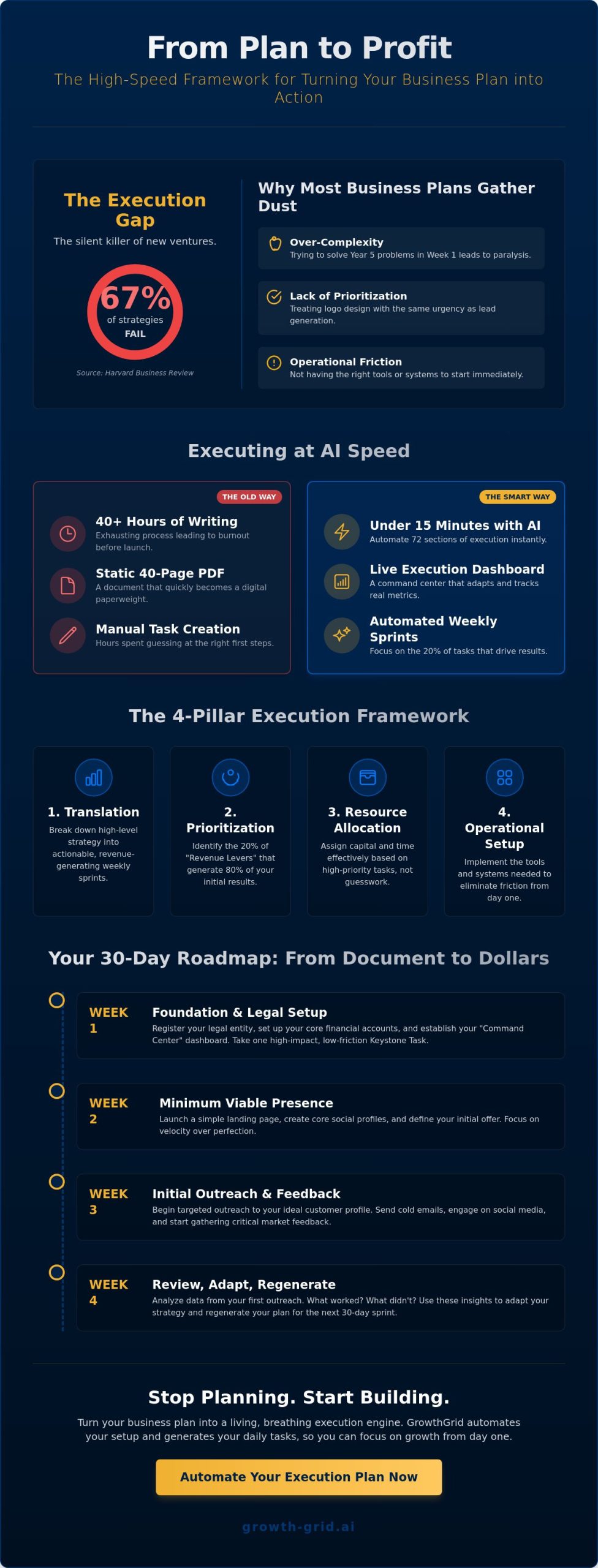
The “Execution Gap” is the silent killer of new ventures. It is the dead zone between finishing your document and securing your first $1 of revenue. Research suggests that 67% of well-crafted strategies fail because they never leave the paper. You have likely spent 40+ hours drafting a vision, but without a bridge to reality, it is just a $0 asset. Turning my business plan into action requires more than just intent; it requires a systematic breakdown of goals into immediate, repeatable steps.
Traditional Strategic planning provides a vital foundation, but it often fails at the transition to daily tasks. A 40-page static PDF often becomes a psychological barrier rather than a roadmap. It is too big to digest at 9:00 AM on a Monday morning. Most plans fail for three specific reasons:
- Over-complexity: Trying to solve year 5 problems in week 1.
- Lack of Prioritization: Treating logo design with the same urgency as lead generation.
- Operational Friction: Not having the right tools or systems to start immediately.
The 2026 Lean Execution Cycle replaces “perfection” with “velocity.” It is about translating that massive document into 2-week sprints. Stop looking at the finish line and start looking at the engine. 🚀
The 48-Hour Rule for New Founders
The first 48 hours after you finish your plan determine your success. This is when your motivation is at its peak. If you do not take a tangible step within this window, the odds of your plan gathering dust increase by 80%. Avoid analysis paralysis by ignoring the big picture for a moment. Instead, focus on one Keystone Task. A Keystone Task is a high-impact, low-friction entry point that triggers a chain reaction of progress. It could be as simple as setting up your CRM or sending five cold emails to prospective partners. Momentum is a perishable resource; use it or lose it.
Moving from “What” to “How”
Executing requires a mental shift. You aren’t a “planner” anymore; you’re an “operator.” Your business plan shouldn’t be a static file sitting in a folder. It needs to be a live document that evolves with market feedback. Turning my business plan into action means setting up a “Command Center.” This is your daily dashboard where you track metrics, not just ideas. In 2026, the smart way involves using AI-driven tools to automate the “how,” allowing you to focus on the “why.” Stop staring at the PDF and start building the machine. ✨
The 4-Pillar Framework for Turning Your Business Plan into Action
Turning my business plan into action requires more than just ambition; it demands a repeatable system. Most entrepreneurs fail because they treat their business plan like a static trophy rather than a living manual. To move fast, you must break the document down into four distinct pillars: Translation, Prioritization, Resource Allocation, and Operational Setup. This framework stops the “analysis paralysis” that kills 60% of new ventures within their first three years.
The Smart Way involves moving from high-level concepts to daily execution in minutes, not months. Before you dive into the deep end, ensure you write your business plan with clear, actionable objectives. A lean, 5-page document often outperforms a 50-page binder because it’s easier to translate into real-world tasks ✨.
Translating Strategy into Weekly Sprints
Stop looking at your 12-month projections every morning. It’s overwhelming and counterproductive. Instead, carve that year-long vision into 4-week milestones. Each month should have one primary objective, such as “Secure first 10 beta testers” or “Finalize manufacturing prototype.”
- Focus on Micro-Wins: A Micro-Win is a task taking under 60 minutes with visible output.
- Weekly Sprints: Assign 3-5 high-priority tasks per week that directly lead to your monthly milestone.
- Friday Reviews: Spend 15 minutes every Friday auditing what actually got done vs. what was planned.
This rhythm creates a sense of relief. You aren’t building a global empire today; you’re just finishing three specific tasks before 5:00 PM. This is how you maintain momentum without burning out.
Identifying Your Revenue Levers
Not all sections of your plan are created equal. In the first 30 days, ignore the “fluff” like your detailed corporate social responsibility statement or the 5-year exit strategy. Focus exclusively on the 20% of activities that will generate 80% of your initial results. These are your revenue levers.
Prioritize cash flow analysis early to understand exactly how much runway you have. If a task doesn’t directly lead to a sale, a lead, or a product improvement, move it to the bottom of the list. Rapid execution means being ruthless with your schedule. You can create a high-performance roadmap that cuts through the noise and keeps you focused on profit-generating activities.
Resource Allocation and Operational Setup
Map your budget and time to the most critical sections of your plan immediately. If your strategy relies on digital marketing, but you’re spending 70% of your time on administrative paperwork, your plan is already failing. Outsource or automate low-value tasks to keep your energy on growth.
Finally, clear your legal and HR hurdles before they stall you. Setting up your EIN, securing your domain, and drafting basic founder agreements should happen in week one. Handling these “boring” details early ensures that when you’re ready to scale, you aren’t held back by a 404 error or a legal technicality. Turning my business plan into action is about removing friction so your business can run at full speed 🚀.
The Old Way vs. The Smart Way: Executing at AI Speed
Stop wasting weeks staring at a blinking cursor. Turning my business plan into action used to be a marathon of manual research and formatting. In 2026, that’s a choice, not a requirement. The traditional method is slow, expensive, and often results in a document that’s outdated before it’s even printed. The Smart Way uses AI to bridge the gap between strategy and reality instantly.
- The Old Way: 😰 40+ hours of manual writing, $2,500+ consultant fees, and weeks of waiting. ✗
- The Smart Way: ✨ 15 minutes to finish, 90% cheaper than a human writer, and 72 sections of professional content. ✓
Speed doesn’t mean sacrificing quality. Modern systems handle the heavy lifting of market research and financial modeling. You get a comprehensive, 40+ page plan while maintaining bank-level encryption for your sensitive data. This level of security ensures your intellectual property remains private while you leverage the power of the GPT-4 model to outpace your competition.
Bypassing the “Operational Debt” Wall
Operational debt is the silent killer of new startups. It consists of all the unwritten contracts, missing policies, and vague workflows that slow you down as you scale. Turning my business plan into action requires clearing this debt before it accumulates. Historically, founders ignored these details because they took too long to document. Today, the landscape has shifted.
Advanced business plan software has evolved to include automated document generation. Instead of just describing your operations, the software builds the actual documents you need to run them. One tech founder recently saved 42 hours by using an AI generator to build his entire operational framework. He bypassed the manual drafting phase entirely and moved straight to hiring his first team members.
Automation as Your First Employee
In 2026, automation acts as your first hire. You don’t need to spend $500 per hour on a lawyer for basic templates. AI tools now draft NDAs, privacy policies, and employment contracts in seconds. This allows you to focus your capital on growth rather than administrative overhead. GrowthGrid provides this smart alternative, replacing the need for expensive, slow traditional business services.
Efficiency starts with developing an action plan that prioritizes immediate output. When your software handles the technical drafting, you can spend your time on high-value tasks like securing partners or closing sales. You get the professional quality of a high-end consultancy at a fraction of the cost. It’s the most pragmatic way to ensure your business is legally and operationally sound from day one without the typical stress of a startup launch.
Your 30-Day Execution Roadmap: From Document to Dollars
Execution is where most entrepreneurs stumble. They spend months polishing a document that never sees the light of day. Turning my business plan into action requires a shift from strategy to high-velocity output. You don’t need a year to launch. You need 30 days of disciplined, focused movement. This roadmap breaks the process into four distinct sprints designed to generate revenue and data quickly.
Week 1: Clearing the Paperwork
The “Old Way” involved hiring expensive consultants and waiting weeks for drafts. The “Smart Way” uses speed as a competitive advantage. If your strategy isn’t 100% ready, use an ai business plan to finalize your document in minutes. This ensures you have professional, bank-ready materials without the 40-hour time sink.
Once the plan is solid, focus on the legal foundations. You cannot scale on a shaky base. Complete these three tasks by Day 7:
- Secure your EIN: Apply via the IRS website. It takes about 15 minutes and provides the tax ID you need for everything else.
- Open a Business Bank Account: Keep your personal and business finances separate from the first dollar. Many digital banks allow you to open an account in under 10 minutes.
- Protect your IP: Generate core HR and legal contracts. Use standardized templates to protect your intellectual property before you hire your first contractor.
Week 2 & 3: Market Testing
Weeks two and three focus on the “Smoke Test.” This is the most critical phase of turning my business plan into action. You aren’t building a finished product yet; you’re validating demand. Use the “Target Audience” section of your plan to identify exactly who your first 100 prospects are. Don’t guess. Use the specific demographics and pain points you’ve already mapped out.
Set up a digital storefront or a simple landing page. If you’re in B2B, start your outreach. The goal is to get your first “No” or “Yes” from a real customer by Day 21. If 75% of your target leads reject your offer, that’s a win. It means you have 10 days left in the month to adjust your messaging. Real-world data is worth more than any theoretical projection.
Week 4: Review & Pivot
By Day 30, you should have a small mountain of data. Compare your actual results against the projections in your plan. If your customer acquisition cost is 30% higher than expected, identify the friction point. Is it the ad copy? Is it the price? Use the final week of the month to refine your operations based on what the market actually did, not what you hoped it would do.
Stop wasting weeks on manual drafting. Generate your professional plan ✨ and start your 30-day execution clock right now.
Beyond the Plan: Scale Your Strategy with GrowthGrid
Execution isn’t a one-time event; it’s a continuous loop. Turning my business plan into action requires constant calibration as you gather real-world data. Most entrepreneurs fail because they treat their strategy like a static document rather than a living tool. GrowthGrid changes that by making your strategy as agile as your startup needs to be. You get 72 sections of professional, bank-ready quality for just $19, ensuring you have the right roadmap for every stage of growth.
The Continuous Planning Model
Successful founders don’t leave their strategy on a shelf to collect dust. You should review and update your startup business plan every 90 days based on your actual execution data. This prevents “strategy drift,” where your daily tasks no longer align with your long-term goals. GrowthGrid makes this process effortless. When the market shifts, you can use our AI to generate “Strategy Pivot” documents in seconds.
As your business grows, your needs will change. GrowthGrid provides more than just a basic outline. You can access specialized HR and Legal generators the moment you’re ready to hire your first team members. Instead of paying a consultant thousands of dollars, you can draft professional employment frameworks and compliance documents directly from your dashboard. This keeps your momentum high and your overhead low.
Get Started in Minutes, Not Weeks
The “Old Way” of planning takes 40 or more hours and often costs thousands in consulting fees. The “Smart Way” takes 8 to 15 minutes. Turning my business plan into action shouldn’t be delayed by writer’s block or formatting issues. GrowthGrid handles the heavy lifting so you can focus on the work that actually generates revenue.
- Plan: Generate a 40+ page professional document in minutes.
- Legal: Access essential templates to protect your venture.
- HR: Build your team with professional hiring documents.
- Strategy: Pivot and regenerate sections as your business evolves.
This is the most efficient way to bridge the gap between an idea and a functioning company. We’ve removed all the friction and all the risk. You’ll love your plan and your results, or you get your money back. There’s no reason to wait for “the right time” to start. Start your execution journey today ✨.
Stop Planning and Start Dominating
Execution is the only thing that separates a static document from a profitable reality. Most founders lose 40+ hours to manual drafting, but the 4-pillar framework proves that speed is your greatest competitive advantage in 2026. You’ve seen how the smart way beats the old way by using technology to bridge the gap between strategy and actual revenue. Success isn’t about having a perfect PDF; it’s about turning my business plan into action before the market shifts.
GrowthGrid is already used by thousands of startups worldwide to bypass the stress of blank pages. You can generate professional 72-section plans in under 15 minutes, ensuring your strategy is bank-ready and execution-focused from day one. It’s the most efficient way to move from a 30-day roadmap to real-world scaling.
Generate your action-ready business plan with AI in 8 minutes ✨
Don’t let your vision gather dust while competitors move faster. There’s no risk with a 100% Satisfaction Guarantee or your money back. You have the tools and the roadmap. Now, it’s time to build your empire.
Frequently Asked Questions
How do I prioritize which part of my business plan to execute first?
Start with your Minimum Viable Product (MVP) or your primary revenue-generating activity. A 2023 Harvard Business Review study found that 75% of startups fail due to premature scaling, so focus on customer validation first. Use the 80/20 rule to identify the 20% of tasks that will drive 80% of your initial growth. Skip the office decor and focus on the product features your first 100 customers actually want. ✓ Focus on sales. ✗ Ignore the fluff.
Can I really turn a business plan into action without a large team?
Yes, you can manage the entire execution phase solo by leveraging AI and automation tools. In 2024, the solopreneur economy grew by 15%, with many owners using AI to handle 40% of their administrative workload. You don’t need a 10-person team when a single smart platform can generate your documentation and track your milestones. Focus on high-impact strategy and let software handle the repetitive tasks that used to take 40+ hours a week.
What are the most common mistakes when moving from planning to execution?
The biggest mistake is analysis paralysis, where founders spend 90% of their time tweaking slides instead of selling. Research from the Small Business Administration shows that 20% of new businesses fail in their first year because they didn’t validate their market fast enough. Don’t fall into the trap of the “Old Way” by waiting for a perfect plan. Move fast, test your assumptions in the real world, and adjust based on actual 2026 market data. ✨
How often should I refer back to my original business plan once I start?
Review your plan every 7 days to ensure your daily actions align with your long-term goals. While 65% of successful businesses update their strategy quarterly, a weekly check-in prevents expensive “mission creep.” Your plan isn’t a static document; it’s a living roadmap. If your initial data shows a shift in customer behavior, update your tactics immediately while keeping your core vision as the North Star.
What tools do I need to manage the execution phase of my startup?
You need a project management tool, a CRM, and an AI-driven planning assistant to stay organized. Research indicates that founders using centralized digital workspaces are 30% more productive than those using scattered spreadsheets. Use GrowthGrid to handle the heavy lifting of turning my business plan into action by generating data-backed milestones. These tools eliminate the “Old Way” of manual tracking and save you weeks of frustrating busywork. ✓
How do I know if my plan is working or if I need to pivot?
Track your Key Performance Indicators (KPIs) against the specific benchmarks you set during the planning phase. If you miss your primary growth targets for 3 consecutive months, it’s time to evaluate a pivot. Data from Startup Genome suggests that startups that pivot 1 or 2 times raise 2.5 times more money than those that don’t. Monitor your customer acquisition cost daily to spot any red flags before they become expensive disasters. 😰
Do I need a lawyer to draft the documents mentioned in my plan?
You can use professional templates for basic internal documents, but you should hire a lawyer for complex intellectual property or equity structures. According to 2025 legal industry reports, 60% of small businesses use online legal services for their initial incorporation to save costs. However, a professional review of your Series A funding documents or partnership agreements is essential. It prevents 5-figure legal disputes that could sink your business later on.
How does AI help in the execution stage of a business?
AI accelerates execution by automating market research, financial forecasting, and content creation. By turning my business plan into action with AI, you can reduce the time spent on strategic drafting by 90%. Modern tools using the GPT-4 model can generate a 40-page execution roadmap in under 15 minutes. This is the “Smart Way” to build a business, allowing you to move from a blank page to a professional operation instantly. ✨