
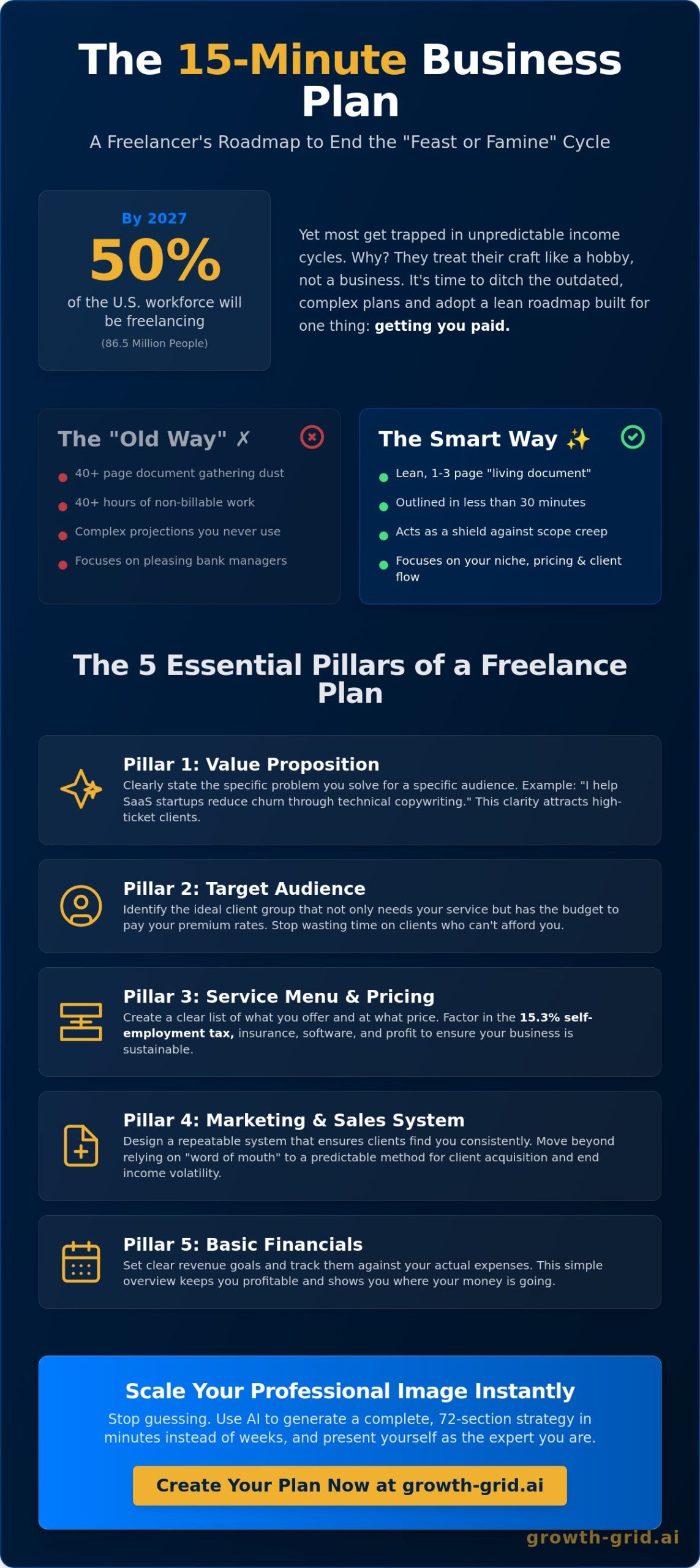
Did you know that by 2027, more than 50% of the U.S. workforce, or about 86.5 million people, will be freelancing? It’s a massive shift in the global economy, yet many independent workers find themselves trapped in “feast or famine” cycles because they treat their craft like a hobby rather than a company. You don’t need a 40-page corporate manifesto to fix this. In fact, a simple business plan for freelancers should take you less than 15 minutes to outline. ✨
We understand the frustration of wasting hours on non-billable tasks while your income remains unpredictable and stressful. This article promises to show you how to build a lean, high-impact roadmap that ditches the fluff and focuses on what actually gets you paid. We’ll preview how to define your niche, set a pricing strategy that accounts for 2026 tax realities, and create a predictable system for landing high-ticket clients without the constant hustle.
Key Takeaways
- Ditch the “Old Way” of 40-page plans for a flexible roadmap that prioritizes execution and billable hours over corporate fluff.
- Master the five essential pillars of a simple business plan for freelancers to attract high-ticket clients who actually have the budget for premium rates.
- Execute a 30-minute strategy sprint to audit competitor pricing and ensure your income covers overhead, insurance, and taxes.
- Bridge the “Marketing Gap” by establishing a predictable system for client acquisition and ending the stress of inconsistent income cycles.
- Scale your professional image instantly by using AI to generate a complete, 72-section strategy in minutes instead of weeks. ✨
What is a Simple Business Plan for Freelancers? (The Lean Definition)
A business plan doesn’t have to be a 40-page anchor that sits in your Google Drive gathering dust. In 2026, the simple business plan for freelancers is a lean, 1-3 page “living document” built for speed and execution. While traditional corporate templates focus on pleasing bank managers, your roadmap focuses on one thing: getting you paid. It’s the difference between guessing your way through the month and having a documented path to profit.
The “Old Way” of planning involves 40+ hours of research and complex financial projections that solo professionals never look at again. ✗ The “Smart Way” ✨ focuses strictly on your niche, your 2026 pricing, and your client flow. This lean approach acts as a professional shield against “scope creep.” When a client asks for extra work without extra pay, your plan reminds you of your service boundaries. It keeps you from becoming a jack of all trades who earns less than the $47.71 per hour national average.
Why Freelancers Skip Planning (and Why It Costs Them)
Most solopreneurs think they’re too busy to plan. They’re stuck in the “Feast or Famine” cycle, where they spend all month working but have zero leads for the next. With the global freelance market hitting $9.91 billion in 2026, you can’t afford to wing it. A simple business plan for freelancers differentiates your business from a basic to-do list. A to-do list tells you what to do today; a plan tells you why you’re doing it and how it will actually build your bank account.
The 3 Core Objectives of Your Freelance Roadmap
Your plan should focus on three high-impact goals to ensure you aren’t just working, but growing. First, you must define your “High-Value” niche. AI-related skills saw an 1,847% increase in demand between 2023 and 2026, so picking a specialized lane is essential to avoid being commoditized. Second, you need a pricing model that accounts for reality. Your rates must cover the 15.3% self-employment tax and your $16,100 standard deduction while still leaving room for profit.
Finally, your roadmap must create a repeatable client acquisition system. Stop relying on “word of mouth” or luck. You need a predictable method to find and sign high-ticket clients every week. When these three objectives are documented, you move from being a “gig worker” to a professional business owner with a clear strategy for success.
The 5 Essential Pillars of a Freelance Business Plan
To stop the “Feast or Famine” cycle, your simple business plan for freelancers must rest on five stable pillars. These aren’t just abstract ideas; they’re the engine of your professional life. The U.S. Small Business Administration often highlights lean startup business plans as a way to focus on high-impact activities. For a freelancer in 2026, that means ditching the corporate fluff and focusing on these five areas:
- The Value Proposition: The specific problem you solve for a specific person.
- Target Audience: The group that actually has the budget to pay your premium rates.
- Service Menu & Pricing: A clear list of what you offer so you stop trading time for pennies.
- Marketing & Sales: The repeatable system that ensures clients find you.
- Basic Financials: Your revenue goals versus actual expenses, including taxes and software.
Defining Your Niche and Value Proposition
Being a “Generalist” is a recipe for low rates and constant burnout. When you try to help everyone, you end up being a commodity. The Smart Way ✨ involves specializing. Use this formula to define your niche: “I help [Audience] achieve [Result] through [Service].” For example: “I help SaaS startups reduce churn through technical copywriting.” This clarity is the foundation of What is a Business Plan? A Step-by-Step Guide for Entrepreneurs who want to scale fast.
Pricing Strategies That Actually Work
Stop guessing what to charge. You must account for the “Freelancer Tax.” In 2026, the self-employment tax rate is 15.3%, and you’ll likely receive a Form 1099-K if you cross the $20,000 reporting threshold. Your rates must cover these costs plus your health insurance and retirement savings. Whether you choose hourly, value-based, or monthly retainer models, ensure your price reflects the profit you need to stay sustainable. For a deeper dive, check out our Cash Flow Analysis: A Simple Guide for Startups.
The Client Acquisition Machine
Don’t wait for work to fall into your lap. You need a machine. Pick exactly two consistent channels, such as LinkedIn and direct referrals, and master them. Set “Milestones” for your outreach. For instance, commit to five personalized pitches every Tuesday. This consistency ensures you aren’t scrambling for work when a project ends. If you’re struggling to map this out, you can generate a professional strategy ✨ in under 8 minutes to get back to billable work faster.
How to Write Your Freelance Plan in a 30-Minute Sprint
Forget the weeks of agonizing over market research. You can build a high-impact simple business plan for freelancers in the time it takes to drink a cup of coffee. Most experts complicate the importance of a business plan by focusing on 40-page documents. The Smart Way ✨ is a 30-minute sprint that prioritizes profit over paperwork. This is about creating a v1.0 that you can test in the real world immediately.
Step 1-2: Identifying Your Market Position
Spend your first ten minutes on a “Quick SWOT” to find your edge. Strengths and weaknesses are internal; opportunities and threats are external. For example, the 1,847% surge in demand for AI skills since 2023 is a massive opportunity if you can pivot your service. Identify three direct competitors and look for their gaps. Are they slow to respond? Do they lack transparent pricing? Use those weaknesses to define your primary target client profile in one sentence: “I serve [Specific Client] who is frustrated by [Competitor Weakness].”
Step 3-5: Financials and Finalization
Next, map your revenue by working backward from your target income. Don’t just pick a number out of thin air. Use this math: (Desired Annual Income + $16,100 Standard Deduction + 15.3% Self-Employment Tax + Software/Health Expenses) / 1,000 Billable Hours = Your Minimum Hourly Rate. If your result is lower than the U.S. average of $47.71 per hour, you need to adjust your niche or your efficiency. Even as a solo professional, using a startup business plan framework helps you treat your freelance work like a scalable company rather than a temporary gig.
Finally, synthesize everything into a one-page document. Cut the noise and keep only the execution steps. If you’re still feeling stuck on the phrasing, use the GPT-4 shortcut. AI can analyze your brain dump and organize it into a professional strategy in under 8 minutes. Don’t aim for a perfect document; aim for a roadmap that gets you to your first high-ticket invoice of the month. You can always iterate as your business grows toward the projected $20.12 billion global market peak in 2030.
Common Pitfalls: Why Most Freelance Plans Fail
Most freelancers fail before they even send their first invoice of the month. They fall into “The Old Way” of planning, creating a static document that quickly becomes irrelevant. A simple business plan for freelancers only works if it’s designed to survive the real world. If your plan is a 40-page manifesto, it will suffer from “Gathering Dust” syndrome. You’ll never look at it again, and your business will drift without a rudder.
Another major trap is the “Marketing Gap.” You might have world-class skills, but if your plan doesn’t include a system for getting leads, you’re invisible. In 2026, relying on luck isn’t a strategy. You also can’t afford to ignore the “Administrative Burden.” Freelancers often spend 40% of their work week on non-billable tasks like invoicing and chasing payments. If your roadmap doesn’t account for this time, you’ll consistently miss your revenue targets. Finally, underestimating the 15.3% self-employment tax or missing quarterly deadlines (like June 17 or September 16) can wipe out your profits instantly. 😰
The ‘Living Document’ Philosophy
Your business plan must be a breathing entity. Set a recurring 15-minute “Strategy Sync” on the first Monday of every month. This isn’t just about checking boxes. It’s about pivoting your niche when the market shifts. For example, with AI demand surging by 1,847% since 2023, a smart freelancer updates their service menu to catch the wave. Use data from your actual billable hours to refine your income projections. If you planned to earn $10,000 but only hit $6,000, your plan should tell you exactly where the leak is.
Addressing the ‘Administrative Burden’
Efficiency is the only way to protect your profit margins. To reduce that 40% admin time sink, you must automate. Your plan should list the specific tools you use to handle everything from lead gen to tax prep. Choosing the right stack is critical, so check out our Business Plan Software: The Ultimate Guide to Choosing the Right Tool. By treating your plan as a dynamic dashboard rather than a fixed document, you stay agile. If you want to skip the trial and error, you can generate a professional strategy ✨ that automates the complex parts of planning for you.
Scale Fast: Generate Your Freelance Plan with GrowthGrid ✨
You’re a freelancer; your time is your most valuable asset. Every hour you spend wrestling with a complex template is an hour you aren’t billing a client. GrowthGrid eliminates this friction. Our AI understands that a simple business plan for freelancers needs to be lean and results-oriented. It doesn’t just fill in blanks. It uses GPT-4 to analyze your specific niche and build a 72-section strategy that actually works. Why spend weeks stressing when you can have it done in minutes?
Our system accounts for the reality of solopreneurship in 2026. It factors in the 15.3% self-employment tax and the $20,000 Form 1099-K reporting threshold. This means your financial projections aren’t just guesses; they’re professional benchmarks. Beyond the plan, you can instantly generate the AI legal and HR documents required to protect your business as you scale toward that $20.12 billion global market peak projected for 2030. It’s a smart, modern solution to an old, frustrating problem.
The Smart Way vs. The Traditional Way
The difference between struggling and scaling often comes down to the tools you use. The Traditional Way involves 40+ hours of manual writing and generic templates that don’t fit a one-person business. ✗ The Smart Way ✨ involves using GrowthGrid to generate a professional 40+ page plan in 8-15 minutes. ✓ For just $19, you get a level of professional quality that helps you land higher-paying corporate clients who expect a documented strategy. You can dive deeper into this process in our AI Business Plan: The Ultimate Guide to Writing Your Plan in Minutes.
Ready to Stop Winging It?
Don’t let another month slip by in a “feast or famine” cycle. You deserve a predictable system for profit. Our AI Business Plan Generator takes the guesswork out of your strategy, allowing you to focus on your craft rather than administrative fluff. We’re so confident in the results that we offer a 100% Satisfaction Guarantee. You’ll love your plan or your money back. It’s time to build your roadmap to success with a partner that values your time as much as you do. Generate your professional freelance plan ✨ and start saving weeks of work today.
Take Control of Your Freelance Future Today
Transitioning from a generalist to a specialist is the fastest way to hit that $47.71 average hourly rate seen across the U.S. workforce. You’ve learned that a lean roadmap protects you from scope creep and ensures your 2026 tax obligations, including the 15.3% self-employment rate, are fully covered. A simple business plan for freelancers is the professional foundation that separates overwhelmed hobbyists from high-earning business owners. It’s about working smarter, not longer.
Don’t waste another 40 hours on manual drafting or complex templates that don’t fit your solo operation. Join the 10,000+ entrepreneurs who have already used GrowthGrid to automate their growth strategy. Our GPT-4 powered engine delivers 72 detailed sections of high-impact strategy instantly. We use bank-level encryption to keep your data safe while you focus on billable work. Generate your professional freelance plan in 8 minutes ✨
You have the skills to succeed in the $9.91 billion global freelance market. Now, you have the roadmap to get there. It’s time to stop winging it and start building the business you’ve always wanted with total confidence.
Frequently Asked Questions
Do I really need a business plan if I’m just a solo freelancer?
Yes, you need a plan to stop the “feast or famine” cycle that plagues nearly 45% of the U.S. workforce. Without a documented strategy, you risk wasting 40% of your week on non-billable admin tasks. A plan isn’t just for investors; it’s your personal roadmap to ensure you’re actually profitable after paying the 15.3% self-employment tax.
What is the simplest format for a freelance business plan?
The simple business plan for freelancers follows a lean, 1-3 page format focused on execution. You only need to document your high-value niche, your service menu with 2026 pricing, and two consistent marketing channels. This “Smart Way” ✨ approach prioritizes billable hours over 40-page corporate templates that usually gather dust.
How often should I update my freelance business plan?
You should conduct a 15-minute “Strategy Sync” every month to review your income goals and client flow. Major updates are necessary whenever market demand shifts, such as the 1,847% spike in AI-related service requests seen since 2023. Keeping your plan as a “living document” allows you to pivot before your income dips.
Can I use a business plan to get a bank loan as a freelancer?
Yes, a professional business plan is required for SBA 7(a) loans, which currently have variable rates between 9.75% and 13.25% as of May 2026. Lenders need to see a 40+ page professional document that verifies your revenue projections and market viability. Using AI to generate these sections ensures you meet bank-level standards without spending 40+ hours writing.
What are the most important financial metrics for freelancers to track?
Focus on your Effective Hourly Rate (EHR) and your tax liability. Your EHR should stay above the $47.71 national average to account for your $16,100 standard deduction and business overhead. You must also track your progress toward the $20,000 Form 1099-K reporting threshold to avoid surprises during the April 15 or June 17 tax deadlines.
How can AI help me write a business plan faster?
AI tools like GPT-4 can analyze your specific skills and generate a complete strategy in under 8 minutes. This “Smart Way” ✨ saves you roughly 90% on the traditional time cost of drafting. Instead of staring at a blank page, you start with a professional 72-section roadmap that’s ready for immediate action.
What should be included in a one-page business plan for freelancers?
A simple business plan for freelancers must include your value proposition formula, a specific target client profile, and a clear pricing menu. You also need to list your two primary acquisition channels, such as LinkedIn and referrals. This condensed version acts as a shield against scope creep and keeps your daily tasks aligned with your profit goals.
Is it worth paying for business plan software as a solo professional?
It’s worth it if the software saves you more than one hour of billable work. When you consider that U.S. freelancers earn an average of $47.71 per hour, spending $19 on a professional generator is a high-ROI move. It eliminates the stress of formatting and ensures your strategy looks professional when you’re pitching high-ticket corporate clients.