

Why are you spending 40+ hours writing a document that most lenders will skim in under 300 seconds? It’s a frustrating reality for entrepreneurs in 2026. You want to be serving street food, not drowning in spreadsheets 😰. You likely agree that the traditional process feels like a barrier rather than a bridge. Between complex financial projections and the fear of a messy plan being rejected by local permit offices, it’s easy to feel stuck before you even buy your first fryer.
This article changes that by showing you how to craft a professional, investor-ready business plan for a food truck in 8 minutes instead of three weeks. You will learn the exact 72 sections required to secure funding and how to automate the heavy lifting ✨. We are diving into the modern strategy for getting your truck on the road at 90% less cost than traditional methods. Here is your roadmap to a 40+ page plan that gets results fast.
Key Takeaways
- Understand why your document serves as a vital ‘passport’ for securing health permits and city zoning approval in 2026.
- Master the 7 essential sections of a professional business plan for a food truck, including hyper-specific unit economics that lenders demand.
- Stop wasting weeks on manual formatting and switch to a modern AI-powered method that builds your strategy in minutes ✓.
- Define your culinary concept and identify the essential tech stack components, from POS systems to GPS tracking, required for a fast launch.
- Generate a custom, investor-ready 40+ page document that captures your unique vision with total confidence ✨.
Why Your Food Truck Needs a Professional Plan in 2026
In 2026, your business plan for a food truck is far more than a simple document. It’s a strategic passport. Without it, you won’t get past the gatekeepers at the health department or the city zoning office. These agencies now require documented proof of how you’ll handle greywater disposal and power generation before they even look at your vehicle. According to this food truck industry overview, the sector has evolved from simple street carts into a complex ecosystem of mobile retail. If you don’t have your logistics on paper, you aren’t a business owner; you’re just a person with a very expensive hobby 😰.
A professional plan also stops “concept drift” in its tracks. It’s easy to start with a taco truck idea and end up buying a $150,000 pizza oven because it looked good on a resale site. Putting your vision into a structured format forces you to commit to a niche. This clarity saves you from spending 30% more on equipment you don’t actually need. Plus, it sets the stage for scaling. Whether you want a fleet of five trucks by 2028 or a brick-and-mortar location in a busy downtown hub, your plan is the roadmap that keeps you on course.
The Role of the Plan in Securing Funding
Banks and private investors have different appetites, but they share one trait: they hate risk. In 2026, lenders require hyper-specific data. They want to see your unit economics, including the exact break-even point for every dish on your menu. If you present “rough estimates,” expect an immediate rejection. Your Executive Summary must act as a high-speed pitch. It is often the only page an investor reads before deciding to bin your proposal or write a check. Don’t leave it to chance when you can generate a professional 40+ page plan ✨ in minutes.
Navigating 2026 Regulatory Requirements
City councils are tightening the screws on mobile vendors. Modern codes often demand 100% compostable packaging and silent, electric-only power systems during peak hours. Your plan must explicitly address these sustainability standards to avoid permit delays. Using an automated system to build these 72 sections ensures you don’t miss a single local ordinance. An Operational Plan is the blueprint for daily truck logistics. It details everything from your morning prep routine to your midnight cleaning schedule, proving to regulators that you are a safe, professional operator.
The 7 Essential Sections of a Food Truck Business Plan
Creating a business plan for a food truck requires more than just a list of recipes. It’s a 72-section architectural document that proves your concept can survive the volatile hospitality market. To win over lenders in 2026, your plan must be structured with precision and clarity. Most entrepreneurs fail because they focus only on the food; you need to focus on the business engine behind the window ✨.
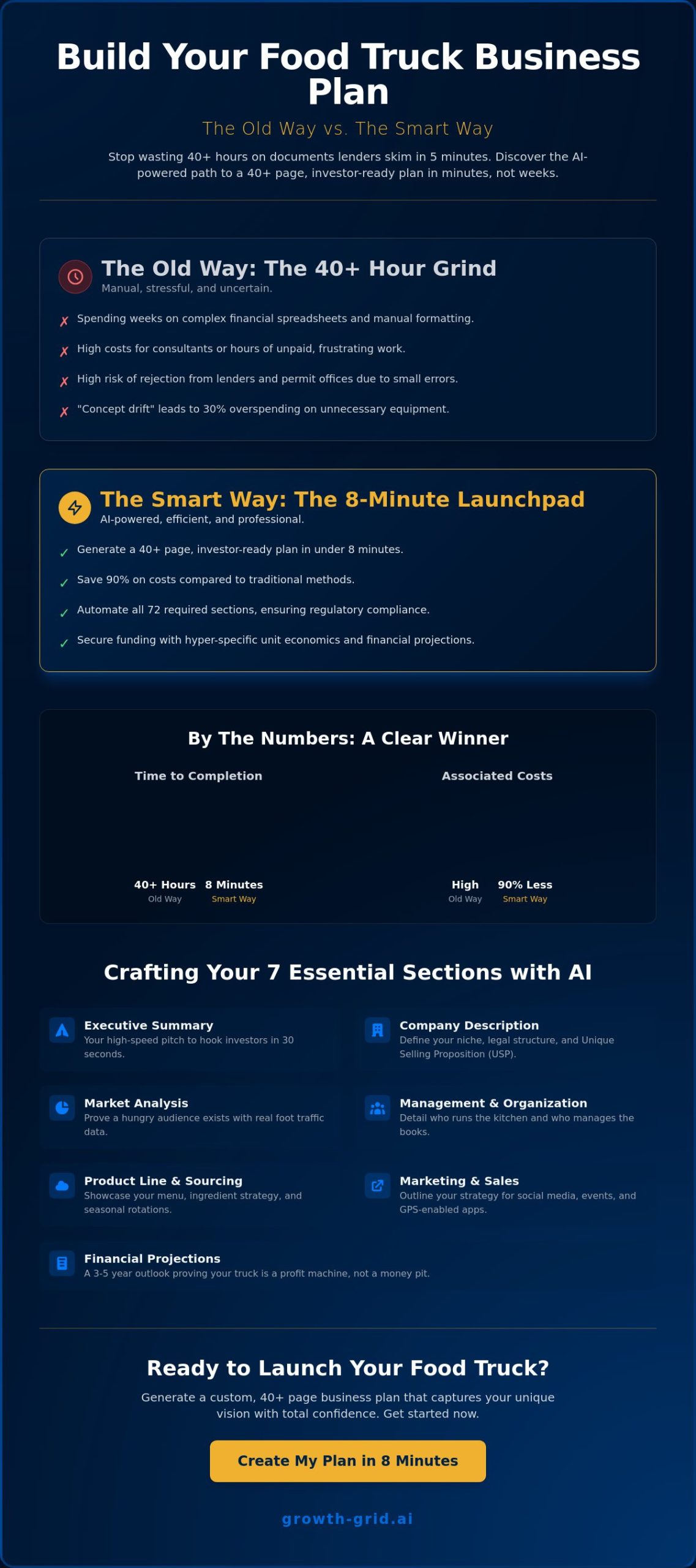
- Executive Summary: This is your high-level pitch. It should summarize your culinary vision and financial goals in under two pages.
- Company Description: Define your niche and legal structure. Are you an LLC or an S-Corp? What is your Unique Selling Proposition (USP)?
- Market Analysis: Prove there is a hungry audience for your specific menu.
- Management & Organization: Detail who is running the kitchen and who is managing the books.
- Product Line: Showcase your menu, sourcing strategy, and how you’ll handle seasonal ingredient rotations.
- Marketing & Sales: Explain how you’ll use social media, GPS-enabled apps, and local events to build a loyal following.
- Financial Projections: Provide a 3-5 year outlook that proves your truck is a profit machine, not a money pit.
Your Executive Summary is your first impression. If it doesn’t hook a reader within 30 seconds, the rest of the document won’t matter. You can generate a professional summary instantly using AI tools designed for speed and accuracy.
Mastering the Market Analysis
Success in this industry depends on where you park. You must identify your “Primary Parking Zones” based on real foot traffic data and local ordinances. Avoid “food truck saturation” by researching how many competitors are within a 5-block radius of your intended spots. This food truck business planning workbook from Michigan State University is a great resource for refining your concept. When you’re ready to document these findings, a robust market analysis will show investors you’ve done the homework.
The Financial Projections Deep Dive
Lenders want facts. You must calculate your Cost of Goods Sold (COGS) for every item on the menu, typically aiming for 28% to 35% of the retail price. Project your revenue by multiplying your “average transaction value” by your “hourly throughput” (how many customers you can serve per hour). Don’t forget to include a cash flow analysis. This is vital for surviving the off-season when foot traffic drops by 40% or more. Having these numbers ready proves you’re a savvy operator.
The Smart Way vs. The Old Way: Why AI Wins
Most entrepreneurs think writing a business plan for a food truck has to be a month-long ordeal. They picture themselves hunched over a laptop at 2 AM, wrestling with complex financial formulas and staring at a blinking cursor. This is “The Old Way,” and it’s a recipe for burnout before you even serve your first customer. In 2026, speed to market is your greatest competitive advantage. Why spend weeks stressing when you can have it done in minutes? 😰
Let’s look at the numbers. The traditional method typically consumes 40+ hours of your life. If you hire a professional consultant to do it for you, expect to pay upwards of $2,500 for a single document. Even then, you might wait three weeks for a draft. The Smart Way leverages AI to flip the script. You can now generate a professional, investor-ready plan in under 15 minutes. It’s about working smarter, not harder ✨.
- The Old Way: 40+ hours of manual research and formatting ✗
- The Old Way: $2,500+ for consultants or messy DIY spreadsheets ✗
- The Smart Way: AI-powered generation in less than 15 minutes ✓
- The Smart Way: Accurate, bank-ready financials for just $19 ✓
Human error is the silent killer of loan applications. A single typo in your projected labor costs can derail your entire financial outlook. AI models like GPT-4 eliminate these math errors by processing data with surgical precision. This ensures your break-even analysis is grounded in reality, giving you the confidence to pitch to any lender.
Eliminating ‘Writer’s Block’ with AI
Staring at a blank page is the hardest part of the process. Modern business plan software has evolved into an intelligent generation partner. You provide a few basic answers about your menu and location, and the AI transforms them into 72 professional sections. It maintains your unique brand voice while ensuring the terminology meets industry standards. This ensures your business plan for a food truck sounds like it was written by a seasoned pro, not a machine.
Instant Formatting and Professionalism
Investors and lenders in 2026 prefer standardized, clean layouts. They don’t want creative DIY designs that make the data hard to find. They want a document that looks like it came from a top-tier firm. AI ensures every section, from your SWOT analysis to your SG&A expenses, is covered and formatted perfectly. Your plan is ready to download in PDF or DOC format instantly, allowing you to hit send on that permit application today.
Step-by-Step: Building Your Food Truck Strategy
Your concept is the soul of your business. In 2026, the most profitable trucks avoid being generalists. Focus on a micro-niche like “Vegan Korean Fusion” or “High-Protein Breakfast Bowls.” Once you’ve nailed the menu, your tech stack becomes the backbone of your business plan for a food truck. You need a POS system that handles offline payments, GPS tracking so fans can find you, and pre-order apps to reduce window wait times by 30%. This digital infrastructure isn’t optional; it’s how you capture the 68% of Gen Z diners who prefer ordering via mobile ✨.
Route strategy isn’t just about where you park. It’s about timing. Map your day into three distinct blocks: morning commutes near transit hubs, lunch at suburban business parks, and evening festivals. Pair this with a hybrid supply chain. Source 20% of your high-impact ingredients from local farmers to boost your “farm-to-truck” marketing, while using bulk wholesalers for staples to keep your margins healthy. This balance ensures your COGS stays below the 32% danger zone.
Staffing in a 150-square-foot kitchen is a delicate dance. You can’t afford specialists. Every team member must be cross-trained to handle the grill, the window, and the POS system. Plan your labor costs to fluctuate between 25% and 30% of gross sales. Use your strategy document to outline exactly how you’ll scale from a two-person crew to a four-person rotation during peak summer months when demand spikes 😰.
Developing a 2026 Marketing Strategy
Marketing in 2026 is about “Live” engagement. Use TikTok and Instagram Live to show your morning prep or the line at your current stop. This creates immediate “FOMO” and drives foot traffic. Integrate digital push notifications through your loyalty program to alert customers when you’re within a 2-mile radius. On slow Tuesday afternoons, toggle on third-party delivery apps like UberEats to capture the 15% of revenue that now comes from “couch-to-truck” orders.
Operational Logistics: Beyond the Kitchen
Logistics extend far beyond the truck’s four walls. Most states require a licensed commissary kitchen for prep and waste disposal. Your plan must account for these monthly fees and the health code compliance that comes with them. Model your fuel and generator costs based on 10 hours of daily operation to avoid mid-month cash crunches. As you look toward “Year Two,” use your strategy to define your path to a second vehicle or a permanent pop-up. Generate your strategy document now and stop guessing about your operational future.
Generate Your Food Truck Plan ✨ with GrowthGrid
Stop stressing over a 40+ page document. You have a menu to perfect and a truck to outfit. Let AI do the heavy lifting for you. In 2026, the traditional method of writing a business plan for a food truck is obsolete. It’s too slow and too expensive. GrowthGrid offers a modern solution that delivers professional quality in the time it takes to prep a lunch order. Why spend weeks staring at a blank screen when you can have a finished strategy in minutes? 😰
We’ve designed our platform to ask the right questions. We don’t just give you a blank template; we guide you through the 72 sections required by lenders and local permit offices. This includes the complex financial projections and cash flow analyses we discussed in previous sections. From your unit economics to your “Year Two” scaling strategy, every detail is handled with surgical precision. You get an investor-ready document that looks like it was written by a $2,500 consultant, but without the three-week wait. It is the most efficient way to turn your food truck dream into a legal, funded reality.
How GrowthGrid Works
Our interface is intuitive and built for speed. You don’t need an MBA to get started. Just follow these three simple steps to build your business plan for a food truck:
- Input your concept, location, and financial goals into our guided interface.
- Watch as our GPT-4 powered models generate a comprehensive ai business plan.
- Download your document in PDF or DOC format and head to your bank meeting with total confidence ✨.
The GrowthGrid Advantage
Security is our top priority. We understand that your business ideas are your most valuable assets. That’s why we use bank-level encryption to protect your data. Your strategy remains your trade secret. We also remove all the risk from your decision with our 100% Satisfaction Guarantee. You’ll love your plan or your money back. It is that simple. This is about empowering you to take the leap without the fear of a “messy” plan holding you back from your permits ✓.
You aren’t alone in this process. While the AI handles the technical writing, our team provides real support when you need it. We know the startup hustle is real. Our goal is to help you get your truck on the road as fast as possible. Stop wasting 40+ hours on “The Old Way.” Choose the Smart Way and launch your culinary dream today. Save weeks of work and start serving your first customers in record time.
Launch Your Culinary Vision Without the Paperwork Stress
The “Old Way” of spending 40+ hours on a document is officially over. In 2026, your success depends on how fast you can secure your permits and start serving customers. You now know that a professional business plan for a food truck requires 72 specific sections to satisfy modern lenders and city regulators. You also understand how AI eliminates the risk of math errors and writer’s block. It’s time to stop stressing and start cooking 😰.
Don’t let a messy spreadsheet stand between you and your first festival. Join the 50,000+ entrepreneurs who have already ditched the traditional struggle for a smarter solution. You can save 90% on costs while receiving a comprehensive, bank-ready document that captures your unique brand voice ✨. Every minute you spend writing is a minute you aren’t at the window.
Generate ✨ Your Food Truck Business Plan in 8 Minutes
The streets are waiting for your menu. You have the passion and the recipes; now you have the tool to make it official. Take the final step toward your grand opening today. You’ll love your plan or your money back.
Frequently Asked Questions
How much does a professional food truck business plan cost?
A traditional professional plan typically costs between $2,500 and $5,000 when you hire a human consultant. These projects often take three weeks or more to complete. In 2026, the smart choice is using AI tools to generate the same professional quality for under $20. This allows you to reallocate your limited startup capital toward high-end kitchen equipment or initial inventory.
Do I really need a business plan for a small food truck?
Yes, you absolutely need one to operate legally. Local health departments and city zoning boards require a formal document to approve your permits. Even if you aren’t seeking a bank loan, a business plan for a food truck acts as your operational roadmap. It prevents expensive mistakes like overspending on a vehicle that doesn’t fit your specific culinary niche.
What is the most important section of a food truck business plan?
The Executive Summary is the most critical section for making a strong first impression. It is the high-speed pitch that determines if a lender reads the rest of your 40+ page document. However; your Financial Projections are the engine of the plan. They prove your unit economics and break-even points are realistic, which is the only way to secure funding in 2026.
Can I use AI to write my entire business plan?
You can use AI to generate 90% of your plan instantly. Modern platforms use GPT-4 models to transform your basic concept into a 72-section, bank-ready document in under 15 minutes. While the technology handles the heavy lifting and professional formatting, you should still review the final PDF to ensure it perfectly reflects your specific seasonal menu and brand voice before submission.
What are the common mistakes in food truck business plans?
The most common mistake is providing rough estimates instead of hard data. Lenders in 2026 will reject plans that don’t include a detailed cash flow analysis for the off-season. Other frequent errors include ignoring local parking ordinances and failing to cross-train staff. A messy plan without clear unit economics is the fastest way to get your permit application denied by city officials.
How long should a food truck business plan be?
A professional, investor-ready plan should be approximately 30 to 50 pages long. This length allows you to cover essential areas like market analysis, marketing strategy, and five-year financial outlooks. While it sounds daunting to write manually, AI tools can build this entire 72-section structure in minutes. This ensures you meet the professional standards expected by modern banks and private investors.
How do I calculate startup costs for a food truck?
Start by totaling your fixed costs, such as the vehicle and kitchen build-out, then add your variable operating expenses. You must include permit fees, insurance, and at least six months of working capital. Most successful launches in 2026 factor in a 15% buffer for unexpected maintenance. Use your business plan for a food truck to model these costs against your projected hourly throughput.
Is a food truck more profitable than a traditional restaurant?
Food trucks often see higher profit margins because they avoid the massive overhead of a brick-and-mortar lease. While a traditional restaurant might have profit margins of 3% to 6%, a well-run mobile unit can achieve 10% to 15%. However, your total volume is limited by your kitchen size. Your profitability depends on how well you manage your route strategy and minimize idle time between festivals.