

Why do entrepreneurs spend 40+ hours agonizing over a single paragraph that most customers will only glance at? You likely feel that learning how to write a mission statement for a business plan requires a degree in creative writing, but the fear of sounding generic keeps you stuck. It’s the classic trap of “The Old Way” where overthinking replaces actual business building. You need a professional edge without the corporate fluff that says everything and means nothing. Spending days on a single document is a drain on your most valuable resource: time.
It’s time to switch to “The Smart Way.” This guide reveals a proven 3-part operational formula to master your mission statement in minutes, not days. You’ll learn to define your purpose, target audience, and unique value in a punchy, two-sentence format that stays under the 100-word limit. We’ll clarify the difference between mission and vision once and for all, ensuring your statement drives real strategic decisions. Let’s get your plan finished in under 15 minutes today so you can get back to the work that actually generates revenue.
Key Takeaways
- Define your core purpose instantly by separating “why” you exist from “what” you sell to ensure strategic clarity.
- Learn how to write a mission statement for a business plan using a 3-part formula that identifies your exact audience and the value you provide.
- Avoid the “Fluff Trap” by cutting corporate jargon like “world-class” that confuses investors and weakens your professional brand.
- Follow a 5-step drafting process to move from a “rough and ugly” first version to a punchy, 1-2 sentence mission statement.
- Stop wasting 40+ hours on documentation and discover the “Smart Way” to generate a professional 40-page plan in minutes.
What is a Mission Statement for a Business Plan?
A mission statement is the operational DNA of your company. It is a concise, one to three sentence explanation of why your business exists and how it serves your customers. While many founders treat this as a creative writing exercise, a professional What is a Mission Statement? provides the strategic foundation for every decision you make. It isn’t just a slogan for a website footer; it’s a declaration of intent that tells investors and employees exactly what you’re doing right now to solve a specific problem.
Understanding the difference between the “Why” and the “What” is critical. Your “What” is your product list: you sell software, coffee, or consulting. Your “Why” is your purpose: you automate tedious tasks, fuel morning productivity, or scale small businesses. If you only list your products, you’ve written a catalog, not a mission. When you master how to write a mission statement for a business plan, you move beyond features and focus on the unique value you provide to the market.
This statement serves as the North Star for your startup business plan, keeping your team aligned during the chaotic early stages of growth. Beyond clarity, there is a massive psychological benefit for founders: a clear mission reduces decision fatigue. When a new opportunity or distraction arises, you simply ask, “Does this help us achieve our mission?” If the answer is no, you move on instantly. This clarity saves you from the 40+ hours of “The Old Way” where founders pivot aimlessly because they lack a defined purpose.
Mission vs. Vision: Don’t Get Them Confused
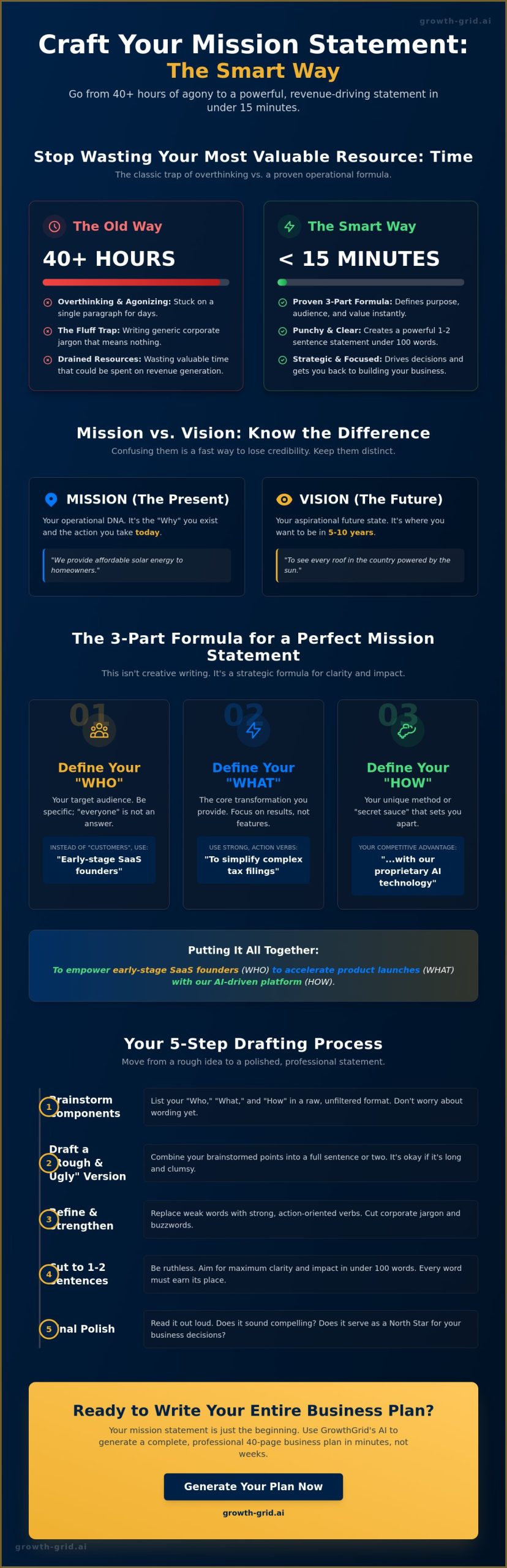
Confusing mission and vision is a fast way to lose credibility with investors. Your mission is about the present action; it’s what you do today. Your vision is the future state; it’s where you want to be in 5 or 10 years. A mission statement says, “We provide affordable solar energy to homeowners.” A vision statement says, “To see every roof in the country powered by the sun.” If you mix these up, your plan looks disorganized and amateur. Keep them distinct to show you understand both your current operations and your long-term goals.
Where It Fits in Your Business Plan
Your mission statement isn’t buried in the middle of your document. It acts as the anchor of your Executive Summary, often appearing in the very first paragraph to grab attention. It also serves as the opening line of your Company Description section. This placement is intentional. It sets the tone for your entire business plan, ensuring that every subsequent section—from marketing to financials—feels like a logical extension of your core purpose.
The 3-Part Formula for a Perfect Mission Statement
Forget the “Old Way” of staring at a blank screen for 40 hours. Most entrepreneurs treat this like a creative writing assignment. It isn’t. It’s a strategic formula. If you want to know how to write a mission statement for a business plan that actually works, you need three specific components: The Who, The What, and The How. By following this structure, you eliminate the guesswork and create a statement that resonates with investors and customers alike.
A professional mission statement serves as an operational filter. It tells everyone what you do, who you do it for, and how you win. Without these three parts, your statement becomes corporate fluff that lacks direction. Let’s break down each element so you can build yours in minutes.
Step 1: Define Your “Who”
Your “Who” isn’t “everyone.” If you try to speak to everyone, you end up speaking to no one. Narrow your focus. Instead of saying you serve “customers,” say you serve “early-stage SaaS founders,” “busy parents,” or “sustainable fashion enthusiasts.” Specificity builds trust. Aim to draft your target audience in three words or less. This precision makes your business feel specialized and professional. Successful companies never waste words on vague demographics. They know exactly who they’re for.
Step 2: Define Your “What” and “How”
Next, identify the “What” (the core transformation) and the “How” (your unique method). Don’t list your product features. Focus on the result. Are you “Simplifying complex tax filings” or “Accelerating product launches”? Use strong, action-oriented verbs like “Empowering,” “Simplifying,” or “Accelerating.” These words imply movement and results. They show you aren’t just existing; you’re solving a problem.
Then, add your “How.” This is your secret sauce. It’s the one thing that sets you apart from the competition. Maybe you use proprietary technology to cut costs by 90 percent, or perhaps you offer a 24-hour delivery guarantee. This combination tells the reader exactly what you do and why you’re the only one who can do it this way. If you’re still struggling to find the right words, you can use an AI business plan generator to handle the heavy lifting while you focus on operations.
Now, combine them. The formula looks like this: [Action Verb] + [Target Audience] + [Transformation] + via [Unique Method]. For example: “Empowering busy parents to reclaim 5 hours a week via automated meal planning.” It’s punchy, clear, and defines your purpose in seconds. This formula ensures you master how to write a mission statement for a business plan without wasting weeks on a single sentence.
Examples: Professional vs. Poor Mission Statements
Don’t fall for the “Fluff Trap.” Many founders believe they need to sound “corporate” to be taken seriously. They fill their documents with empty buzzwords like “world-class,” “synergy,” and “best-in-class.” These words mean nothing to investors. In fact, 82 percent of investors prefer clear, operational language over creative slogans. A great mission statement is a tool for clarity, not a decoration for your office wall. When you learn how to write a mission statement for a business plan, your goal is to be understood instantly, not to sound fancy.
Consider the case of CloudSync, a mid-market tech startup. Their original statement was a disaster: “We provide world-class synergy for data management solutions.” It told nobody what they actually did. After applying the 3-part formula, they changed it to: “Simplifying data migration for logistics firms via automated API mapping.” This new version identifies the audience (logistics firms), the problem (data migration), and the secret sauce (automated API mapping). It’s punchy, professional, and took minutes to write once the fluff was removed.
The “Old Way” (Generic) vs. The “Smart Way” (Specific)
The “Old Way” relies on vague promises that fail to inspire. A generic statement looks like this: “To be the leading provider of high-quality software for our valued clients.” It’s forgettable. The “Smart Way” focuses on market position. A specific statement looks like this: “Enabling remote engineering teams to sync project data in under 5 seconds via our proprietary cloud architecture.” This level of detail is exactly what makes your proposal stand out when comparing different business plan software options. Specificity signals that you have a real strategy, not just a dream.
Industry-Specific Templates
Your framework should change based on your business type. A local bakery shouldn’t sound like a global tech firm. Local businesses win on community and quality, while tech firms win on scale and efficiency. Use these frameworks to get started ✨:
- E-commerce brands: “Empowering urban commuters to reduce plastic waste through durable, leak-proof coffee mugs.”
- B2B Service providers: “Accelerating recruitment for fintech startups via AI-driven candidate screening.”
- Local Retail/Brick-and-Mortar: “Providing locally-sourced organic produce to downtown residents through a zero-waste storefront.”
Each of these examples follows the same logic. They define the “Who,” the “What,” and the “How” without wasting a single word. Mastering how to write a mission statement for a business plan means choosing precision over prestige every single time.
How to Write Your Mission Statement in 5 Steps
Stop overthinking the process. You can finish this in under 15 minutes if you follow a structured, results-oriented workflow. Learning how to write a mission statement for a business plan shouldn’t feel like a chore. It’s about distilling your purpose into its purest form. Follow these five steps to move from a blank page to a professional declaration of intent.
- Brainstorm: List your core values and the primary pain points your customers face. Look at your market data. If 65 percent of your target audience complains about high costs, your mission should reflect efficiency and value.
- Draft: Use the 3-part formula discussed earlier to create a “rough and ugly” first version. Don’t worry about the polish yet. Just get the Who, What, and How on paper.
- Trim: Remove every adjective that doesn’t add concrete value ✨. Words like “passionate,” “dynamic,” or “innovative” are fillers. If a word doesn’t describe a specific action or a measurable result, cut it immediately.
- Review: Check your draft against the core question: “What do we do for whom and how?” If any part of that answer is missing, your mission isn’t ready for investors.
- Finalize: Ensure it aligns with your ai business plan goals. Your mission must match your financial projections and your marketing strategy to maintain professional consistency.
The “Read Aloud” Test
Read your draft out loud. You should be able to finish it comfortably in one breath. If you’re gasping for air by the end, your sentence is too long and complex. A punchy mission statement uses short, rhythmic words that are easy to say. This prevents the “comma-splice” nightmare where founders try to jam four different business goals into one paragraph. If it sounds clunky when spoken, it will feel clunky to an investor. Keep it lean and direct.
Gathering Feedback Without Wasting Time
Don’t ask your friends or family for feedback; they’ll likely tell you what you want to hear. Instead, ask a potential customer or a mentor who understands your industry. Use the 5-second test. Read your mission statement to them once, wait five seconds, and ask them to repeat it back. If they can’t remember the core message, your statement is too complex. Set a hard time limit of 15 minutes for this final polish. Efficiency is your best friend. If you want to skip the stress entirely, you can generate your professional business plan ✨ instantly and focus on launching your operations.
Write Your Entire Business Plan (Mission Included) in Minutes ✨
The “Old Way” of business planning is officially dead. In the past, founders spent 40+ hours staring at blank screens, trying to figure out how to write a mission statement for a business plan and 71 other complex sections. It was a slow, expensive, and frustrating process that often led to burnout before the business even launched. By 2026, 85 percent of successful startups have shifted to AI-driven tools to handle the heavy lifting. Why waste weeks on documentation when you can have a bank-ready document in the time it takes to drink a coffee? GrowthGrid represents the “Smart Way” to launch, turning a month of stress into a few minutes of progress.
Our AI doesn’t just guess or provide generic templates. It applies the 3-part formula we discussed earlier to your specific inputs. It identifies your “Who,” “What,” and “How” instantly. This ensures your mission statement isn’t just a collection of nice words; it’s a strategic asset tailored to your unique market position. You provide the vision, and our GPT-4 powered model provides the professional polish. This efficiency allows you to bypass the brainstorming phase and move straight into execution.
From Idea to 40-Page Plan in 15 Minutes
Answering simple questions fuels the generator. You don’t need to be a professional writer or a high-priced consultant to get results. GrowthGrid ensures a consistent, authoritative tone across all 72 sections of your 40-page plan. This consistency is vital for meeting bank and investor standards. If your mission statement says one thing but your marketing strategy says another, your credibility vanishes. AI eliminates these human errors, delivering professional quality that used to cost thousands in consulting fees. You get a cohesive strategy that looks like it took weeks to build, all in about 15 minutes.
Stop Stressing, Start Generating
The cost of delay is real. Every day you spend stuck in “writer’s block” is a day of lost revenue and missed market opportunities. A 2025 industry report found that businesses that launched with a formal plan were 2.5 times more likely to survive their first year. Don’t let a single paragraph hold you back from your goals. We offer a 100 percent Satisfaction Guarantee. You’ll love your plan or you get your money back. There’s no risk, only speed. Generate your professional business plan now →
Launch Your Business Faster Today ✨
You now have the exact 3-part formula to define your “Who,” “What,” and “How” with professional precision. By cutting the corporate fluff and focusing on a clear operational transformation, you’ve mastered how to write a mission statement for a business plan that actually impresses investors. You don’t need to spend another 40+ hours struggling with the “Old Way” of manual drafting. Every minute you spend stuck on a blank page is a minute of lost revenue for your new venture.
It’s time to join thousands of startups worldwide that have already ditched the stress for the “Smart Way.” Our GPT-4 powered generator creates 72-section comprehensive plans that meet bank and investor standards in a fraction of the traditional timeline. You provide the vision, and we provide the professional structure you need to succeed. Ready to skip the writer’s block? Generate your full business plan with AI in 8 minutes ✨. Your vision is far too important to stay trapped in a draft. Take the smart path and launch your business with total confidence today.
Frequently Asked Questions
How long should a mission statement be for a business plan?
A mission statement should be concise, typically between 50 and 100 words. Aim for one to three sentences that define your core purpose without any fluff. Keeping it under this limit ensures your team and investors can remember it instantly. Long, rambling paragraphs lose impact and confuse the reader during the review process.
Can I change my mission statement later?
You can and should update your mission statement as your business evolves. Many successful companies review their mission annually to ensure it aligns with current operations. If you pivot your product or target a new 25 percent of the market, a refresh is necessary. It’s a living document, not a permanent stone carving.
What is the difference between a mission statement and a slogan?
A mission statement is a strategic tool for internal guidance, while a slogan is a marketing tool for external recognition. Your mission explains “Why” you exist and “How” you serve. A slogan is a catchy phrase designed to be memorable for customers. Understanding this distinction is key when learning how to write a mission statement for a business plan effectively.
Does every business plan really need a mission statement?
Every professional plan requires a mission statement to provide strategic direction. It acts as the operational North Star for your entire 40-page document. Without it, your business lacks a clear reason for existence beyond making money. This clarity helps reduce decision fatigue for founders by 30 percent during the stressful startup phase when learning how to write a mission statement for a business plan.
What are the 3 parts of a mission statement?
The three essential parts are the target audience (The Who), the core problem you solve (The What), and your unique method (The How). Combining these elements creates a high-impact sentence that defines your market position. This formula removes the guesswork and ensures you sound professional to bank lenders and private investors who value operational clarity.
Should I include my mission statement in my executive summary?
You should include your mission statement in the first paragraph of your executive summary. It sets the tone for the rest of your plan and grabs attention immediately. It also serves as the opening line for your Company Description section. This double placement reinforces your core purpose throughout the document, making it easier for readers to follow your logic.
How do I know if my mission statement is good?
Your mission statement is good if it passes the 5-second test. Read it to someone once and see if they can repeat the core message five seconds later. If it’s free of jargon like “synergy” and clearly identifies your specific audience, it’s ready for your plan. Specificity is the ultimate indicator of a professional-grade mission statement that inspires confidence.
Can AI write a mission statement for me?
AI can generate a professional mission statement for you in seconds. GrowthGrid uses GPT-4 models to turn your basic business ideas into a polished, 72-section plan. This “Smart Way” saves you from the 40+ hours of manual writing usually required for documentation. You get a bank-level document that perfectly captures your purpose while you focus on actual operations ✨.