

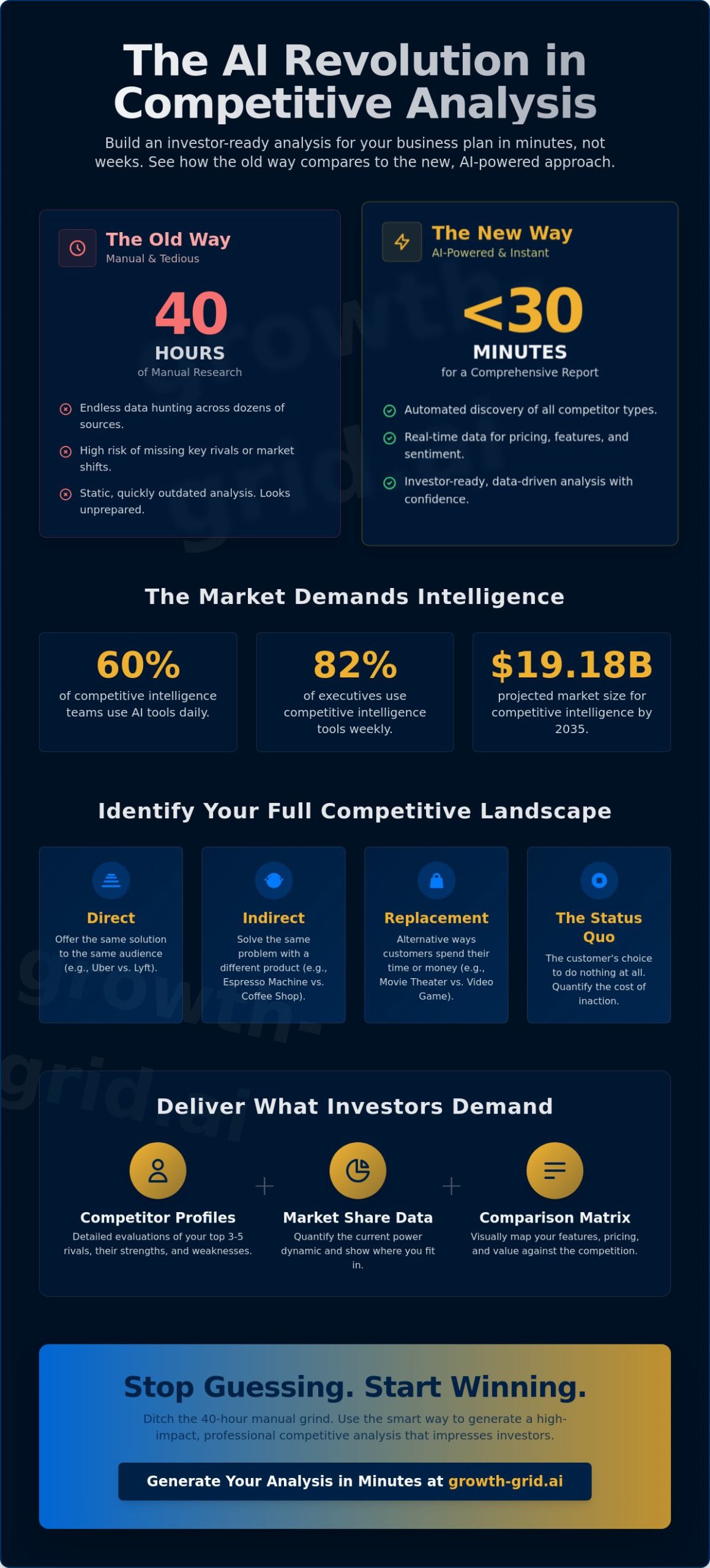
As of early 2026, 60% of competitive intelligence teams use AI tools daily to slash their research time from 40 hours to under 30 minutes. You likely feel the pressure to keep up, yet building the competitive analysis section of business plan often feels like a 😰 week-long trap of manual data hunting. It’s exhausting to worry about missing a key rival or looking unprepared, especially when 82% of executives now use competitive intelligence tools weekly to maintain their edge.
We know the “Old Way” is broken. You shouldn’t have to choose between a professional plan and your sanity. This guide promises to help you master the art of competitive intelligence so you can build a high-impact, investor-ready analysis in minutes, not weeks. You’ll get a clear look at how to handle the 20 different U.S. state-level privacy laws and use modern predictive analytics to define your unique value proposition with total confidence ✨. It’s time to stop guessing and start winning.
Key Takeaways
- Learn why the competitive analysis section of business plan is a strategic map, not just a list, to prove your market gap to investors.
- Identify both direct rivals and indirect threats to demonstrate a complete, professional understanding of your industry landscape.
- Build a visual comparison matrix using specific criteria like price and customer service to highlight your unique value proposition instantly.
- Follow a simple 5-step process to profile your top competitors and define your competitive edge with total confidence.
- Discover how to ditch the “Old Way” of manual research and use AI to generate a high-impact analysis in minutes ✨.
What is the Competitive Analysis Section of a Business Plan?
Think of the competitive analysis section of business plan as your market radar. It isn’t just a list of names you found on Google. It’s a strategic evaluation of your rivals’ playbooks. By conducting a formal competitor analysis, you show stakeholders that you’ve done the heavy lifting. You understand the market landscape better than anyone else. This section serves as the foundation for your pricing and marketing strategies. It proves that your business has a legitimate reason to exist in a crowded field.
Investors expect to see three main things here. First, detailed competitor profiles for your top three to five rivals. Second, market share data that quantifies the current power dynamic. Third, a comparison matrix that visually maps your features against the field. These elements turn abstract ideas into concrete data. They transform your plan from a hopeful idea into a calculated strategy. When 82% of executives report using competitive intelligence tools on a weekly basis, you can’t afford to treat this as an afterthought.
The Role of Competitive Intelligence in 2026
In 2026, static lists are dead. Competitive intelligence is now a dynamic, ongoing process. Investors don’t just want to see who your rivals are; they want to see your moat. This is your defensibility. They use this section to judge if you can survive a price war or a new feature launch from a tech giant. We’ve seen a massive shift from manual secret shopping to automated, AI-powered data scraping. This allows you to track competitor pricing and sentiment changes in real time. It’s the difference between guessing and knowing.
Investor-Ready vs. Internal Analysis
There’s a big difference between what you show a bank and what you keep in your internal files. An investor-ready competitive analysis section of business plan must be polished, objective, and data-driven. It focuses on market gaps and high-level trends to build confidence. Your internal analysis, however, should be brutally honest. It needs to dig into the dirty laundry of your rivals to find specific weaknesses you can exploit. Whether you’re writing for a VC pitch or a bank loan, maintain professional objectivity. Avoid bashing competitors. Instead, let the data prove why you’re the better choice.
Identifying Your Rivals: Direct vs. Indirect Competitors
You can’t win a game if you don’t know who’s on the field. Most founders make the mistake of only looking at the most obvious names. To build a truly professional competitive analysis section of business plan, you must look deeper. The global competitive intelligence market is projected to hit $19.18 billion by 2035, and 67% of Fortune 500 companies already have dedicated teams for this. You don’t need a massive team, but you do need to categorize your rivals correctly to show investors you’ve done your homework.
- Direct Competitors: These businesses offer the same solution to your target audience. A direct competitor is a company like Lyft competing with Uber, where both provide on-demand ride-sharing to the same urban commuter demographic.
- Indirect Competitors: These companies solve the same problem with a different product. If you sell high-end espresso machines, a local artisan coffee shop is an indirect rival.
- Replacement Competitors: This is about “share of wallet.” It’s any alternative way customers spend their money or time. For a movie theater, a replacement competitor isn’t just another theater; it’s a video game console or a night at a local restaurant.
Finding these rivals doesn’t have to take weeks of manual searching. You can use industry databases and Market research and competitive analysis techniques to uncover hidden players. If you want to move faster, you can generate a professional landscape instantly without the manual headache. It’s the difference between guessing and having a data-backed strategy ✨.
The “Invisible” Competitor: Status Quo
Your biggest rival isn’t always another company. It’s often the customer’s decision to do nothing at all. In many industries, the “status quo” accounts for a massive chunk of lost deals. To address this in your competitive analysis section of business plan, you must quantify the cost of inaction. Show investors that the pain of the current situation is higher than the cost of your solution. If a prospect loses $5,000 every month in efficiency, that’s your real competition.
Tools for Fast Competitor Discovery
Don’t waste 40 hours on manual Googling. Use LinkedIn and Crunchbase to find emerging startups that haven’t hit the mainstream yet. These platforms let you filter by industry and funding rounds to see who’s gaining steam. Modern AI tools can now map out a complete market landscape in under 5 minutes. This shift to predictive analytics helps 80% of intelligence teams forecast rival moves before they happen. It’s the smart way to stay ahead of the pack 😰.
Building Your Competitive Comparison Matrix
A comparison matrix is the visual heart of the competitive analysis section of business plan. It’s a clear, professional table that pits your features against your top 3 to 5 rivals. While 67% of Fortune 500 companies use complex, dedicated intelligence teams, you can win by focusing on the 5 to 7 criteria that actually drive customer decisions. These usually include price, quality, specific technical features, and customer service responsiveness. Don’t fall into the “sea of checkmarks” trap. Investors spot a biased matrix from a mile away. If you claim to be the best at everything, you lose credibility instantly ✨.
Instead, use the matrix to highlight your “Blue Ocean” opportunities. This means finding the strategic space where your competitors aren’t playing. According to the SBA’s guide to competitive analysis, identifying these market gaps is the key to proving your business is unique. You want to show that while others focus on high-volume, low-cost services, you are the premium, high-touch alternative. This turns a simple table into a powerful argument for your market entry.
Choosing Your Competitive Benchmarks
You must separate “table stakes” from “differentiators.” Table stakes are the basic features every customer expects, like bank-level encryption or a mobile app. Differentiators are the unique “hacks” that make your solution superior. To gather data on private competitors who don’t have public filings, look at their Glassdoor reviews or customer support forums. You’ll often find 84% of a company’s weaknesses hidden in their own users’ complaints. This gives you the “brutal honesty” needed for an investor-ready plan 😰.
Visualizing the Market Gap
A 2×2 grid, or Perceptual Map, is a high-impact way to show where you fit. One axis might represent price, while the other represents speed or innovation. When you plot your rivals, you’ll likely see a cluster in one corner, leaving a wide-open gap for you. This visual proof links directly to your startup business plan goals. It creates a narrative that your business is the logical next step for the market. Companies with formal programs like this report 22% higher win rates in competitive deals. Don’t just list facts; tell a story of market dominance ✨.
How to Write the Section in 5 Simple Steps
Drafting the competitive analysis section of business plan shouldn’t feel like a 40-hour grind. You need a clear, repeatable flow to move from raw data to a professional narrative. By following these five steps, you can transform your research into a strategic asset that wins over investors ✨.
- Step 1: Define the Landscape. Start with a broad industry overview. Mention the global market’s 12.90% CAGR to show you understand the growth trajectory and the stakes involved.
- Step 2: Profile Top Rivals. Choose your 3 to 5 most dangerous direct competitors. Detail their current market share and core customer demographics to show you’ve done the work.
- Step 3: Provide Visual Proof. Insert the comparison matrix or perceptual map we discussed earlier. Visuals break up the text and prove the market gap instantly for busy readers.
- Step 4: Conduct a Mini-SWOT. Compare your business directly against the field. Be honest about your weaknesses but highlight how your strengths mitigate them effectively.
- Step 5: Close with your Advantage. Summarize why you will win in one punchy paragraph. This is your “closer” for the section and should leave no doubt about your potential.
If you want to skip the manual drafting process, you can generate your competitive section in minutes. It’s the smart way to ensure your plan is investor-ready without the stress 😰.
Writing with “Objective Confidence”
Avoid the amateur mistake of bad-mouthing your rivals. Investors want to see professional objectivity, not emotional bias. Instead of saying a competitor’s product is “bad,” phrase it as an “opportunity for market improvement.” For example, you might write: “While Rival X maintains a strong 25% market share through legacy contracts, their slow adoption of mobile-first features creates a gap for our more agile solution.” This acknowledges their strength while pivoting to your advantage ✨.
Refining Your Value Proposition
Your analysis must remain consistent with your overall business plan. If your analysis shows customers are frustrated with high prices, your strategy section shouldn’t propose a premium pricing model. Use your findings to justify every financial decision you make. Pass the “So What?” test by ensuring every insight leads to a specific strategic action. If you find a competitor has a 5.2x ROI, explain exactly how you’ll beat that number. This level of detail proves you’re a pragmatic problem-solver ready to scale.
The Smart Way: Using AI to Automate Your Analysis
Traditional research methods are a relic of the past. The “Old Way” of building the competitive analysis section of business plan involves 40+ hours of manual Googling, tedious spreadsheet entry, and the constant fear of missing a critical rival. It’s a recipe for “plan paralysis” that keeps your business stuck on the starting line. As of early 2026, 60% of competitive intelligence teams have ditched the manual grind for AI tools, reducing report creation time from a full work week to under 30 minutes. You don’t need a massive research budget to get these results ✨.
The “Smart Way” leverages a professional AI business plan generator to do the heavy lifting for you. GrowthGrid uses advanced models to analyze live market data, generating comprehensive 72-section plans in as little as 8 minutes. This technology doesn’t just work faster; it works smarter by removing founder bias. We all want to believe our business is the best, but AI provides the objective, data-driven analysis that investors actually trust. It identifies market gaps based on facts rather than feelings 😰.
Why Speed is a Competitive Advantage
Speed is your secret weapon in 2026. Every hour you spend formatting a comparison matrix is an hour you aren’t spending on customer acquisition. By using modern business plan software, you eliminate the friction of document creation. This allows you to get to market faster and adapt your strategy in real time. When a competitor shifts their pricing or a new regulation like the California “Delete Act” takes effect on August 1, 2026, you can update your analysis instantly. Don’t let a static document hold your strategy hostage ✨.
Quality Control for AI-Generated Plans
AI provides the professional foundation, but your “human touch” provides the soul. Once your competitive analysis section of business plan is generated, spend 15 minutes refining the data. Verify specific rival names and add your personal industry insights that a machine might miss. This combination of AI efficiency and human expertise creates a document that is both technically superior and deeply authentic. Once you’re satisfied, you can finalize your plan for a professional PDF or DOC download, ready for any bank or VC pitch. You’ll love the results, or you get your money back ✨.
Dominate Your Market with a Data-Backed Strategy
Building a professional competitive analysis section of business plan is no longer a multi-week hurdle. You now have the tools to identify direct rivals, map out market gaps using a visual matrix, and prove your defensibility to any investor. By moving from historical reporting to predictive analytics, you join the 60% of teams already using AI to gain a 22% higher win rate in competitive deals. Don’t let “plan paralysis” slow your momentum when the market is moving this fast.
Stop stressing over manual research and spreadsheets. You can save 90% on business plan costs while generating a professional, 72-section plan powered by GPT-4 technology. Whether you’re pitching a bank or a VC, you need speed and accuracy to win. We take the risk out of the process with a 100% Satisfaction Guarantee. You’ll love your plan or your money back ✨.
Generate your investor-ready business plan in 8 minutes ✨
Your future business deserves a smart start. Take the lead today and show the world why your vision is the one that will scale. You’ve got this.
Frequently Asked Questions
How long should the competitive analysis section be?
Aim for 2 to 4 pages in a standard 40 page plan. This length allows you to profile 3 to 5 key rivals without overwhelming the reader. Investors want high level strategic insights rather than an encyclopedia. Keep it punchy and focus on the data that proves your market gap instantly ✨.
Where do I find information on private competitors?
Look at Glassdoor reviews and LinkedIn employee counts to estimate growth and internal stability. You can also monitor their customer support forums or social media mentions to find weaknesses. Since 84% of a company’s flaws are often hidden in user complaints, these public platforms are gold mines for finding honest data about private rivals.
Is a SWOT analysis the same as a competitive analysis?
No, a SWOT analysis is just one component used within the broader competitive analysis section of business plan. While a competitive analysis maps the entire market landscape, a SWOT focuses specifically on your internal strengths and weaknesses relative to those rivals. Think of the competitive analysis as the map and the SWOT as your specific route ✨.
Should I include indirect competitors in my business plan?
Yes, you should include 2 to 3 indirect competitors to show you understand the full share of wallet. If you ignore businesses that solve the same problem with different products, you look unprepared. High performing teams that track indirect threats see an 84% increase in sales effectiveness because they anticipate every possible customer alternative.
How often should I update the competitive analysis section?
Update this section every 90 days to keep your strategy relevant. The market moves fast; 80% of teams are shifting to predictive analytics to stay ahead of rival launches. Regular updates ensure you don’t get blindsided by a new startup or a sudden regulatory change like the 2026 state level privacy laws 😰.
What if I have no direct competitors?
You always have competition, even if it’s just the status quo. If no one else offers your exact solution, your rival is the customer’s decision to do nothing. Address the cost of inaction to prove your value. Investors get nervous if you claim zero rivals, as it often suggests a lack of market demand.
Can I use AI to write my competitive analysis section?
Yes, using an AI generator is the most efficient way to build your competitive analysis section of business plan. It can slash your research time from 40 hours to under 8 minutes. This technology removes founder bias and ensures your plan is objective and investor ready while saving you 90% on traditional costs ✨.
What is a perceptual map in a business plan?
A perceptual map is a 2×2 grid that visually plots your business against rivals based on two key metrics like price and innovation. It provides instant proof of the market gap you intend to fill. This visual tool is essential for bank level plans because it makes your unique value proposition scannable in seconds.