

In 2026, your business plan isn’t a reading assignment; it’s a 60-second stress test for your operational competence. If your document doesn’t meet a professional business plan ready for investors checklist, most lenders will assume your business lacks discipline. You already know that a single formatting error or misplaced financial jargon can get you rejected instantly. It’s a high-stakes hurdle that often feels like a massive, unnecessary time-sink.
Audit your document against 2026 standards and close the professionalism gap in minutes. You’ll walk into your pitch with the total confidence of a bank-grade document that passes due diligence. We’ll cover the essential 15 to 20 page structure investors now demand, the specific data points required for due diligence, and how to ensure your projections reflect current benchmarks like the 3.5% federal funds rate.
Key Takeaways
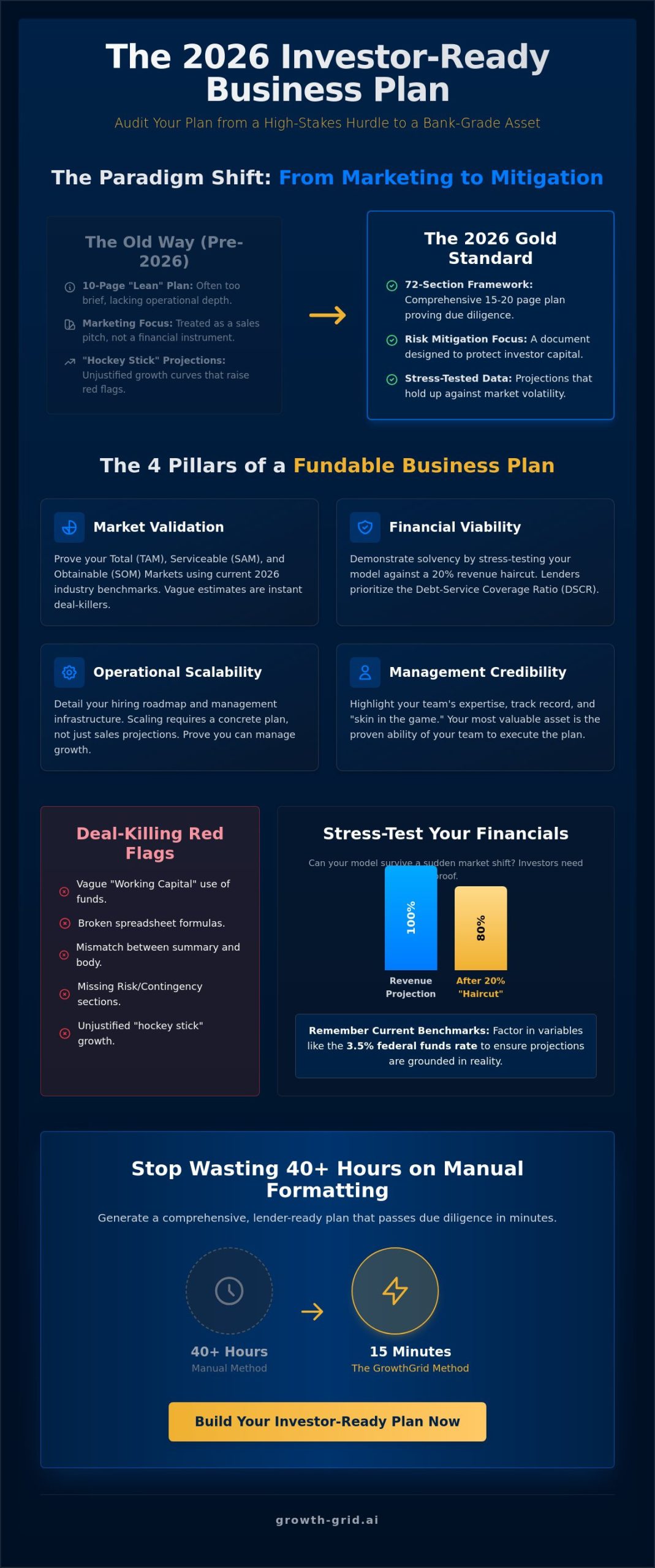
- Shift your mindset from marketing to risk mitigation to meet the structural maturity standards investors demand in 2026.
- Use a professional business plan ready for investors checklist to ensure every dollar of your “ask” is tied to a specific ROI.
- Prove your financial viability by stress-testing your projections against a 20% revenue haircut before your pitch.
- Eliminate deal-killing red flags like broken spreadsheet formulas and vague “working capital” categories that destroy due diligence.
- Stop wasting 40+ hours on manual document formatting and generate a comprehensive 72-section plan in just 15 minutes.
What Does ‘Investor-Ready’ Mean in 2026?
In 2026, investor readiness isn’t a buzzword; it’s a measurable standard of structural and financial maturity. Your plan isn’t a marketing brochure anymore. It’s a risk-mitigation document designed to prove you can protect and grow an investor’s capital. Professionalism is now judged by the depth of your research and the clarity of your data visualization. If your document lacks the required 70+ sections, you’re signaling that you haven’t done the heavy lifting required to manage a high-growth company.
Investors prioritize three key areas in 2026:
- Financial logic that holds up under significant stress tests.
- Operational roadmaps that account for sudden market shifts.
- Internal consistency where every milestone matches your capital allocation.
This internal consistency is where most founders stumble. If you say you’ll hire ten engineers in Q3, but your cash flow doesn’t show the payroll spike, you’ve failed the audit. Use a What is a Business Plan? guide to understand the foundational components, but realize that today’s lenders demand significantly more granular detail than the basics. A solid business plan ready for investors checklist must prioritize this logical alignment over simple marketing fluff.
The 3-Minute Executive Summary Test
Lenders and VCs decide whether to keep reading within the first two pages. This is the ultimate “go/no-go” filter. Your summary must clearly state the “Ask,” the specific use of funds, and the exit strategy. Don’t be vague. Instead of saying you need “growth capital,” specify that you’re seeking $500,000 for a 12-month R&D cycle. Write this section last. It must be a perfect mirror of your final data. Any mismatch between the summary and the body of the plan is a red flag that ends the meeting immediately.
Structural Integrity: Why 10 Pages Isn’t Enough
The “lean” movement led many founders to believe a 10-page plan was sufficient. In 2026, that’s no longer true for professional funding rounds. Modern startup business plans require comprehensive operational and HR roadmaps. Missing a “Risk Management” or “Contingency” section signals a lack of preparedness. Investors want to see how you’ll handle a 20% revenue haircut or a sudden shift in the 3.5% federal funds rate. A 72-section framework is the new gold standard. It proves you’ve audited every corner of your business model. Depth creates trust. Trust secures funding.
The 4 Pillars of a Fundable Business Plan
A high-quality business plan ready for investors checklist focuses on four non-negotiable pillars. These aren’t just sections in a document; they’re the load-bearing walls of your startup’s future. If one is weak, the entire structure collapses during due diligence. Investors in 2026 have moved past the era of “growth at all costs.” They now demand proof of stability and a clear path to profitability.
- Market Validation: You must prove your TAM, SAM, and SOM using 2026 industry benchmarks. Vague estimates are deal-killers.
- Financial Viability: Can your business survive a 20% revenue haircut? You need to show that your model stays solvent even when the market dips.
- Operational Scalability: Your plan must detail how you’ll hire and manage growth. Scaling requires infrastructure, not just sales.
- Management Credibility: Highlight your “skin in the game.” Expertise and a proven track record are your most valuable assets.
Founders often focus too much on the “idea” and not enough on the “engine.” Your business plan must convince a lender that you have the operational discipline to handle their capital. It’s about moving from a visionary concept to a bankable asset. This shift in perspective is what separates successful raises from rejected applications.
Realistic Financial Projections and Cash Flow
Stop using “hockey stick” growth curves that lack justification. If your revenue jumps 300% in year two, you must show the exact marketing spend that drives it. Lenders prioritize the Debt-Service Coverage Ratio (DSCR). This metric tells them if your operations generate enough cash to repay loans. Include a detailed cash flow analysis for the first 36 months of operation. This level of granularity removes the perceived risk for the lender. It transforms your plan from a guess into a professional financial model.
Market Analysis and Competitive Edge
You need a unique value proposition (UVP) that stands up against market incumbents. Don’t just list competitors; explain why their customers will switch to you. Use real-time data from 2026 to justify your penetration strategy. When you write your business plan, ensure every dollar of investment capital is tied to accelerating your market share. Investors want to see that their money acts as fuel, not just a safety net. If you want to move faster, using a tool like GrowthGrid can help you visualize these data points instantly. Clarity is your greatest competitive advantage in a crowded fundraising environment.
Red Flags: Why DIY Plans Fail Due Diligence
DIY plans often fail because they prioritize “the dream” over “the data.” When you use a business plan ready for investors checklist, you’re looking for the same holes a cynical lender will find. Mathematical errors are the most common deal-killer. A single broken formula in a spreadsheet destroys all trust. It proves you haven’t audited your own logic. If your balance sheet doesn’t balance, why should an investor trust you with $500,000? Generic “Use of Funds” descriptions like “Working Capital” or “General Expenses” are equally problematic. Vague categories suggest you don’t have a specific plan for the capital. Investors want to see ROI-driven allocation where every dollar is tied to a milestone.
Missing legal frameworks can also stall your progress. If your plan doesn’t mention NDAs, intellectual property (IP) protection, or employment contracts, you’re signaling that your business is fragile. Investors need to know that you own your innovations and that your team is legally committed to the company’s success. These omissions suggest a lack of founder preparedness that no amount of marketing “fluff” can hide.
The ‘Optimism Bias’ in Forecasting
Investors automatically “haircut” your revenue projections. They know founders are naturally optimistic, so they’ll likely model for 50% of what you’ve promised. Be conservative from the start. Your SG&A expenses must grow logically alongside your projected revenue. If you plan to double your sales, your customer support and marketing costs must reflect that scale. Failing to account for rising Customer Acquisition Costs (CAC) is a major red flag. The SBA guide to writing a business plan provides a baseline, but 2026 standards require much deeper financial stress testing. Include a “Worst-Case Scenario” in your risk management section to prove you can survive a downturn. This shows you’re a pragmatist, not just a dreamer.
Incomplete Operational Frameworks
Lenders want to see a business that is legally ready to scale today. Missing HR policies, IP protection, or employment contracts suggest your business is fragile. Every business plan should include a regulatory compliance section. If you ignore legal frameworks, you’re signaling a lack of founder preparedness. Professionalism is about more than just numbers; it’s about structural integrity. Ensure your plan documents how you protect your intellectual property and manage your team. Missing mention of NDAs or IP assignments can kill a deal during the final stages of due diligence. Investors need to know that you own what you’re selling. This level of detail is what ensures your business plan ready for investors checklist actually produces results.
Your 5-Step Investor-Ready Audit Checklist
Building a document is only half the battle. To ensure your business plan ready for investors checklist actually produces a “yes,” you must move from writer to auditor. Investors look for reasons to say no. Your goal is to remove every possible friction point before they find it. This 5-step audit provides the objective pass/fail criteria you need to secure professional funding in 2026. Don’t hit send until you’ve verified every point below.
- Step 1: Check the Math. Do the P&L, Balance Sheet, and Cash Flow align perfectly without a single broken formula?
- Step 2: Verify the ‘Ask’. Is every dollar of the investment tied to a specific, measurable ROI?
- Step 3: Test the Clarity. Can a non-expert understand your revenue model in 120 seconds or less?
- Step 4: Assess the Risk. Have you identified three external threats and provided concrete mitigations for each?
- Step 5: Review the Formatting. Is the document professional, bookmarked for digital navigation, and 100% error-free?
Steps 1 & 2: Financial Logic and Funding Purpose
Confirm that the requested amount appears correctly in your “Source and Use” table. If you’re asking for $250,000, don’t just list generic “marketing” costs. Break it down into specific acquisition channels. Show how that capital acts as a catalyst for growth. Ensure your projections show interest coverage even in slow-growth months. With the federal funds rate holding at 3.5% to 3.75% in May 2026, lenders are hyper-focused on your ability to service debt. Define exactly how the funding generates more revenue in one concise sentence. If you can’t explain the ROI clearly, the investor won’t go looking for it. Your financial logic must be bulletproof to survive the scrutiny of a modern due diligence process.
Steps 3, 4 & 5: Clarity and Professional Presentation
Clarity is a proxy for operational competence. Use a SWOT analysis that focuses as much on “Threats” as “Strengths.” Identifying three external threats, such as regulatory shifts or supply chain disruptions, proves you’re a pragmatist. This connects back to the 20% revenue haircut test we discussed earlier; you must show you can survive the worst-case scenario. Check for grammatical errors that signal a lack of attention to detail. A single typo in the executive summary can kill your credibility instantly. Finally, ensure the document is a bookmarked PDF. Digital navigation must be seamless. If a VC has to scroll through a 72-section document to find your “Market Analysis,” you’ve already lost their interest. A professional business plan ready for investors checklist ensures your presentation is as polished as your logic.
Don’t leave your startup’s future to chance. Audit your plan with GrowthGrid to ensure it meets every 2026 professionalism benchmark instantly.
Generate a Lender-Ready Plan in 15 Minutes
Traditional methods for drafting a document are fundamentally broken. Most legacy business plan software still requires 40+ hours of manual labor. You end up wrestling with broken spreadsheet formulas and inconsistent formatting. GrowthGrid eliminates this friction. Our AI produces a 72-section comprehensive plan instantly. It’s specifically engineered to meet every requirement on a modern business plan ready for investors checklist. You get a bank-grade document without the high overhead of a consultant.
Financial accuracy is the cornerstone of any successful raise. Integrated financial modeling removes the risk of manual spreadsheet errors that destroy trust during due diligence. If your numbers don’t align, your pitch is over. GrowthGrid ensures your P&L, balance sheet, and cash flow statements are perfectly synchronized. Once generated, professional DOC and PDF exports allow you to tailor the document for specific investor needs. You can move from a blank page to a fundable asset in the time it takes to grab a coffee.
Why AI-Generated Plans Win More Approvals
Investors in 2026 prioritize structural rigor. AI ensures no critical section, such as your risk mitigation strategy or HR roadmap, is overlooked. Many DIY plans fail because they’re incomplete. An ai business plan leverages real-time data to establish credible market benchmarks. This level of detail proves your operational competence. A consistent, professional tone across all 70+ sections builds instant trust with lenders and VCs alike. When your document feels cohesive, you look like a founder who is ready to scale. Trust is the currency of fundraising; depth is how you earn it.
Stop Guessing and Start Growing
Don’t walk into a high-stakes meeting with a “good enough” plan. You need a superior document that stands up to intense scrutiny. Every startup deserves affordable access to professional-grade documentation. The “professionalism gap” is often what keeps great ideas from getting funded. By using a business plan ready for investors checklist powered by AI, you remove that hurdle. You gain the confidence to pitch any lender, knowing your document meets the highest industry standards. It’s time to stop wasting weeks on manual formatting and start focusing on your actual growth. Generate your bank-ready business plan now and secure the capital your business deserves.
Secure Your Funding Future Today
The fundraising landscape in 2026 doesn’t reward “good enough.” It rewards structural integrity and financial precision. By following a rigorous business plan ready for investors checklist, you move beyond the “optimism bias” that kills most DIY startups. You’ve seen that a 72-section document isn’t just about length; it’s about proving you’ve audited every risk and validated every market benchmark. Professionalism is your best defense against rejection.
Don’t let manual formatting or broken spreadsheet formulas stand between you and your capital. Thousands of founders globally have already transitioned from legacy methods to modern, streamlined solutions. You can now produce a bank-grade document with professional financial projections included in less time than it takes to prep for a pitch. GrowthGrid provides the depth and data visualization lenders demand without the 40-hour time investment required by traditional software. Stop wrestling with documents and start leading your company.
Get your investor-ready business plan in 15 minutes
Your vision deserves a document that matches its professional potential. Take the final step toward a successful raise and close the professionalism gap today.
Frequently Asked Questions
Do I really need a full business plan for a small SBA loan?
Yes. Even for SBA Express loans under $50,000, lenders require a comprehensive plan to verify your ability to repay the debt. While the SBA has waived some upfront guarantee fees for manufacturers in FY 2026, the documentation standards remain strict. A full plan proves you have the operational discipline to manage capital effectively. It’s your primary tool for reducing the lender’s perceived risk.
What is the most important section of a business plan for an investor?
The Financial Projections and the Executive Summary are tied for the top spot. Investors use the summary to decide if your “Ask” makes sense within 120 seconds. They then jump to the financials to see if your logic holds up under scrutiny. Your business plan ready for investors checklist should prioritize the “Source and Use of Funds” table to show exactly where every dollar goes.
How many years of financial projections do lenders want to see?
Lenders typically require three to five years of detailed financial projections. The first 12 months must be broken down by month to show seasonal fluctuations and initial burn rates. Years two through five can be presented quarterly or annually. This timeline allows lenders to see your path to profitability and your capacity to cover interest payments as you scale.
Can I use a business plan template for a bank loan?
You can use a template as a structural guide, but generic content will lead to an instant rejection. Banks look for specific, data-driven analysis of your local market and current industry benchmarks. A static template often lacks the 70+ sections required for modern due diligence. Ensure your final document is customized to your specific operational roadmap and local competitive landscape.
What should I do if my business plan is rejected by a lender?
Ask for specific feedback on which section failed their internal audit immediately. Rejections often stem from a weak Debt-Service Coverage Ratio or vague descriptions in your “Use of Funds” section. Once you have their notes, update your document to address those specific risks. Professionalism is about iteration; use the feedback to strengthen your document before approaching the next lender.
Is an AI-written business plan acceptable for professional investors?
Yes, provided the output is comprehensive, accurate, and backed by real-time data. Investors care about the quality of your logic and the depth of your research. They don’t care about the tool you used to generate it. Using an AI generator ensures your business plan ready for investors checklist is complete and free of manual calculation errors that often plague human-written drafts.
How much should I pay a consultant to write my business plan for a loan?
Consultant fees vary based on industry complexity, but many founders spend thousands for a single document. This high cost usually covers manual research and document formatting. Modern AI tools provide the same professional-grade depth and financial accuracy for a tiny fraction of that price. This allows you to keep your capital for actual business operations instead of administrative overhead.
What is the ‘Debt-Service Coverage Ratio’ and why do lenders care?
The Debt-Service Coverage Ratio (DSCR) measures your business’s ability to pay its current debt obligations with its operating income. Lenders care because a DSCR below 1.0 indicates you aren’t generating enough cash to cover your loan payments. Most lenders look for a ratio of 1.25 or higher. This ensures you have a sufficient cushion to handle unexpected expenses or temporary revenue dips.