

Why are you still paying thousands of dollars for a document that should take less time than your morning coffee? Most founders believe that legal protection requires a massive retainer and weeks of back-and-forth emails. It doesn’t. You can create a simple employment contract that is professional, legally sound, and ready for signature today.
We know that hiring is already stressful. You’re likely tired of deciphering complex HR jargon or worrying that a missing clause will lead to a costly dispute later. This guide provides the exact roadmap to drafting a high-quality agreement without the overhead of a traditional firm. You’ll learn the absolute minimum requirements to protect your business, understand critical 2026 regulations like California’s new “Stay or Pay” prohibitions, and discover how to build a scalable hiring process that grows with your team.
Key Takeaways
- Identify the seven core clauses required to create a simple employment contract that remains legally binding without unnecessary complexity.
- Understand why a streamlined agreement acts as your primary defense against future litigation and costly employee disputes.
- Learn how to differentiate between simple and comprehensive agreements to ensure you use the right level of detail for every specific role.
- Protect your business by identifying common classification errors that can turn a simple document into a significant legal liability.
- Discover how to generate professional-grade HR documents in under five minutes using advanced AI automation tools.
Why Your Business Needs a Simple Employment Contract Today
An employment contract is the structural foundation of your company. It acts as the “operating manual” for every new hire you bring onto the team. Without this document, you’re operating on assumptions. In the business world, assumptions lead to expensive lawsuits and fractured relationships. When you create a simple employment contract, you replace ambiguity with authority. You set the tone for a professional, transparent relationship from the very first minute.
Relying on a “handshake deal” is a legacy mistake that modern founders can’t afford. While a verbal agreement feels friendly, it offers zero protection when a dispute arises over compensation or job responsibilities. A written agreement provides a concrete paper trail. It ensures that both parties are aligned on the mission, the pay, and the rules of engagement. This clarity prevents future litigation by removing the “he said, she said” dynamic that drains bank accounts and destroys productivity.
There’s also a significant psychological benefit to professional onboarding. New hires feel a sense of security and relief when they receive a polished agreement. It signals that your business is organized, stable, and ready to grow. This initial trust reduces “new hire anxiety” and allows your talent to focus on producing results rather than questioning their job security.
The Protection Every Founder Deserves
Protection starts with intellectual property (IP). You must clarify that any work produced on company time belongs to the business. Without this clause, your core assets could be at risk. Additionally, clear boundaries for confidentiality and non-disclosure keep your trade secrets safe from competitors. Finally, a simple contract reinforces “at-will” employment status. This protects you from misunderstandings regarding termination, ensuring you maintain the flexibility to manage your team as the market shifts.
Speed as a Competitive Advantage
In 2026, the talent market moves at lightning speed. If you tell a top-tier candidate that you’re “waiting for the legal firm to draft the papers,” you’ll lose them to a faster competitor. High-growth companies no longer waste days on manual drafting. They use an AI HR Document Generator to produce professional agreements instantly. Standardizing your workflow means you can create a simple employment contract in five minutes, allowing you to secure talent before the interview high wears off. Efficiency isn’t just about saving money; it’s about winning the race for the best people.
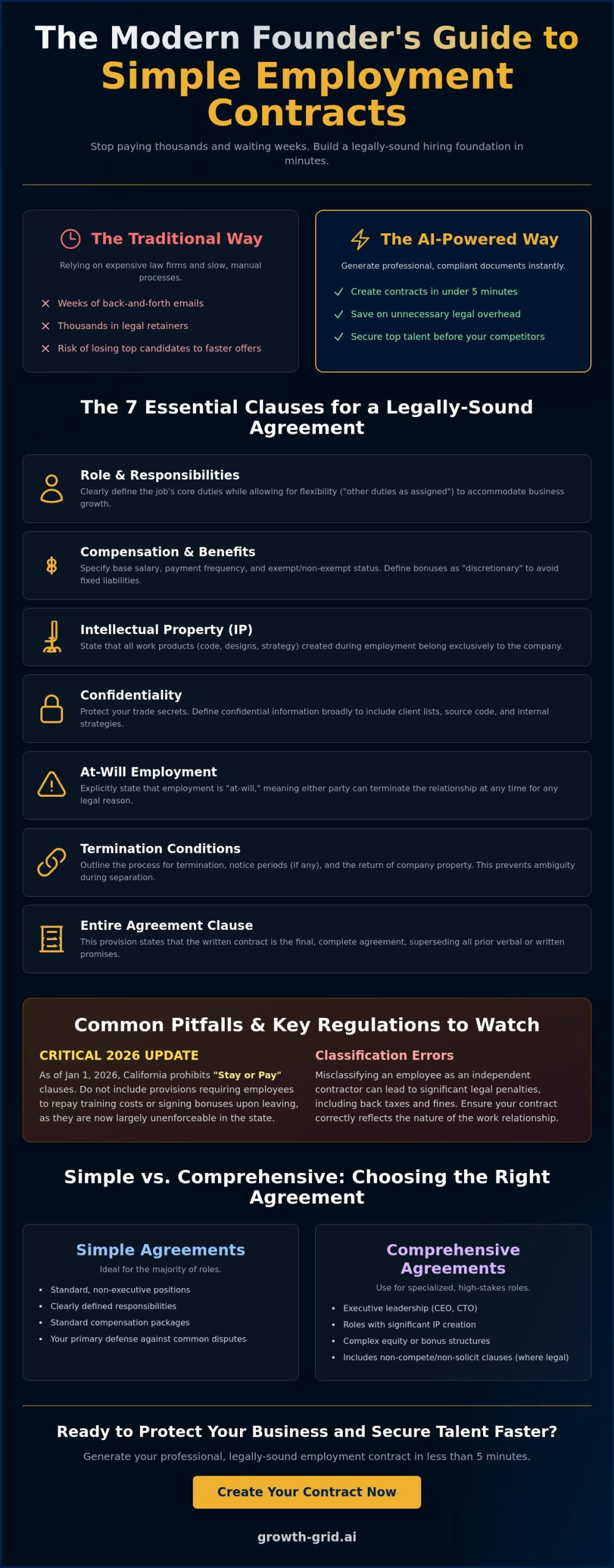
The 7 Essential Clauses for a Legally Sound Simple Agreement
A legally binding agreement doesn’t require fifty pages of dense text. In fact, clarity often provides better protection than complex legalese that neither party understands. To create a simple employment contract that actually holds up in court, you must include specific pillars that define the relationship. These common employment contract provisions ensure that expectations are set in stone before the first day of work. You need a document that is functional, not just formal.
Start with a clear definition of the role. Avoid overly rigid job descriptions that prevent your team from evolving as the company grows. Instead, define core responsibilities but include a clause for “additional duties as reasonably required.” This maintains your operational flexibility while giving the employee a clear understanding of their primary mission. Precision in the beginning prevents friction later.
Compensation and Benefits Breakdown
Specify the base salary and the exact payment frequency. For 2026, ensure you’re compliant with local minimum wage laws. For example, California’s rate is now $16.90 per hour. Clearly state if the role is exempt or non-exempt to avoid overtime disputes. If you offer bonuses, define them as “discretionary” rather than guaranteed. This avoids creating a fixed financial liability that you’re forced to pay regardless of company performance or individual results.
Intellectual Property and Confidentiality
Your business is built on its ideas. Ensure every contract states that all work products created during employment belong exclusively to the company. In our digital-first environment, define confidential information broadly to include source code, client lists, and internal strategy documents. Note that as of January 1, 2026, California prohibits “Stay or Pay” clauses. Don’t include requirements for employees to repay training costs or signing bonuses upon leaving, as these are now largely unenforceable.
Termination and At-Will Clauses
Most U.S. employment is “at-will.” This means either party can end the relationship at any time for any legal reason. You must state this status explicitly to avoid “implied contract” claims. Define the difference between “for cause” termination, such as gross misconduct, and “without cause” termination. Setting a fair notice period, typically two to four weeks, ensures business continuity while providing a professional transition for the departing employee. Using a modern AI HR Document Generator helps you include these seven essentials without the risk of manual drafting errors.
Simple vs. Comprehensive: Choosing the Right Level of Detail
A simple contract isn’t a shortcut. It’s an optimization. Most businesses over-engineer their documents, adding pages of legacy clauses that don’t apply to the role. This creates unnecessary friction. When you create a simple employment contract, you’re prioritizing the 20% of terms that provide 80% of the protection. This lean approach is perfect for roles where the duties are standard and the risk profile is low. You don’t need fifty pages to hire a receptionist, but you do need total clarity on the essentials.
The goal is to eliminate “fluff” while maintaining a legal shield. A simple agreement focuses on the mechanics of the job: what the employee does, what they get paid, and how the relationship ends. It avoids the dense, circular language found in traditional legal templates. By stripping away the jargon, you ensure that both you and your new hire actually understand the terms of the deal. This transparency builds trust and gets people working faster.
When Simple is Sufficient
Simple agreements are the gold standard for junior, administrative, or general staff positions. If the role has clear, non-complex duties and a standard salary structure, a streamlined document is your best tool. Early-stage startups, in particular, should favor these agreements. Speed is your primary competitive advantage. If the annual salary is below the 2026 California exemption threshold of $70,304, you likely need a straightforward, non-exempt agreement that focuses on hourly compliance and basic IP protection.
When to Upgrade to Comprehensive Agreements
Some hires carry a higher risk profile that requires more detail. If you’re bringing on a C-suite executive, a simple document isn’t enough. These roles often involve equity grants, complex vesting schedules, and specific severance packages. You also need comprehensive agreements for employees with access to highly sensitive trade secrets or those working across international borders. International hires require specific clauses to handle multi-jurisdictional tax laws and local labor regulations. When you create a simple employment contract for a standard role, it works perfectly; for a CEO, you need the extra layers.
Your hiring process should be scalable. Start with a high-quality, simple template for the majority of your team. As your company grows and roles become more specialized, you can refine these documents. The objective is to match the complexity of the contract to the complexity of the role. Don’t let a quest for “perfection” stall your onboarding engine.
Common Pitfalls When You Create a Simple Employment Contract
Many founders fear that a streamlined document won’t hold up in court. This anxiety is common. However, legality isn’t determined by the number of pages. It’s determined by compliance with current regulations. When you create a simple employment contract, the real danger lies in ignoring local requirements or misrepresenting the nature of the work. If your document doesn’t align with the actual day-to-day operations, it becomes a liability rather than a shield. Accuracy always beats volume.
The Misclassification Trap
One of the costliest mistakes is misclassifying an employee as an independent contractor. Tax authorities like the IRS use strict criteria to distinguish between W2 employees and 1099 contractors. If you exercise significant control over when, where, and how the person works, they are likely an employee. Labeling them a contractor in a “simple” agreement doesn’t change the legal reality. Getting this wrong leads to massive financial penalties, including back taxes, unpaid overtime, and workers’ compensation claims. Your contract must reflect the actual working relationship to provide any real protection.
Vague Duties and Performance Standards
Vague job descriptions are a breeding ground for “scope creep” disputes. While you want flexibility, being too broad can make it impossible to manage performance. If you don’t define what success looks like, you can’t fairly terminate for poor performance later. Every role should be linked back to the goals in your business plan. Use measurable expectations. Instead of “managing social media,” try “delivering three weekly reports on engagement metrics.” This clarity simplifies future performance reviews and ensures the employee knows exactly how to contribute to the company’s growth.
Local law compliance is the final hurdle. As of early 2026, regulations are shifting rapidly. For example, California employers must now provide a “Workplace Know Your Rights” notice to all new hires by February 1, 2026. Additionally, the state minimum wage has increased to $16.90 per hour. If your simple contract uses outdated rates or misses these mandatory notices, you’re exposed. You don’t need a law degree to stay compliant, but you do need the right tools. Using a modern AI Legal Document Generator ensures your agreements are updated with the latest 2026 requirements automatically. This eliminates the fear of missing a critical legal clause while keeping your hiring process fast and efficient.
Create Your Professional Employment Contract in Under 5 Minutes
Stop wasting your valuable hours wrestling with static templates that require manual “fill-in-the-blanks” guesswork. Most founders get stuck in the drafting phase because they aren’t sure if their custom edits invalidate the legal framework. With the GrowthGrid AI HR Document Generator, you can create a simple employment contract that is both robust and tailored to your specific hire. Our system isn’t just a text editor. It’s a 72-section-aware engine that cross-references your inputs against 2026 standards to ensure your business stays protected.
Static templates are a legacy liability. They often contain outdated language or generic clauses that don’t apply to your specific jurisdiction. GrowthGrid solves this by using an AI Legal Document Generator that understands the context of your hire. By answering a few simple questions, you trigger an engine that evaluates dozens of distinct legal sections to ensure nothing is missed. This level of precision was previously only available through high-priced firms. Now, it’s accessible to you in minutes.
The AI-Powered Workflow
Traditional drafting feels like a chore. Our process turns it into a fast, logical conversation. You don’t need to be an HR expert to get professional results.
- Step 1: Input your basic company details and the specific parameters of the new hire, such as salary and role.
- Step 2: The AI drafts a comprehensive legal framework aligned with 2026 labor standards and state-specific requirements.
- Step 3: Review the output, add any custom nuances, and finalize your professional agreement.
This workflow eliminates the “blank page” syndrome entirely. You receive a professional-grade document in a fraction of the time it takes to even schedule a call with a consultant. It’s about getting your new team member productive as quickly as possible.
Beyond the Contract: Scaling Your Business
Your hiring strategy shouldn’t exist in a vacuum. It works best when it’s part of a larger, cohesive strategy. Every hire you make should reflect the milestones and resource allocations outlined in your ai business plan. GrowthGrid allows you to synchronize your HR documentation with your broader operational goals. Once you create a simple employment contract, you can use the same ecosystem to generate NDAs, strategy documents, and operational manuals.
The final result is a clean, ready-to-sign document available in both PDF and DOC formats. This flexibility allows you to send the contract for digital signature immediately or make minor stylistic adjustments in your favorite word processor. Don’t let administrative friction slow down your growth. Take the lead and generate your professional employment contract now. Secure your talent today and get back to the work that actually moves the needle.
Ready to Scale Your Team with Confidence?
Hiring is a major milestone for your business, not a legal chore. You’ve learned that a clear agreement protects your intellectual property, ensures 2026 regulatory compliance, and sets professional expectations from day one. By stripping away unnecessary fluff, you prioritize both speed and clarity. Thousands of global startups already use our platform to eliminate the high costs and delays of traditional legal drafting. Our engine uses 72-section comprehensive logic to ensure your business is covered from every angle with AI-powered accuracy.
It’s time to move past the friction of manual paperwork and expensive firm retainers. You can create a simple employment contract that is professional, legally sound, and ready for signature right now. Don’t let administrative bottlenecks slow your momentum or cost you top-tier talent. Take control of your onboarding process and build a scalable foundation for your company’s future.
Create Your Employment Contract in 5 Minutes
Your next great hire is waiting to help you grow. Let’s get them started today.
Frequently Asked Questions
Is a simple employment contract legally binding in 2026?
Yes, a simple contract is fully binding if it contains an offer, acceptance, and consideration. In 2026, courts prioritize the substance of your agreement over its length. You must ensure the document covers base salary, role expectations, and termination terms. When you create a simple employment contract using professional standards, you provide the clarity required to make the agreement enforceable in a legal setting.
What is the difference between an offer letter and an employment contract?
An offer letter is a high-level overview of a job proposal, while a contract is a detailed, binding agreement. Offer letters often lack the specific “at-will” protections and intellectual property clauses found in a formal contract. Transitioning from an offer to a contract provides the legal shield your business needs. It moves the relationship from an informal stage to a professional partnership with clear boundaries and protections.
Can I use the same simple contract for every employee?
No, you should customize your agreement based on the specific role and jurisdiction. While the core framework remains consistent, details like overtime eligibility and job duties must change. For instance, a non-exempt worker in California must meet the $16.90 hourly minimum wage effective January 1, 2026. Using a single template for every hire creates a risk of misclassification or non-compliance with local labor regulations.
Do I need a lawyer to review my AI-generated employment contract?
Many founders use AI-generated documents for standard roles to save on high legal fees. Modern tools use updated 2026 standards and comprehensive logic to draft compliant frameworks. If you are hiring for a complex executive position with equity, a specialized review is a smart choice. For general staff, the ability to create a simple employment contract through a generator provides the necessary protection without the delay of traditional consulting.
What happens if I hire someone without a written contract?
Hiring without a written agreement leaves your business vulnerable to “implied contract” claims and intellectual property disputes. Without a document, you have no concrete proof that work produced belongs to your company. You also lose the ability to explicitly define “at-will” status, which can make termination difficult and expensive. A written agreement is your only reliable defense against the ambiguity of verbal promises and handshake deals.
How do I include remote work clauses in a simple agreement?
Include a specific section that defines the remote work location and expectations for data security. You should clarify who provides the hardware and whether the company offers a remote work stipend. In 2026, it is also vital to mention that the employee must maintain a secure, private workspace. This ensures your company data remains protected even when your team is working from home or a co-working space.
Can an employment contract be modified after it is signed?
Yes, you can modify a contract through a written amendment that both parties sign. You cannot change terms unilaterally; the employee must agree to the new conditions. This is common when a team member receives a promotion or a salary increase. Always document these changes formally to ensure the original agreement remains accurate and enforceable as your business relationship evolves over time.
What are the specific requirements for IP ownership in a contract?
You must include a “Work-for-Hire” clause stating that all work produced during employment belongs to the company. This should cover everything from source code to client lists. To be fully protected, add an “Assignment of Rights” provision. This ensures the employee explicitly transfers ownership of any inventions or creative works to your business. Without these clauses, you may not actually own the products you paid to develop.