

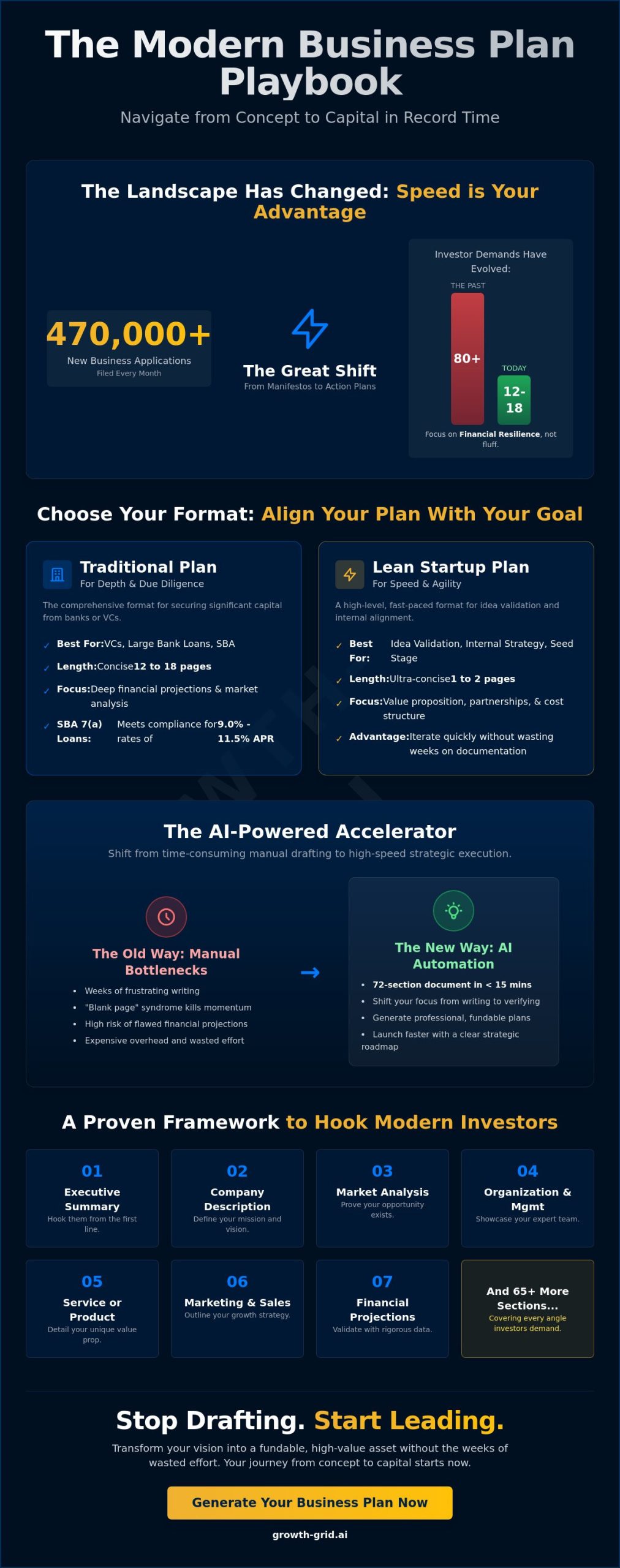
With roughly 470,000 new business applications filed every month, the race to launch has never been more competitive. In 2026, the traditional 80-page manifesto is dead. Investors now demand concise, 12-to-18-page documents that prioritize financial resilience over fluff. If you’re struggling with blank page syndrome or the technical hurdles of financial projections, you aren’t alone. Most founders find the manual planning process to be the biggest bottleneck in their journey.
You deserve a more efficient way to move from concept to capital. This guide teaches you exactly how to create a business plan that’s professional, fundable, and ready in record time. We’ve replaced legacy methods with a streamlined, modern approach that eliminates stress and high overhead costs. We’ll walk through the essential structural components every lender requires, from SBA-compliant data to strategic frameworks. By the end of this article, you’ll have a clear roadmap to transform your vision into a high-value asset without the weeks of wasted effort. It’s time to stop drafting and start leading.
Key Takeaways
- Identify whether a traditional or lean startup format aligns with your specific funding and growth objectives.
- Learn how to create a business plan using a proven 7-step framework designed to hook modern investors.
- Eliminate the “hockey stick” forecasting trap by validating your financial projections with a rigorous SWOT analysis.
- Discover how to generate a professional, 72-section strategy document in under 15 minutes using AI automation.
- Transition from time-consuming manual drafting to high-speed strategic execution for a faster market launch.
Table of Contents
Understanding the Purpose of Your Business Plan
A business plan isn’t a trophy for your bookshelf. It’s a living GPS. In 2026, founders don’t have months to waste on 80-page manifestos that are obsolete before they’re printed. With 470,000 new business applications filed every month, speed is your only real competitive advantage. Learning how to create a business plan isn’t about writing a static document; it’s about building a high-speed framework for decision-making. You need a tool that evolves as the market shifts.
Your plan serves three primary goals: securing funding, guiding growth, and identifying risks. Whether you’re eyeing an SBA 7(a) loan with variable rates between 9.0% and 11.5% or seeking venture capital, your documentation must be airtight. You can find a comprehensive overview of a business plan to see its traditional academic roots, but modern execution requires a sharper focus. Investors now prioritize financial resilience over optimistic "hockey stick" projections. They want to see how you’ll handle 2026’s economic volatility, not just how you’ll spend their money.
There is a massive difference between internal strategy and investor-facing documents. Internal plans are raw. They focus on operations, team alignment, and the gritty details of execution. Investor documents are polished. They highlight the value proposition and the exit strategy. ⚡ Efficiency Tip: Don’t write two separate documents from scratch. Use a single source of truth and pivot the presentation based on your audience.
Why Every Startup Needs a Clear Strategy
Clarify your value proposition before you spend a single dollar. If you can’t articulate why a customer will choose you over 36.2 million other small businesses, your venture is at risk. A clear strategy aligns your team around one core mission. It prevents expensive "feature creep" and keeps your overhead low. Identify potential market roadblocks now. It’s much cheaper to pivot on paper than it is to pivot after you’ve hired a team and signed a lease. ✅ Result: A leaner, more focused launch.
The "Blank Page" Problem and How to Solve It
Staring at a empty cursor is the leading cause of startup delay. It kills momentum and breeds second-guessing. While traditional templates offer a basic structure, they still require weeks of manual labor. High-efficiency founders in 2026 have moved beyond manual drafting. They use an AI Business Plan Generator to produce professional, 72-section documents in under 15 minutes. This shifts your workload from "writing" to "verifying." Focus on the data points that matter, such as your 21% C-Corp tax rate or specific state LLC fees, and let technology handle the prose. Stop drafting. Start leading.
Choosing the Right Format: Traditional vs. Lean Startup
Picking the wrong format is a common reason for startup friction. You need to align your document with your specific funding goals. If you’re wondering how to create a business plan that actually gets results, you must first decide between a traditional structure and a lean startup model. One is built for depth; the other is built for speed. Choosing correctly saves you dozens of hours in the drafting phase and ensures you’re speaking the right language to your audience.
The Traditional Business Plan Structure
Use this format if you’re chasing venture capital or a large bank loan. Lenders today expect deep financial projections and historical data. Even though it’s comprehensive, the 2026 standard has slimmed down significantly. A professional document now typically runs 12 to 18 pages, a sharp decrease from the 40-page monsters of the past. Refer to the SBA guide to writing a business plan to ensure you meet all regulatory requirements for government-backed loans. This is essential if you’re applying for an SBA 7(a) loan with current interest rates between 9.0% and 11.5% APR. Focus on clarity and data over long-winded descriptions.
The Lean Startup Plan: Speed and Agility
Choose this if you’re validating a new idea or tracking internal progress. It’s a high-level overview that fits on one or two pages. You won’t spend weeks on prose. Instead, you’ll focus on your value proposition, key partnerships, and cost structures. It’s the "15-minute plan" for early-stage founders who need to iterate fast. If your strategy changes tomorrow, you won’t have wasted dozens of hours on a document that’s now obsolete. It keeps your team agile and your overhead low while providing enough structure to identify major roadblocks before they happen.
Making the Decision
Your choice depends on your current stage and the capital you need. Most successful founders use a hybrid approach as they grow.
-
Seed Stage: Use the Lean Startup model for rapid internal validation and testing.
-
Growth Stage: Move to a Hybrid approach with detailed sections and punchy summaries.
-
Funding Stage: Execute a Traditional plan for banks and investors to demonstrate long-term stability.
Don’t let the document hold you back. If you need a professional draft without the manual grind, an AI business plan generator can build both formats in minutes. This ensures you have the right document for the right audience at exactly the right time. You focus on the strategy; let technology handle the structure.
7 Essential Steps to Create Your Business Plan
Stop overthinking the structure. Execution matters more than perfection. In 2026, the how to create a business plan process is about removing friction and focusing on high-impact data. Investors don’t want fluff; they want to see that you understand your numbers and your niche. Follow these five core steps to build your foundation before moving into the technical strategy.
-
Step 1: The Executive Summary. This is your hook. If you don’t grab an investor’s attention in the first 30 seconds, they won’t read the rest. Summarize your vision, the problem you solve, and your funding needs in one page or less.
-
Step 2: Company Description. Define your unique value proposition. What makes you different from the 36.2 million other small businesses in the U.S.? State your mission clearly.
-
Step 3: Market Analysis. Use hard data. Identify your target demographic and analyze your competitors’ weaknesses. Don’t just claim there is a market; prove it with current trends.
-
Step 4: Organization and Management. Detail your legal structure. Whether you’re a C-Corp or an LLC, explain who is leading the team and why they are qualified to execute this specific strategy.
-
Step 5: Product or Service Line. Focus on benefits, not just features. Explain the lifecycle of your product and how it directly addresses the pain points identified in your market research.
The importance of a business plan lies in its ability to reveal weaknesses in your logic before they become expensive mistakes. Use these steps as a diagnostic tool for your startup’s health.
Crafting Your Marketing and Sales Strategy
How will you reach your target market without burning through your capital? You must define your customer acquisition cost (CAC) immediately. In 2026, organic reach is harder to sustain, so your sales funnel must be optimized for conversion from day one. Map out your first 12 months of sales activity. Are you using social proof, AI-driven marketing, or direct outreach? Be specific about your lead generation tactics and your anticipated conversion rates.
Building Financial Projections Without the Stress
Financials are where most founders freeze up. You need three essential documents: a cash flow statement, a profit and loss (P&L) statement, and a balance sheet. Use a professional cash flow analysis to predict your runway and ensure you don’t run out of capital during your growth phase. Quantify your funding request with precision. Don’t just ask for "investment." Tell them exactly how much you need and provide a detailed breakdown of the use of proceeds. This transparency builds trust and speeds up the approval process.
Avoiding Common Pitfalls and Validating Your Strategy
Planning is where strategy meets reality. Most entrepreneurs fail because they treat their document as a hurdle to clear rather than a tool to use. If you want to master how to create a business plan, you must confront the psychological traps that lead to startup failure. Chief among these is the "hockey stick" trap. Avoid projecting exponential growth without the data to back it up. Be realistic about your debt service. With SBA 7(a) variable rates sitting between 9.0% and 11.5% APR as of June 2026, your cash flow must be resilient enough to handle high interest costs. ✅ Success Factor: Conservative estimates build more trust than aggressive ones.
Ignoring the competition is another fatal error. A SWOT analysis isn’t a formality; it’s a defensive weapon. If you don’t acknowledge the strengths of the 36.2 million existing small businesses, you can’t carve out your own niche. Shift your focus from your product’s features to the specific customer problem you’re solving. Your plan should evolve every quarter based on real-world feedback. A static document is a dead document. You need a roadmap that breathes.
The Importance of Market Validation
Stop guessing. Test your assumptions with real customer feedback before committing your entire budget. Use a startup business plan as a dynamic, living document. This approach allows you to pivot quickly when the data contradicts your initial vision. Persevering in the wrong direction is just an expensive way to fail. Validate your price points against current market standards to ensure your margins are sustainable. ⚡ Efficiency Tip: Short feedback loops save more money than long planning cycles.
Reviewing Your Plan for Investor Readiness
Apply the "30-second test" to your executive summary. If a lender can’t understand your value proposition in half a minute, they’ll move to the next application. Ensure your data is consistent across all 72 potential sections of your document. Reviewing industry-specific business plan examples can help you benchmark your projections against realistic standards. Check your state-specific LLC fees, which can range from $35 in Montana to $520 in Massachusetts, to ensure your startup cost estimates are accurate. Accuracy in the small details proves your competence in the large ones.
Ready to build a strategy that stands up to investor scrutiny? Generate your professional business plan in minutes and stop the manual guesswork.
Accelerating the Process with AI Business Planning
Manual drafting is a legacy problem. In 2026, founders who spend weeks on prose are losing the race to market. You don’t have time for a blank page. The traditional method of hiring a business plan consultant often results in high overhead and frustratingly slow turnarounds. Why wait weeks for a document you could generate in under 15 minutes? Modern technology has transformed how to create a business plan from a grueling writing exercise into a high-speed strategic configuration.
AI-driven planning combines advanced computing models with your unique founder intuition. You provide the vision; the machine provides the market data, structural integrity, and financial logic. This synergy allows you to produce a comprehensive, 72-section document without the stress of manual calculation or formatting. It’s about working on your business, not just in it. By automating the heavy lifting, you can focus on testing your value proposition and securing your first customers. ⚡ Speed Advantage: While your competitors are still drafting their executive summaries, you’ll be ready for your first investor pitch.
GrowthGrid: Your AI-Powered Planning Partner
GrowthGrid eliminates the friction of startup documentation. By answering simple, targeted questions about your business model, you can generate a complete ai business plan. The output is a professional PDF or DOC export, fully formatted for bank review or venture capital pitches. It includes integrated financial projections that account for current 2026 tax rates and SBA loan interest margins. You get lender-ready quality without the legacy price tag. It’s the most efficient way to learn how to create a business plan that actually secures funding.
Next Steps: From Plan to Launch
A plan is only the beginning of your journey. Once your strategy is finalized, use AI to generate your essential legal and HR documents to ensure your operations are compliant from day one. Set your first 90-day milestones and focus on execution. Don’t let your documentation become a static file on your hard drive. Update your projections every quarter as you gather real-world data. Your roadmap is ready. The market is waiting. Don’t let a slow, outdated process stop your momentum.
Create your professional business plan in 15 minutes with GrowthGrid and launch with confidence today. 🚀
Secure Your Funding and Launch Faster
Modern business planning is no longer a test of endurance; it’s a measure of strategic agility. You’ve learned that 2026 investors prioritize 12-to-18-page documents that emphasize financial resilience over outdated, 80-page manifestos. You now know how to create a business plan that balances lean startup speed with the technical depth required for SBA-compliant lending. By validating your strategy with real market data and avoiding the "hockey stick" forecasting trap, you position your startup for long-term stability rather than just initial hype.
Don’t let the technical hurdles of financial projections or the weight of a blank page stall your momentum. GrowthGrid has already powered over 10,000 startups by delivering comprehensive 72-section outputs in record time. With our 100% satisfaction guarantee, you can remove all perceived risk from the planning process and focus entirely on execution. Generate your 72-section business plan in 15 minutes and stop wasting valuable weeks on manual drafting. You have the vision and the modern tools to succeed. It’s time to build your future.
Frequently Asked Questions
How long does it typically take to create a business plan?
Traditional manual drafting usually takes between 40 and 100 hours of research and writing. However, using an AI generator reduces this timeframe to under 15 minutes. Modern founders prioritize speed to ensure they launch while their market data is still relevant. Automation allows you to move from a blank page to a professional, lender-ready document in a single session.
Can I create a business plan for free?
You can use basic government templates or open-source documents at no cost, but these often require weeks of manual labor to complete. Free options rarely include the complex financial modeling or the 72-section depth that 2026 investors expect. While the initial template is free, the time investment and risk of errors often make it the most expensive route for a new startup.
Do I really need a business plan if I am not seeking funding?
Yes, because a plan serves as your internal roadmap for growth and risk management. It helps you identify potential cash flow bottlenecks and operational roadblocks before they become costly mistakes. Even without external investors, you need a clear strategy to manage your 21% C-Corp tax obligations and stay competitive against the 36.2 million other small businesses in the U.S.
What is the most important part of a business plan?
The Executive Summary is the most critical section because it serves as your primary hook for lenders and partners. If this page fails to clearly communicate your value proposition, the rest of the document will likely go unread. When learning how to create a business plan, you must ensure your summary is concise, data-driven, and capable of passing a 30-second readiness test.
How often should I update my business plan?
Update your plan every quarter to reflect actual sales data and shifting market conditions. A static document becomes a legacy artifact within months in a fast-moving economy. Use these 90-day reviews to adjust your customer acquisition costs and refine your financial projections. Regular updates ensure your strategy remains a living document that guides daily decision-making.
Is an AI business plan generator as good as a human writer?
AI generators are often superior for structural integrity, financial accuracy, and speed, provided you guide them with your specific vision. Human writers are significantly more expensive and can take weeks to deliver a first draft. An AI-driven process ensures your how to create a business plan journey is efficient, professional, and free from the formatting errors common in manual drafting.
What is the difference between a business plan and a pitch deck?
A business plan is a comprehensive technical document used for due diligence, while a pitch deck is a visual summary designed for high-level presentations. You use the pitch deck to capture initial interest and the business plan to close the deal. The plan contains the deep financial data and operational details that a 10-slide presentation simply cannot cover.
Can I use a business plan template for any industry?
Generic templates exist, but they often lack the specific sections required for niche industries or complex regulatory environments. A static template cannot adapt to your unique business model or provide customized financial projections. It is more effective to use a dynamic generator that can tailor all 72 potential sections to your specific industry requirements and legal structure.