

Your business plan becomes obsolete exactly 30 days after the funding hits your bank account. It’s a bold reality, but in a market projected to reach 1.28 trillion dollars by 2031, static documents simply can’t keep pace. Most founders lose over 10 hours every month manually wrestling with spreadsheets just to give investors the real-time performance data they demand. You didn’t raise capital to spend your weekends acting as a data entry clerk.
You likely feel the friction of using a legacy “map” for a territory that changes every week. We agree that the traditional planning process is a drain on your most valuable resource: time. This article helps you master the transition from a static pitch to a dynamic strategy using living business plan software to scale effectively. You’ll learn how to automate financial tracking and generate professional board reports in minutes. It’s time to stop reacting to the market and start out-pacing it with a strategy that evolves as fast as you do.
Key Takeaways
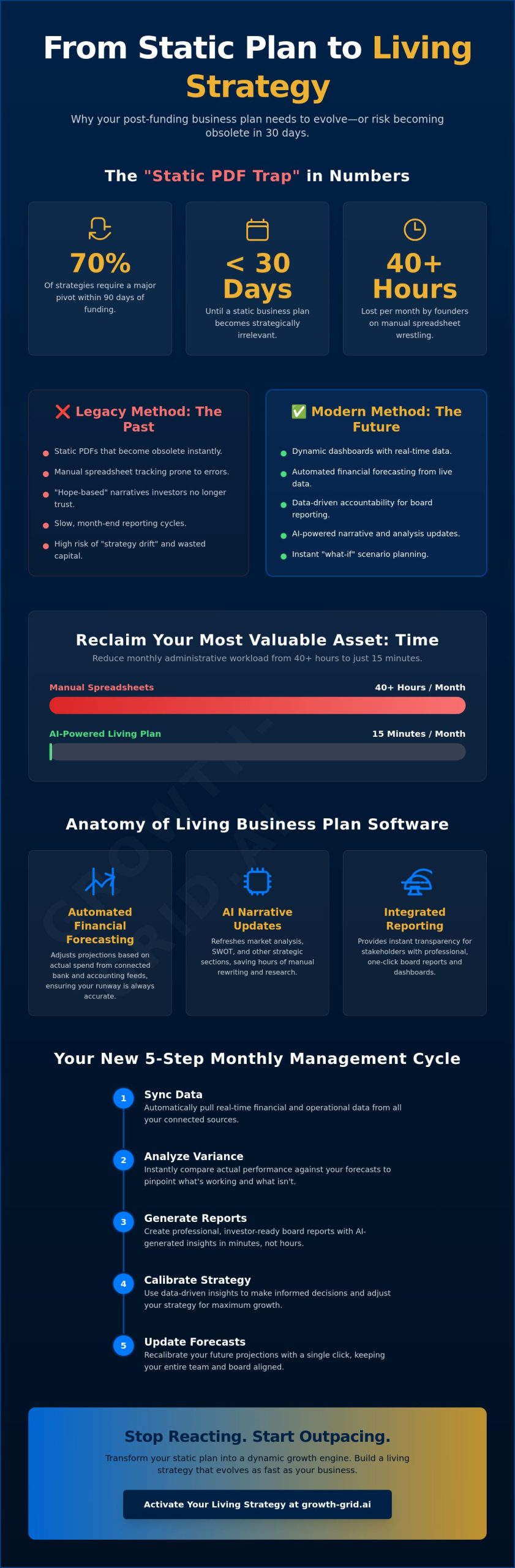
- Avoid the “Static PDF Trap” by understanding why 70% of original business strategies require a major pivot within the first 90 days of funding.
- Master the transition to living business plan software to synchronize your high-level strategy with real-time financial data automatically.
- Reduce your monthly administrative workload from 40+ hours to just 15 minutes by replacing manual spreadsheets with AI-powered automation.
- Implement a professional 5-step management process to perform monthly variance analysis and keep your board reports investor-ready.
- Scale your operations rapidly by integrating AI-generated HR, legal, and operational documents into one cohesive, dynamic strategy ecosystem.
Why Static Business Plans Fail After Funding
The moment that wire transfer clears, your original business plan starts dying. It’s a harsh reality for founders, but 70% of original strategies change within the first three months of receiving capital. This isn’t a sign of poor planning. It’s the result of high-velocity execution. If you’re still relying on a static PDF to guide your post-funding operations, you’re stuck in the “Static PDF Trap.” Outdated documents lead to misallocated resources, wasted burn, and a leadership team that’s out of sync with current market demands.
Investor expectations in 2026 have shifted from “hope-based” narratives to “data-driven” accountability. Your board doesn’t want a polished story from six months ago; they want to see how you’re managing today’s capital. Relying on manual spreadsheet updates consumes over 10 hours every month and introduces massive operational risk through human error. Adopting living business plan software allows you to maintain a professional strategic planning process that connects your vision directly to your bank balance.
The Strategic Shift:
- ❌ Legacy Method: Static PDFs that become obsolete in 30 days.
- ✅ Modern Method: Dynamic dashboards that update with real-time data.
- ❌ Legacy Method: Manual spreadsheet tracking prone to version control errors.
- ✅ Modern Method: Automated financial forecasting using living business plan software.
The Velocity of Change in 2026
Market volatility moves at the speed of AI. A rigid strategy is a liability when your customer acquisition costs or churn rates signal an immediate need for a pivot. Sticking to a plan written before you scaled your team or increased your budget is reckless. Strategy drift is the gradual divergence between a company’s actual operational activities and its documented long-term goals, often resulting in a fatal loss of competitive advantage. You need a system that allows for rapid recalibration without starting from scratch every month.
From Pitching to Performing
Your board of directors cares more about variance than your original vision. They want to see exactly how your actual performance stacks up against your forecasts. While initial startup business plans are vital for securing the check, they must evolve into living systems to manage the friction of scaling. Transitioning from “selling the dream” to “managing the reality” requires tools that turn raw data into actionable strategy. Stop treating your plan like a trophy and start using it as a GPS for your capital.
The Anatomy of Living Business Plan Software
Living business plan software is a dynamic ecosystem designed to bridge the gap between your high-level strategy and your daily financial reality. Unlike a traditional document that sits in a digital folder, this technology connects directly to your operational tools to provide a single source of truth. It transforms the foundational elements of a business plan from static words into active, data-driven insights. By integrating automated forecasting and AI-driven narrative updates, founders maintain total clarity as they scale. This software doesn’t just store your plan; it breathes life into it by syncing your vision with your bank balance.
The core of this technology rests on three pillars. First, automated financial forecasting adjusts your projections based on actual spend, ensuring your burn rate is always accurate. Second, AI narrative updates allow you to refresh market analysis or SWOT sections without manual rewriting. Finally, integrated reporting dashboards provide instant transparency for stakeholders. This structure eliminates the friction of legacy methods, allowing you to generate a strategy document that stays relevant long after the initial pitch.
Real-Time Financial Intelligence
In 2026, waiting for month-end reports is a competitive disadvantage. Modern software connects your bank feeds and accounting platforms directly to your strategic goals. This automation makes cash flow analysis a continuous process rather than a monthly chore. You can predict your runway with surgical precision because the data reflects today’s transactions, not last month’s guesses. High-performance software must handle complex “what-if” scenarios in seconds. If you lose a major client or decide to double your marketing spend, you need to see the impact on your 18-month outlook immediately.
AI-Powered Narrative Recalibration
Markets shift overnight as new competitors emerge and technology evolves. Living business plan software uses generative models to rewrite your market assessment and competitive landscape automatically. You can update a comprehensive 72-section plan without starting from scratch, ensuring every page reflects your current operational reality. Utilizing AI business plans allows your team to maintain perfect strategic alignment. Instead of wasting 10 hours on manual updates, you can focus on execution while the software handles the documentation. This ensures your strategy remains a GPS for your business rather than a historical record of where you used to be.
Living Software vs. Manual Spreadsheet Tracking
Many founders believe spreadsheets are the most cost-effective way to manage a post-funding strategy because they’re “free.” This is a dangerous misconception. While Excel doesn’t have a monthly subscription fee, the hidden costs of manual tracking are staggering. Between broken formulas, version control nightmares, and the sheer volume of manual labor, you’re likely losing days of productivity every quarter. Transitioning to living business plan software eliminates these inefficiencies by automating data entry and ensuring your team always works from a single, accurate version of the truth.
The speed gap between legacy tools and AI-driven systems is undeniable. Manually updating a comprehensive strategy can take 40 or more hours of focused writing and data manipulation every month. Modern software reduces this to just 15 minutes of AI-driven recalibration. This efficiency allows you to focus on high-level execution rather than administrative upkeep. It’s the difference between driving a car with a paper map and using a real-time GPS that reroutes you around traffic automatically.
- ❌ Manual Spreadsheets: Siloed files that lead to “version confusion” among team members.
- ✅ Living Software: Cloud-based collaboration that keeps every stakeholder in sync.
- ❌ Manual Spreadsheets: Unprotected local files that are vulnerable to data loss or theft.
- ✅ Living Software: Bank-grade encryption and secure access protocols for sensitive data.
The Error Margin of Manual Planning
Precision is not optional when you’re managing millions in capital. Research indicates that up to 88% of spreadsheets contain significant errors. For a funded startup, a single misplaced decimal in a hiring forecast or a broken cell reference in a burn rate calculation can trigger a premature cash crunch. Presenting flawed data to investors or lenders destroys your professional credibility instantly. Investing just $19 in professional software to protect a $1,000,000 investment provides an immediate return by securing your most critical financial data.
Stakeholder Confidence and Transparency
Professional dashboards do more than track data; they build trust. When you walk into a board meeting with real-time visualizations and interactive forecasts, you demonstrate a level of operational control that static files cannot match. This transparency reduces “reporting friction” between founders and financial officers by providing a shared, automated environment. As highlighted in the SBA guide to business planning, successful companies often move toward leaner, more flexible frameworks as they scale. To support this growth, you need specific business plan software features like automated variance reporting and secure stakeholder permissions.
How to Manage Your Business Plan Post-Funding (The 5-Step Process)
Securing capital is a milestone, but managing that capital requires a rigorous operational framework. Most founders treat their initial pitch as the finish line. In reality, it’s the starting block. To maintain investor confidence and operational efficiency, you must transition into a continuous management cycle. Using living business plan software allows you to execute this 5-step process without drowning in administrative debt.
Step 1: Sync your “Actuals.” Connect your accounting and banking data directly to your strategy. This creates a real-time mirror of your financial health and eliminates manual data entry errors.
Step 2: Perform a Monthly Variance Analysis. Compare your planned budget against your actual spend. Identifying where you are over or under budget early prevents a premature cash crunch.
Step 3: Update Key Assumptions. Your Customer Acquisition Cost (CAC), pricing models, and churn rates will fluctuate. Adjust these variables monthly to keep your runway projections accurate and honest.
Step 4: Recalibrate the Narrative. Use AI to refresh your SWOT analysis and milestones. If a new competitor enters the market or a product launch is delayed, your living business plan software should reflect these changes immediately.
Step 5: Export and Distribute. Generate automated investor updates. Professional, data-backed reports build massive trust by proving you have total control over the company’s trajectory.
Ready to automate your post-funding workflow? Start building your dynamic strategy today with a professional strategy document generator.
Setting a Monthly Cadence
Consistency is the key to strategic agility. We recommend a “First Monday” cadence where the leadership team reviews the plan updates for the previous month. Within the software, assign section ownership to specific department heads. The Head of Sales updates the revenue milestones while the COO handles operational targets. Use AI to summarize monthly wins and losses for the executive summary. This ensures the entire team stays aligned on the current mission rather than a vision from six months ago.
Pivoting with Precision
Knowing when to change your plan is just as important as knowing when to stay the course. If your KPIs show a consistent 20% variance from your goals, it’s time to recalibrate. Documenting these strategic pivots creates a historical audit trail that investors value during subsequent funding rounds. Think of your business plan as a GPS, not a fixed map. It should provide a clear direction while remaining flexible enough to reroute when market conditions shift. Precision execution requires a tool that adapts as fast as your startup does.
Scaling with GrowthGrid: The Ultimate Living Strategy Tool
GrowthGrid is more than a document generator. It’s a comprehensive ecosystem designed to keep your entire business investor-ready. While legacy methods force you to juggle disconnected files, this platform centralizes your vision. You can generate a 72-section comprehensive plan in under 15 minutes. This is the new standard for living business plan software. By automating the heavy lifting, you achieve a level of professionalism that previously required a team of consultants. You save 90% on costs compared to hiring traditional business writers. This isn’t just about saving money. It’s about gaining the speed required to dominate your market in 2026.
- ✅ Efficiency: Move from concept to a 72-section plan in 15 minutes.
- ✅ Cost-Savings: Reduce strategy overhead by 90% compared to human consultants.
- ✅ Compliance: Maintain a “due diligence ready” state for your next funding round.
- ✅ Integration: Sync your strategy with HR and legal documentation automatically.
The GrowthGrid ecosystem ensures your strategy remains a functional asset rather than a historical relic. By using our AI Strategy Document Generator, you maintain a dynamic roadmap that evolves alongside your bank balance. This results-oriented approach removes the friction of traditional planning. It empowers you to make bold moves with the security of data-backed insights. Efficiency is the only way to scale without burning out your leadership team.
Total Operational Alignment
A strategy is only as effective as the operations that support it. Most platforms fail because they treat your business plan as an island. GrowthGrid solves this by integrating your strategy with essential AI-generated HR and legal documents. You can link your high-level milestones directly to employment contracts and NDAs. A living plan requires living legal support to remain valid as you scale. Our AI HR Document Generator ensures your team expansion is handled with professional precision. We automate the “boring” paperwork so you can focus on high-impact leadership. Beyond strategy documents, you can discover Editivo to bring similar AI-driven efficiency to your editorial and content operations. Stop wasting hours on manual drafting and start executing with total alignment.
Ready for the Next Round
The best time to prepare for your Series B is the day your Series A closes. GrowthGrid is the pragmatic choice for efficiency-obsessed founders who refuse to be caught off guard. By maintaining your documentation in a centralized, dynamic environment, you’re always ready for a surprise audit or a sudden investor inquiry. Transparency and speed are your greatest assets during due diligence. Don’t let outdated files slow down your momentum. Lead with confidence and keep your strategy agile. Generate your living business plan with GrowthGrid today.
Master Your Post-Funding Growth
Managing a funded startup in 2026 requires more than a static PDF. You’ve seen how legacy spreadsheets introduce high error margins and why most strategies must pivot shortly after capital hits your account. Transitioning to living business plan software eliminates this friction. It transforms your strategy into a dynamic GPS that reacts to real-time financial data and market shifts. By automating your monthly variance analysis and narrative updates, you reclaim over 10 hours every month to focus on high-level execution.
GrowthGrid provides the ultimate ecosystem for efficiency-obsessed founders. Our platform is already used by startups in 180 countries to maintain total operational alignment. You can generate a 72-section comprehensive AI output that saves you 90% in costs compared to traditional consultants. It’s time to stop wrestling with manual data and start leading with precision.
Create your investor-ready living business plan in 15 minutes.
Your next level of scale is just one dynamic strategy away. You have the capital; now give your team the tools to manage it effectively.
Frequently Asked Questions
Is living business plan software better than a standard template?
Yes, living business plan software is superior because it connects to real-time data instead of remaining a static document. Standard templates provide a basic structure but become obsolete the moment your market conditions change. Professional software automates the updates that a template requires you to do manually, saving you hours of administrative labor.
Can I use AI to update my business plan after I have already launched?
You can absolutely use AI to recalibrate your strategy at any point post-launch. An AI Strategy Document Generator allows you to input new KPIs and market shifts to refresh your narrative in minutes. This ensures your operational goals stay aligned with your actual performance as you scale, rather than relying on a plan written before you had real-world data.
How much does living business plan software typically cost in 2026?
Industry pricing for business software in 2026 typically follows two paths. Subscription-based models often range between $20 and $40 per month for premium features like accounting integration and industry benchmarking. Alternatively, some AI-driven tools offer one-time payment structures for generating comprehensive plans. You should choose a model that fits your company’s growth stage and reporting needs.
What is the difference between a static plan and a living business plan?
A static plan is a historical snapshot, while a living business plan is a real-time GPS for your company. Static plans are often delivered as PDFs that gather dust immediately after a pitch. In contrast, living business plan software integrates with your accounting tools to show actual performance against your original forecasts, allowing for immediate course correction.
How often should I update my business plan after receiving funding?
You should update your plan at least once a month. This monthly cadence allows you to perform a variance analysis and adjust your assumptions regarding customer acquisition costs and burn rate. Regular updates ensure you can pivot with precision before a small deviation becomes a major financial crisis that threatens your runway.
Do investors prefer living business plans over traditional PDFs?
Investors increasingly prefer the transparency of living documents over traditional, static PDFs. Real-time dashboards prove that you have a firm grip on your financials and operational milestones. This data-driven approach builds higher levels of trust during board meetings and makes the due diligence process for subsequent funding rounds much faster.
Can I export my living plan to PDF for board meetings?
Yes, you can export your dynamic data into professional PDF reports for board meetings or lender reviews. While the software remains “living” and interactive, these exports provide a clean, investor-ready summary of your progress at a specific point in time. It is the most efficient way to combine modern agility with traditional reporting requirements.
How does living software help with cash flow management?
Living software improves cash flow management by syncing directly with your bank feeds and accounting platforms. This automation provides a continuous view of your runway and current cash position. You can run “what-if” scenarios instantly to see how new hires or increased marketing spend will impact your bank balance over the next 12 months.