

If your business plan is more than ninety days old, it is effectively a historical artifact rather than a roadmap. With 2026 market volatility pushing the federal funds rate to 3.62% and U.S. GDP growth at a steady 2.2%, relying on static projections is a gamble you cannot afford. You likely feel the pressure of outdated financial data and the fear that a necessary pivot will take months you don’t have. It is exhausting to watch your strategy slip out of alignment while the competition moves faster.
You aren’t alone in this frustration. Most entrepreneurs realize that the 20% to 22% first-year failure rate is often tied to rigid planning that ignores real-time shifts. This guide teaches you exactly how to adapt my business plan to market changes in minutes. You will learn to use AI-powered strategy and business plan generators to iterate your model instantly. We are moving past the era of expensive consultants and manual spreadsheets. By the end of this article, you will have a clear framework to update your documents and secure a competitive edge through rapid, data-driven execution.
Key Takeaways
- Don’t rely on static PDFs; adopt a dynamic data-loop to survive 2026 market shifts.
- Learn to identify the macro and micro signals that demand an immediate update to your strategy.
- Follow a streamlined 5-step framework on how to adapt my business plan to market changes without starting from scratch.
- Reduce overhead by replacing $5,000 legacy consulting fees with efficient, AI-driven iteration.
- Update your entire 72-section plan in 15 minutes with a professional AI business plan generator.
Why Your 2026 Business Plan Must Be a Living Document
The traditional “Annual Review” is officially a relic of a slower economic era. In a 2026 market defined by rapid AI integration and a 3.62% federal funds rate, waiting twelve months to evaluate your strategy is a recipe for obsolescence. Static plans lead to resource misalignment. They force you to spend capital on yesterday’s problems while your competitors seize tomorrow’s openings. Understanding how to adapt my business plan to market changes is no longer a luxury; it’s a core operational requirement for survival.
Modern business planning functions as a continuous feedback loop rather than a finished document. This agility directly impacts your company’s valuation. Investors in 2026 are less interested in rigid five-year forecasts and more focused on your “Agility Ratio.” They want to see a strategy that can ingest real-time data and output actionable adjustments in minutes. A living document proves that you can manage volatility without crashing your cash flow.
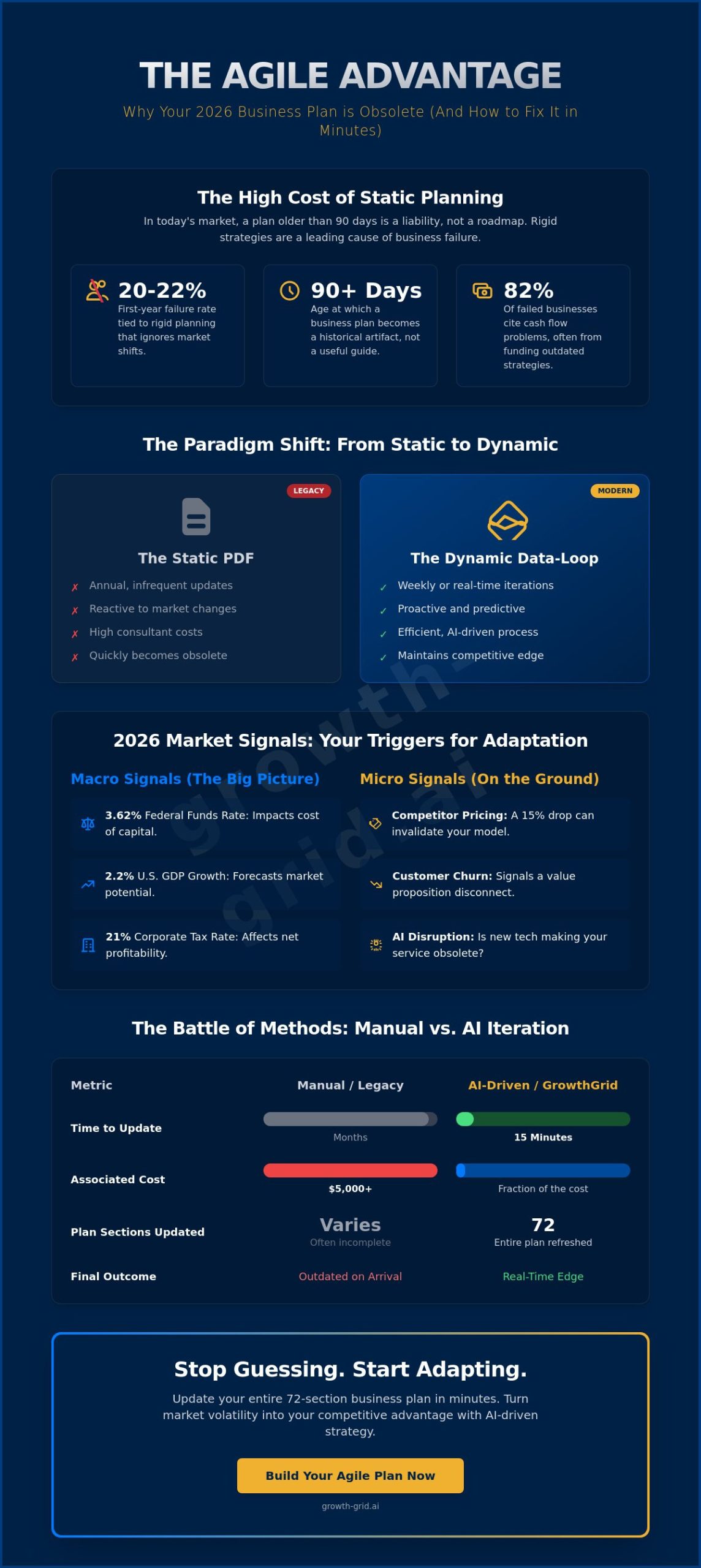
- Legacy Approach: Static PDF, annual updates, high consultant costs, reactive.
- Modern Approach: Dynamic data-loop, weekly iterations, AI-driven, proactive.
The Difference Between a Pivot and an Adaptation
Many entrepreneurs confuse these two concepts, leading to unnecessary stress. A pivot changes the “What” of your business, such as your core mission or target industry. Adaptation refines the “How.” It involves making fundamental changes to a business model to stay relevant. For example, a 2026 micro-adaptation might involve shifting your service delivery from human-led to AI-agent-assisted to maintain margins. You don’t always need to rewrite your core assumptions; often, you just need to update your execution strategy to match current market signals.
The Cost of Planning Inertia
Outdated plans are expensive. Research shows that 82% of failed businesses cite cash flow problems as the primary cause. Much of this stems from “Planning Inertia,” where a company continues to fund a strategy that the market has already rejected. The psychological barrier of “but I spent months writing this” can be fatal. You must be willing to kill underperforming initiatives immediately. Planning Inertia is the #1 killer of 2026 startups because it prioritizes ego over evidence. Stop clinging to a document that doesn’t reflect the current 2.2% GDP growth forecast. Update your strategy now to protect your capital.
Identifying Market Changes: Signals That Require a Plan Update
Identifying the right signals is the first step in learning how to adapt my business plan to market changes. In 2026, you cannot wait for quarterly reports to notice a shift. You need to monitor ‘Macro’ shifts like the effective federal funds rate, currently at 3.62%, and the flat 21% federal corporate income tax rate. These numbers directly impact your cost of capital and net profitability. Global supply chains remain sensitive; any disruption can instantly invalidate your inventory strategy and pricing structure.
‘Micro’ signals are equally critical for your survival. Track competitor pricing daily. If a rival drops prices by 15% using a new automation tool, your old pricing model is effectively dead. Monitor customer sentiment and churn rates through automated tracking. High churn is a loud signal that your value proposition has decoupled from market needs. You must listen to what the data says about your current relevance.
The ‘AI Disruption Factor’ is the newest variable you must track. Ask yourself: Is a new AI agent making my service model obsolete? If a task you charge for can now be performed for free by a specialized model, you must iterate. Setting up a ‘Market Watch’ dashboard to automate this detection ensures you aren’t blindsided by innovation. Professional agility requires seeing the wave before it hits your balance sheet.
External vs. Internal Trigger Points
External triggers include new technology, shifts in consumer behavior, or economic downturns like the forecasted 2.2% U.S. GDP growth limit. Internal triggers often manifest as team turnover, cash flow shortages, or product-market fit gaps. You must weight these triggers to decide the scale of your update. A slight shift in interest rates may only require a financial tweak, but a 42% lack of market need requires a structural overhaul. Follow clear steps to adapt your business plan to ensure you don’t overreact to noise or underreact to legitimate threats.
Using Real-Time Data to Validate Changes
Stop relying on gut feelings to run your company. Use sentiment analysis tools to see how people feel about your brand versus your competitors. Data-backed decision making is the only way to maintain a competitive edge. Integrating a thorough cash flow analysis into your market response allows you to see exactly how much “pivot runway” you have left. If your cash flow is tightening while the world economy grows at 3.1%, the problem is likely internal. Using an AI strategy document generator can help you synthesize this data into a coherent roadmap in minutes, ensuring your plan stays as fast as the market.
The 5-Step Framework to Adapt Your Plan Without Starting Over
You don’t need to burn your existing strategy to stay relevant. Learning how to adapt my business plan to market changes is a surgical process, not a total demolition. In 2026, speed is your primary asset. If you spend three weeks rewriting a document, the market has already moved again. Follow this five-step framework to iterate with precision and maintain your momentum.
- Step 1: Audit. Compare your current assumptions against live data like the 3.62% federal funds rate.
- Step 2: Isolate. Identify which “Impact Zones” (Financials, Marketing, or Operations) are failing to meet targets.
- Step 3: Model. Run scenario tests to see how a 10% drop in demand affects your 6.75% prime loan rate obligations.
- Step 4: Reallocate. Shift capital from stagnant projects to high-growth, AI-integrated initiatives.
- Step 5: Synchronize. Update your legal and HR documents to match your new operational reality immediately.
Auditing Your Impact Zones
Start with a high-speed review of your document structure. Most professional plans contain roughly 72 sections; you likely only need to fix five or six. Prioritize your Executive Summary and Financial Projections first. These are the areas investors and lenders scrutinize most during economic shifts. To Adapt to Market Changes effectively, your startup business plan needs a quarterly stress test. This ensures your burn rate doesn’t exceed your forecasted 2.2% GDP growth environment. Identify the gaps, then fix them. Don’t overthink it.
Scenario Modeling and Testing
Stop guessing about your future. Create three distinct financial versions: Best Case, Worst Case, and Most Likely. Use a “What-If” framework to stress-test your supply chain. For example, what if your shipping costs spike by 15% next month? Using an AI business plan generator allows you to simulate these market responses in seconds. You can see the immediate impact on your margins without touching a manual spreadsheet. This level of preparation turns market volatility into a manageable variable rather than a constant threat. It gives you the confidence to act while others are still analyzing.
Comparing Methods: Manual Updates vs. AI-Driven Iteration
Traditional planning methods are built for a world that no longer exists. In the past, refreshing a strategy meant hiring a consultant for $5,000 or more and waiting weeks for a revised draft. By the time the document was finished, the market had often shifted again. Speed is now your most valuable asset. Comparing the legacy approach to modern iteration reveals a stark difference in both cost and utility.
- The Legacy Approach: Manual drafting, $5,000+ consultant fees, 15 days of iteration, static data.
- The Modern Approach: AI-assisted generation, sub-$100 costs, 15 minutes of iteration, real-time data integration.
Accuracy is the other half of the equation. Human-led updates often rely on outdated spreadsheets that can’t easily ingest complex variables like the 3.62% federal funds rate or fluctuating prime loan rates. AI handles these projections with precision, ensuring your financials remain grounded in 2026 reality. When you solve how to adapt my business plan to market changes using intelligent automation, you eliminate the risk of human error in your most critical projections.
Why Traditional Planning Software Fails in 2026
Most legacy platforms rely on rigid templates. These frameworks don’t allow for the quick pivots required to survive a 2.2% GDP growth environment. You need business plan software that includes native AI generation to keep up. Another major hurdle is the “Document Silo” problem. Your strategy doesn’t exist in a vacuum; it must talk to your contracts and HR policies. Traditional software leaves these documents disconnected, while modern AI suites synchronize your entire operational library instantly.
The ROI of Rapid Planning
Every hour you spend wrestling with a Word document is an hour stolen from customer acquisition or product development. Rapid planning reduces the decision fatigue that paralyzes many entrepreneurs during market shifts. By automating the heavy lifting, you stay focused on execution rather than administration. Using advanced AI saves 95% of planning time compared to manual methods. This efficiency allows you to test new ideas and update your roadmap without draining your mental or financial reserves. Start iterating your strategy today to reclaim your time and secure your competitive edge.
Rapid Adaptation with GrowthGrid: Update Your Strategy in 15 Minutes
Stop treating your business plan like a static monument. In a 2026 economy where the world economy grows at 3.1% and AI agents are standard in finance, your strategy must be as fluid as the data driving it. GrowthGrid’s AI engine is built specifically for this level of speed. It takes your existing data and instantly adapts it to new market inputs, such as shifting interest rates or competitor price drops. You don’t need to start over. You just need to iterate.
The platform allows you to generate a fresh, comprehensive 72-section plan by simply updating your answers in a guided interface. If your churn rate spikes or a new regulation changes your tax obligations, you input that single variable. The AI then recalibrates your entire financial forecast and operational roadmap. Once the update is complete, you can download your fresh ai business plan in PDF or DOC format instantly. Professional planning has never been this efficient.
One of the most powerful features is the ‘Operational Ripple.’ When you update your core strategy, GrowthGrid doesn’t stop at the business plan. It identifies necessary changes across your entire document library. This includes automatically updating NDAs, service agreements, and HR documents to ensure your legal and team structures match your new direction. This synchronization eliminates the friction that usually slows down a pivot. It turns a complex organizational shift into a streamlined, automated process.
From Strategy to Execution in One Click
GrowthGrid uses a question-based interface that removes the “blank page” anxiety. It guides you through the specific data points that reflect 2026 market changes. Having a unified dashboard for your strategy, legal, and HR documents means you spend less time searching for files and more time growing your revenue. It is the pragmatic choice for the modern entrepreneur who values results over overhead. You stay in control of the vision while the AI handles the structural heavy lifting.
Your Next Move: Start the 15-Minute Update
Before you hit the ‘Generate’ button, run through a final checklist. Ensure your 2026 revenue targets align with the current 2.2% GDP growth forecast. Verify that your team roles account for new AI efficiencies. Once you are ready, present your adapted plan to stakeholders with confidence. A plan that was updated ten minutes ago carries far more weight with investors than one written six months ago. Speed is your competitive edge. Adapt your business plan now with GrowthGrid and lead your market with a strategy that never goes out of date.
Secure Your 2026 Competitive Edge
The 2026 market doesn’t wait for annual reviews or expensive consultants. You now have a clear, actionable framework for how to adapt my business plan to market changes without losing weeks to manual drafting. By shifting from a static PDF to a dynamic data-loop, you protect your startup capital and maintain alignment with real-time economic shifts. Agility is no longer a buzzword; it is your primary defense against the 45% to 50% five-year failure rate.
Speed is your ultimate advantage in this high-velocity economy. Thousands of 2026 startups already use AI to replace legacy planning methods that once cost thousands of dollars. You can join them by generating a professional, 72-section comprehensive plan that keeps your financials and operations in perfect sync. Stop wrestling with outdated spreadsheets and start leading your industry with data-backed confidence.
Update your business plan in 15 minutes with GrowthGrid and download your results in PDF or DOC format instantly. You have the tools to stay ahead. Take the next step and secure your business’s future today.
Frequently Asked Questions
How often should I update my business plan in 2026?
Update your plan every three to six months to stay aligned with the 2026 economy. In a market where U.S. GDP growth is forecasted at 2.2%, a static document becomes a liability very quickly. Monthly reviews are even better for sectors sensitive to the 3.62% federal funds rate. Treat your plan as a dynamic roadmap that requires regular data refreshes to remain accurate.
Can I adapt my business plan without changing my core mission?
You can absolutely evolve your strategy while keeping your mission intact. Adaptation is about refining your “how,” such as your pricing models or supply chain, to meet new market pressures. Your core mission is your “why,” which should remain stable even as you pivot your operations. This balance allows you to stay relevant without losing your brand identity.
What are the first sections of a business plan I should change when the market shifts?
Prioritize the Executive Summary and Financial Projections before touching anything else. These sections are the most sensitive to macro shifts like interest rate changes or new tax regulations. Updating these first provides an immediate view of your runway and helps you understand how to adapt my business plan to market changes without wasting time on secondary operational details.
How do I communicate plan changes to my investors or team?
Use a direct, data-backed approach to explain the reasoning behind every strategic shift. Present your updated financial models and new milestones clearly to demonstrate proactive leadership. Reassure your stakeholders by showing how these adjustments protect the company’s valuation. Transparency reduces friction and ensures your entire team remains aligned with your new 2026 roadmap.
Is it better to write a new plan or edit the old one?
Iteration is significantly more efficient than starting from scratch. Use an AI business plan generator to update specific data points within your existing framework. This method saves 95% of the time required for manual drafting while maintaining your historical context. Focus on surgical edits to your current strategy to move faster and reduce the risk of planning inertia.
How can AI help me predict market changes before they happen?
AI agents analyze massive datasets to identify emerging trends and micro-signals that human analysis often misses. These tools track competitor pricing and customer sentiment in real time. By ingesting these signals early, AI helps you anticipate disruptions before they hit your balance sheet. This predictive power allows you to move from a reactive stance to a proactive, data-driven strategy.
What happens if I don’t adapt my business plan to market changes?
Failure to adapt is the primary cause of cash flow problems, which trigger 82% of small business failures. If you ignore 2026 market shifts, your resource allocation will quickly decouple from actual customer needs. This misalignment burns through capital and hands your market share to more agile competitors. Staying static in a 3.1% global growth economy is a fast track to obsolescence.
How much does it cost to professionally update a business plan?
Legacy consultants often charge $5,000 or more for a single comprehensive update. Modern AI-driven tools have reduced this cost to a small fraction of traditional fees. You should choose a solution based on the speed and accuracy your business requires. Opting for automated iteration allows you to reinvest those significant savings into your marketing and product development efforts immediately.