

The “blank page” syndrome is the silent killer of your hiring velocity. When you’re building a team in 2026, you can’t afford to waste days on generic listings that attract the wrong candidates. Finding the right ai tool for writing job descriptions is the only way to ensure your recruitment stays precise and strategy-aligned without the manual grind.
You likely feel the pressure to scale while keeping your culture intact. It’s exhausting to manually scrub for unconscious bias or worry if your JD actually reflects your latest business plan. You deserve a workflow that produces a 90% finished draft in seconds. This allows you to focus on the people instead of the paperwork.
This roundup explores the top tools currently transforming the hiring landscape, including Jasper and Workable. We’ll show you how to leverage automation to reduce hiring costs by up to 30% per hire. It’s time to stop writing from scratch and start hiring with professional precision.
Key Takeaways
- Slash your drafting time from two hours to 15 minutes by replacing legacy manual methods with modern automation.
- Discover how a dedicated ai tool for writing job descriptions ensures every role you hire for is perfectly mapped to your long-term business strategy.
- Evaluate the top five platforms for 2026 based on critical metrics like bias detection, speed, and strategic alignment.
- Implement a four-step framework to define business context and core competencies for more precise candidate matching.
- Streamline your entire HR workflow by integrating your job descriptions into a broader ecosystem of AI-generated strategy and legal documents.
Why Your Hiring Starts with the Right AI Tool for Writing Job Descriptions
Legacy hiring methods are a liability. Staring at a blank document for two hours or copying a stale template from a competitor doesn’t work anymore. An ai tool for writing job descriptions isn’t just a basic text generator; it’s a strategic engine. These tools use Large Language Models to map specific technical skills and soft competencies to your company’s unique needs. You’re no longer just filling a seat. You’re engineering a role for maximum performance.
The hidden cost of generic job descriptions is devastating. When your JD is vague, you attract “spray and pray” applicants who don’t fit your culture. This leads to bad hires and turnover rates that can sink a startup. In 2026, inclusivity is a legal and operational standard. With new regulations like Colorado’s SB 24-205 requiring bias audits, you need a system that flags exclusionary language automatically. While platforms like Wikipedia have established Wikipedia’s policy on AI-generated content to maintain information integrity, smart founders use AI to ensure their hiring documents are compliant, fair, and professional.
The ROI of Automated Job Drafting
Founders wear too many hats to act as full-time copywriters. Every hour you spend tweaking bullet points is an hour lost on product development or closing deals. Switching from the “Legacy Method” to an AI-driven workflow shrinks your drafting time from 120 minutes to just 15 minutes. This efficiency isn’t just about speed; it’s about the bottom line. Employers using AI report up to a 75% reduction in time-to-hire. By generating precise drafts in-house, you also slash the need for expensive recruitment agencies that often charge 20% to 30% of a candidate’s first-year salary. It’s a direct injection of capital back into your business.
Beyond Keywords: Strategic Alignment
A job description is more than a list of tasks. It’s a strategic bridge between your daily operations and your long-term vision. Your JD must align perfectly with the goals established in your business plan. If your plan calls for rapid market expansion, your JD should prioritize “outcome-based” requirements over “task-based” ones. Instead of saying “must answer phones,” an AI-optimized JD focuses on “maintaining a 95% customer satisfaction rating.” This shift ensures that every person you hire is directly contributing to the milestones that matter for your growth. Stop hiring for activities; start hiring for results.
Top 5 AI Job Description Generators Compared for 2026
Selecting the right ai tool for writing job descriptions determines whether your hiring process is a bottleneck or a catalyst. In 2026, the market has split into two camps: generic generators and integrated document ecosystems. While free tiers like ChatGPT provide a starting point, they often lack the industry-specific nuance required for high-stakes roles. Professional suites now dominate because they offer built-in bias detection and strategic alignment as standard features.
As IBM’s analysis of AI in recruiting highlights, the objective evaluation of candidates starts at the job description phase. If your tool doesn’t actively scrub for gendered language or cultural bias, you’re exposing your brand to risk. Standalone tools are losing ground to platforms that connect your hiring documents directly to your broader business strategy. Speed is no longer enough; you need precision that scales.
Workable and Metaview: The Recruiter’s Favorites
Workable remains a powerhouse for teams that need volume. Its massive role library allows you to pull from thousands of templates, though it can sometimes feel generic. Metaview takes a different approach by using AI to analyze actual intake calls. This results in context-rich JDs that reflect how your team actually speaks. These are excellent choices for dedicated HR departments, but they often require significant manual oversight to ensure they match a founder’s specific vision.
GrowthGrid: The Founder’s Efficient Choice
For founders, the friction of jumping between different apps is a productivity killer. GrowthGrid changes the game by integrating JD generation directly into your business plan software. This ensures that every role you draft is automatically aligned with your company’s mission, financial projections, and operational goals. It’s the difference between a generic “Marketing Manager” post and one specifically engineered to hit your Q3 growth targets.
The GrowthGrid Evolution:
- Legacy Method: Disconnected documents, manual data entry, and inconsistent brand voice. ❌
- GrowthGrid Method: Unified ecosystem, strategy-aligned JDs, and automated legal compliance. ✅
By using a single platform for your Business Plan, HR documents, and Employment Contracts, you eliminate the “blank page” syndrome entirely. You can generate your first strategy-aligned JD today and see the difference in candidate quality immediately.
Start. ➔
Beyond the Prompt: Integrating JDs into Your Business Strategy
The biggest mistake founders make is treating a job description as a simple broadcast. It isn’t just a post to attract resumes; it’s a strategic blueprint for your company’s next phase. If your ai tool for writing job descriptions doesn’t understand your long-term vision, it’s just generating generic noise. You need a system that digests your startup business plan before it suggests a single requirement. This context ensures every hire moves the needle on your specific KPIs rather than just filling a desk.
Your AI should understand your “Why” before it ever writes your “What.” When the software knows you’re aiming for a Series B in eighteen months, it won’t just list basic tasks. It will prioritize candidates with scaling experience and high-pressure problem-solving skills. This alignment transforms a standard HR document into a competitive advantage. It bridges the gap between your high-level strategy and your daily operations.
Aligning Hiring with Financial Goals
Don’t hire in a vacuum. Every new role has a price tag and a projected ROI that must be reflected in your cash flow analysis. If your JDs outpace your actual revenue-driving activities, you risk shortening your runway. Lean hiring in 2026 demands that every position is either a direct revenue generator or a critical bottleneck-breaker. AI helps you quantify these needs by linking role responsibilities to specific financial outcomes. This ensures your payroll remains an investment rather than a drain on resources.
Culture Mapping with AI
Culture isn’t about office perks; it’s about shared behaviors. Use AI to translate your core values into specific behavioral requirements. This shift helps you avoid the “culture fit” trap, which often acts as a mask for unconscious bias. Instead, focus on “culture add” by looking for diverse perspectives that strengthen your existing team. AI identifies exclusionary language by scanning for gendered adjectives or age-related phrases that might alienate top-tier diverse talent. This precision ensures your talent pool is wide, inclusive, and perfectly matched to your mission. Stop guessing and start engineering your team for success. ➔
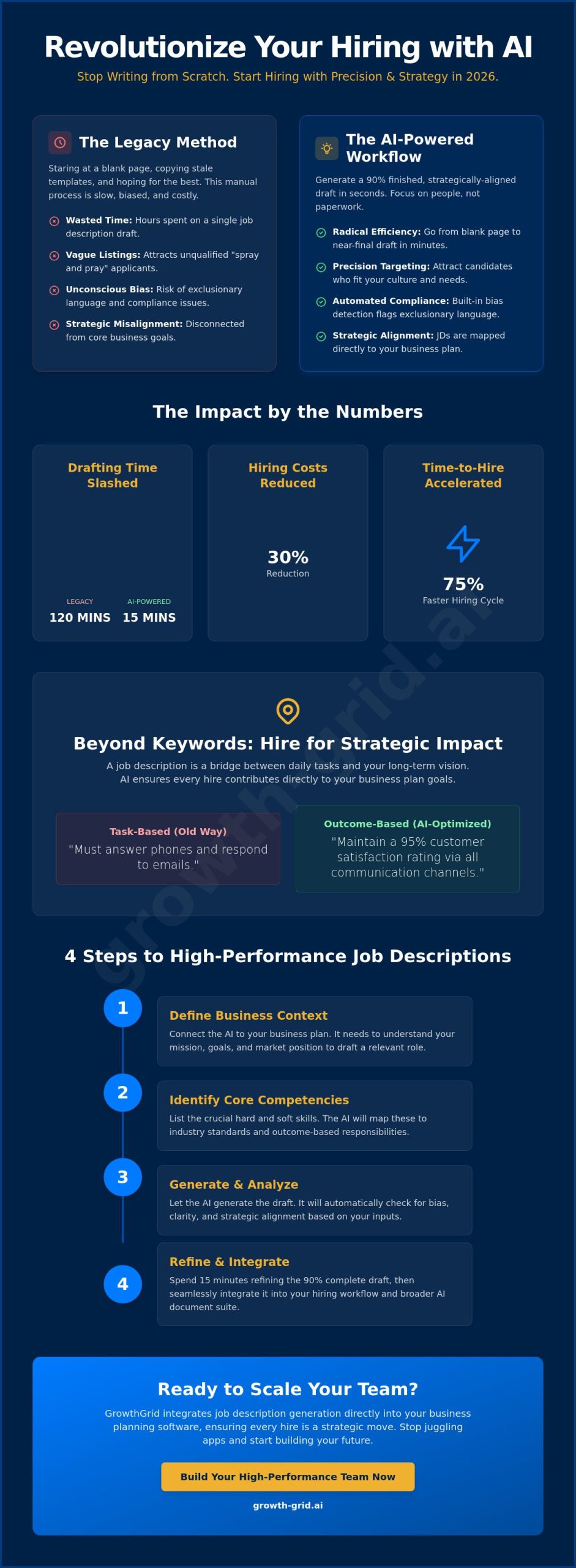
4 Steps to Generate High-Performance Job Descriptions with AI
Efficiency is a choice, not a lucky break. To turn an ai tool for writing job descriptions into a high-performance engine, you need a repeatable workflow. Speed matters, but only if the output is accurate. Follow this four-step framework to ensure every listing you post is engineered for conversion and compliance.
- Step 1: Define the Business Context. Start with the “Why.” Feed the AI your current growth stage and departmental goals. This prevents the tool from generating generic filler text.
- Step 2: Input Core Competencies and Outcomes. Focus on the “What.” Instead of listing daily chores, define the measurable results you expect within the first six months.
- Step 3: Apply Bias and Tone Filters. Address the “How.” Use built-in filters to scrub for gendered language. In 2026, this isn’t just best practice; it’s a legal necessity under regulations like Colorado’s SB 24-205.
- Step 4: Audit against Strategic Documents. Cross-reference the draft with your existing strategy. Ensure the requirements don’t conflict with your financial projections or operational roadmap.
Prompt Engineering for JDs
The quality of your JD depends on the quality of your prompt. Use the “Context-Role-Task” framework for the best results. For an executive role, your prompt should look like this: “Context: We are a fintech startup scaling to Series B. Role: You are an expert HR strategist. Task: Draft a JD for a Head of Growth focused on P&L ownership and 30% month-over-month user acquisition.” For entry-level roles, shift the focus to learning agility and core technical skills. Iterate with the AI by asking it to “make the tone more punchy” or “shorten the requirements list to the five most critical items.”
The Human-in-the-Loop Audit
AI is a powerful assistant, but it isn’t a replacement for your judgment. You must still review every draft for “hallucinated” requirements. Sometimes an AI might claim a junior developer needs 15 years of experience in a language that has only existed for five. Check the output against your internal AI business plans to ensure the role’s scope hasn’t drifted. Finally, use the AI to “stress test” your JD. Ask it to compare your draft against top competitor listings and identify where your offer is weaker or stronger. This ensures you’re not just posting a job; you’re winning the talent war.
Ready to automate your recruitment workflow? Build your high-performance hiring suite with GrowthGrid today.
Optimize. ➔
Scaling Your Team Fast with GrowthGrid’s AI Document Suite
Scaling a startup requires more than just one good hire. It requires a cohesive documentation strategy that keeps your operations lean and your legal exposure low. GrowthGrid’s AI HR Document Generator has become the 2026 standard for founders who refuse to settle for fragmented tools. While other platforms offer a standalone ai tool for writing job descriptions, GrowthGrid provides a unified ecosystem. You move from a high-level strategy to an active job post in a single workflow.
The power of a single platform cannot be overstated. When your job descriptions, strategy documents, and employment contracts live in the same environment, data silos disappear. You can generate a complete, professional document suite in just 15 minutes. This efficiency allows you to focus on interviewing top-tier talent rather than formatting paragraphs. It is the modern solution for founders who need to move at the speed of the market.
One Answer, Seventy-Two Sections
GrowthGrid utilizes a sophisticated questionnaire-based approach to ensure total document consistency. You provide the core details about your vision and operational needs once. Our AI then maps that intelligence across seventy-two potential document sections. This ensures your JDs perfectly mirror the market analysis and competitive positioning found in your business plan. There is no risk of a “tone mismatch” between what you tell investors and what you tell candidates. Everything is exported in professional PDF or DOC formats for immediate implementation. It’s precise. It’s professional. It’s done.
Future-Proofing Your Startup Documentation
Your hiring needs will evolve, and your documentation must keep pace. GrowthGrid doesn’t stop at job descriptions. Our suite includes an AI Legal Document Generator for NDAs and privacy policies, ensuring you maintain a professional standard without the overhead of a massive legal team. This integrated approach protects your intellectual property while you scale. You get the protection of a corporate infrastructure with the agility of a lean startup. Stop wasting time on disconnected templates that don’t talk to each other.
Generate your professional job descriptions and business docs with GrowthGrid today.
Scale. ➔
Build Your High-Performance Team Today
Hiring in 2026 is a high-stakes game of speed and precision. You’ve seen how the right ai tool for writing job descriptions transforms recruitment from a time-consuming chore into a strategic advantage. By following a structured four-step process and aligning your roles with your financial milestones, you eliminate the friction that holds most startups back. You no longer have to choose between moving fast and hiring correctly.
The days of struggling with generic templates and disconnected documents are over. You need a system that understands your vision as well as you do. GrowthGrid provides a complete suite of AI HR and legal documents to ensure your team remains compliant and strategy-aligned from day one. Trusted by startups worldwide, our platform delivers comprehensive 72-section business plans in under 15 minutes. It’s the modern way to build a legacy.
Start your business plan and generate HR documents in minutes with GrowthGrid.
Your next great hire is waiting for a role that’s clearly defined and perfectly aligned. Take the first step toward a more efficient hiring process today. You’ve built the vision; now build the team to execute it.
Succeed. ➔
Frequently Asked Questions
What is the best AI tool for writing job descriptions for startups?
GrowthGrid is the premier choice for startups because it integrates your hiring needs directly with your business strategy. Unlike standalone tools, it ensures every JD you draft is perfectly aligned with your company’s financial projections and growth milestones. This unified ecosystem allows founders to move from a strategy document to a professional job post in a single, efficient workflow.
Can AI job description generators help remove unconscious bias?
Yes, modern AI tools include sophisticated filters designed to identify and replace gendered or exclusionary language. By using an ai tool for writing job descriptions, you can automatically ensure your listings are inclusive and reach a wider, more diverse talent pool. This automation is essential for staying compliant with 2026 labor regulations that prioritize transparency and bias reduction in hiring.
Do I need a paid subscription to use an AI JD generator?
You can often find free tiers for basic drafts, but professional suites are necessary for growing teams that require precision and compliance. Free tools typically lack the advanced features like deep bias detection, strategic alignment, and integrated document exports. A professional subscription ensures your HR documents are part of a secure, consistent, and legally compliant ecosystem.
How do I ensure an AI-written job description is legally compliant?
Legal compliance requires a human-in-the-loop audit to verify that all requirements match local labor laws. You must check the AI output against specific state regulations, such as Illinois HB 3773 or Colorado’s SB 24-205, to ensure non-discrimination. Always cross-reference the generated text with your internal legal documents to confirm that the job’s scope and requirements are accurate and valid.
Should I use ChatGPT or a specialized AI tool for job descriptions?
Specialized tools are significantly better because they are built on HR frameworks and strategic business logic. While ChatGPT is a capable generalist, a dedicated ai tool for writing job descriptions includes built-in bias filters and industry-specific templates that generic models lack. Specialized platforms eliminate the need for complex prompt engineering, delivering a 90% finished draft in seconds.
How long does it take to generate a job description with AI?
Generating a high-performance job description with AI takes roughly 15 minutes from start to finish. This is a drastic reduction compared to the legacy method of manual drafting, which often takes two hours or more. This speed allows founders to maintain their hiring velocity without sacrificing the quality or strategic alignment of their recruitment documents.
Can AI tools help with SEO for job postings?
AI tools excel at optimizing your listings for search engines and job board algorithms by identifying high-traffic keywords. By using industry-standard titles and relevant skill clusters, the AI ensures your post appears in front of the most qualified candidates. This data-driven approach increases your visibility on platforms like LinkedIn and reduces your overall time-to-hire.
What information should I provide the AI to get the best result?
Provide the AI with your company mission, the role’s core competencies, and the specific outcomes you expect in the first six months. The more context you provide about your business plan and growth stage, the more precise the output will be. This ensures the AI drafts a role that isn’t just a list of tasks, but a strategic engine for your startup’s success.