

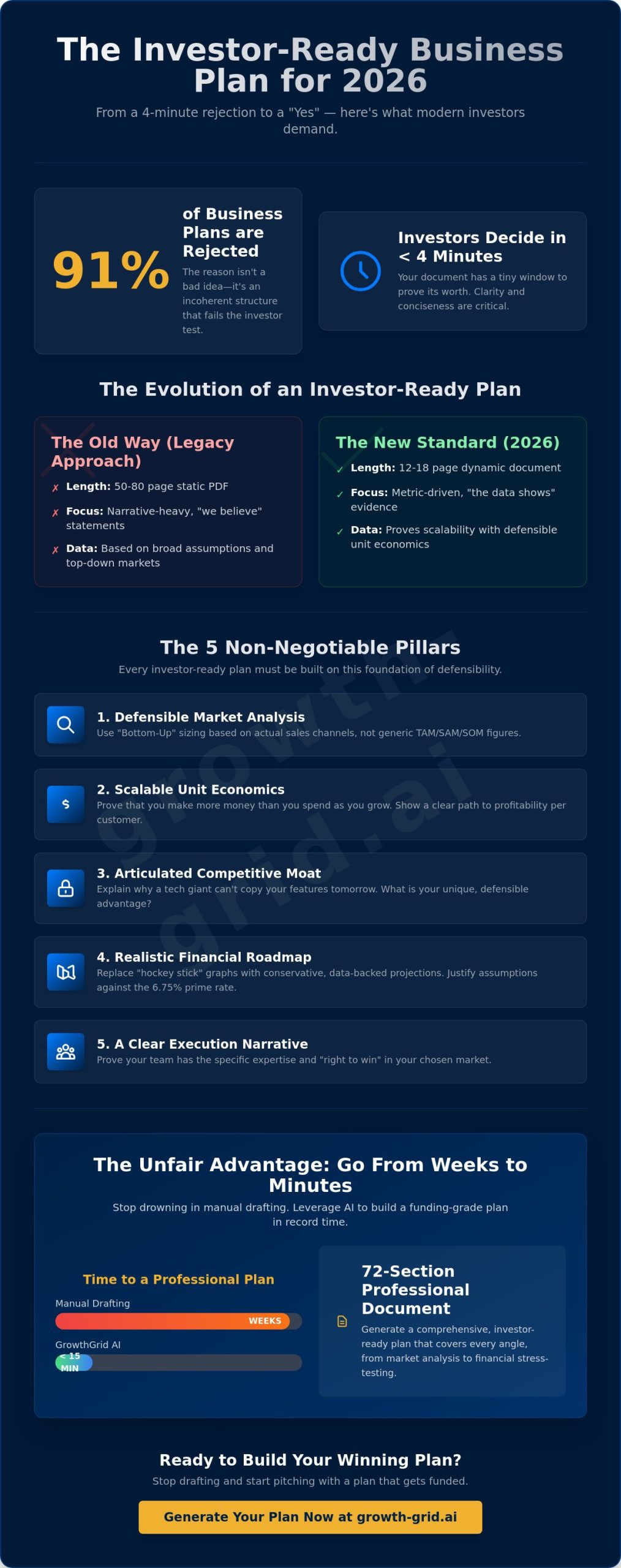
91% of investors reject business plans because the structure is incoherent, not because the idea is bad. That is a staggering figure from GrowthGrid. Most founders spend weeks drowning in manual drafting and complex financial modeling only to face a rejection in under four minutes. You likely feel the pressure to look professional while watching your time slip away. Understanding what makes a business plan investor-ready is the difference between a “yes” and a quick “no” in the current market.
You deserve a plan that reflects your vision without the stress of starting from a blank page. This guide eliminates the guesswork. You’ll discover the exact criteria investors use to vet plans in 2026 and how to build a funding-grade document in record time. We cover how to justify assumptions against a 6.75% prime rate and 4.2% inflation. We also break down the shift toward 12 to 18 page documents and the data-driven metrics that prove your company is scalable. It’s time to stop drafting and start pitching with total confidence.
Key Takeaways
- Understand why 2026 investors prioritize “intention” over mere innovation and how to prove your market demand using real-time customer data.
- Master the five non-negotiable pillars that define what makes a business plan investor-ready, focusing on defensible unit economics and acquisition metrics.
- Identify and avoid common red flags like the “unrealistic growth trap” and vague fund allocation that cause most professional pitches to fail.
- Implement a two-step stress-test audit to ensure every claim in your plan is defensible and has a clear impact on your bottom line.
- Learn how to leverage an AI Business Plan Generator to transform weeks of manual drafting into a professional, 72-section document in under 15 minutes.
What Does “Investor-Ready” Actually Mean in 2026?
In its simplest form, a business plan is a formal written document that outlines your goals. However, in the high-stakes environment of 2026, the definition has evolved into something far more rigorous. An investor-ready business plan is a strategic asset that proves market demand, operational scalability, and financial defensibility. Understanding what makes a business plan investor-ready requires a focus on three areas: validated data, clear intent, and risk mitigation.
Investors have moved past the era of “innovation for innovation’s sake.” They no longer fund vague ideas about disruption. Instead, they look for intention. This means showing a clear, calculated path to profitability. They want to see that you understand the 6.75% prime rate and how it impacts your cost of capital. Innovation gets you a meeting, but intention gets you a term sheet. If your plan doesn’t explicitly state how you will capture and defend your market share, it isn’t ready for a pitch.
The core of what makes a business plan investor-ready is the shift from ego to evidence. Most founders rely on “we think” or “we believe” statements. Professional investors ignore these. They prioritize “the data shows” or “our pilot program proved” statements. According to IdeaFloat, investors spend less than four minutes reviewing a business plan. You have a very narrow window to win the deal. Your executive summary must act as a standalone sales tool that addresses every major concern before the reader even turns the page.
The Psychology of the Investor Review
Investors don’t read your plan to find reasons to say yes. They read it to find a single reason to say no. This is the “Risk Mitigation” mindset. They perform a 30-second skim test to look for red flags like incoherent financial models or generic market analysis. Clarity of thought equals clarity of execution. If you can’t explain your unit economics simply, they assume you can’t manage them effectively. Every sentence must remove a layer of perceived risk.
Traditional vs. Modern Investor Expectations
The days of the 50-page business plan are over. In 2026, conciseness is a sign of founder strength. Modern investors prefer documents between 12 and 18 pages that focus on hard metrics. They also view your plan as a “Living Document.” They expect you to iterate based on market shifts and inflation data.
- Legacy Approach: Static 80-page PDF; Narrative-heavy; Based on assumptions.
- 2026 Standard: 15-page dynamic document; Metric-driven; Proves scalability with unit economics.
Quantifying your value through a professional structure is no longer optional. It is the baseline for entry into any serious VC office or angel group.
The 5 Non-Negotiable Pillars of an Investor-Ready Plan
Building a document that secures funding requires more than just filling out a template. You need a roadmap for how to structure, run, and grow your venture that stands up to intense scrutiny. In 2026, defensibility is the standard. If your assumptions can’t survive a stress test, your plan isn’t ready. What makes a business plan investor-ready is the presence of five specific pillars that prove you have a viable, scalable business.
First, your market analysis must move beyond generic TAM/SAM/SOM figures. Investors are tired of hearing that “the market is worth $10 billion.” They want to see actual customer acquisition data. Second, you must demonstrate a scalable unit economic model. If you lose money on every customer, scaling will only accelerate your failure. You need to prove that your business makes more money than it spends as it grows. Third, you must articulate a competitive moat. Be clear about why a tech giant cannot simply copy your features tomorrow. Fourth, your financial roadmap should be realistic. Conservative, data-backed projections always beat “hockey stick” graphs that lack a foundation in reality. Finally, you need an execution narrative. This proves your team has the “right to win” in your specific niche.
Crafting a Defensible Market Analysis
Stop using “Top-Down” fluff. Investors look for “Bottom-Up” market sizing. This starts with your specific sales channels and conversion rates. It’s about how many people you can actually reach, not the total number of people in the world. Use a market assessment analysis to show you’ve studied competitor weaknesses without being dismissive. If you claim you have no competition, you haven’t looked hard enough. Identifying direct and indirect threats builds credibility.
Financial Projections That Build Trust
Your numbers tell a story about your operational discipline. A clear cash flow analysis is the most important part of this section. Investors check your burn rate and runway before they look at your exit strategy. They want to know exactly how long their capital will last. Set realistic milestones for your next funding round based on current 4.2% inflation rates and the 6.75% prime rate. If you need a professional edge, using an AI Business Plan Generator can help you structure these complex financial sections with precision.
Success in fundraising comes down to removing doubt. By focusing on these five pillars, you shift the conversation from “if” your business will work to “how” it will dominate. Don’t leave your funding to chance. Build a plan that proves your logic is as strong as your vision.
Red Flags: Why 91% of Business Plans Fail the Investor Test
91% of business plans never make it past the first review. This failure rate exists because founders often ignore the “Investor Lens.” Investors don’t just want to see your vision; they want to see your discipline. Understanding what makes a business plan investor-ready requires identifying the specific red flags that trigger an immediate rejection. If your document feels like a collection of guesses rather than a strategic roadmap, you’ve already lost the room.
One of the most common errors is the Unrealistic Growth Trap. Claiming 1000% year-over-year growth without a corresponding marketing spend is a major warning sign. It suggests you don’t understand your customer acquisition costs. Similarly, Vague Founder Syndrome occurs when you fail to explain exactly how you will use the capital. If you can’t map every dollar to a specific milestone, you won’t get the meeting. You should consult the SBA guide to writing a business plan to ensure your core structure meets basic professional standards before you start adding complex projections.
Investors also look for a clear exit strategy. They aren’t just funding your dream; they are buying a future return. If your plan doesn’t explain how they get their money back, it’s incomplete. Finally, avoid the Static Plan Error. Presenting data that is six months old in a fast-moving economy is a mistake. Your projections must reflect current market conditions, including the latest prime rates and inflation figures. A plan that hasn’t been updated to reflect the 6.75% prime rate shows a lack of operational awareness.
Common Financial Projection Errors
Many plans fail by ignoring seasonality or customer churn rates. If you assume every customer stays forever, your lifetime value calculations are wrong. You must also account for rising Sales and Marketing costs. A plan that lacks a “worst-case” scenario feels like a fantasy. Investors respect founders who plan for the downturn as much as the upswing. Proving you have a plan for a 10% increase in churn builds more trust than a perfect, uninterrupted growth curve.
Structural and Tone Mistakes
Stop using overly technical jargon. It obscures the business value and frustrates the reader. Your plan should be scannable and professional. While traditional formats matter, a modern startup business plan must feel urgent. It should communicate that the opportunity is happening now and that your team is the one to capture it. Professional formatting is the final layer of trust. A messy document suggests a messy business; keep your sections clean and your data points prominent.
The Polish Phase: How to Stress-Test Your Plan Before the Meeting
Drafts don’t get funded. Finished, stress-tested documents do. The final polish is where you move from a “good idea” to a “low-risk investment.” Understanding what makes a business plan investor-ready involves a ruthless audit of your own logic. You must act as your own toughest critic before an investor has the chance. This phase is about eliminating friction and proving that your strategy is bulletproof.
Start with the “So What?” Audit. Question every claim for its direct impact on the bottom line. If you mention a specific technology, explain exactly how it reduces overhead or increases delivery speed. Investors don’t care about features; they care about the economic advantage those features provide. Next, seek a Peer Review from founders who have successfully closed a round in the last twelve months. They know the specific friction points in the current market. Follow this with a Data Refresh. Ensure your numbers reflect the 4.2% inflation rate and the 6.75% prime rate verified for mid-2026. Finally, perform a Format Check. Your H2s and H3s should make the document perfectly scannable. Investors spend less than four minutes on a review, so your key data points must jump off the page. If your plan doesn’t align perfectly with your elevator pitch, you create cognitive dissonance that kills deals.
Questions to Ask Yourself Before Sending
Ask these three questions to gauge your readiness. Is my Value Proposition clear in the first 30 seconds? If a reader can’t identify how you make money by page two, they will stop reading. Are my financial assumptions defensible under scrutiny? You must be able to explain the logic behind every growth percentage. Finally, does this plan look like it was written by a professional or a hobbyist? Professionalism in your documentation is a proxy for how you will run the company once you have their capital.
Iterating with Speed
Investors value founders who move fast. If a VC gives you feedback on Tuesday, they expect an updated plan by Wednesday morning. This speed signals operational excellence and a lack of ego. Using modern business plan software allows you to make these updates in minutes rather than days. It also helps you maintain strict version control during a high-pressure funding round. Don’t let manual drafting slow your momentum when the stakes are this high.
To ensure your document meets every professional standard without the manual struggle, generate your investor-ready plan now.
Scaling the Process: Building a Funding-Grade Plan with AI
Manual drafting is the single biggest bottleneck for modern founders. You often spend weeks staring at a blank screen or wrestling with broken spreadsheet formulas. This delay doesn’t just cost you time; it drains your momentum. In the fast-moving 2026 fundraising environment, a slow document is a missed opportunity. Transitioning from a concept to a professional, structured plan is where most startups fail before they even pitch. Legacy methods require 40 or more hours of manual labor. GrowthGrid delivers a superior result in under 15 minutes.
GrowthGrid changes the equation. Our AI Business Plan Generator produces 72-section, investor-ready plans with precision. This isn’t just a simple template. It’s a deep-dive strategic document that addresses the specific questions VCs ask. It handles the heavy lifting of market analysis while you provide the core vision. This “Human-in-the-Loop” advantage gives you the speed of advanced computing without losing your unique strategic direction. A well-structured plan does more than just sit in a folder. It fuels your pitch deck, your executive summary, and your internal strategy. It provides the defensible foundation you need to survive a 30-second skim test.
The GrowthGrid Advantage
Speed is irrelevant if the quality is low. What makes a business plan investor-ready is the defensibility of its data and the professionalism of its presentation. GrowthGrid automates the complex financial modeling and market deep-dives that usually require expensive consultants. You receive professional PDF and DOC exports that meet the most rigorous VC standards. Using an ai business plan helps you secure your first meeting by demonstrating immediate operational discipline. You move from the idea phase to a funding-grade status in a single afternoon.
Next Steps for Founders
Don’t let the manual drafting process stall your growth. Start by gathering your core business data. You need your current revenue, target market demographics, and team bios. Next, define a specific funding goal and a clear use-of-funds breakdown. Investors want to see exactly where their capital goes. Once these inputs are ready, you can eliminate the friction of traditional writing. Generate your investor-ready plan now with GrowthGrid. Stop wasting weeks on manual drafting and start focusing on what matters most: closing your round and scaling your business.
Secure Your Funding with a Defensible Strategy
Fundraising in 2026 requires more than a vision; it demands operational discipline and data-backed intention. You now understand that what makes a business plan investor-ready is the shift from “we think” to “the data shows.” By focusing on defensible market analysis and realistic financial roadmaps, you eliminate the red flags that cause 91% of documents to fail. Investors spend less than four minutes on a review. You must ensure every page proves your business is scalable and resilient against current economic shifts.
Don’t let manual drafting and complex modeling become your biggest bottleneck. Join over 10,000 entrepreneurs worldwide who have streamlined their path to the pitch. With GrowthGrid, you can produce 72-section comprehensive plans with all financial projections included. It is time to stop drafting and start closing. Generate your investor-ready business plan in 15 minutes and step into your next meeting with total confidence. Your vision deserves a professional foundation.
Frequently Asked Questions
Do investors actually read full business plans in 2026?
Investors spend less than four minutes reviewing a business plan. They don’t read every word cover to cover during the initial screening. Instead, they perform a 30 second skim test to identify red flags or incoherence. If you pass this screen, the full document becomes a critical tool for their due diligence process. A professional structure is what makes a business plan investor-ready because it allows VCs to find key data without friction.
How long should an investor-ready business plan be?
Your business plan should be 12 to 18 pages long. This is a significant shift from legacy formats that often exceeded 50 pages. Modern investors value your ability to communicate complex ideas concisely. Focus on high impact data and clear visuals rather than narrative fluff. If your document is too long, you risk losing the reader’s attention before they reach your financial projections.
What is the most important section of a business plan for VCs?
The Executive Summary and the Unit Economic Model are the most critical sections. The summary acts as your initial sales pitch; it must win the deal in the first two pages. The unit economics section proves that your business can actually generate profit at scale. Investors look at these first to determine if your venture is worth the risk of a deeper review.
Can I use an AI business plan generator for a bank loan?
Yes, you can use an AI business plan generator for a bank loan. Banks prioritize structured data, clear cash flow analysis, and defensible projections. Most lenders look for documents that meet SBA standards for professional formatting. Using a generator ensures your plan includes the 72 sections typically required for a formal review. This makes it easier for loan officers to approve your application quickly.
What financial statements are required for a funding-grade plan?
A funding-grade plan requires three core financial statements: a cash flow analysis, an income statement, and a balance sheet. You should provide three to five years of projections based on realistic market data. Include your burn rate and runway clearly. These documents prove you have the operational discipline to manage capital effectively in a high inflation environment where every dollar counts.
How often should I update my business plan during a raise?
You should update your plan every time you receive significant feedback or when market conditions shift. In 2026, investors expect you to iterate quickly. If the prime rate stays at 6.75% or inflation moves from 4.2%, your financial assumptions must reflect those changes immediately. Updating your plan weekly during a raise shows that you are an active, data-driven founder who stays on top of the details.
Is an NDA necessary before sharing my business plan with investors?
NDAs are rarely necessary and often discouraged when dealing with professional VCs. Most reputable investors see hundreds of plans a year and won’t sign a non-disclosure agreement just to see a pitch. They rely on their reputation to maintain trust within the ecosystem. Instead of worrying about an NDA, focus on execution. Your competitive moat should be based on your ability to out-execute the market.
What is the difference between a pitch deck and a business plan?
A pitch deck is a visual tool designed to hook an investor and secure a meeting. A business plan is the comprehensive proof of that hook. Think of the deck as the trailer and the plan as the full script. Understanding what makes a business plan investor-ready means knowing that the plan provides the deep-dive due diligence that a 10 slide deck simply cannot cover.