

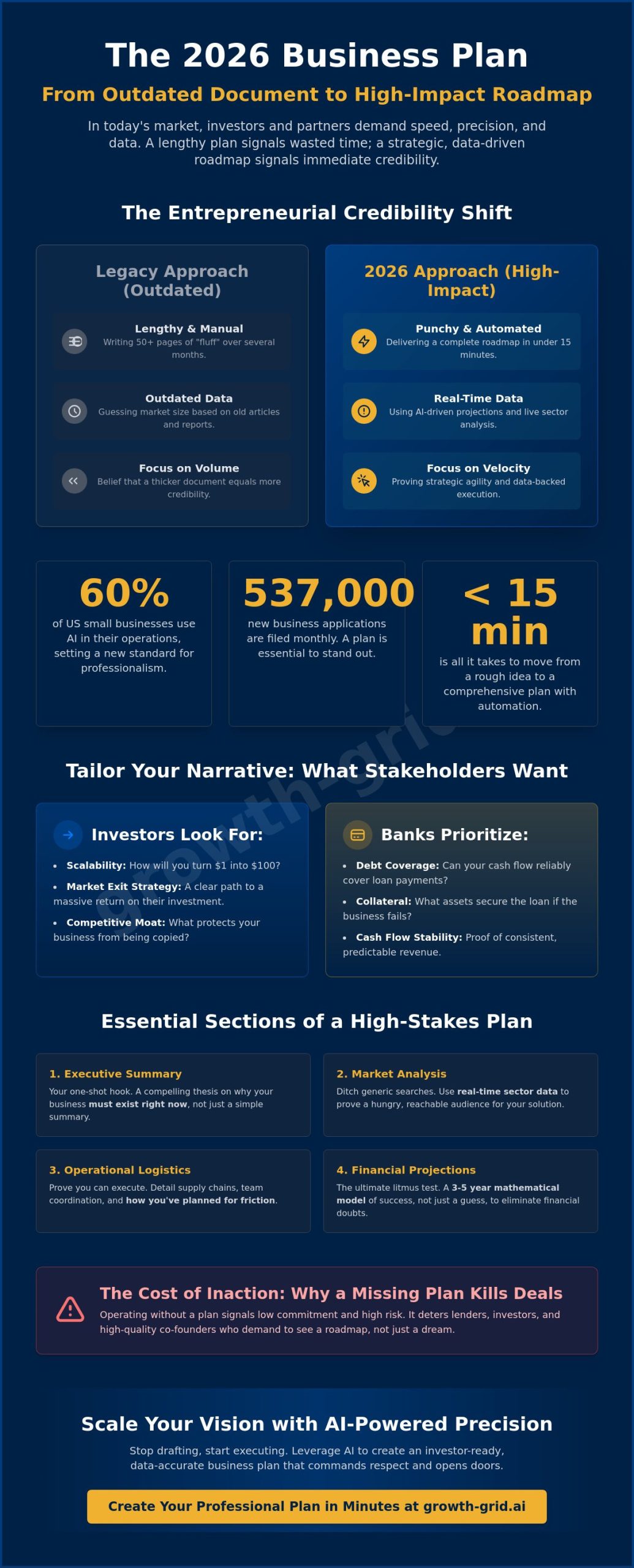
In 2026, a 50 page business plan doesn’t prove you’re a serious entrepreneur; it just proves you have too much free time. Investors and partners no longer want to see a dusty binder filled with fluff. They want to see speed, precision, and data that reflects the current market. With 60% of US small businesses now using AI in their operations, the standard for professional documentation has shifted from volume to velocity. If you want to build a business plan to show I’m a serious entrepreneur, you are likely feeling the weight of outdated templates and complex financial projections.
It’s natural to feel overwhelmed by the pressure to look professional while managing the daily grind of a startup. You don’t need to be a financial wizard to produce a document that commands respect. This article will teach you how to craft a high impact plan that signals immediate credibility to lenders and partners. You’ll learn how to skip the manual drafting phase, focus on the content that actually drives value, and walk away with a roadmap that helps you run your business. We will cover the essential metrics for 2026, investor ready financial structures, and the streamlined tools that turn your vision into a professional grade document in record time.
Key Takeaways
- Shift your focus from document length to data depth to prove your professional credibility and Founder Fit to stakeholders instantly.
- Learn how to build a business plan to show I’m a serious entrepreneur by prioritizing a high-impact Executive Summary and real-time sector data.
- Identify whether a traditional or lean startup plan is the right choice for your specific 2026 funding or operational goals.
- Use an AI Business Plan Generator to automate the narrative drafting process while ensuring investor-ready financial accuracy.
- Discover how to move from a rough idea to a comprehensive, multi-section roadmap in under 15 minutes using advanced automation.
The Business Plan as a Credibility Signal
A business plan is your most powerful credibility signal. It is the psychological bridge that transforms your vision from a “side project” into a “validated venture.” When you present a professional document, you signal that you possess the operational discipline required to manage capital. In a market with 36.2 million small businesses, standing out requires more than a good idea. It requires a comprehensive Business plan overview that proves you have analyzed every risk and opportunity.
Investors in 2026 prioritize “Founder Fit.” This is your ability to execute a strategy with data-backed precision. A structured plan mitigates the biggest fear stakeholders have: the “improvisation trap.” By delivering a business plan to show I’m a serious entrepreneur, you demonstrate that your startup is built on a foundation of strategic agility rather than guesswork. With 60% of small businesses now integrating AI into their daily operations, your ability to provide accurate, real-time data is the new benchmark for professionalism.
The Entrepreneurial Credibility Shift:
- Legacy Approach: Guessing market size based on outdated articles.
- 2026 Approach: Using real-time sector data and AI-driven projections.
- Legacy Approach: Writing 50 pages of manual fluff.
- 2026 Approach: Delivering a punchy, high-impact roadmap in minutes.
What ‘Serious’ Means to Investors vs. Banks
Professionalism isn’t a one-size-fits-all concept. You must pivot your narrative based on who is holding the checkbook. Investors look for scalability, market exit strategies, and a competitive moat that protects their equity. They want to see how you will turn their investment into a massive return. Banks, however, prioritize debt coverage ratios, collateral, and cash flow stability. They want to know you can pay the loan back. Tailoring your startup business plan to these specific needs is the difference between a “yes” and a “not right now.”
The Cost of Inaction: Why Lack of a Plan Kills Deals
Operating without a plan is a signal of low commitment. With business applications hitting 537,000 per month, lenders have no reason to gamble on someone who hasn’t done the homework. Poor financial planning is a leading cause of failure, especially when inflation and labor quality remain top challenges in 2026. A missing plan doesn’t just hurt your funding; it prevents you from attracting high-quality co-founders. Serious partners want to see a roadmap, not a dream. If you want to use a business plan to show I’m a serious entrepreneur, you cannot afford to wing it. Professionalism is now measured by your ability to leverage modern tools for data accuracy and speed.
Essential Sections of a High-Stakes Business Plan
A high-stakes business plan requires more than just filling out a template. It demands a surgical focus on the areas where investors and lenders look for cracks in your armor. While the official SBA business plan guide provides a solid baseline for traditional formats, a 2026-ready document needs to go deeper. When you craft a business plan to show I’m a serious entrepreneur, every section must scream operational readiness and strategic depth.
The Executive Summary is your first and often only chance to hook a stakeholder. It shouldn’t just summarize; it should present a compelling thesis for why your business must exist right now. Following this, your Market Analysis needs to ditch generic Google searches. Serious founders use real-time sector data to prove there is a hungry audience for their solution. Proving you understand the nuance of your industry is the fastest way to build trust with external partners.
Operational Logistics are equally vital. You must prove you know how to execute on a daily basis. Whether it’s supply chain management or remote team coordination, show that you’ve planned for the friction. Finally, your Financial Projections are the ultimate litmus test. A 3-5 year forecast isn’t a guess. It is a mathematical model of your success that eliminates any doubt about your financial literacy. Lenders expect to see these numbers presented with professional clarity to justify their risk.
The Deep Dive: Market and Competitive Strategy
Understanding your competition is about more than knowing who they are. It’s about knowing where they are weak. Use a SWOT analysis to map out internal strengths and external threats with brutal honesty. You need to define your target market with granular demographic and psychographic data. Don’t just say you’re targeting “small businesses.” Specify the industry, revenue bracket, and specific pain points. For a deeper look at these components, check out this guide on Mastering Business Analysis.
Financial Integrity: Proving the Numbers Work
Serious entrepreneurs never guess their numbers. You must have a firm grip on your customer acquisition cost (CAC) and your monthly burn rate. If you don’t know how much it costs to win a client, you don’t have a scalable business. A robust cash flow analysis is non-negotiable for proving long-term viability. It shows you can survive the “valley of death” before reaching profitability. Including a break-even analysis further demonstrates your risk awareness. If you want to eliminate spreadsheet errors, you can generate a professional plan that handles these complex calculations automatically.
Traditional vs. Lean: Choosing the Right Format for Your Goal
Choosing the wrong format is a rookie mistake that wastes your most valuable resource: time. In 2026, professionalism is measured by strategic agility and the ability to match your output to the specific needs of your audience. If you want a business plan to show I’m a serious entrepreneur, you must first define your objective. A 40 page document for a rapid internal pivot is overkill; a one page summary for a $500,000 bank loan is a guaranteed rejection. Founders who thrive in the current market understand that the format is a tool, not a chore.
The traditional plan remains the gold standard for high stakes financing and institutional partnerships. It provides the deep dive required to prove long term viability. Conversely, the lean startup plan serves as your engine for rapid testing and seed stage pitches. Many modern entrepreneurs now use a hybrid approach. They maintain a lean core for daily operations while keeping professional financial appendices ready for external scrutiny. This balance allows you to stay agile while maintaining the credibility needed to close deals with sophisticated partners.
Which Format Do You Need?
- Traditional: Best for SBA 7(a) loans, where interest rates currently sit around 11.25% APR for loans over $50,000.
- Lean: Best for internal strategy sessions and testing new product-market fit.
- Lean: Perfect for early stage tech startups looking for angel investment or co-founder buy-in.
When to Go Traditional
Certain scenarios demand the exhaustive depth of a traditional plan. If you are entering industries like manufacturing or biotech, stakeholders expect a rigorous breakdown of assets and risk management. This format is also required for most federal and state level business grants. It serves as a comprehensive step-by-step guide to creating a business plan that covers every legal and operational base. Use this when you need to prove you have the stamina for corporate governance and the financial literacy to manage significant debt coverage ratios.
The Power of the One-Page Pitch
A lean plan isn’t about doing less work; it’s about being faster. It helps you iterate without getting locked into a failing strategy. By using a Business Model Canvas, you can visualize your value proposition and revenue streams on a single page. This is ideal for initial conversations where the goal is to spark interest. However, as your venture matures, you’ll need to transition from a simple sketch to a full scale ai business plan. This evolution shows that you are responsive to market feedback while maintaining a clear, professional path toward scalability.
How to Create a Professional Plan Without the 2-Month Wait
Spending months manually drafting a document is no longer a badge of honor. In a market where 537,000 new business applications are filed monthly, speed is your primary competitive advantage. If you want a business plan to show I’m a serious entrepreneur, you must demonstrate that you value resource allocation. Investors don’t want a founder who gets bogged down in administrative minutiae. They want a leader who uses modern technology to produce high-value results instantly.
Efficiency starts with a structured workflow. Follow these five steps to move from a blank page to a professional grade document without the two month wait:
- Step 1: Aggregate core data. Gather your pricing models, operational costs, and target market size before you start writing.
- Step 2: Leverage AI narrative. Use advanced business plan software to draft the first 70% of your structure. This eliminates writer’s block and ensures you meet industry standards.
- Step 3: Customize your strategy. Inject your unique competitive moat and “secret sauce” into the framework. This is where you prove your specific value proposition.
- Step 4: Audit financials. Ensure your growth rates are realistic. Verify that your projections align with the current 11.25% APR benchmark for SBA 7(a) loans.
- Step 5: Format for impact. Export your plan into a high-end PDF or DOC format with clean typography and professional layout for visual authority.
Why Efficiency is a ‘Serious’ Entrepreneurial Trait
Modern founders realize that a 15-minute plan is often more effective than a 15-day plan. It allows for more time spent on execution. When you use AI to generate 72 sections of deep analysis, you aren’t skipping work. You are multiplying your output. Investors value founders who understand how to use tools to scale. Using a business plan to show I’m a serious entrepreneur means proving you can navigate 2026 technology to solve legacy problems.
Final Polishing: The Details That Matter
Professionalism lives in the details. Shift your tone from subjective “I think” statements to objective “The data indicates” phrasing. This psychological shift signals that your decisions are rooted in evidence. Include charts and graphs to visualize your cash flow and break-even points. Before you hit send, check these five essentials:
- Is the Executive Summary under two pages?
- Are the financial projections retrofitted for 2026 tax code changes?
- Is the market analysis based on real-time data?
- Does the plan include a BOI reporting strategy?
- Is the branding consistent throughout the entire document?
Don’t waste another weekend on manual drafting. Generate your professional business plan in under 15 minutes today.
Scaling Your Vision with GrowthGrid
GrowthGrid is the ultimate leverage for the modern founder who refuses to be slowed down by 20th century processes. It transforms a rough concept into a comprehensive, 72 section professional document in under 15 minutes. This isn’t just about finishing a task; it’s about high-velocity execution. When you use a business plan to show I’m a serious entrepreneur, you don’t just need words on a page. You need a mathematical model of your future success that commands respect from the first glance.
One of the biggest hurdles for new founders is the lack of financial expertise required for complex projections. GrowthGrid features built-in financial modeling that eliminates spreadsheet errors and broken formulas. In 2026, where traditional bank loan rates for established businesses range from 7% to 10%, your data must be bulletproof. By automating the logic behind your cash flow and break-even analysis, you present a document that is statistically sound and investor ready. You shift from a “business idea” to a “validated venture” without the high overhead of human consultants.
The Efficiency Advantage:
- Legacy Method: 60+ hours of manual research and writing.
- GrowthGrid: 15 minutes of guided data input.
- Legacy Method: Risk of manual errors in 5 year forecasts.
- GrowthGrid: Automated, error-free financial logic.
- Legacy Method: Static documents that are hard to update.
- GrowthGrid: A dynamic roadmap that scales with your growth.
Beyond the Business Plan
A serious venture requires a complete legal and operational foundation. GrowthGrid goes beyond the initial roadmap by offering an AI Legal Document Generator and an AI HR Document Generator. You can generate NDAs, employment contracts, and privacy policies instantly to protect your brand. Maintaining a central hub for all your strategic documents ensures you are prepared for due diligence at a moment’s notice. This level of organization signals to partners that you have the operational discipline to handle rapid scaling.
Start Your Serious Journey Today
Choosing speed and precision over manual drafting is the hallmark of a savvy entrepreneur. By using an AI Business Plan Generator, you achieve a 90% cost saving compared to hiring traditional business plan writers. Join thousands of founders who have launched faster and secured more funding by prioritizing execution. You don’t have to wait months to look professional. Generate your professional business plan now and take the first step toward building a legacy in 2026.
Launch Your 2026 Venture with Authority
Success in the modern market requires more than just a dream; it demands a roadmap built with technical precision. You now understand that professionalism isn’t measured by the weeks you spend writing. It’s about the strategic depth of your data and your ability to execute quickly. By matching your plan’s format to your specific funding goals, you signal a high level of operational maturity to every stakeholder. Using a business plan to show I’m a serious entrepreneur means choosing tools that prioritize accuracy and strategic speed over manual drafting.
Don’t let outdated templates or complex financial projections hold your vision back. Trusted by startups worldwide, our generator provides a 72-section comprehensive output that includes professional financial projections automatically. You can move from a rough idea to an investor-ready document in record time. Stop guessing and start executing with a tool designed for the 2026 economy.
Build your investor-ready business plan in 15 minutes
Your journey toward professional credibility starts with a single, efficient step. Take control of your business strategy today and show the world you’re ready to lead.
Frequently Asked Questions
Does an AI-generated business plan look professional to investors?
An AI-generated plan looks highly professional if you use a high-quality generator that prioritizes data accuracy and narrative structure. Investors in 2026 value founders who leverage technology to eliminate manual errors and increase strategic speed. Using modern tools shows you understand how to multiply your output and focus on high-level execution rather than administrative tasks.
How long should a business plan be to show I’m serious?
Focus on clarity and data depth rather than a specific page count. A traditional document might reach 40 pages for an SBA loan, while a lean plan stays under 10 pages for internal testing. A business plan to show I’m a serious entrepreneur must prioritize high-impact sections like the executive summary and financial projections over generic fluff.
Do I really need a business plan if I’m self-funding?
Yes, self-funded founders need a roadmap to manage their own capital effectively. A plan serves as your operational guide, helping you track cash flow and avoid the improvisation trap that leads to 20% of startups failing in their first year. It ensures your resources are allocated to the strategies that actually drive growth and scalability.
Can a business plan help me get a bank loan in 2026?
Banks require a formal plan to evaluate your debt coverage ratio and cash flow stability before approving any funding. With SBA 7(a) interest rates currently at 11.25% for loans over $50,000, your financial projections must be bulletproof to justify the lender’s risk. A professional document proves you have the financial literacy to manage debt, and utilizing vendors like The CEO Creative to establish net-30 accounts can further help build the business credit profile that lenders prioritize.
What is the most important section of a business plan for a startup?
The Executive Summary is the most critical section because it serves as your primary hook for stakeholders. If you don’t grab interest in the first two pages, investors will rarely look at your financial data or market analysis. It must clearly define your competitive moat and explain why your business is a validated venture in the current market.
How often should I update my business plan to stay relevant?
Review your plan quarterly and update it whenever a significant market shift or internal pivot occurs. In 2026, staying relevant means maintaining strategic agility and reflecting real-time sector data in your roadmap. A static document becomes obsolete quickly, so keeping your projections and market analysis current is a sign of professional maturity.
Is a one-page business plan enough to be taken seriously?
A one-page plan is excellent for initial pitches or rapid internal testing, but it is rarely enough for institutional funding. You need a more comprehensive business plan to show I’m a serious entrepreneur when seeking capital from sophisticated partners who demand 5-year forecasts. Use the lean format to iterate and the traditional format to close high-stakes deals.
What are the common mistakes that make an entrepreneur look like an amateur?
Amateur red flags include unrealistic growth rates, vague market research, and failing to define a clear target market. Missing essential data like customer acquisition cost (CAC) or monthly burn rate signals a lack of operational discipline to lenders. Professionalism is measured by your ability to provide concrete data and realistic milestones rather than optimistic guesses.