

Most founders treat a business plan like a 50-page homework assignment that nobody ever reads. It’s a massive waste of time. Your plan isn’t a static report; it’s the professional translation layer between your imagination and real-world execution. You’ve likely felt the frustration of having a brilliant idea but struggling when communicating my vision with a business plan to skeptical investors. Feeling misunderstood is a common friction point that stalls growth and creates unnecessary anxiety.
You need a roadmap that works as hard as you do. With 93% of small businesses expecting to grow in 2026, the competition for capital and talent is high. We’ll show you how to transform abstract ideas into a structured, persuasive plan that secures buy-in and drives results. You’ll learn to ditch the complexity and build a document that actually aligns your team and wins funding rounds. It’s time to stop guessing and start executing with a streamlined strategy designed for speed and clarity.
Key Takeaways
- Bridge the gap between abstract ideas and actionable roadmaps by making your invisible goals visible to stakeholders.
- Master communicating my vision with a business plan by using your Executive Summary as a high-impact hook that secures immediate interest.
- Learn to pivot your messaging for different audiences, focusing on ROI for investors and purpose-driven culture for your employees.
- Avoid the “Vagueness Trap” by replacing generic buzzwords with specific, measurable milestones that prove your business is viable.
- Leverage modern AI tools to compress weeks of traditional drafting into a professional, growth-ready document in just 15 minutes.
What Does Communicating My Vision with a Business Plan Actually Mean?
Your brain is likely full of brilliant ideas, but until they are on paper, they remain invisible to everyone else. Communicating your vision is the active process of taking that mental blueprint and turning it into a concrete reality that others can see, touch, and measure. It’s the difference between being a dreamer and being a founder. When you focus on communicating my vision with a business plan, you’re essentially building a window for investors and employees to see the future exactly as you do. It moves your concept from a private thought to a public commitment.
A business plan serves as the primary source of truth for your company. Verbal pitches are effective for networking, but they lack the durability needed for long-term growth. If you can’t document the “how,” people won’t believe in the “why.” Mastering the art of communicating my vision with a business plan ensures that every stakeholder understands the roadmap without you having to repeat it in every meeting. While a vision statement provides the emotional spark, the plan provides the mechanical certainty required for execution.
The Difference Between a Dream and a Strategic Plan
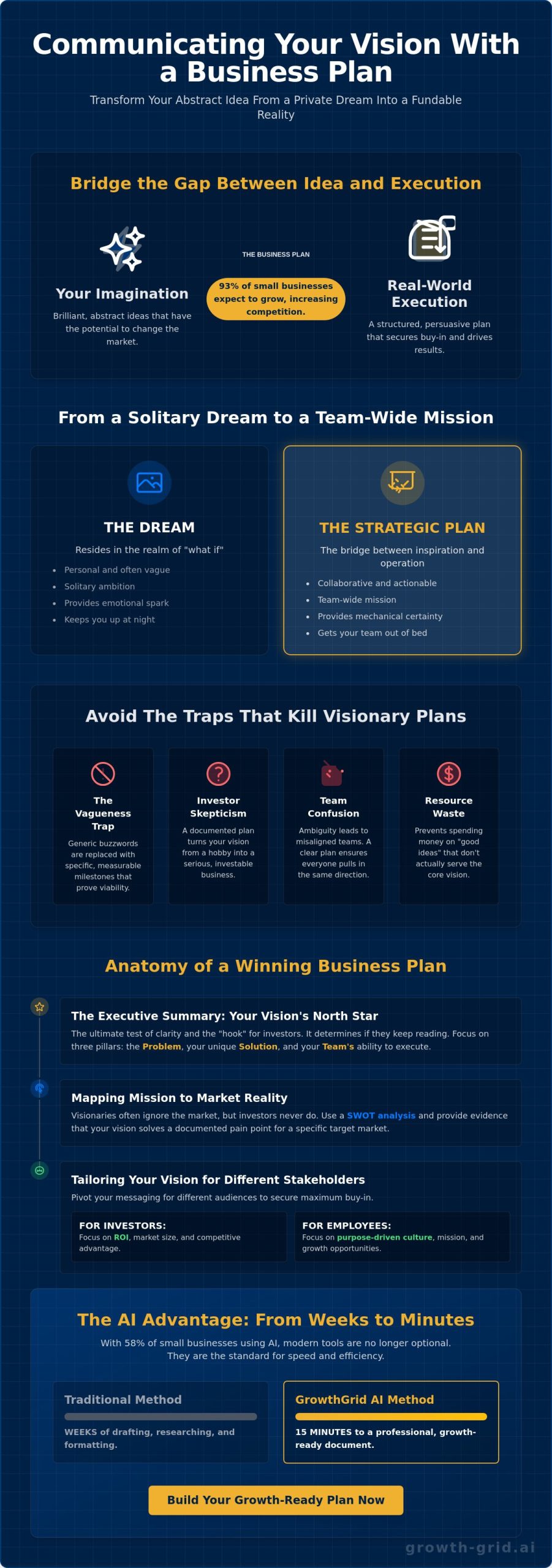
Dreams are personal and often vague; they reside in the realm of “what if.” Plans are collaborative and actionable. While a dream keeps you up at night, a strategic plan gets your team out of bed in the morning with a clear list of objectives. A structured document provides the necessary “how” to support your vision’s “why.” It transforms a solitary ambition into a team-wide mission. A strategic plan is the bridge between inspiration and operation.
Why Vision Communication Fails Without Structure
Many founders fall into the “Founder’s Trap.” This is the dangerous assumption that everyone automatically understands the nuances of your vision just because you’ve explained it once. They don’t. Ambiguity is a silent killer in startups. It leads to misaligned teams, wasted resources, and skeptical investors who won’t write a check based on a “feeling.” You need structure to survive.
Consider these friction points that arise without a plan:
- Investor Skepticism: Without a plan, your vision looks like a hobby, not a business.
- Team Confusion: Employees pull in different directions when goals aren’t documented.
- Resource Waste: You spend money on “good ideas” that don’t actually serve the core vision.
In 2026, with 58% of small businesses already using AI to streamline operations, investors expect more than just a good story. They want a structured framework that proves your vision fits the real world. Market data is the tool you use to validate your claims and turn skeptics into believers. Structure doesn’t limit your vision; it gives it the foundation it needs to scale.
The Anatomy of a Vision-Oriented Business Plan
A business plan isn’t just a document; it’s a structural framework for your ambition. To succeed in communicating my vision with a business plan, you must move beyond vague mission statements. You need a blueprint that translates high-level concepts into concrete data points. This structure allows stakeholders to see the exact path from where you are to where you intend to be. By following the standards used to write a business plan, you provide a professional foundation that investors and partners trust. It turns your private ambition into a shared roadmap.
The Executive Summary as Your Vision’s North Star
Your Executive Summary is the ultimate test of clarity. If you can’t condense a decade of ambition into two pages, you don’t yet have a clear grasp of your strategy. This section acts as the “hook” for external partners who see hundreds of pitches every month. Focus on three pillars: the specific problem you solve, your unique solution, and why your team is the only one capable of execution. It’s the most critical part of communicating my vision with a business plan because it determines whether a reader closes the file or keeps reading.
Mapping Your Mission to Market Reality
Visionaries often ignore the market, but investors never do. Use a SWOT analysis to demonstrate that you understand both your internal strengths and the external competitive threats. Link your target market directly to your long-term goals. You must provide evidence that your vision solves a documented pain point for a specific group of people. When your vision aligns with market reality, it stops being a “guess” and starts being a “forecast.”
The rest of the anatomy ensures your big ideas survive the transition to daily operations:
- Operational Plan: This translates big ideas into daily workflows. It answers the question: “What actually happens on Monday morning to move the needle?”
- Financial Projections: This is the quantitative proof of your vision. Since lack of capital is the top challenge for 23% of small business owners in 2026, your projections must show a clear path to cash flow and scalability over the next 3 to 5 years.
Building this document manually can take weeks of tedious research and drafting. You can eliminate the stress and ensure professional quality by using an AI business plan generator to handle the structural heavy lifting. This allows you to focus on the high-level vision while the software ensures your data and formatting meet industry standards for 2026.
Tailoring Your Vision for Different Stakeholders
You can’t use the same script for a venture capitalist and a marketing intern. Each group looks at your company through a different lens. When communicating my vision with a business plan, you must understand what each listener values most. Investors want to see the numbers, while employees want to see the purpose. Tailoring your message ensures that your strategic document isn’t just a paperweight but a versatile tool for influence. It moves you from being a founder with a dream to a leader with a strategy that everyone can get behind.
Winning Over Investors with Financial Clarity
Investors are pragmatic. They don’t just want to hear how you’ll disrupt an industry; they want to see how you’ll return their capital. Translating “change the world” into “deliver 10x returns” is the secret to building visionary trust. Providing a professional cash-flow analysis is vital for this process. It answers the primary question: “Is this vision actually profitable?” With interest rates for SBA 7(a) variable-rate loans currently between 9.0% and 11.5% as of June 2026, lenders and investors are more cautious than ever. They need quantitative proof that your roadmap can handle these overhead costs while scaling toward a successful exit.
Inspiring Your Team Through Strategic Alignment
Your team needs to know why their work matters on a Tuesday morning. While investors focus on the exit, employees focus on the journey. Communicating my vision with a business plan helps create a shared mental model for the entire office. It allows you to delegate authority without losing control over the core mission. By communicating your vision clearly, you show every team member how their individual impact contributes to the larger growth roadmap. This alignment reduces friction, boosts retention, and ensures everyone is pulling in the same direction.
Beyond these two groups, your plan should address other key players in your ecosystem:
- Partners: Focus on synergy and stability. They want to know your business is a reliable long-term ally.
- Customers: Focus on your brand promise. They need to see that your vision directly solves their specific pain points.
Success requires speaking the right language to the right people. By adjusting the emphasis of your plan, you turn a single document into a multi-purpose communication engine. You aren’t changing the vision; you’re simply highlighting the parts that matter most to the person sitting across from you.
Common Pitfalls in Visionary Business Planning
Even the most inspired founders often stumble when communicating my vision with a business plan because they fall into predictable traps. A vision without a clear, functional plan is just a daydream. To scale in 2026, you must avoid the common errors that turn high-potential startups into statistics. Historically, about 67.6% of new employer businesses survive at least two years. To be in that successful majority, your planning must be precise, active, and grounded in reality. Don’t let your ambition be obscured by poor execution.
The “Vagueness Trap” is the most frequent offender. Using empty buzzwords like “synergy” or “disruption” doesn’t help anyone. Specific milestones are the only way to prove you have a real strategy. Similarly, the “Shelf-Ware Trap” occurs when you write a document once and never look at it again. Your plan should be a living source of truth, not a trophy in a drawer. If your document is so long that it obscures the core vision, you’ve fallen into the “Over-Complexity Trap.” Most investors won’t read a 50-page document. They want the signal, not the noise.
Avoiding the ‘Blank Page’ Paralysis
Many founders spend months “thinking” instead of documenting. This hesitation usually stems from the psychological barrier of starting a 70-section document from scratch. You don’t need a perfect first draft; you need a functional one. Perfectionism is the enemy of visionary communication. The longer you wait to put your ideas on paper, the longer your team and investors remain in the dark. Speed is a competitive advantage that you can’t afford to waste.
Balancing Ambition with Financial Realism
You can stay a visionary while respecting the laws of economics. In fact, you must. Lack of capital or cash flow is the number one challenge for 23% of small business owners in 2026. This makes the financial section of your startup business plan the most important reality check you’ll ever face. Use year-over-year (YOY) growth projections to ground your most ambitious goals in tangible data. When you show exactly how your vision generates revenue, you turn a risky bet into a calculated opportunity.
Don’t let these pitfalls stall your progress. You can bypass the “Blank Page” paralysis and ensure your document meets professional standards in minutes. Use an AI business plan generator to build a structured, data-driven plan that keeps your vision front and center without the traditional planning headaches.
Accelerating Your Vision: From Idea to Plan in 15 Minutes
In the high-stakes environment of 2026, speed is more than just a preference. It’s a competitive advantage. If you spend three months drafting a document, your market opportunity might vanish before you even hit “print.” Communicating my vision with a business plan should be a catalyst for growth, not a bottleneck that keeps you from your customers. Traditional, manual drafting is a legacy problem that wastes your most valuable resource: time. Modern founders are ditching the weeks of research for streamlined, automated solutions that deliver results immediately.
AI removes the “busy work” of business planning by handling the structural heavy lifting. You shouldn’t have to spend hours formatting tables or wondering if you’ve included the right financial ratios. With 58% of small businesses already reporting a positive impact from AI adoption, the technology is no longer optional for those who want to scale. By using an intelligent framework, you ensure that communicating my vision with a business plan is a professional, high-impact experience that happens in minutes, not months.
Using AI to Draft a Professional 72-Section Roadmap
The complexity of a comprehensive plan often leads to “Blank Page” paralysis. Writing an ai business plan solves this by guiding you through a series of targeted questions. This process ensures you don’t miss any of the 72 critical sections that investors and lenders look for in a professional document. It’s the reason why savvy entrepreneurs are moving away from traditional business plan software that offers little more than basic templates. You need a tool that understands the nuances of your specific industry and generates market-ready content instantly.
Your Vision, Executed Instantly
The most significant benefit of this modern approach is the transition from “writer” to “editor” of your company’s future. You are the only person who can provide the soul and direction of the business. By automating the technical drafting, you free yourself to focus on leadership and strategy. You maintain your unique voice while the software provides the professional polish required for a successful funding round. Use the time you save to lead your team, build your product, and secure your first customers.
Don’t let a slow planning process hold back your ambition. You have the ideas; we have the framework to make them tangible. Ready to share your big idea? Generate your professional business plan in minutes with GrowthGrid.
Build Your Roadmap to Success Today
Your vision is only as powerful as your ability to share it. By transforming abstract ideas into a structured document, you eliminate the friction that stalls growth and confuses stakeholders. Mastering the art of communicating my vision with a business plan ensures your team is aligned and your investors are confident. You now have the tools to avoid common pitfalls like the “Vagueness Trap” and the ability to tailor your message for maximum impact across different audiences. Don’t let the legacy process of traditional planning slow your momentum.
GrowthGrid is built to keep up with your pace, delivering a full 72-section plan in under 15 minutes. It’s used by thousands of global startups to produce professional financial and market analysis that actually secures buy-in. You don’t need to waste weeks on research when the technology exists to do the heavy lifting for you. Stop dreaming and start documenting; generate your professional business plan with GrowthGrid today. You have a brilliant vision. Now, give it the professional structure it needs to thrive and scale.
Frequently Asked Questions
How do I write a vision statement for my business plan?
Start with your core purpose and project your company’s impact five to ten years into the future. It should be a concise, aspirational declaration of what you want to achieve. Avoid generic buzzwords and focus on the specific problem you solve for the world. Keep it under two sentences so it remains memorable for your team and stakeholders during daily operations.
Can I communicate my vision with a one-page business plan?
Yes, but it’s primarily effective for early-stage internal alignment rather than securing major capital. A one-page plan forces extreme clarity by highlighting only your most critical objectives. However, when communicating my vision with a business plan to banks or VCs, you’ll eventually need a full document. Use the one-pager as a high-speed summary to gain initial interest before presenting the comprehensive roadmap.
What is the most important part of a business plan for investors?
The Executive Summary and Financial Projections are the highest priority for any investor. They want to see a clear, compelling hook followed by quantitative proof that your vision is financially viable. Since cash flow is the top concern for 31% of small business owners in 2026, your financials must be rock solid. They need to see a clear path to profitability and a realistic exit strategy.
How often should I update my business plan to reflect my vision?
Review and update your plan at least once per quarter to ensure it stays relevant. Your long-term vision might remain constant, but market conditions and technology change rapidly. Regular updates ensure your roadmap reflects current data as you scale. If your business model shifts or you hit a major milestone, update the document immediately to keep your team and stakeholders fully aligned with your new strategy.
Do I need a business plan if I’m not looking for funding?
Absolutely, because a plan serves as your internal source of truth for daily execution. It helps you manage resources, set milestones, and avoid the trap of assuming everyone is on the same page. Even without outside capital, communicating my vision with a business plan ensures your team understands their individual impact. It is an operational tool that drives growth and efficiency regardless of your funding status.
Is it better to hire a consultant or use AI to write my business plan?
Use an AI business plan generator for maximum speed and cost efficiency. Consultants often charge thousands of dollars and take weeks to deliver a single draft. AI can produce a professional, 72-section roadmap in under 15 minutes at a fraction of the cost. This modern approach allows you to spend your time leading your company rather than managing an expensive, slow-moving consulting project.
How do I make my business plan sound inspiring rather than boring?
Use active language and focus on the transformation your business creates for its customers. Instead of just listing features, describe the future state your company will build. Connect your daily operations to your long-term goals to show purpose. A plan becomes inspiring when it clearly demonstrates how small, tactical wins lead to a massive outcome. Keep sentences short and punchy to maintain reader engagement.
What are the 3 most important elements of a vision-driven plan?
The three essential pillars are the Executive Summary, Market Analysis, and Financial Projections. The summary acts as your hook, the analysis proves market fit, and the financials provide the evidence of viability. Without these three components, your vision lacks the foundation required to survive real-world competition. Together, they turn an abstract idea into a professional, persuasive document that secures buy-in and drives growth.