

Nearly 90% of startups fail, and a staggering number of those closures happen because of unexpected operational disruptions in the first 24 months. It’s a sobering reality that often stems from the lack of a clear risk mitigation plan for startup operations. You’re likely feeling the pressure to protect your vision while drowning in complex jargon and shifting 2026 regulations like the California Transparency in Frontier AI Act. Legacy risk management is a slow, expensive hurdle. It drains your momentum and your budget.
Building your defense doesn’t have to be a manual grind. Research shows that early planning can reduce operational disruptions by up to 40%. This guide will show you how to identify, categorize, and neutralize threats using a streamlined, AI-enhanced framework. You’ll move from anxiety to an investor-ready strategy that ensures stability. We’ll walk through the exact steps to automate your defenses, secure affordable coverage like the $99 monthly Business Owner’s Policy, and stay ahead of new federal compliance deadlines. Get the peace of mind you deserve.
Key Takeaways
- Learn why an investor-ready risk mitigation plan for startup success is a mandatory survival document in the 2026 regulatory landscape.
- Master the 4-pillar matrix to identify and neutralize market, financial, operational, and legal threats before they impact your bottom line.
- Implement a rigorous 5-step framework using SWOT analysis and Probability matrices to quantify and prioritize every potential hazard.
- Discover how modern AI-driven generation cuts 20+ hours of manual research down to just 15 minutes of streamlined inputs.
- Transition from error-prone spreadsheets to a professional, comprehensive strategy document that ensures long-term operational stability.
What is a Startup Risk Mitigation Plan and Why It Matters in 2026
Survival in 2026 isn’t guaranteed by a good idea alone. With the Prime Rate sitting at 6.75% and a complex web of new technology laws like the California Transparency in Frontier AI Act, the margin for error has vanished. A risk mitigation plan for startup founders is a living document that evolves alongside your business. It isn’t a static, “check-the-box” exercise you perform once during your launch phase. It’s your blueprint for strategic survival. Risk mitigation is a proactive defense mechanism designed to neutralize threats before they paralyze your operations.
Think of this plan as an insurance policy for your equity. When you pitch venture capital firms, they aren’t just looking for aggressive growth charts. They’re looking for proof that you won’t lose their capital to avoidable disasters. In 2026, market volatility is the new baseline. Founders who ignore this reality often find themselves among the 90% of startups that fail within their first two years. Stop reacting to crises as they happen. Start shielding your assets with a structured approach.
The Difference Between Risk Management and Mitigation
Identifying a problem isn’t the same as solving it. While risk management focuses on the identification and assessment of uncertainties, mitigation is the tactical execution of your defense. Most startups fail at the mitigation stage because they lack the bandwidth to build response protocols. A clear risk mitigation plan for startup operations eliminates “founder friction.” When a pivot becomes necessary, you aren’t scrambling. You’re following a pre-verified playbook that saves time and preserves cash flow.
Investor Expectations: The Risk Section in Your Business Plan
Investors often flip straight to the “Risks” section of your business plan to test your maturity. A professional plan signals operational competence. It shows you understand that early planning can reduce operational disruptions by up to 40%. By quantifying your risks and presenting clear solutions, you drive a higher valuation. You’re selling a de-risked asset. In a high-interest-rate environment where SBA 7(a) variable rates can reach 11.5%, investors demand this level of professionalism. They want to see that you’ve secured your foundation before they help you build the skyscraper.
Mapping the Minefield: The 4 Pillars of Startup Risk
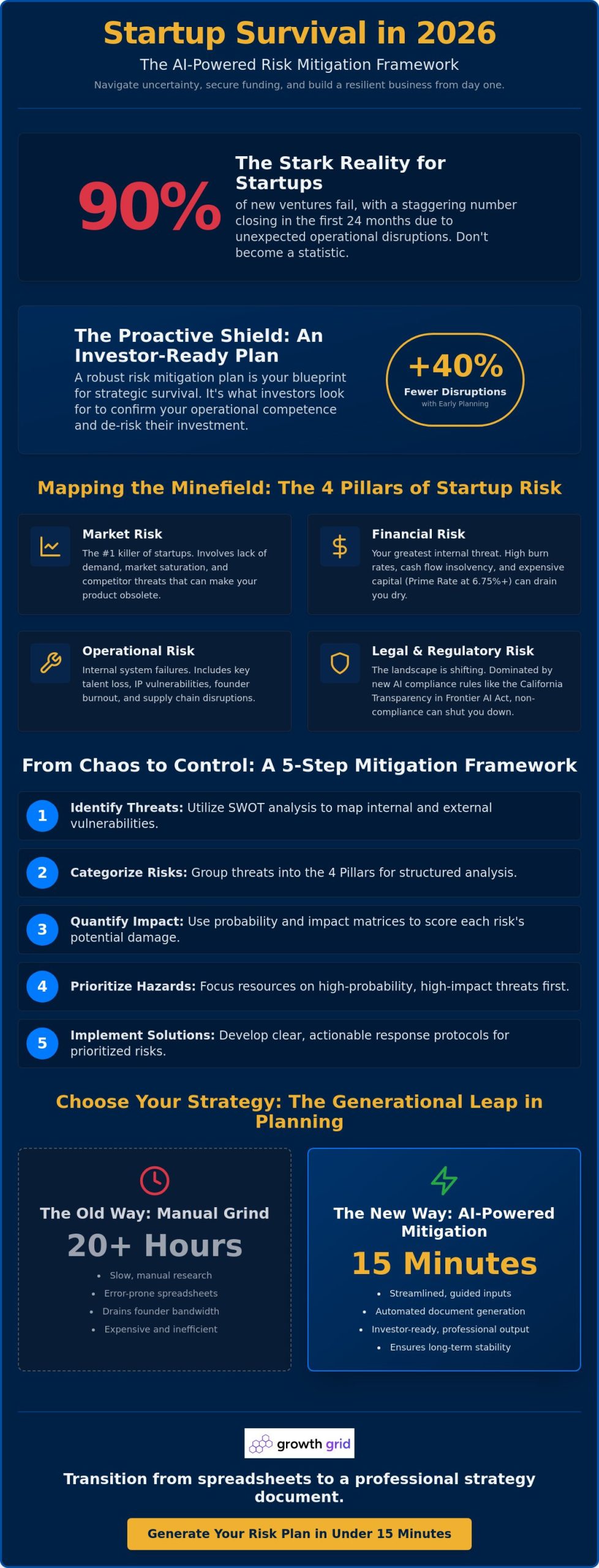
Identifying threats is the first step toward neutralizing them. To build an effective risk mitigation plan for startup resilience, you must categorize your vulnerabilities into a 4-pillar matrix: Market, Financial, Operational, and Legal/Regulatory. Each pillar requires a specific set of “plays” to ensure your business survives the critical first 24 months. In 2026, these categories have shifted. Regulatory scrutiny is higher, and capital is more expensive. You can’t afford to treat these as abstract concepts. They are the coordinates of your survival map.
Market and Financial Risks
Lack of demand is the undisputed #1 killer of early-stage companies. Mapping this risk involves more than just checking competitor prices. You must analyze market saturation and anticipate competitor moves before they happen. Financial risk is equally sharp. With the Prime Rate at 6.75% and SBA 7(a) variable rates reaching up to 11.5%, your “Burn Rate” is your greatest internal threat. Identifying exactly when your cash reserves will hit zero is vital. A detailed cash flow analysis is no longer optional; it’s the heartbeat of your risk planning. If you don’t know your numbers, you don’t know your risks.
Operational and Legal Safeguards
The operational pillar now includes the complexities of a remote-first world. Hiring and retention are high-stakes risks. If your key talent leaves because your remote culture is stagnant, your tech stack dependencies become liabilities. You also need to implement risk management strategies that protect your Intellectual Property (IP) and address founder burnout. Operational systems should run the business so the founders don’t have to carry every burden.
Legal risks in 2026 are dominated by AI compliance. The California Transparency in Frontier AI Act (SB 53), effective January 1, 2026, requires developers to disclose safety frameworks. If you’re building in the AI space, non-compliance isn’t just a fine; it’s a shutdown order. Managing these overlapping pillars manually is a recipe for oversight. Using a modern AI strategy document generator allows you to map these minefields in minutes rather than weeks. Don’t leave your compliance to chance. Build a defense that scales with your growth.
How to Create Your Risk Mitigation Plan: A 5-Step Framework
Informal chats at a coffee shop aren’t a strategy. While some online communities suggest simply “talking it through” with co-founders, this lack of structure leads to overlooked threats and unprofessional documentation. You need a formal risk mitigation plan for startup success. Professionalism is your best defense against 2026 market volatility. Follow this 5-step framework to build a defense that actually works.
Step 1: Identify threats. Conduct a rigorous SWOT analysis to pinpoint internal weaknesses and external market shifts. Don’t be vague. List specific competitors, supply chain bottlenecks, and regulatory changes like the new AI safety disclosure laws.
Step 2: Quantify the danger. Use an Impact vs. Probability matrix to score every threat. This prevents you from wasting resources on low-stakes issues while ignoring the “black swan” events that could end your company.
Step 3: Develop response plays. Choose whether to Avoid, Transfer, Mitigate, or Accept the risk. Integrate proven risk management strategies like entity choice and comprehensive insurance to strengthen your position.
Step 4: Assign ownership. Accountability is the bridge between planning and execution. Every risk play must have a designated team member responsible for monitoring it. If no one owns the risk, no one is watching the gate.
Step 5: Set a review schedule. Your plan is a living document. Review it monthly or after every major pivot to ensure it remains accurate. In a world where Prime Rates and federal regulations shift quarterly, static plans are useless.
Step 2 Deep Dive: Scoring Your Risks
Assign a score from 1 to 5 for both the probability of a risk occurring and its potential impact on your business. A score of 5 in impact means a total operational shutdown. A score of 5 in probability means the event is nearly certain to happen. Focus your energy on the “High Impact, High Probability” quadrant first. You calculate your Risk Priority Number by multiplying the probability score by the impact score. This numerical ranking allows you to prioritize your limited resources with mathematical precision.
Step 3 Deep Dive: The Four Response Strategies
Avoidance means changing your business plan to bypass a risk entirely. If a specific product feature triggers heavy regulatory fines, you might cut it before launch. Transfer involves shifting the burden to a third party. This is where insurance or outsourcing key functions becomes essential. Mitigation is about taking active steps to reduce the likelihood of a threat. For example, implementing zero-trust security models mitigates the rising risk of cybercrime. Finally, Acceptance is for low-impact risks where the cost of mitigation exceeds the potential loss. Choose your play based on the Risk Priority Number you calculated earlier.
Manual Planning vs. AI-Powered Mitigation: Choosing Your Strategy
Choosing how to build your risk mitigation plan for startup success is a decision between legacy friction and modern speed. The “Legacy Method” relies on 20 to 40 hours of manual research. You end up trapped in complex spreadsheets, battling high error rates and outdated academic models. This traditional approach often takes 15 days to finalize. In contrast, the “Modern Method” uses AI-driven generation to produce a comprehensive plan in just 15 minutes. Speed is a competitive advantage. If your competitors are shielded in minutes while you spend weeks on research, you’ve already lost the lead.
Consistency is the hallmark of a professional founder. Your risk strategy shouldn’t exist in a vacuum; it must align perfectly with your financial projections and market analysis. AI ensures this coherence by cross-referencing thousands of industry data points. It eliminates the “Founder Blindness” that plagues manual SWOT analyses. We often overlook our own weaknesses. AI doesn’t have an ego. It provides a cold, hard look at the threats you might be too close to see.
The Cost of Manual Planning
Every hour you spend building a manual risk document is an hour you aren’t selling. The opportunity cost is massive. Manual plans are often outdated the moment they’re printed because market conditions in 2026 shift faster than a human can type. If you’re still using manual FMEA procedures that take 40+ man-hours, you’re burning precious runway. You need a document that evolves, not a static relic that gathers dust in a drawer. Professionalism requires agility, not just effort.
Why AI is the Standard for 2026 Founders
Modern founders use AI to access global risk benchmarks instantly. This technology ensures your documentation meets the rigorous standards of banks and venture capitalists. An ai business plan includes risk sections automatically, ensuring your strategy is integrated from day one. You get professional formatting, accurate data, and a defense system that scales with your growth. Don’t waste weeks on a legacy process. Build your professional risk plan now and secure your startup’s future in minutes.
Generate Your Professional Risk Plan in Under 15 Minutes
Speed is the only currency that matters for early-stage founders in 2026. Waiting weeks to finalize your defense is a risk in itself. GrowthGrid transforms the way you approach a risk mitigation plan for startup operations by integrating it directly into a comprehensive, 72-section business plan. You don’t have to be a risk management expert to protect your assets. You just need to answer a few guided questions about your industry, team, and technology. The AI Business Plan Generator does the heavy lifting. It analyzes thousands of data points to generate complex mitigation plays that would take a human consultant days to draft.
Stop viewing your startup as a “risky idea” and start presenting it as a “resilient business.” Once the generation is complete, you can download your plan in PDF or DOC format immediately. This ensures you’re ready to share a professional, investor-grade strategy the moment a VC asks for it. You move from vulnerability to operational stability in the time it takes to drink a cup of coffee. The system ensures that every risk identified is paired with a concrete, actionable response, leaving no room for investor doubt or founder anxiety.
Beyond the Plan: Ongoing Operational Documents
Your defense doesn’t end with a single document. As market conditions shift, use the AI Strategy Document Generator for quarterly risk reviews. This keeps your strategy aligned with the 2026 economic reality and shifting interest rates. Beyond strategy, you must mitigate legal and internal risks at the source. Use the AI Legal Document Generator to draft airtight NDAs and the AI HR Document Generator for employment contracts. These tools act as your fractional “Risk Officer.” They ensure that your intellectual property is protected and your team structure is sound. GrowthGrid provides the modular tools you need to stay compliant with new regulations without the high overhead of traditional legal teams.
Take Action: Secure Your Startup Future
Stop guessing. Start protecting. Every day you operate without a verified risk mitigation plan for startup stability is a day you’re gambling with your equity. We’ve eliminated the friction of manual research and the anxiety of overlooked threats. Take the 15-minute challenge today. Go from zero documentation to a complete, professional defense system. You’ve built your vision; now give it the armor it deserves. Generate your startup risk mitigation plan now with GrowthGrid and lead your market with confidence.
Secure Your Vision for 2026 and Beyond
You’ve seen the data. 90% of startups fail, but those with a structured defense reduce operational friction by up to 40%. Building a risk mitigation plan for startup success is no longer about avoiding the inevitable; it’s about engineering your business to absorb shocks that sink your competitors. You now have the tools to categorize threats into the four pillars of survival and the 5-step framework to neutralize them before they impact your burn rate. Professionalism isn’t just about your product; it’s about the systems you build to protect it.
Don’t let manual research drain your runway. GrowthGrid is used by thousands of founders worldwide to generate 72-section comprehensive plans that include AI-powered financial and risk projections. You get professional, investor-ready documentation that signals operational maturity to banks and venture capitalists alike. Go from a vulnerable idea to a resilient enterprise today. Build your investor-ready risk mitigation plan in 15 minutes. It’s time to stop reacting and start leading. Your future self will thank you for the stability you build today.
Frequently Asked Questions
What is the most common risk for a new startup?
Lack of market demand is the most frequent cause of failure, affecting a significant portion of closed companies. You must validate your product-market fit early and monitor competitor moves. A robust risk mitigation plan for startup success ensures you have a pivot strategy ready if your initial assumptions about customer demand prove incorrect.
How often should I update my risk mitigation plan?
Update your plan at least once per quarter or immediately after any significant business pivot. The 2026 economic environment moves quickly. Shifting interest rates and new tech regulations like the California Transparency in Frontier AI Act require constant vigilance. Treat your document as a dynamic tool rather than a one-time launch requirement.
Do I need a risk plan if I am not seeking investment?
Yes, you need a plan even if you are self-funded. Risk planning isn’t just for investors; it’s for your operational survival. It helps you reduce disruptions by up to 40% and protects your personal assets. Secure your foundation by ensuring you have the right insurance, such as a Business Owner’s Policy which averages about $99 per month.
What is the difference between a SWOT analysis and a risk plan?
A SWOT analysis identifies internal and external factors, while a risk plan dictates your tactical response to those factors. SWOT is the “what,” and the risk mitigation plan for startup resilience is the “how.” The plan moves beyond simple identification to assign ownership and specific response strategies like avoidance or transfer.
Can AI accurately predict risks for my specific industry?
AI uses thousands of global industry data points to identify benchmarks and “black swan” events you might overlook. While it can’t predict the future with absolute certainty, it removes “Founder Blindness” by providing a data-driven analysis of threats specific to your sector. It acts as an efficiency expert that scales with your growth.
How much does it cost to create a professional risk mitigation plan?
Traditional human consultants often charge thousands for a bespoke risk strategy and take weeks to deliver. Modern AI tools eliminate these high overhead costs and excessive time investments. You can now generate professional, investor-grade documents for a fraction of the legacy price in under 15 minutes.
Should I include my risk plan in my main business plan document?
Yes, including a dedicated risk section in your main business plan is standard practice for 2026 founders. It signals operational competence and maturity to banks and venture capitalists. Showing that you’ve quantified risks with an Impact vs. Probability matrix makes your business a de-risked, more attractive asset for potential partners.
What happens if I ignore risk planning in the early stages?
Ignoring risk planning leads to a significantly higher probability of closure within the first two years. You’ll likely face higher insurance premiums and difficulty securing SBA loans with variable rates that can reach 11.5%. Early planning is the difference between a controlled pivot and a total business collapse.