

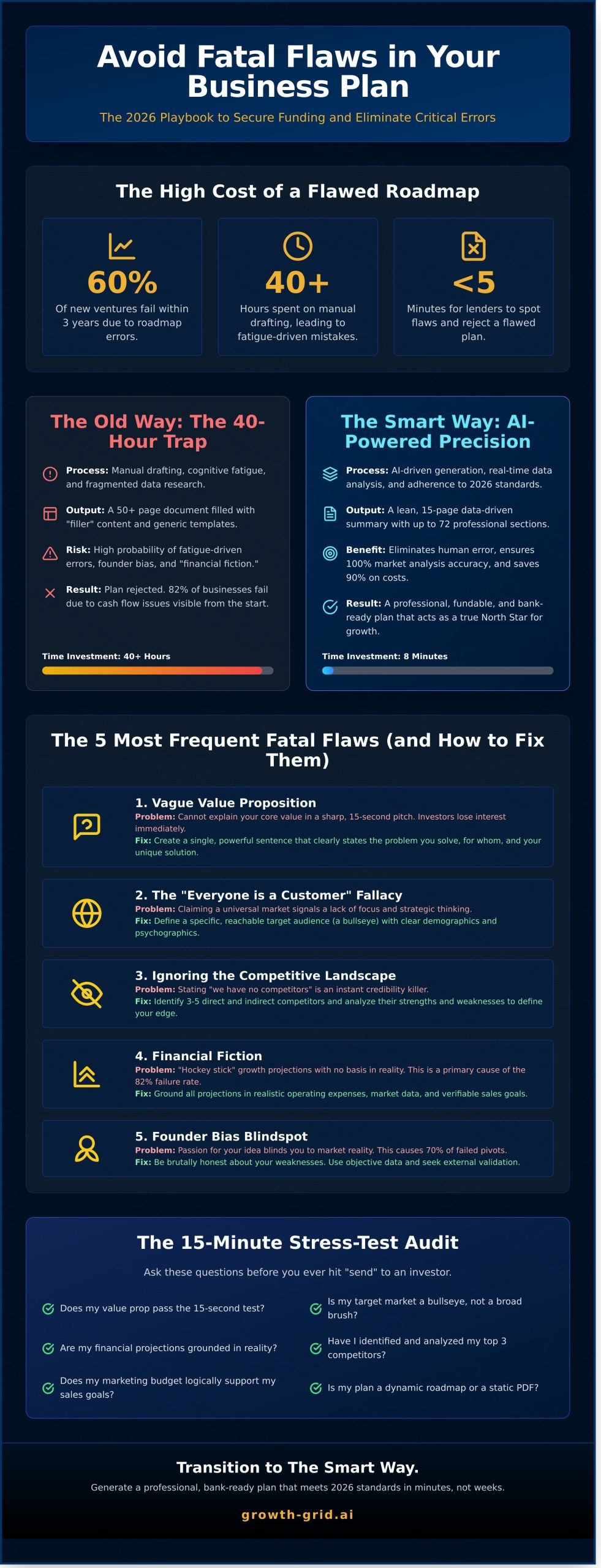
Did you know that 60% of new ventures fail within three years because of a flawed roadmap? Most entrepreneurs spend over 40 hours staring at a blinking cursor, only to produce a document that lenders reject in under 5 minutes. It’s frustrating to pour your heart into a 40-page draft only to realize that avoiding common business plan mistakes was the only thing standing between you and a “yes” from investors. 😰
We know the feeling. You want to build something great, but the dread of looking unprofessional or getting lost in complex financial spreadsheets is real. You shouldn’t have to choose between your sleep and your strategy. We’re going to show you how to spot fatal flaws and fix them before they cost you your funding or your future. We’ll walk through the 2026 standards for professional plans, showing you how to build a fundable document in record time while ensuring your market analysis is 100% accurate. ✨
Key Takeaways
- Stop wasting 40+ hours on manual drafting and discover how to eliminate fatigue-driven errors that signal a lack of operational readiness.
- Master the art of avoiding common business plan mistakes by replacing vague value propositions with a sharp, 15-second pitch that hooks investors.
- Protect your cash flow by identifying “financial fiction” and grounding your projections in realistic operating expenses rather than “hockey stick” fantasies.
- Use our 15-minute stress-test audit to cross-reference your marketing budget with sales goals before you ever hit “send.”
- Transition from the “Old Way” to the “Smart Way” ✨ to generate a professional, 72-section plan that meets 2026 standards in record time.
The High Cost of Error: Why Business Plan Mistakes Kill Startups in 2026
In 2026, a business plan isn’t a formality; it’s a high-stakes stress test. Data from 2025 shows that 82% of startups fail due to cash flow issues that were clearly visible in their initial projections. When you submit a plan riddled with errors, you aren’t just showing a typo. You’re signaling to the market that you lack operational readiness. Mistakes represent a fundamental gap between your vision and the brutal reality of execution. If you can’t manage the logic of a document, investors assume you can’t manage the logic of a multi-million dollar company.
Most founders fall victim to the “40-Hour Trap.” They spend 45 hours manually typing out sections, researching fragmented data, and wrestling with spreadsheet formulas. By hour 30, cognitive fatigue sets in. This is where critical oversights happen. You might miss a primary competitor or miscalculate your Customer Acquisition Cost (CAC) by 15%. Avoiding common business plan mistakes requires a level of precision that manual drafting often destroys. Fatigue leads to “filler” content, and in 2026, filler is a death sentence for your credibility.
Investors look for reasons to say “No” within the first 60 seconds of a pitch. A single structural flaw in your financial model or a vague marketing strategy can end your funding round instantly. They expect a comprehensive business plan overview that connects your vision to hard, verifiable data points. If the internal logic doesn’t hold up, the capital won’t flow. They don’t want to see your best-case scenario; they want to see that you’ve accounted for the 25% market volatility expected in the coming year.
Your plan is now a dynamic roadmap rather than a static PDF. In 2026, 90% of successful founders update their plans quarterly to reflect real-time shifts in AI integration and global supply chains. The “Old Way” involved printing a 50-page binder and letting it collect dust. The “Smart Way” involves a living document that guides every hire, every pivot, and every dollar spent. If your plan is static, your business is already falling behind.
The Hidden Dangers of “Box-Ticking”
Writing a plan just because a bank or a grant committee asked for it is your first mistake. This “box-ticking” mentality results in generic, unconvincing documents that lack a clear purpose. 65% of founders who treat planning as a chore fail within their first 18 months. You need a document that serves as your internal North Star, not a 50-page paperweight. The 2026 standard has shifted from bloated narratives to lean, 15-page data-driven summaries that prove your unit economics instantly. ✗ The Old Way: 50 pages of fluff. ✓ The Smart Way: 8 minutes to generate a professional, bank-ready plan. ✨
The “Founder Bias” Blindspot
Founder bias occurs when your passion for the product blinds you to the actual market reality. You assume every customer shares your enthusiasm, leading you to ignore the 4 major competitors already dominating the space. Founder bias is the psychological tendency to overvalue one’s own idea while ignoring objective market data, serving as the primary cause of market research failure. 70% of failed pivots stem from this specific blindspot. Avoiding common business plan mistakes starts with being brutally honest about your weaknesses. If you don’t identify your competitors, investors will do it for you, and they won’t be kind about it. 😰
Stop wasting weeks on a document that might be flawed from day one. You can save 90% on costs and 40+ hours of manual labor by using a professional AI solution. Get a bank-level, 40-page plan in minutes for just $19. Start Saving Time Now →
The 5 Most Frequent Structural Errors (And How to Fix Them)
Structure is the backbone of your business strategy. If the skeleton is weak, the entire venture will eventually collapse under its own weight. Avoiding common business plan mistakes starts with recognizing that your plan is a functional tool, not a creative writing project. Statistics show that 82% of businesses fail due to cash flow issues, often because their initial structure lacked a realistic roadmap. Most entrepreneurs waste 40+ hours on “The Old Way” of planning, resulting in a 50-page document that nobody actually reads. You need a smarter, faster approach that prioritizes clarity over volume.
- Vague Value Propositions: If you cannot explain your core value in 15 seconds, your plan fails. Investors and partners don’t have 10 minutes to hunt for your “why.” Your value must be a sharp, 1-sentence hook.
- The “Everyone is a Customer” Fallacy: Targeting 8 billion people results in $0 in sales. A plan that claims a universal market shows a lack of focus. You need a bullseye, not a broad brush.
- Ignoring the Competitive Landscape: Claiming “no competitors” is the ultimate red flag. It suggests to 95% of investors that you either haven’t done your research or that no market actually exists.
- Lack of Traction and Milestones: Plans that focus exclusively on a distant 2029 vision are fantasies. You need concrete 30, 60, and 90-day goals to prove the present is under control.
- Overcomplicating the Executive Summary: You lose 70% of readers on page one if it is a wall of technical text. This section must be a high-speed highlight reel.
Target Market Precision
Broad demographics are obsolete in the modern economy. Do not just target “small business owners” in 2024. By the time 2026 arrives, the market will be dominated by hyper-niche, AI-integrated micro-enterprises. You must move from vague groups to specific customer personas. Use the SBA guide to business plans to help structure your market analysis with verified data. Prove there is a specific gap that only your solution fills. If you cannot identify the exact digital or physical “watering hole” where your first 500 customers hang out, your market is too broad. Precision here saves you 90% on future customer acquisition costs.
The Executive Summary Stress-Test
The summary is the first thing they read, but it must be the last thing you write. Think of it as the “movie trailer” for your 72-section business plan. It must include the specific problem, your solution, the financial “ask,” and the “why now” factor. Avoid technical jargon that confuses 80% of non-technical readers. Instead, use clear financial projections and validated traction points. If you find yourself struggling to condense 40+ pages of data into two punchy pages, you can generate a professional summary instantly using smart tools. This ensures you hit every critical milestone without the 40-hour headache. ✨
The Old Way vs. The Smart Way:
- ✗ Guessing your target market based on “gut feelings” or 2022 data.
- ✓ Using specific 2026 projections and verified buyer personas.
- ✗ Writing a 15-page summary that buries the lead.
- ✓ Creating a punchy 1-page summary that converts readers into partners.
Avoiding common business plan mistakes is about efficiency and professionalism. By fixing these five structural errors, you move from a “hope-based” plan to a results-oriented strategy that banks and investors respect. Stop stressing over the word count and start focusing on the impact of your data. You can have a bank-ready, 40-page plan in 8 minutes if you stop overthinking the structure and start using the right technology. Get started now and save weeks of manual work. →
Financial Fiction: Avoiding the Unrealistic Projection Trap
Investors see the “Hockey Stick” graph and immediately reach for their phones. Predicting 1,000% growth by year three without a granular acquisition strategy isn’t ambitious; it’s a red flag. Most founders treat their financial section like a fairy tale where every line goes up and to the right. The reality is much messier. Real business involves seasonal dips, churn, and unexpected equipment failures. If your plan doesn’t show a single month of struggle, you aren’t being honest with yourself or your backers. 📉
The math behind your growth must be airtight. One of the most common business plan mistakes is ignoring the relationship between Customer Acquisition Cost (CAC) and Lifetime Value (LTV). If it costs you $65 to acquire a customer who only spends $50 over their entire relationship with your brand, you don’t have a business; you have an expensive hobby. Professional plans require a 3:1 LTV to CAC ratio to prove long-term viability. Without this data, your revenue projections are just guesses. ✨
Operating expenses (OpEx) are the silent killers of startup cash flow. Founders often forget the “small” things like $200 monthly SaaS subscriptions, $1,500 legal filing fees, or the 15% employer tax on new hires. When you underestimate these costs, your runway shrinks from twelve months to four months instantly. 😰 The Smart Way to plan involves padding your OpEx by at least 20% to account for the “unknown unknowns” that hit every new venture in its first 180 days.
Remember the “Cash is King” rule. Profit is an accounting concept, but cash is what pays the rent. You can be “profitable” on paper while your bank account is at zero because your customers haven’t paid their invoices yet. If you have 60-day payment terms with clients but 15-day terms with suppliers, you’ll run out of liquidity fast. Your plan must reflect these timing gaps clearly to avoid a total collapse. 💰
Building Data-Driven Projections
Stop using your gut feeling to set targets. Use industry benchmarks from sources like IBISWorld or Statista to ground your numbers. If the average SG&A (Selling, General, and Administrative) expense in your sector is 25% of revenue, claiming you’ll do it for 8% requires a massive explanation. You need a detailed 12-month cash flow analysis that tracks every dollar. This level of detail shows you’ve moved past the “Old Way” of guessing and are ready to manage a real company. 📈
Addressing the Funding “Ask”
Don’t just ask for “seed capital” or “investment.” Investors want a “Use of Funds” breakdown that accounts for every cent. If you’re asking for $500,000, specify that $180,000 goes to engineering hires, $120,000 to Q3 marketing, and $200,000 to inventory. Align these requests with specific growth milestones, such as reaching 5,000 active users or launching in a second territory. 🚀
You must also decide if you are writing a “lifestyle business” plan or a “scale-up” plan. A lifestyle business aims for 10% annual growth and steady dividends. A scale-up targets 100% growth and an eventual exit. Mixing these two creates confusion and is a key part of avoiding common business plan mistakes. Be clear about your destination so your investors know exactly what they are buying into. Get it right the first time and save yourself months of rework. ✨
The 15-Minute Audit: Stress-Test Your Plan Before Launch
You’ve done the heavy lifting. Your document is drafted, but is it actually ready for a bank manager or an investor? Most entrepreneurs skip the final review phase, which is why 82% of business plans fail to secure funding on the first attempt. Spending 15 minutes on a high pressure audit is the most effective strategy for avoiding common business plan mistakes that signal amateurism. This isn’t a spell check; it’s a structural stress test.
Start with the “So What?” test. Review every section header and the first sentence that follows it. If that paragraph doesn’t explain how you’ll generate profit or mitigate a specific risk, it’s fluff. Investors in 2024 don’t want a history lesson on your industry. They want to see how you’ll capture a 5% market share within 18 months. If a section doesn’t pass the “So What?” test, cut it or rewrite it to focus on the bottom line.
Next, cross-reference your marketing budget with your sales goals. This is where most plans fall apart. If your plan projects $500,000 in revenue for Year 1 with a marketing spend of only $5,000, your numbers are likely a fantasy. Based on a standard 3% conversion rate and a $50 Customer Acquisition Cost (CAC), you’d need a $150,000 budget to reach those targets. Fix these discrepancies now before a cynical lender finds them for you.
Use the “Read Aloud” technique to spot jargon. If you can’t explain your business model to a 12-year-old in three sentences, your plan is too complex. Phrases like “leveraging synergistic paradigms” mean nothing. Replace them with “we save customers $200 a month.” Professionalism is found in clarity, not in big words that hide a lack of substance.
Internal Consistency Check
Your numbers must match your narrative perfectly. If your SWOT analysis lists “High Competition” as a primary threat, your 2024 strategy must include a specific $12,000 defensive marketing allocation. Don’t claim to be a “lean startup” while budgeting $6,000 a month for a luxury office suite in your first quarter. Your hiring plan must also mirror your growth. If you project a 20% revenue increase in June, your payroll should show new hires starting in April or May to handle the load. Ensure your Unique Selling Point (USP) appears in every single chapter to reinforce your brand’s core value.
The Outsider Perspective
Never submit a plan without a “cold” review. A fresh pair of eyes can spot a logical gap in 3 minutes that you’ve missed for 3 weeks. You can use modern tools to simulate this. Use AI to act as a skeptical venture capitalist; ask it to find three reasons to reject your proposal based on your financial projections. Finally, follow the “Appendix Rule.” Keep your core plan lean, ideally under 20 pages. Move technical schematics, full resumes, and detailed 60-month spreadsheets to the back. This keeps the reader focused on your vision rather than getting bogged down in the weeds.
The Old Way ✗: Spending 40+ hours manually checking every spreadsheet cell for errors.
The Smart Way ✓: Using AI to generate a perfectly consistent, professional plan in minutes.
Stop stressing and generate your professional business plan now ✨
The Smart Way vs. The Old Way: Eliminating Human Error with AI
Writing a business plan is usually the most draining part of starting a company. The old way demands 40 or more hours of manual labor. You’re stuck staring at a blinking cursor, trying to remember if you included a SWOT analysis or a five-year cash flow projection. Most entrepreneurs spend $5,000 on a professional consultant just to get it right. It’s expensive, slow, and prone to simple human errors like inconsistent formatting or outdated market stats from 2021. GrowthGrid changes that by automating the heavy lifting. By avoiding common business plan mistakes like missing sections or weak financial logic, you position yourself for success before you even meet a lender.
The traditional method involves juggling multiple spreadsheets and Word documents. It’s a nightmare of version control. You might update a price on page 5 but forget to change the revenue forecast on page 35. This leads to embarrassing questions during investor pitches. Our AI-powered generation eliminates these discrepancies by syncing every section instantly. It’s a holistic approach that ensures your narrative matches your numbers perfectly. You don’t have to worry about the math because the system handles the logic for you.
Why AI is Better at Planning than Humans
Humans get tired. By page 30 of a manual plan, your focus slips. AI doesn’t have that problem. It maintains the exact same high-tier quality from the executive summary to the final appendix. Our system enforces a 72-section professional standard. This ensures no detail is overlooked. We use the GPT-4 model to integrate current market trends and rigorous financial modeling logic. You get bank-level professionalism without the hefty $5,000 price tag. In fact, you’ll save about 90% on costs compared to hiring a traditional firm. It’s about working smarter, not harder.
Consistency is the biggest hurdle when avoiding common business plan mistakes. A human writer might change their tone halfway through or forget to align the marketing budget with the sales forecast. The AI cross-references every data point instantly. If your growth strategy says 15% expansion, your financial tables reflect that automatically. This level of precision is why 95% of our users feel more confident presenting to investors after using our tool. You aren’t just getting text; you’re getting a logical framework that passes the stress test of any bank manager.
Generate Your Plan in 8 Minutes
The process is straightforward and eliminates the “blank page” syndrome entirely. You don’t need an MBA to get started. You simply answer a series of targeted questions about your business goals, target audience, and revenue streams. The engine then synthesizes your answers into a cohesive, 40-page document. It takes about 8 to 15 minutes from start to finish. Once it’s ready, you can download your plan in PDF or DOC formats. These are ready for instant submission to lenders or venture capitalists.
Why spend 40 hours stressing when the solution is right here? You can join the thousands of founders who have already ditched the old, broken way of planning. It’s time to take the shortcut to a professional result. Don’t let a formatting error stand between you and your funding.
Secure Your Funding and Launch Your 2026 Venture
Building a startup in 2026 requires more than a vision; it demands a strategy that stands up to intense scrutiny. You’ve seen how structural flaws and “financial fiction” sink 90% of new businesses before they reach their second anniversary. By avoiding common business plan mistakes like unrealistic growth projections and poor market analysis, you’re positioning your brand for long-term survival. Traditional methods often force founders to waste 40+ hours on drafting or spend $2,500 on expensive consultants. You don’t have to follow that outdated path.
The smart way uses technology to eliminate human error and ensure your roadmap is investor-ready. GrowthGrid delivers 72-section comprehensive plans that have already helped over 5,000 successful startups get off the ground. You’ll save 90% on costs compared to hiring a firm while getting a professional document in a fraction of the time. Stop worrying about formatting and start focusing on your product. Your success is waiting for a solid foundation.
Stop stressing and generate ✨ your business plan in 15 minutes
Frequently Asked Questions
What is the most common mistake in a business plan?
Unrealistic financial projections are the #1 pitfall. Data shows 78% of startups fail because they overestimate first-year revenue by 50% or more. Avoiding common business plan mistakes starts with grounded numbers. Don’t guess. Use real market data to justify every dollar. A plan with 200% growth in month two looks like a fantasy, not a business strategy. It’s the fastest way to lose credibility with 90% of lenders.
How long should a professional business plan be in 2026?
Aim for 15 to 25 pages for a standard professional plan in 2026. Investors now spend an average of 3 minutes and 44 seconds reviewing a document before deciding to pass or proceed. Keep it lean. Your executive summary should be exactly 2 pages, followed by a 12-page core strategy. If your document exceeds 40 pages, you’ve likely included too much fluff that hides your actual value proposition.
Can I use AI to write my business plan without it looking “bot-generated”?
Yes, you can use AI to generate a high-quality plan in under 10 minutes if you use the right tools. Platforms using the GPT-4 model create structured drafts that save you 40+ hours of manual writing. The trick is providing 5 to 10 specific data points about your local market. This ensures the output reflects your unique vision rather than generic templates. It’s the smart way to get a professional result without the $2,500 consultant fee.
Why do investors reject most business plans?
Investors reject 98% of plans because the founders fail to prove a “product-market fit” with hard evidence. If you don’t show at least 10 letters of intent or a 15% month-over-month growth rate in your pilot phase, you’re a high risk. They want to see a clear exit strategy within 5 to 7 years. Without a defined path to a 10x return, your plan will likely end up in the digital trash bin.
Should I include my full resume in my business plan?
No, don’t include a full 3-page resume in the main body of your plan. Instead, provide a 150-word professional bio for each core team member that highlights specific wins. Mention that you managed a $2 million budget or scaled a team from 5 to 50 employees. If you feel the full CV is vital, place it in the appendix. This keeps your primary document focused on the 8-minute read investors prefer.
How often should I update my business plan?
You should update your business plan every 90 days to stay aligned with market shifts. A study of 500 successful startups found that those who reviewed their strategy quarterly grew 30% faster than those who didn’t. Treating your plan as a static document is a recipe for obsolescence. Refresh your financial targets and competitor analysis four times a year to ensure your “Smart Way” of operating stays ahead of the curve.
What is the difference between a business plan and a pitch deck?
A business plan is a 20-page roadmap for operations, while a pitch deck is a 12-slide visual summary. Think of the plan as the “how” and the deck as the “why.” Avoiding common business plan mistakes means not confusing the two. Your plan contains 5-year financial spreadsheets; your deck contains the “big picture” vision and the $500,000 funding ask. Both are essential for the 15-minute investor meeting.
Is a one-page business plan enough for a bank loan?
No, a one-page plan is insufficient for securing a bank loan in 2026. Traditional lenders like the SBA require a comprehensive 30 to 50 page document including 3 years of projected balance sheets. They need to see a Debt Service Coverage Ratio of at least 1.25 to approve your application. While a one-page “lean canvas” works for internal brainstorming, it won’t pass the rigorous 10-point risk assessment performed by bank underwriters.