

Staring at a blank page, trying to write a 40-page business plan? 😰 It’s the old, slow way to get started. What if you could map your entire business idea-from customers to costs-on a single page, in just minutes? That’s the power of the Business Model Canvas. Forget the dense documents and endless paragraphs. The bmc canvas is the smart, visual framework for structuring your thinking and getting straight to what makes your business work.
In this 5-minute guide, we’ll show you exactly how it’s done. You’ll learn what the canvas is, how to use its 9 essential building blocks for instant clarity, and the best part? We’ll reveal how you can use AI to instantly generate the insights needed to fill it out. Stop stressing and start building. Get ready to transform your idea into a clear, professional, and shareable plan in record time. ✨
What Is a Business Model Canvas (BMC)? The One-Page Strategic Plan
Forget the dense, 40-page documents that take weeks to write and gather dust. The Business Model Canvas is a visual, one-page strategic plan that lets you map out your entire business model in minutes. Created by Alexander Osterwalder, this powerful tool organizes your business into nine essential building blocks-from your value proposition and customer segments to revenue streams and key partners.
It’s designed for speed and clarity, giving you a high-level view of how all the pieces of your business connect. Whether you’re a startup sketching out an initial idea or an established company looking to innovate, the Business Model Canvas provides a shared language to describe, design, and challenge your business model efficiently.
Key Benefits: Why Use a BMC Instead of a 40-Page Document?
The traditional business plan is slow and rigid. The BMC is the smart, modern alternative for rapid strategic planning. It’s about getting to the core of your business, fast.
- Visual & Intuitive: See your entire business on a single page. Instantly spot connections, gaps, and opportunities you might otherwise miss.
- Speed: Stop wasting weeks on text-heavy documents. Brainstorm, test, and iterate on your business model in a single afternoon.
- Collaboration: The canvas acts as a common language. It gets your entire team-from marketing to finance-on the same page, fostering better ideas and alignment.
- Focus: With limited space, you’re forced to be concise. It cuts through the noise and makes you concentrate on what truly drives the business.
BMC vs. Traditional Business Plan: What’s the Difference?
So, should you throw out the traditional business plan? Not necessarily. They serve different purposes and are powerful when used together.
Think of the bmc canvas as the strategic snapshot-it answers the ‘what’. It’s your high-level overview, perfect for ideation, strategy meetings, and initial validation. The full, traditional business plan is the operational guide-it answers the ‘how’. It contains the detailed financial projections, market analysis, and execution steps needed to secure funding or guide your team’s day-to-day work. The BMC is your first move; the detailed plan is how you execute it flawlessly.
The 9 Building Blocks of the Business Model Canvas Explained
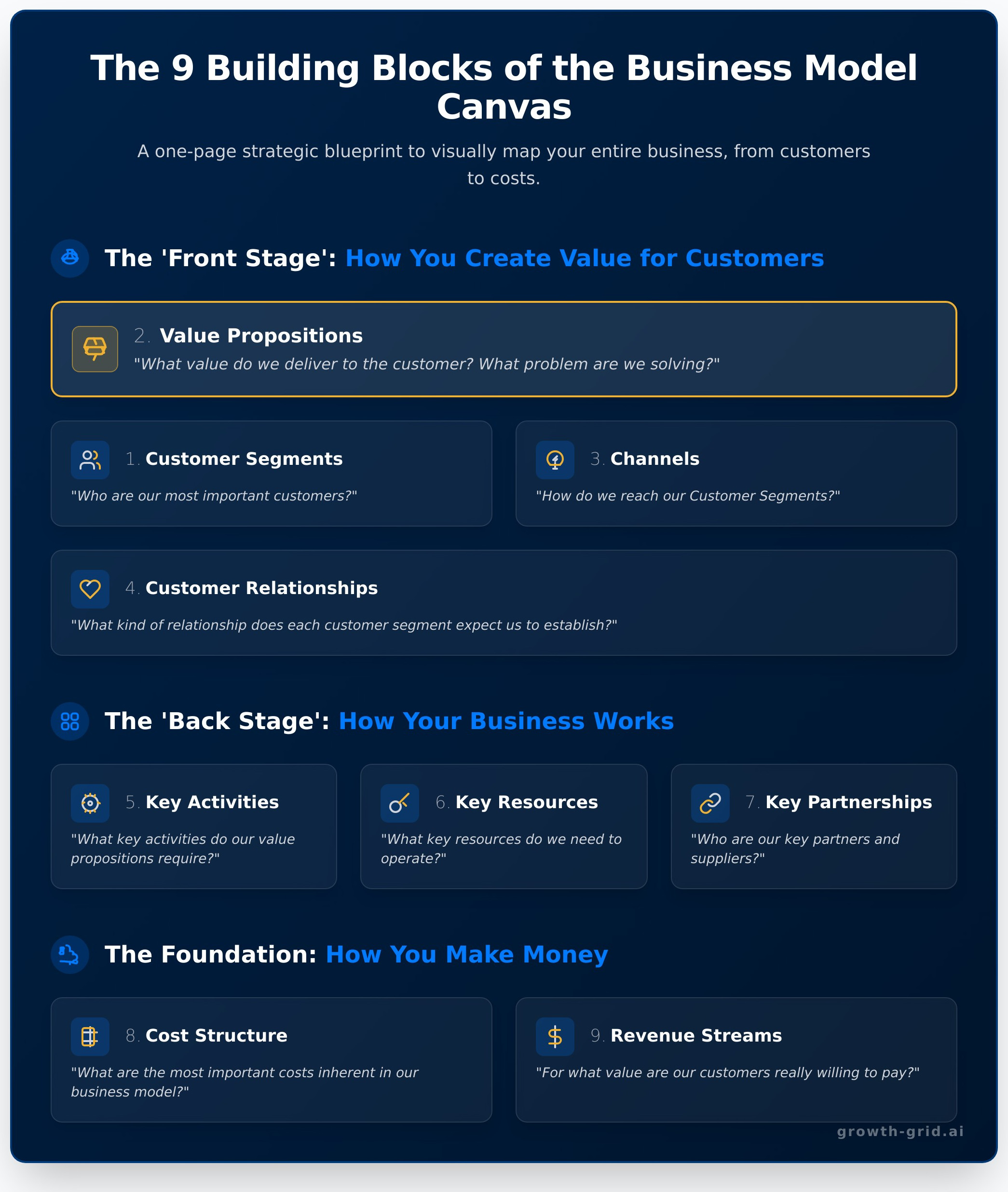
Forget the stress of a 40-page business plan. The Business Model Canvas (BMC) is your one-page blueprint for instant clarity. It maps your entire business strategy across nine fundamental building blocks, showing you exactly how they connect. Using the bmc canvas framework forces you to get specific about what matters, turning vague ideas into a concrete, actionable plan.
[Visual Diagram of the Business Model Canvas]
A visual grid showing the 9 building blocks, numbered 1 through 9, illustrating the connections between customer-facing elements, operational activities, and financial structures.
The ‘Front Stage’: How You Create Value for Customers
This group focuses on your customer-facing elements. It’s what your audience sees and interacts with.
- 1. Customer Segments: This is who you are creating value for. Don’t say “everyone.” Get specific about your niche or mass market. Key Question: Who are our most important customers?
- 2. Value Propositions: This is the core of your business-the bundle of products or services that solves a customer’s problem or satisfies a need. Key Question: What value do we deliver to the customer?
- 3. Channels: These are the touchpoints where you interact with your customers, from marketing and sales to delivery and post-purchase support. Key Question: How do we reach our Customer Segments?
- 4. Customer Relationships: This defines the type of interaction you establish with each segment, from automated services to personal assistance. Key Question: What kind of relationship does each customer segment expect us to establish?
The ‘Back Stage’: How Your Business Actually Works
These are the internal operations and resources required to deliver your value proposition efficiently.
- 5. Key Activities: The most important actions your company must take to make its business model work. This could be software development, supply chain management, or problem-solving. Key Question: What key activities do our value propositions require?
- 6. Key Resources: The essential assets-physical, intellectual, human, or financial-needed to run your business and deliver value. Key Question: What key resources do we need to operate?
- 7. Key Partnerships: The network of suppliers and partners that make the business model work. The bmc canvas is so versatile that even large organizations use it to define complex relationships, as shown in the UN’s introduction for mechanization hire services, which relies on a network of local partners. Key Question: Who are our key partners and suppliers?
The Foundation: How You Make Money
This is the financial engine of your business, outlining how you spend and earn money.
- 8. Cost Structure: This describes all costs incurred to operate your business model, from fixed costs like salaries to variable costs like marketing spend. Key Question: What are the most important costs inherent in our business model?
- 9. Revenue Streams: This represents the cash a company generates from each Customer Segment. It’s how you capture value. Key Question: For what value are our customers really willing to pay?
How to Fill Out Your BMC: The Old Way vs. The Smart Way
Staring at a blank Business Model Canvas can be paralyzing. You have nine empty boxes, a great idea, and a huge gap in between. Most entrepreneurs get stuck right here. But what if the problem isn’t the canvas, but the way you’re trying to fill it?
Let’s break down the slow, traditional method versus the fast, data-driven approach. The difference is night and day.
The Old Way: Manual Brainstorming and Guesswork
The traditional method is a slow grind of sticky notes, whiteboards, and endless meetings. The process usually looks something like this:
- ✗ Start with your Value Proposition and Customer Segments.
- ✗ Work your way through the nine building blocks, a process detailed in this excellent Business Model Canvas Explained guide from EU Business School.
- ✗ Spend hours on market research and internal debates for each box.
- ✗ End up with a first draft full of assumptions after days or weeks of effort.
This manual approach relies heavily on guesswork and drains your most valuable resources: time and momentum.
The Challenge: Getting Accurate Information is Slow
The biggest roadblock isn’t a lack of ideas-it’s a lack of data. Filling each box correctly requires hard numbers on market size, operational costs, revenue streams, and customer acquisition channels. Most founders simply don’t have this information readily available. This is the exact point where the process stalls, and the half-finished bmc canvas gets abandoned.
The Smart Way: Generate the Core Data First with AI
Instead of staring at an empty template, what if you started with all the answers? The smart way flips the process on its head.
You use an AI tool to generate a complete, 40+ page business plan first. In just a few minutes, you get a comprehensive market analysis, detailed financial projections, and a solid operational strategy. All the complex data you need is instantly at your fingertips.
With this foundation, filling out your Business Model Canvas becomes a simple summary exercise. It transforms from a daunting research project into the final, satisfying step of visualizing a strategy you already have. Why spend weeks stressing when you can have it done in minutes? ✓
Power Your BMC with GrowthGrid’s AI Business Plan Generator
A Business Model Canvas is a powerful tool, but it’s only as good as the data and strategy behind it. Staring at nine empty boxes can be paralyzing. Where do you even begin? This is where theory meets action. Instead of guessing, you can use AI to generate the strategic insights you need, instantly.
GrowthGrid doesn’t just give you a blank template; our AI-powered generator creates a comprehensive, 40+ page business plan in minutes. This detailed document provides all the answers you need to populate every single block of your bmc canvas with confidence and precision.
Instantly Generate Content for Every Block
Stop brainstorming in a vacuum. Our AI does the heavy lifting by conducting market research and formulating strategy, giving you professionally written content ready to use. Simply generate your plan and pull the key summaries for each corresponding BMC block:
- Market Analysis: Fills your Customer Segments, Customer Relationships, and Channels blocks with data-backed insights on who your customers are and how to reach them.
- Products & Services: Defines a clear and compelling Value Proposition that resonates with your target audience.
- Financial Projections: Details your Revenue Streams and Cost Structure with realistic, 3-year forecasts.
- Operations Plan: Outlines your Key Activities, Key Resources, and Key Partnerships needed to deliver your value proposition.
From 40-Page Plan to 1-Page Canvas in Minutes
Why spend weeks stressing over research and writing? Let our AI handle the difficult parts. Once your full business plan is generated, you can simply copy and paste the executive summaries from each section directly into your bmc canvas template. What used to be a month-long project of research, writing, and financial modeling now takes less than 15 minutes. You get a professional, data-backed model without the exorbitant cost or stress.
Ready to Stop Guessing? Generate Your Plan Now.
Move from a vague idea to a clear, actionable strategy today. With GrowthGrid, you get two critical assets at once: a bank-ready business plan to secure funding and a perfectly summarized canvas to guide your operations. It’s the fastest way to build a foundation for success.
Generate your business plan with AI and fill your canvas in minutes!
Common Mistakes to Avoid When Using the Business Model Canvas
The Business Model Canvas is a powerful tool for mapping out your strategy. But like any tool, its effectiveness depends on how you use it. Avoid these common pitfalls to turn your canvas from a simple sketch into a dynamic blueprint for success. Save yourself weeks of rework by getting it right the first time.
Mistake 1: Creating It in a Vacuum
The Old Way: Spending hours alone, trying to guess what customers want and how your team will deliver it. 😰
The Smart Way: Treat the BMC as a team sport. Your business model isn’t just your idea; it’s a shared vision. Involve your co-founders, key employees, and trusted advisors. Better yet, get feedback from potential customers to validate your assumptions instantly. Collaboration turns a solo guess into a collective, data-backed strategy.
Mistake 2: Being Too Vague
Generic statements kill a business model. A box that says “good customer service” is a placeholder, not a plan. You need specifics to execute and measure. Vague ideas lead to vague results.
- ✗ Vague: “We’ll have great customer relationships.”
- ✓ Specific: “We will offer 24/7 online chat support with a guaranteed 60-second first-response time.”
Struggling to find the right words? This is where AI becomes your co-pilot. Tools like GrowthGrid can help you instantly flesh out ideas into professional, concrete details for your bmc canvas, saving you hours of work.
Mistake 3: Treating It as a Static Document
The biggest error is thinking your canvas is finished once all nine boxes are filled. Don’t frame it and hang it on the wall. Your first bmc canvas is simply a collection of hypotheses-your best guesses about your business.
Your real job is to test these guesses. As you learn from customer interviews, market data, and product tests, update the canvas. It is a living document that should evolve as your business does. A successful model isn’t written in stone; it’s refined with real-world data.
Turn Your BMC Canvas into a Winning Business Plan
You now have the framework to map out your entire business on a single page. The Business Model Canvas is a powerful tool for strategic clarity, breaking down your idea into nine essential building blocks. But understanding the blocks is one thing; filling them with accurate, data-backed information is the real challenge that separates a good idea from a fundable business.
Why spend hours on guesswork when you can have the heavy lifting done for you in minutes? Stop staring at a blank template. GrowthGrid’s AI Business Plan Generator instantly provides the market research, financial projections, and strategic insights you need to populate your bmc canvas with confidence.
Join over 10,000 startups who have traded weeks of stress for a professional, 40+ page business plan. It’s fast, efficient, and backed by our 100% Satisfaction Guarantee. Generate your business plan now and get the data for your BMC in minutes!
Your great idea deserves a brilliant strategy. It’s time to bring it to life.
Frequently Asked Questions
Is a Business Model Canvas enough to get funding from investors?
No, a BMC is a starting point, not the finish line. Think of it as the high-level blueprint for your strategy. It’s perfect for clarifying your ideas and for initial pitch meetings. However, investors will require a comprehensive business plan with detailed financial projections, in-depth market analysis, and a clear operational plan. The BMC is the foundation; the full plan is the building investors want to see.
What is the difference between the Business Model Canvas and the Lean Canvas?
The main difference is their focus. The Business Model Canvas is for mapping out a new or existing business. The Lean Canvas, adapted by Ash Maurya, is streamlined for startups. It swaps out sections like “Key Partners” and “Key Activities” for “Problem,” “Solution,” “Key Metrics,” and “Unfair Advantage.” It’s designed for speed, helping founders quickly identify and test their riskiest assumptions before building a product.
Can I use the BMC for a non-profit organization?
Absolutely. The framework is incredibly versatile. For a non-profit, you simply adapt the language. “Customer Segments” become “Beneficiaries and Donors,” and “Revenue Streams” become “Funding Streams and Social Impact.” The canvas remains a powerful tool for visualizing how your organization creates, delivers, and captures value, helping you plan for sustainability and communicate your mission with total clarity.
How often should I update my Business Model Canvas?
Your BMC is a living document, not a one-and-done task. You should review and update it quarterly or any time your business faces a major change. This includes new competitors, significant market shifts, or internal changes to your cost structure. Regularly updating your BMC canvas ensures your strategy remains agile and aligned with reality, allowing you to pivot fast and stay ahead of the curve.
Where can I find a good BMC template?
You can find excellent free templates from Strategyzer (the creators) or on digital whiteboarding tools like Miro and Mural. These are great for manual brainstorming. For a faster, smarter solution, AI-powered platforms can guide you through the process, helping you generate a professional BMC canvas in minutes. This saves you hours of work and ensures you cover every critical strategic angle from the start.
What’s the next step after completing a Business Model Canvas?
The next step is validation. Your canvas is filled with assumptions, and now you need to test them in the real world. Talk to potential customers to validate your value proposition. Research your cost structure to confirm your financial model is viable. Once your core assumptions are proven, use the canvas as the strategic outline to build a detailed, investor-ready business plan complete with financial forecasts.