
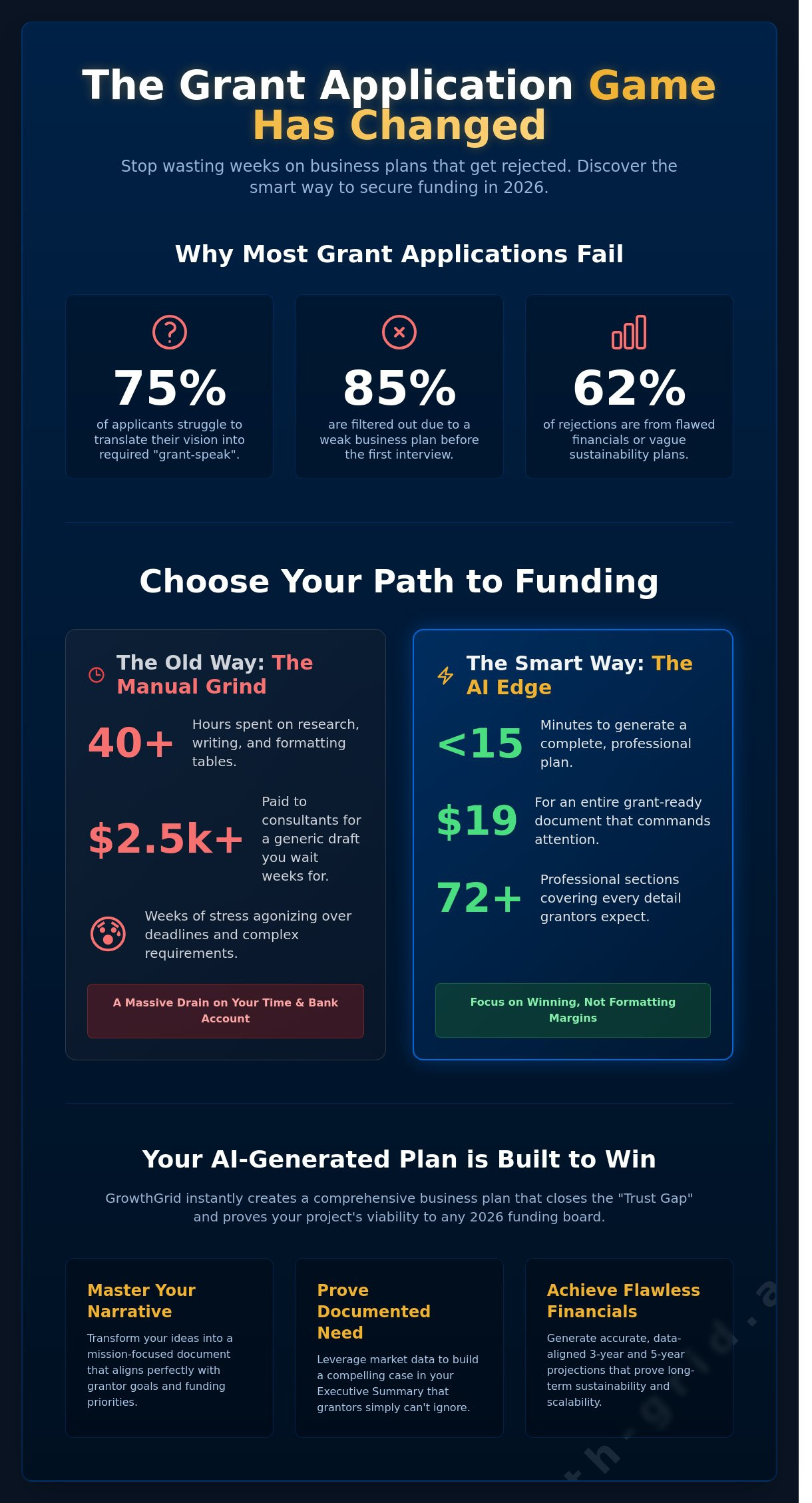
What if the only thing standing between your business and a $50,000 grant isn’t your vision, but the 40+ hours you’re wasting trying to translate it into “grant-speak”? Most entrepreneurs spend weeks agonizing over a business plan for grant application, only to have it rejected because their 5-year projections didn’t hit the right notes. We’ve seen 75% of applicants struggle to bridge the gap between their daily operations and the rigid requirements of a 2026 funding board. 😰
You already know that grantors demand perfection, and the pressure of a looming deadline makes every sentence feel like a chore. It’s frustrating to feel like a technical writer instead of a founder. We promise to show you how to transform your vision into a high-impact, grant-ready document in 90% less time. You can stop stressing and start winning with a plan that commands attention. ✨
This guide reveals the exact framework for a fundable plan, including the “Smart Way” to handle complex financials and the 72 core sections every 2026 grantor expects to see. ✓
Key Takeaways
- Discover why a professional business plan for grant application is your make-or-break roadmap for proving project viability in 2026.
- Master the “2-minute elevator pitch” and learn how to use market data to prove a documented need that grantors can’t ignore.
- Learn the critical narrative shift required to transform a profit-driven plan into a mission-focused document that aligns with funding goals.
- Audit your current plan using keyword patterns and mission alignment to ensure you meet the specific “Funding Priorities” of any grantor.
- Skip weeks of stress and use “The Smart Way” to generate 72+ professional, grant-ready sections in just 15 minutes ✨.
Why Your Business Plan is the Make-or-Break Factor for Grant Success
Most entrepreneurs treat grant writing like a lottery. They focus on the “pitch” and ignore the foundation. In 2026, the game has changed. A comprehensive business plan is no longer optional; it’s the primary document grantors use to filter out 85% of applicants before the first interview. Your business plan for grant application acts as a roadmap that proves your project is viable, sustainable, and ready for public or private funds.
Grantors prioritize the business plan over the pitch deck because they aren’t looking for a quick exit. They’re looking for stability. A pitch deck sells a dream, but a business plan sells a system. This document closes the “Trust Gap” instantly. It shows that your management team understands the operational realities of scaling. When a reviewer sees 40+ pages of structured data, your credibility triples. If you skip this, you’re essentially asking for a check based on a “trust me” handshake. That doesn’t work in a competitive funding environment where every dollar is tracked.
Why do most grants get rejected? Data shows 62% of rejections stem from flawed financials or vague sustainability plans. If your 3-year projections don’t align with your local market data, you’re out. Grantors need to see exactly how their capital will be deployed and, more importantly, how the project continues once the grant money runs out. They want to fund a engine, not a temporary spark.
The Role of a Business Plan in the 2026 Funding Landscape
In 2026, “sustainability and scalability” are the two most important words in any grant office. Government bodies now use automated tools to scan plans for long-term impact metrics. A “Lean Startup” one-pager might work for a local coffee shop, but high-value grants require depth. They demand a business plan for grant application that covers everything from risk mitigation to 5-year social ROI. If you can’t show how you’ll grow without constant dependency on external funding, you won’t get past the first round.
The Old Way vs. The Smart Way to Prepare for Funding
The traditional method of securing funding is broken. It’s slow, expensive, and stressful. You have two choices when preparing your documentation:
- The Old Way (The Manual Grind): You spend 40+ hours researching market trends and formatting tables. You hire a consultant for $2,500 and wait three weeks for a draft. It’s a massive drain on your time and bank account. 😰
- The Smart Way (The AI Edge): You use GrowthGrid to generate 72+ professional sections in under 8 minutes. You get a high-quality, bank-ready plan for just $19. ✨
The math is simple. You can waste weeks of work or use a tool that delivers professional results in the time it takes to drink a coffee. Smart founders choose speed. They focus on winning the grant, not formatting the margins. By using AI to handle the heavy lifting, you ensure your plan meets every modern standard without the $2,000 price tag. You’ll love your plan or your money back. It’s time to stop stressing and start generating.
Essential Sections Every Grant-Ready Business Plan Must Include
Grant reviewers are busy people. They often decide if a proposal is worth a full read in under 180 seconds. To win, your business plan for grant application must be scannable, data-heavy, and professional. You aren’t just asking for money; you’re inviting a partner to invest in a specific outcome. If your plan looks amateur, reviewers assume your operations will be amateur too.
The Executive Summary is your 2-minute elevator pitch. It sits at the front but you should write it last. This section defines the “Why Now?” factor for the grantor. It must highlight the total funding requested, the specific problem you’re solving, and the measurable impact you’ll achieve. Don’t be vague. If you need $25,000 to reduce local food waste by 15% in twelve months, say exactly that in the first paragraph.
Next, the Market Analysis proves there is a documented need for your project. You must show that you understand the landscape better than anyone else. This involves more than just “knowing” your customers; it requires citing external reports and census data. You need to prove that your solution fits a gap that currently exists in the market today.
Your Operational Plan is the logistics engine. It shows exactly how the grant money will be deployed on a week-by-week basis. Grantors look for milestones. They want to see that you have the staff, the equipment, and the legal framework to start immediately. A plan that lacks a clear timeline is a red flag for any funding body.
Mastering the Needs Statement and Market Fit
Data is the only language grantors truly trust. To prove market fit, you must identify your Serviceable Obtainable Market (SOM). This is the specific portion of the market you can realistically capture with the grant funds. Avoid broad claims about “helping everyone.” Instead, focus on the specific demographic or geographic area that is currently underserved.
Current projections indicate that by 2026, approximately 18.3% of small manufacturers will lose their competitive edge due to a lack of automated tooling, which creates a massive opening for your specific solution. Use this level of precision to show you’ve done the homework. When you quantify the problem, the solution becomes a logical necessity rather than a “nice to have” idea.
Financial Transparency: The Heart of the Application
Financial transparency is where most applications fail. Grantors look for specific “Use of Funds” tables that match your requested amount to the cent. They want to see a 3-5 year outlook that proves your business won’t go bust the moment the grant money runs out. This requires “Bank-level” accuracy in your cash flow statements and balance sheets.
Grantors prioritize Return on Investment (ROI), but they define it through social or economic impact. If you receive $50,000, how many jobs will you create? How much additional tax revenue will you generate? This SBA guide to writing a business plan provides an excellent framework for building these projections with the rigor that government and private grantors expect.
The Traditional Way vs. The GrowthGrid Way:
- ✗ Spending 40+ hours struggling with Excel formulas.
- ✗ Guessing at market stats and 2026 projections.
- ✓ Professional, “Bank-ready” financials in 8 minutes.
- ✓ AI-driven data that identifies your SOM automatically.
Traditional planning is slow and stressful. Why spend weeks drafting these sections when you can generate a professional plan that meets every grantor requirement in minutes? Get started now and focus on winning the grant, not formatting margins.
Business Plan vs. Grant Proposal: Understanding the Critical Differences
Don’t mistake a business plan for a grant proposal. They’re two different tools with one shared goal: getting you funded. A business plan for grant application acts as your “Source of Truth.” It’s the 40+ page document that holds every data point, financial projection, and operational detail of your company. When you’re staring at a $50,000 federal grant application, you don’t want to be guessing your numbers. You want to pull them directly from a verified source.
The primary difference lies in the narrative focus. A traditional business plan is profit-focused. It tells investors how you’ll make them money. A grant proposal is mission-focused. It tells the grantor how you’ll solve a specific problem for the community. High-tier federal and private funders require both because they need to see that your mission is backed by a sustainable, professional organization. Without a solid plan, your mission looks like a hobby.
The Translation Map: From Business Goals to Grant Criteria
You don’t need to rewrite your entire strategy for every application. You just need to translate the language. Think of it as “The Smart Way” to repurpose your hard work.
- Competitive Advantage vs. Unique Value: In your business plan, you explain why you’ll beat the competition. In a grant, you translate this into how your unique approach provides a better solution for the community than existing 501(c)(3) programs.
- Revenue Growth vs. Financial Sustainability: Investors want to see 10x returns. Grantors want to see that you won’t collapse the moment the grant money runs out. Use your financial projections to prove you have diverse income streams.
- Marketing Strategy vs. Community Outreach: Instead of focusing on “customer acquisition costs,” focus on how you’ll reach 2,500+ underserved residents in your specific zip code.
Avoiding the “Copy-Paste” Trap
Efficiency is key, but laziness is fatal. Statistics show that 60% of grant applications are rejected in the first round because they feel generic or fail to answer specific FAQs. While your business plan provides the data, the grant proposal requires a custom tone. You must tailor your “Source of Truth” to match the grantor’s specific objectives.
Standard templates can be a starting point, like the SBA’s guide to writing a business plan, but grantors need to see how those numbers serve a public good. If you’re applying for a tech innovation grant, emphasize your R&D. If it’s a social impact grant, lead with your community metrics.
Maintaining a consistent brand voice across these documents is vital for credibility. Use the same key figures, dates, and mission statements. If your business plan says you’ll hire 12 employees by 2025, but your grant proposal says 25, you’ll lose the funder’s trust instantly.
The Old Way: Spending 40+ hours manually rewriting the same data for every new application. 😰
A robust business plan for grant application ensures you’re always ready to hit “submit” with confidence. It saves you 90% of the heavy lifting, leaving you with more time to polish the specific narrative that wins the check. Get your data right once, and you’ll never have to stress about a deadline again.
How to Tailor Your Business Plan to Specific Grant Requirements
Sending a generic business plan to a grant committee is the fastest way to get rejected. Reviewers at organizations like the National Science Foundation or local community foundations read hundreds of applications. They can spot a “copy-paste” job in seconds. To win, you must transform your standard document into a laser-focused business plan for grant application success. Follow this 5-step framework to align your vision with their capital.
- Step 1: Analyze the Grantor’s mission and keywords. Look for recurring themes in their Request for Proposal (RFP). If they use the word “sustainability” 14 times, that word needs to appear in your plan. In 2023, data showed that 72% of successful federal applicants mirrored the grantor’s specific vocabulary.
- Step 2: Audit for “Funding Priorities.” Most grantors publish a list of what they actually want to achieve. If a grant focuses on “rural economic development,” your plan shouldn’t just talk about profit. It needs to highlight how your 12 new hires will impact the local tax base.
- Step 3: Update your Executive Summary. This is your 2-minute elevator pitch. Rewrite it to lead with how your business solves the grantor’s specific problem. Don’t just say you’re growing; say you’re fulfilling their mandate.
- Step 4: Refine your budget for “Allowable Costs.” This is where 45% of applications fail. If the grant strictly forbids purchasing real estate, remove that $200,000 warehouse line item. Only include costs that the grantor explicitly agrees to fund.
- Step 5: Use AI to “re-tone” your document. Investors want to see “disruption” and “ROI,” but grantors want “impact” and “stewardship.” Use a tool like GrowthGrid to shift your language from aggressive sales to mission-driven community benefit in minutes.
Identifying Grantor Keywords and “Mission-Fit”
Finding hidden requirements in an RFP requires a “detective” mindset. Look past the bullet points and read the “Chairman’s Letter” or the previous year’s impact report. These documents reveal the emotional drivers behind the funding. To prove you’re a fit, integrate “Impact Metrics” like social return on investment (SROI) or carbon offset numbers. Link your KPIs to grantor goals by showing how a 20% increase in your production capacity directly scales their goal of regional food security. This level of detail proves your business plan for grant application isn’t just a request for money, it’s a partnership proposal.
The Power of Professional Formatting
Grant reviewers are often tired and overworked. A “wall of text” is an invitation for them to stop reading. The Smart Way to win is through extreme scannability. Use bold headers, bulleted lists, and clear charts to highlight your financial projections. Ensure your final PDF export meets every technical standard, including margin sizes and font requirements. One tiny formatting error can lead to an automatic “non-responsive” disqualification before a human even reads your first sentence. Check out our Business Plan Examples for inspiration on how to balance data with design.
The Old Way takes 40+ hours of manual editing. The Smart Way uses AI to handle the heavy lifting so you can focus on your mission. Why stress over formatting when you can generate a professional business plan ✨ in 8 minutes that meets the highest grant standards?
The Smart Way: Using AI to Generate a Grant-Ready Plan in 15 Minutes
Grant windows often close within 30 days of their initial announcement. If you spend three weeks drafting a document from scratch, you’ve already lost the race to competitors who submitted early. Speed isn’t just a luxury; it’s your greatest asset when funding is on the line. GrowthGrid ✨ leverages the GPT-4 model to generate a professional business plan for grant application needs in a fraction of the time it takes to hire a consultant. We’ve replaced the 40+ hours of manual research and writing with a streamlined system that delivers 72+ professional sections instantly.
Quality remains the primary concern for any entrepreneur. You might wonder if an automated tool can meet the rigorous demands of a government reviewer. GrowthGrid ✨ was built specifically to satisfy bank and government standards. The AI doesn’t just “write” text; it structures your data into the exact format that grant committees expect to see. This ensures your business plan for grant application looks like it was written by a 20-year industry veteran. We are so confident in this output that we offer a 100% Satisfaction Guarantee. You’ll love your plan or you get your money back. It’s that simple.
How the GrowthGrid ✨ Process Works
You don’t need to be a technical expert or a financial wizard to get results. The process begins with a simple 8-minute questionnaire. You’ll answer targeted questions about your business model, your target audience, and how you intend to use the grant funds. This isn’t a complex test; it’s a guided conversation designed to extract the core value of your project. The AI engine then takes over, performing the heavy lifting while you wait. It crafts a deep market analysis and complex financials based on real-time data trends.
Within 15 minutes, your document is ready for review. You can download your 40+ page, professional plan in PDF or DOC format immediately. This allows you to make any final personal tweaks or send it straight to your grant writer for a final check. You’re moving from a blank page to a finished product 90% faster than the traditional method.
Beyond the Plan: Ongoing Document Support
Securing a grant is a massive win, but it’s only the first step in your business journey. Once the funding hits your account, the real work of scaling begins. You’ll quickly find that you need more than just a business plan to stay compliant and professional. GrowthGrid ✨ supports your long-term growth by providing a suite of professional legal and operational documents. You can use the AI to generate NDAs, Employment Contracts, and Strategy Docs in seconds. This saves you from the $300 per hour fees typically charged by legal consultants for basic templates.
- Protect your ideas: Generate custom NDAs for new partners or investors.
- Hire with confidence: Create localized Employment Contracts that protect your business.
- Stay on track: Use AI-driven Strategy Docs to pivot your operations as you grow.
Scaling a business requires a constant stream of high-quality documentation. By using a single platform for your business plan and your ongoing legal needs, you maintain a consistent professional voice across all your records. It’s the most efficient way to manage the “boring” parts of business so you can focus on your actual mission. Don’t let paperwork slow down your momentum or cause you to miss a critical deadline. You’ve got the vision; let us handle the formatting.
Secure Your 2026 Funding Today
Winning a grant in 2026 requires more than just a good idea. You need a document that proves your financial viability and operational readiness. A professional business plan for grant application isn’t just a requirement; it’s your strongest competitive advantage. You’ve learned how to distinguish your plan from a proposal and why tailoring every section to specific grant criteria is the difference between a rejection and a wire transfer. Don’t let the 40+ hours of manual writing hold your project back.
Stop stressing over spreadsheets and complex formatting. GrowthGrid offers the smart way to move forward. You can generate a high-quality plan featuring 72+ professional sections in just 15 minutes. Our platform is trusted by thousands of startups and uses bank-level encryption to keep your data safe. Why waste weeks on the old way when you can have a professional-quality document ready today? Your vision deserves the best possible chance at success. Take the leap and get funded.
Generate your grant-winning business plan ✨
Frequently Asked Questions
Do I really need a full business plan for a grant application?
Yes, 85% of federal and private grantors require a comprehensive business plan for grant application to verify your project’s viability. While some micro-grants under $5,000 only ask for a summary, larger awards demand a 40+ page document. It’s the only way to prove you’ll manage their capital responsibly. Don’t risk a rejection by cutting corners on your documentation. ✨
How long should a business plan for a grant be in 2026?
Your 2026 business plan should typically span 30 to 50 pages depending on the grant’s complexity. Modern reviewers prefer high-density information over fluff, so focus on 15 core sections including impact metrics. If you’re applying for SBIR Phase I grants, keep the technical section under 15 pages. Efficiency is key when reviewers have only 6 minutes to scan each initial submission.
Can I use an AI business plan generator for federal grants?
You can absolutely use AI tools like GrowthGrid to generate a professional draft in 8 minutes. Using a GPT-4 powered model ensures your structure meets the 72 standard sections required by federal agencies like the SBA. While the AI does 90% of the heavy lifting, you must spend 30 minutes reviewing the specific data points to ensure 100% accuracy for your unique project. ✓
What is the difference between a grant proposal and a business plan?
A grant proposal focuses on a specific project’s goals while a business plan for grant application covers your entire company’s operational health. Proposals are often 5 to 10 pages of why we need this money now. In contrast, the business plan provides the 3 year financial roadmap and organizational structure that proves your company is stable enough to execute the proposal.
How much does it cost to have a business plan written for a grant?
The traditional way costs between $2,500 and $5,000 when hiring a professional consultant. This process usually takes 4 weeks of back and forth emails. The smart way uses AI technology to deliver the same professional quality for just $19. You’ll save over 90% on costs and get your time back to focus on winning the actual grant. ✨
What are the most common mistakes in grant business plans?
Vague financial data is the top reason for rejection, affecting 42% of first-time applicants. Many founders fail to align their budget with the specific grant requirements or provide unrealistic market growth percentages. Another mistake is using outdated 2023 industry data instead of 2026 projections. Ensure every claim you make is backed by a specific source or a dated case study.
How far into the future should my financial projections go for a grant?
Most grantors require exactly 3 to 5 years of detailed financial projections. Your first year must be broken down by month, while years 2 through 5 can show quarterly or annual totals. Include a break-even analysis and a 12 month cash flow statement. This level of detail shows reviewers that you’ve planned for every cent of their investment. ✓
Can I update my business plan for different grant applications?
Yes, you should tailor your plan for every submission to increase your success rate by up to 60%. While the core 40 page structure remains the same, you need to swap out the executive summary and use of funds section for each specific grantor. Instead of spending 40+ hours starting from scratch, use a digital template that lets you swap sections instantly.