

Food Truck Business Plan: The Ultimate Template for Success in 2025
You’ve perfected your menu and found the perfect truck. But now comes the part many entrepreneurs dread: writing a formal food truck business plan. The spreadsheets, market analysis, and financial projections can feel overwhelming, especially when you’re a culinary expert, not a business analyst. You know your food is a winner, but how do you prove it on paper to a bank or investor?
Stop the stress. This guide is your fast track to a powerful plan that gets results. We’ve stripped away the jargon and complexity to give you a straightforward, step-by-step template designed specifically for mobile food entrepreneurs in 2025. It’s the smart way to get it done right, saving you weeks of work and uncertainty.
Follow along to confidently calculate startup costs, forecast your revenue, and define your unique market niche. You’ll walk away with a professional, fund-ready document that serves as your strategic roadmap long after you serve your first customer. Let’s turn your passion into a profitable plan.
Why Your Food Truck Needs More Than Just a Great Recipe
Your secret-family-recipe tacos might be the best in the city, but a great product alone won’t keep your engine running. The difference between a passion project that fizzles out and a profitable, thriving mobile kitchen is a solid roadmap. Your business plan is that roadmap-not just a dusty document, but a live guide to success.
Consider the tale of two food trucks. Wanderlust Wraps had incredible food but no plan. They guessed at locations, ran out of ingredients during the lunch rush, and burned through cash in three months. 😰 In contrast, Precision Pizza started with a detailed plan. They knew their costs, secured a small business loan with ease, and targeted office parks on weekdays and festivals on weekends. They’re now looking to expand. The difference wasn’t the food-it was the strategy.
The Core Purpose: From Passion to Profit
A business plan is the tool that transforms your culinary passion into a profitable enterprise. It forces you to stop dreaming and start strategizing. You’ll define your core concept, identify your ideal customer, and pinpoint what makes you different from the competition. For a solid foundation, a quick look at a general food truck industry overview can provide valuable context on business models and economics. This process helps you set clear, achievable goals for your first year, like hitting a specific revenue target or booking 20 private events.
Who Is This Plan For? (Hint: It’s Not Just for the Bank)
Thinking your plan is just a formality for a loan application is a huge mistake. This document is your most critical operational tool, serving multiple audiences:
- For You: It’s your North Star. When you’re facing tough decisions, your plan provides the data-driven clarity you need to stay on track and measure what’s working.
- For Partners: It aligns everyone on a single vision. A clear plan prevents costly misunderstandings about roles, financial contributions, and long-term goals.
- For Investors & Lenders: It’s your proof of concept. A professional food truck business plan demonstrates you’ve done the hard work, analyzed the risks, and have a viable strategy to generate a return. It screams ‘safe bet.’
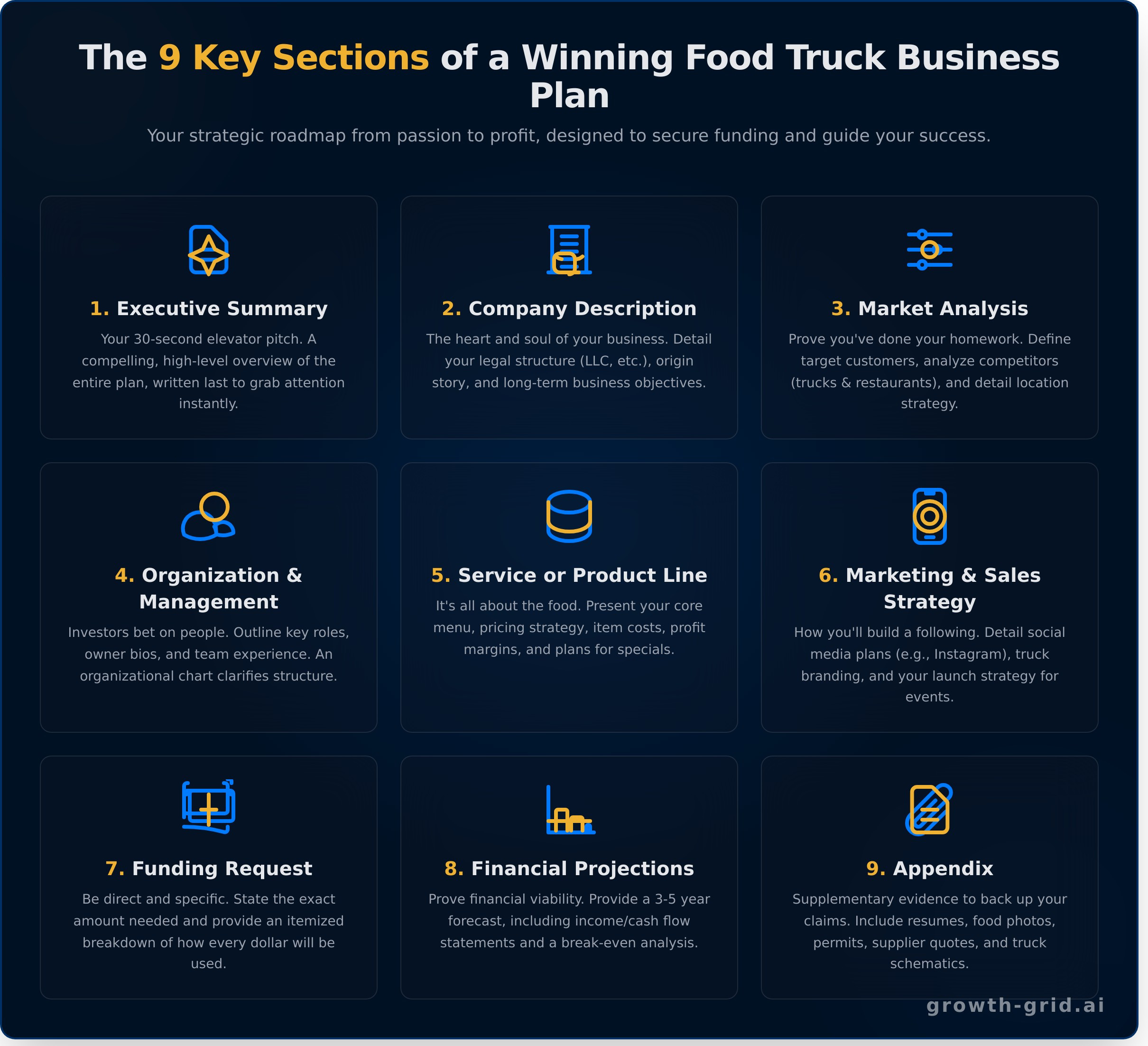
The 9 Key Sections of a Winning Food Truck Business Plan
A powerful business plan isn’t just a document; it’s your roadmap to funding and success. Lenders and investors expect a clear, standardized format that answers their critical questions upfront. This 9-part structure is the industry gold standard, closely following the U.S. Small Business Administration’s official business plan guide. While the framework is consistent, the details must be uniquely yours. Let’s break down exactly what to include in each section of your food truck business plan.
1. Executive Summary: Your Business in a Nutshell
Think of this as your 30-second elevator pitch. Although it appears first, you should write it last. It must be a compelling, high-level overview of your entire plan, grabbing the reader’s attention instantly. Include your mission statement, core food concept, target market, key financial projections, and your specific funding request.
2. Company Description: The Story Behind Your Brand
This is where you introduce the heart and soul of your business. Detail your legal structure (e.g., LLC, Sole Proprietorship), share your origin story-what inspired your concept?-and clearly state your short and long-term business objectives. What makes your brand special?
3. Market Analysis: Who Are Your Customers & Competitors?
Prove you’ve done your homework. You need to show a deep understanding of the market you’re entering.
- Target Customers: Define them. Are they office workers on a lunch break, families at a local park, or the late-night bar crowd?
- Competitors: Analyze other food trucks and nearby brick-and-mortar restaurants. What are their strengths and weaknesses?
- Location: Identify ideal vending spots and confirm you understand the local regulations and permit requirements.
4. Organization & Management: The Team Driving Your Success
Investors bet on people, not just ideas. Outline the key roles and responsibilities, even if you’re a one-person operation. Include brief bios for the owner(s) and key team members, highlighting relevant culinary, business, or marketing experience. An organizational chart clarifies the structure.
5. Service or Product Line: Detailing Your Menu
It’s all about the food. Present your core menu with enticing descriptions. Crucially, you must also explain your pricing strategy, including the estimated cost to produce each item and your target profit margin. Mention any plans for seasonal specials, catering packages, or future menu expansions.
6. Marketing & Sales Strategy: How You’ll Attract Customers
A great menu means nothing if no one knows about it. Detail your plan to build a following. Cover your social media strategy (especially visual platforms like Instagram), your truck’s branding and wrap design, and your launch plan for grand openings or attending high-traffic local events.
7. Funding Request: How Much You Need and Why
Be direct and specific. State the exact amount of capital you are seeking. Provide a detailed, itemized breakdown of how every dollar will be used-from the truck purchase and outfitting to permits, licenses, and initial food inventory. Also, specify the type of funding you need (e.g., a loan, line of credit).
8. Financial Projections: Proving Your Profitability
This is where you prove your concept is financially viable. Provide a 3- to 5-year forecast including projected income statements, cash flow statements, and a balance sheet. You must include a break-even analysis that shows exactly how much food you need to sell per day/week to become profitable.
9. Appendix: The Supporting Documents
This section holds all the supplementary evidence that backs up the claims in your plan. Include items like owner resumes, professional food photos, truck schematics, copies of permits and licenses, quotes from suppliers, and letters of intent from event organizers.
Nailing Your Financials: A Food Truck Cost Breakdown
Let’s be honest: the numbers section is where most entrepreneurs get overwhelmed. 😰 It feels complex, and the stakes are high. But getting this right is the most critical part of your food truck business plan. The key is to simplify. We’ll break everything down into two clear categories: one-time startup costs and ongoing operating expenses.
Getting these figures accurate is essential for any lender or investor, and they form the backbone of any professional business plan template you might follow. Let’s get started.
One-Time Startup Costs Checklist
These are the initial investments you need to make before you sell your first taco. Think of it as your launch budget. Accuracy here prevents surprises down the road.
- The Truck: Your biggest expense. A reliable used truck can range from $30,000 – $80,000, while a new, custom-outfitted truck can cost $80,000 – $150,000+. A professional vinyl wrap adds another $3,000 – $7,000.
- Kitchen Equipment: This includes your grill, fryers, refrigeration, and prep stations. Budget $10,000 – $40,000 if not included with the truck. Don’t forget a modern POS system ($500 – $1,500).
- Licenses & Permits: Expect to pay $500 – $2,000 for your business license, health department permits, and food handler cards. This varies widely by city and state.
- Initial Inventory & Branding: Your first big food order, plus branded packaging, menus, and a professional logo design will run $2,000 – $5,000.
Ongoing Monthly Operating Expenses
Once you’re open, these are the costs you’ll pay every month to keep the engine running and the food cooking. Tracking these is key to profitability.
- Food & Supplies (COGS): Your Cost of Goods Sold. Aim for this to be 28-35% of your total revenue.
- Fuel & Maintenance: Budget $500 – $1,000 per month for both truck fuel and propane/gas for your generator.
- Commissary & Parking Fees: Most cities require you to use a commissary kitchen for prep and storage ($400 – $1,200/month). Event fees can range from $50 to $500+ per day.
- Recurring Bills: This covers staff salaries, business insurance ($200 – $500/month), payment processing fees (2.5-3.5% of sales), and your marketing budget.
Projecting Your Revenue Realistically
Forecasting sales can feel like guesswork, but you can make educated estimates. Start by calculating your potential average transaction value (e.g., $15 per customer). Then, estimate how many customers you can serve per hour at a given location. If you serve 15 customers an hour for a 6-hour lunch rush, that’s 90 customers. At $15 each, you have a daily revenue target of $1,350. Always factor in slow days due to bad weather or poor location-don’t assume every day will be a sell-out success.
Financials stressing you out? Let our AI generate them for you. ✨
The Smart Way vs. The Old Way: Create Your Plan in Minutes
You’ve seen what it takes to build a winning plan: deep market analysis, a detailed operational strategy, and complex financial projections. Traditionally, assembling this 40+ page document is a marathon of research, writing, and endless calculations. But what if you could skip the marathon and still win the race for funding?
The choice is clear. You can either struggle with the outdated, stressful process or embrace a modern solution that delivers a professional food truck business plan in a fraction of the time.
The Old Way: Weeks of Stress & Guesswork 😰
The traditional route is paved with long hours and high costs. It often involves wrestling with complicated spreadsheets and paying steep fees, all with no guarantee of a polished result that will impress lenders or investors.
- ✗ Spending 40-80 hours writing and researching.
- ✗ Paying a consultant $1,500 – $5,000.
- ✗ Struggling with complex financial spreadsheet formulas.
- ✗ Risking an unprofessional document that gets rejected.
The GrowthGrid Way: A Professional Plan by Tomorrow ✨
There’s a smarter path. Using AI, you can automate the entire process. Simply answer a few questions about your food truck concept, and our platform instantly handles the heavy lifting for you.
- ✓ Answer simple questions and get a complete plan in under 15 minutes.
- ✓ Save over 90% compared to hiring a writer.
- ✓ AI-generated financials based on your specific inputs.
- ✓ Get a bank-ready, professional document guaranteed.
Your time is your most valuable asset. It’s better spent perfecting your menu, scouting locations, and building your brand-not stuck behind a screen formatting documents. A powerful food truck business plan is your key to securing funding and launching successfully. Don’t let the old way hold you back.
Ready to create a plan that gets results without the headache? Generate your complete plan with GrowthGrid today.
Your Roadmap to a Profitable Food Truck Is Ready
Your journey from passionate chef to successful entrepreneur starts with a solid strategy, not just a great menu. As we’ve covered, a comprehensive plan is your roadmap-it defines your unique concept, maps out your operations, and proves your financial viability to lenders and to yourself. A powerful food truck business plan is the critical ingredient that separates a popular hobby from a profitable, scalable business.
But building that plan shouldn’t feel like a chore. Forget the weeks of stress and endless templates of the “old way.” It’s 2025, and there’s a smarter, faster path to success. Stop stressing, start building. Generate Your Pro Food Truck Plan in Minutes!
Join a community of over 10,000 startups who have launched with confidence using GrowthGrid. Our AI generates a complete, 40+ page plan tailored to your vision in minutes, not weeks. Plus, it’s all backed by our 100% Money-Back Satisfaction Guarantee. The road is open, and your future customers are hungry. Let’s get you moving.
Frequently Asked Questions
How long should a food truck business plan be?
Aim for a plan between 20-40 pages. The goal isn’t just length-it’s clarity. A shorter, 20-page food truck business plan packed with solid research and clear financials is more effective than a 50-page document filled with fluff. Focus on covering all key sections thoroughly, from your executive summary to your financial forecasts. This ensures your plan is a professional, actionable roadmap for success, whether it’s for you or for potential lenders.
Do I really need a business plan if I’m self-funding my food truck?
Absolutely. Even if you don’t need a loan, a business plan is your strategic guide. It forces you to validate your concept, analyze your competition, and create realistic financial projections before you spend a dollar. Think of it as a crucial stress-test for your idea. A well-crafted plan helps you avoid costly mistakes, identify opportunities, and stay focused on your goals, saving you significant time and money down the road.
What’s the single biggest mistake people make in their food truck plan?
The biggest mistake is unrealistic financial projections. Entrepreneurs often overestimate sales and drastically underestimate startup and operational costs. Forgetting to account for truck maintenance, permit renewals, commissary kitchen fees, and marketing can sink a business before it starts. Your financial section must be grounded in thorough research and conservative estimates. A plan with believable numbers shows you’ve done your homework and are prepared for the real-world challenges of the industry.
How do I find the right information for the market analysis section?
Get fast, accurate data by focusing on these key sources. Start with your local chamber of commerce and city government websites for demographic data and business regulations. Use tools like Google Trends to gauge interest in your cuisine type. Most importantly, conduct field research: visit potential locations at different times, count foot traffic, and analyze competing food trucks and restaurants. This direct observation provides invaluable, real-world insights for a strong market analysis.
Can I use a generic business plan template for my food truck?
A generic template can be a starting point, but it’s not a complete solution. Food trucks have unique challenges-like location strategy, commissary needs, and specific health permits-that generic plans often miss. Using one without heavy customization can lead to a weak, unconvincing document. To be effective, your food truck business plan must be tailored specifically to your concept, market, and operational details. A customized plan demonstrates true professionalism and foresight.
What permits and licenses should I list in my business plan?
Your plan should detail all required local and state credentials. This typically includes a business license, an Employer Identification Number (EIN), a food handler’s permit, and a seller’s permit. For the truck itself, you’ll need a vehicle license and a mobile food facility permit. Be specific and research your city and county requirements, as they vary significantly. Listing these shows lenders and investors that you understand the regulatory landscape and are prepared to operate legally.