

Staring at a blank page, feeling completely overwhelmed by business jargon? If terms like SWOT, P&L, and cash flow projections make you feel like an imposter, you are not alone. That fear-the belief that you’re not qualified to write a formal plan-stops too many great ideas before they even start.
But what if you could skip the stress and the self-doubt? This guide is your fast track, showing you exactly how to create a business plan without experience. We’ve eliminated the complexity to give you a simple, step-by-step process that anyone can follow. Forget spending weeks trying to figure it all out 😰.
Here, you’ll get clear, actionable instructions for every section, from market research to financial forecasts. You’ll gain the confidence to build a professional document that clarifies your vision and gets you ready to talk to partners or lenders. Let’s build your roadmap to success. ✨
Key Takeaways
- Leverage your fresh perspective as a strategic advantage instead of a weakness.
- Break down any business plan into four simple, logical parts that are easy to tackle.
- Discover actionable hacks to gather professional market data using free, everyday tools.
- Learn how to create a business plan without experience by comparing the old way (templates) with the smart way (AI).
Why ‘No Experience’ Is Actually Your Advantage
Does the thought of writing a business plan with zero formal experience make you sweat? 😰 Good. Let’s reframe that fear right now. Not having an MBA or years of corporate baggage isn’t a weakness-it’s your secret weapon. You have what seasoned executives pay thousands for: a fresh perspective.
You aren’t burdened by outdated industry “rules” or bad habits. You see problems with clear eyes and can imagine solutions others have missed. This is the perfect starting point for learning how to create a business plan without experience. The real purpose of your first business plan isn’t to impress a professor; it’s to create a clear, actionable roadmap for yourself. Your deep passion and knowledge of your idea are far more valuable than a fancy degree.
Shift Your Mindset: From ‘Thesis’ to ‘Story’
Forget the intimidating image of a 100-page document filled with complex jargon. A business plan is simply your business’s story, written down. It answers a few straightforward questions:
- What problem are you solving?
- Who are you solving it for? (Your customer)
- Why is your solution the best choice?
Focus on telling that story with clarity and passion. Your belief in your idea will shine through more than any buzzword ever could.
The Only Two Audiences You Need to Consider
When you’re just starting, you only need to write for two audiences. First and foremost is You. The process forces you to think critically, challenge your assumptions, and find the weak spots in your strategy before they cost you real time and money. It’s your personal stress-test.
The second audience is Others-like investors or banks. Don’t worry, they aren’t expecting a literary masterpiece. They simply want to see you’ve done your homework. They need confidence that you understand The Anatomy of a Business Plan and can present a logical path to profitability. Your plan shows them you’re a serious founder, not just a dreamer.
The Anatomy of a Business Plan (Simplified for Beginners)
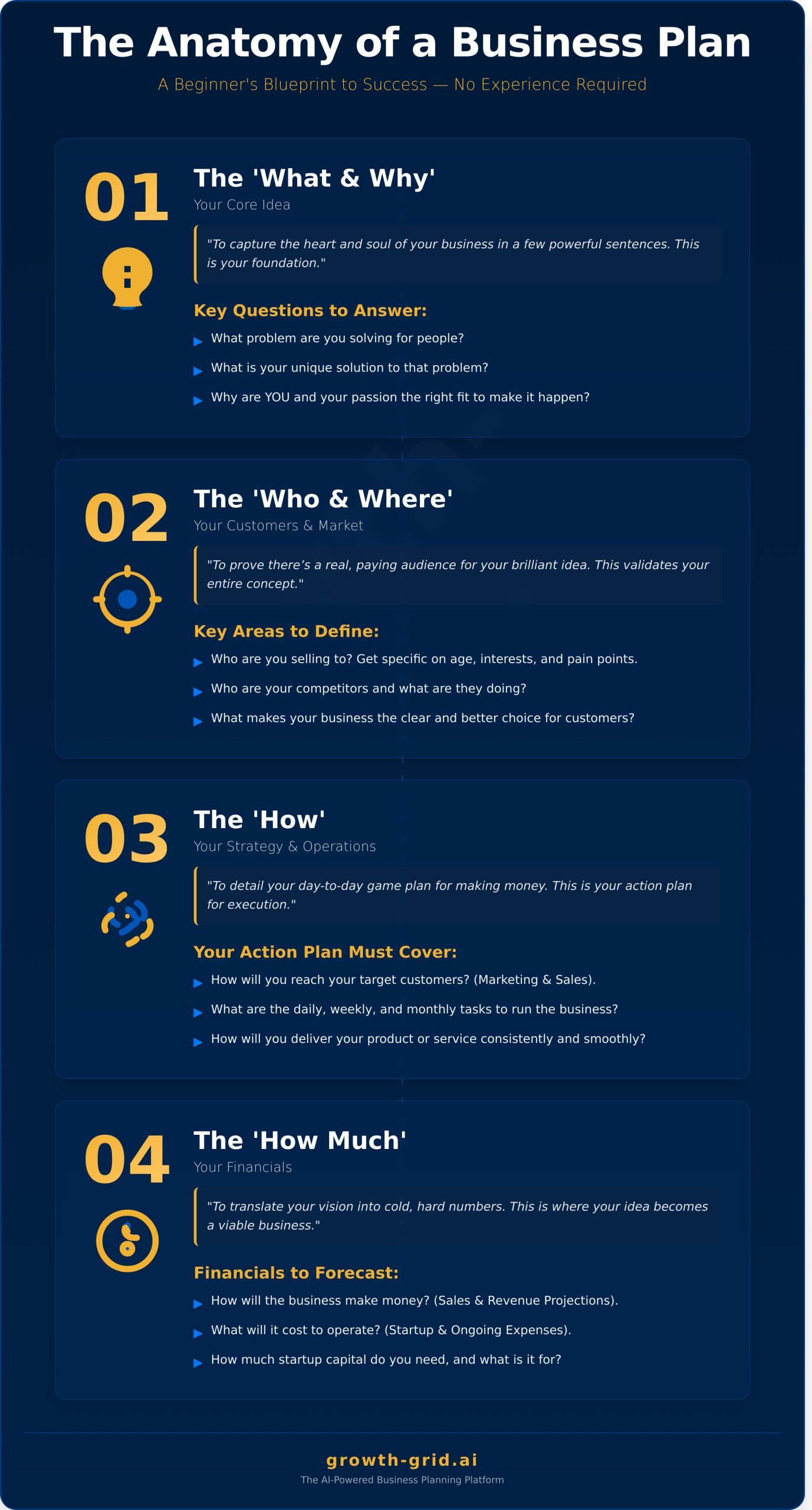
Forget the intimidating, 50-page templates you’ve seen online. A business plan doesn’t have to be a nightmare, especially when you’re just starting out. The secret to how to create a business plan without experience is to stop thinking about formal sections and start thinking in four simple, logical blocks. This framework turns a mountain of work into four manageable steps, giving you a clear roadmap from idea to launch.
Think of it like this:
- Part 1: The ‘What & Why’
- Part 2: The ‘Who & Where’
- Part 3: The ‘How’
- Part 4: The ‘How Much’
Let’s break down exactly what each part means for you.
Part 1: The ‘What & Why’ – Your Core Idea
The goal: To capture the heart and soul of your business in a few powerful sentences. This is your foundation. It covers what problem you are solving for people and what your unique solution is. More importantly, it answers why you are the right person to do it. This is where you channel your passion into a clear and compelling mission.
Part 2: The ‘Who & Where’ – Your Customers & Market
The goal: To prove there’s a real, paying audience for your brilliant idea. Who are you selling to? Get specific-think age, interests, and pain points. You also need to look at your competitors. Who are they, and what makes your business a better choice? You don’t need a marketing degree for this. In fact, the U.S. Small Business Administration offers actionable research hacks to help you define your market fast.
Part 3: The ‘How’ – Your Strategy & Operations
The goal: To detail your day-to-day game plan for making money. This is your action plan. How will you reach the customers you identified in Part 2? What will your marketing and sales process look like? It also covers the practical stuff: what tasks do you and your team (even if it’s just you) need to complete every day to deliver your product or service and keep the business running smoothly?
Part 4: The ‘How Much’ – Your Financials
The goal: To translate your vision into cold, hard numbers. Don’t panic! This doesn’t require an accounting degree. You simply need to estimate how your business will make money (sales projections) and what it will cost to run (expenses). Answering how to create a business plan without experience often comes down to facing the numbers. If you need startup cash, this section also explains exactly how much you need and what you’ll use it for.
Actionable Research Hacks When You’re Starting from Scratch
The word “research” can sound intimidating, but it doesn’t have to be. You don’t need a massive budget or a fancy degree to understand your market. The goal here is simple: gather enough information to make smart, educated guesses. Remember, good-enough research is infinitely better than no research. This is a core part of learning how to create a business plan without experience, because it’s about being resourceful. Focus on a few key areas, and you’ll have the data you need in hours, not weeks. A smart approach to writing a plan is always by understanding your audience and market first.
Market Research Without a Marketing Degree
Forget complex surveys. Your mission is to find out if real people will actually want what you’re selling. Get fast, practical answers with these simple steps:
- Talk to 5 potential customers. Find five people in your target audience and ask them about the problems your business solves. Listen more than you talk. What are their biggest frustrations? What do they wish existed?
- Use Google Trends. This free tool shows you if people are searching for your idea, product, or service. Is interest growing, shrinking, or flat? It’s a quick pulse check on demand.
- Explore online communities and social media groups. Find digital spaces where your customers gather. Read their posts and comments. You’ll uncover their exact pain points, the language they use, and what they’re currently using to solve their problems.
Spying on Your Competitors (Ethically!)
You can’t win the game if you don’t know the other players. Understanding your competition is crucial. Spend an hour or two being a detective:
- Analyze their digital footprint. Look at their website, pricing page, and social media. What message are they sending? Who are they targeting?
- Read their customer reviews. Check Google, Yelp, or industry-specific sites. The 1-star and 5-star reviews are pure gold. Bad reviews reveal their weaknesses, and good reviews show what customers value most.
- Create a simple list. Open a document and list 3-5 competitors. For each one, write down their biggest strength and their most obvious weakness. That’s it.
Financial Projections for Non-Accountants
Numbers can be the scariest part of how to create a business plan without experience, but you can simplify it. Don’t aim for perfection; aim for a realistic starting point.
- List all your expenses. Think monthly. Rent, software, marketing, supplies, salaries-write it all down. Be brutally honest.
- Create three sales forecasts. Don’t just plan for success. Create a pessimistic (worst-case), realistic (most likely), and optimistic (best-case) sales forecast for your first year. This shows you’re prepared for anything.
- Use a simple spreadsheet. You don’t need complex accounting software. Google Sheets or Excel is more than enough to get started.
- Feeling stuck? 😰 Numbers not your thing? The GrowthGrid AI generator can create your financial projections for you. Save time and get it done right.
The Smart Way to Write: Templates vs. AI Tools
You know what goes into a business plan, but the biggest question remains: How do you actually write it? When you’re figuring out how to create a business plan without experience, you have two clear paths. There’s the old, frustrating way, and the new, smart way.
The ‘Old Way’: Using a Standard Template
Templates seem like a helpful start. They’re often free and provide a basic structure. The problem? They leave you to do all the heavy lifting, which often leads to major roadblocks for first-time founders.
- ✗ The Blank Page Problem: A template is just an empty outline. You’re still staring at dozens of blank sections, which is a perfect recipe for writer’s block.
- ✗ Hours of Stressful Research: You are responsible for every word, every financial projection, and every market analysis. This can easily consume 40+ hours of your time.
- ✗ Risk of Sounding Unprofessional: It’s incredibly easy to use the wrong tone, forget key financial details, or miss entire sections that banks and investors expect to see.
The ‘Smart Way’: Using an AI Business Plan Generator
This is the modern solution for entrepreneurs who need results, fast. Instead of giving you an empty box to fill, an AI generator acts as your co-writer, strategist, and editor. It’s designed to eliminate the guesswork and deliver a professional document instantly.
- ✓ Instantly Overcome Writer’s Block: The AI generates clear, professional text for every section based on simple questions about your business idea. No more staring at a blinking cursor.
- ✓ Professional Tone, Guaranteed: The system is trained on thousands of successful business plans. It automatically adopts the right format and language to impress lenders and partners.
- ✓ A Guided, Step-by-Step Process: You’re never left wondering what to do next. The tool guides you through each section, ensuring your plan is comprehensive and complete.
- ✓ Save Weeks of Work: What traditionally takes weeks of stress can now be completed in under 15 minutes, freeing you to focus on what matters most-building your business.
The rise of such AI-driven platforms is part of a larger movement to empower founders. For instance, the innovative work being done by the Robots Project highlights how technology is tackling various entrepreneurial challenges, from planning to execution.
When to Choose Which Method
A standard template is okay if you’re just jotting down a rough, internal draft for your own eyes. Think of it as a personal brainstorming tool, not a finished product.
However, for anyone who needs a polished, professional document for a loan application, investor pitch, or strategic roadmap, an AI tool is the only logical choice. For beginners, it removes the single biggest barrier to getting started: the writing itself. It transforms a daunting project into a simple, guided process.
Ready to skip the stress and get a bank-ready plan? See how GrowthGrid can write your plan in under 15 minutes.
Turn Your Vision into a Plan-No Experience Required
Writing a business plan can feel intimidating, but it doesn’t have to be. You now have a clear roadmap for how to create a business plan without experience. Remember, your fresh perspective is a powerful asset, and understanding the core components of a plan is simpler than you think when you leverage smart tools that do the heavy lifting for you.
Why spend weeks struggling with outdated templates? It’s time to work smarter. Join over 10,000 startups and entrepreneurs who use GrowthGrid to generate a complete, 40+ page plan in under 15 minutes and save over 90% compared to hiring a consultant. Stop stressing, start generating. Create your professional business plan in minutes with GrowthGrid.
Your big idea deserves a brilliant plan. Now go make it happen.
Frequently Asked Questions
Do I really need a full business plan if I’m not looking for funding?
Yes. Stop thinking of a business plan as just a document for investors. Think of it as your strategic GPS. A great plan gives you a clear roadmap, helping you identify potential roadblocks, set measurable goals, and make smarter decisions, faster. It’s the most efficient way to turn your vision into a concrete, actionable strategy for success. Why build on guesswork when you can build on a solid foundation?
How long should a business plan be for a startup with no experience?
Focus on quality over quantity. A professional, comprehensive business plan typically lands between 20 to 40 pages. The goal isn’t to write a novel; it’s to communicate your vision clearly and prove you’ve done the research. Ensure all key sections are covered-from your executive summary to financial projections-without the fluff. Modern AI tools can generate a perfectly structured, lender-ready plan of this length in minutes.
What is the most important section of a business plan for a beginner?
For a beginner, the two most critical sections are the Executive Summary and the Market Analysis. Your Executive Summary is your first impression-it must be powerful, concise, and compelling. The Market Analysis proves you truly understand your customer, your industry, and the problem you solve. Nail these two sections to show that even without a long track record, you have a data-backed vision for success.
What if my financial projections are just a guess? Will investors laugh at me?
No, they won’t laugh at educated guesses. Investors know early projections are forecasts, not guarantees. The key is to show your work. Base your numbers on solid market research, competitor pricing, and realistic sales targets. Clearly state your assumptions. This shows you’re a pragmatic, data-driven founder, not just a dreamer. It’s about demonstrating a credible thought process, not predicting the future with 100% accuracy.
Can I write a business plan for a completely new idea that has no competitors?
Absolutely. A “no competitors” scenario is an opportunity to showcase your deep market insight. Your plan should focus on indirect competitors or alternative solutions customers currently use. This demonstrates the market gap your idea fills. A key part of learning how to create a business plan without experience is proving a clear market need exists. Your plan is the perfect tool to tell that story with data and conviction.
Is a business plan created by AI good enough for a bank loan?
Yes, provided you use a professional-grade AI tool. The best AI planners use advanced models like GPT-4 to generate a complete, 40+ page plan that is structured exactly how banks and lenders expect. It will include all 72 essential sections, from detailed market analysis to five-year financial projections. You get a bank-ready, professional document in minutes, not weeks. It’s the smart, fast way to meet lender requirements.