

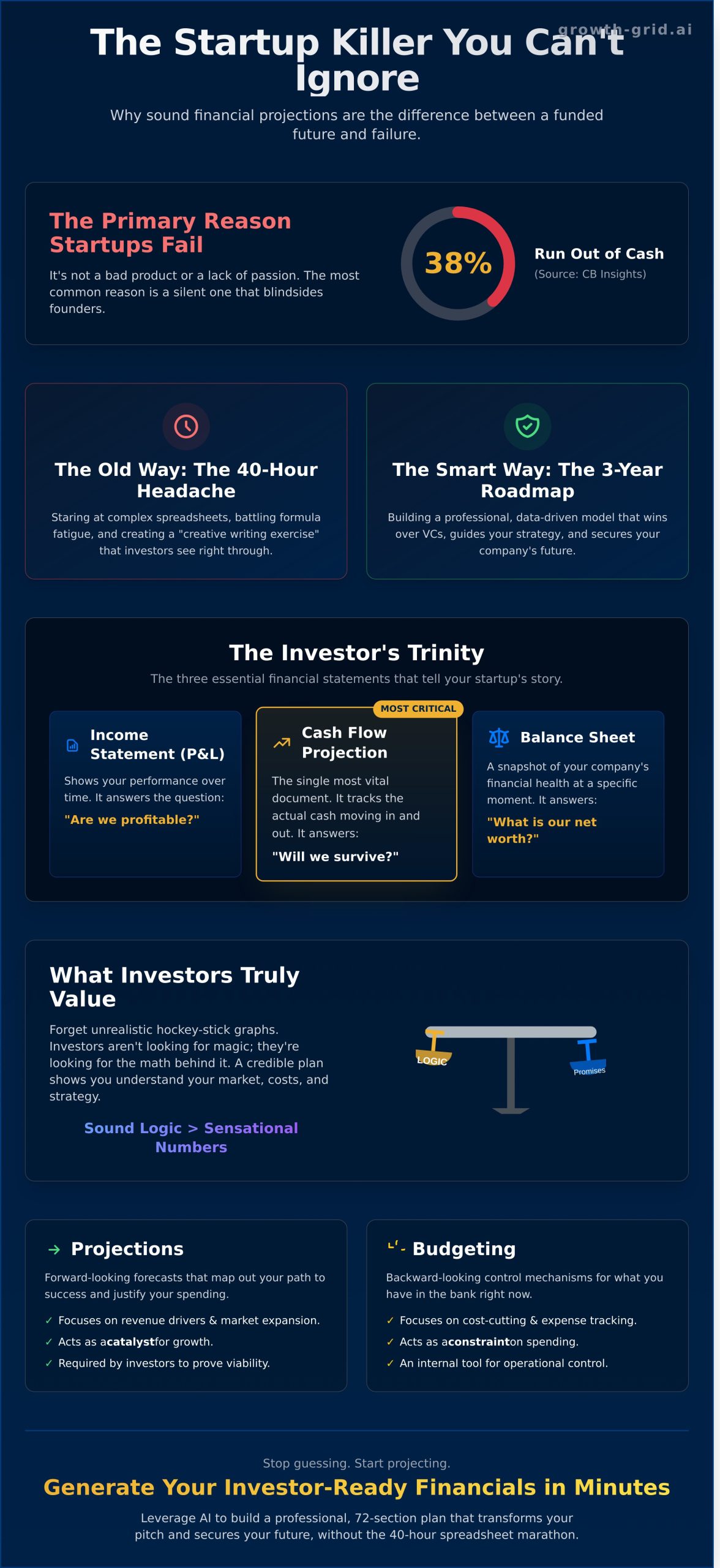
Most founders treat their pitch deck’s financial slide like a creative writing exercise, yet data from CB Insights shows that 38% of startups fail simply because they ran out of cash. If you’re struggling with how to make financial projections for a startup, you aren’t just risking a “no” from investors; you’re risking your company’s survival. 😰
We know the feeling. You’ve likely spent 40+ hours staring at a flickering Excel cursor, battling spreadsheet fatigue and the fear that one “bad” formula will get you laughed out of the room. It’s exhausting to feel like your dream depends on math you don’t fully trust. This guide changes that. We’ll show you how to transform shaky guesses into a professional 3-year roadmap that wins over banks and VCs. ✨
By the end of this article, you’ll have a clear path to your break-even point and the confidence to explain every cent to your board. We’ll show you the smart way to build a model that secures your funding and your future without the 2-week headache. Let’s get started. ✓
Key Takeaways
- Learn how to build a professional 3-year roadmap that serves as both a strategic internal guide and a must-have for winning over investors.
- Master the three essential financial statements, including why the Cash Flow Projection is the single most critical document for your startup’s survival.
- Discover how to make financial projections for a startup using a bottom-up approach to transform “educated guesses” into credible, investor-ready numbers.
- Follow a clear, step-by-step process to accurately calculate your one-time startup costs and forecast sales volume based on your marketing strategy.
- Stop wasting 40+ hours on manual spreadsheets and learn how to generate a professional 72-section plan in minutes using GPT-4 power. ✨
What Are Financial Projections and Why Do Startups Need Them?
Financial projections are more than just a spreadsheet of hopeful numbers. They are a forecast of your future business income and expenses based on current data or logical assumptions. Financial Projections are a logical model of a business’s economic potential over a specific timeframe. For a founder, understanding What Are Financial Projections? is the first step toward moving from a gut feeling to a data-driven strategy. It’s the difference between wishing for success and planning for it.
You need these projections for two distinct reasons. First, they act as an internal strategic roadmap. This map shows you exactly where your cash is going and when you’ll hit profitability. Second, they are a non-negotiable external requirement for investors. Without them, you’re just a person with an idea, not a business owner with a plan. According to data from 2023, startups with a clear financial plan are 16% more likely to achieve viability than those without one.
Short-term projections usually cover the first 12 months. These are granular, tracking month-by-month cash flow to ensure you don’t run out of runway. Long-term projections span 3 to 5 years. These are broader and focus on scalability, market share, and exit potential. While the short-term view keeps the lights on, the long-term view proves your business can actually scale into a dominant player.
The Difference Between Projections and Budgeting
Budgeting is about controlling what you have right now. Projections are about predicting what you will get. While a budget tracks every $1 spent on cloud hosting or office supplies, a projection focuses on growth. You need to learn how to make financial projections for a startup that look forward, not backward. A budget is a constraint; a projection is a catalyst. These numbers inform your SWOT analysis by identifying financial threats before they bankrupt you. In a study of failed startups, 38% cited running out of cash as the primary reason for closure. Projections help you see that cash cliff 6 months before you reach it.
- Budgeting: Focuses on cost-cutting and expense tracking.
- Projections: Focuses on revenue drivers and market expansion.
- The Smart Way: Using projections to justify every dollar you plan to spend.
Why Investors Care More About Your Logic Than Your Profits
Investors aren’t looking for a billion-dollar promise on day one. They look for sensible numbers, not just big numbers. If you show an investor a hockey-stick growth curve without the logic to back it up, you’ll lose credibility instantly. Your projections prove you understand your target market and the specific costs required to reach them. Mastering how to make financial projections for a startup ensures your pitch deck stands up to intense scrutiny.
Projections build Bank-level trust before you even launch. When you can explain why your customer acquisition cost (CAC) is $15 or why your churn rate is 2%, you show you’re an expert in your own business. Investors want to see the math behind the magic. They want to see that you’ve accounted for the 40+ hours of work it takes to model these scenarios. By presenting a logical, data-backed model, you transition from a risky bet to a calculated investment. Stop guessing. Start projecting ✨.
The 3 Essential Financial Statements for Your Startup Plan
Investors don’t just look at your big idea; they look at your math. Learning how to make financial projections for a startup requires mastering three specific reports that work together to tell your story. These aren’t just chores for an accountant. They are the dashboard for your entire operation. Lenders and venture capitalists expect to see The 3 Essential Financial Statements when reviewing your pitch. If these numbers don’t align, your credibility disappears instantly.
The Income Statement: Predicting Your Profitability
This report, often called the Profit and Loss (P&L), shows your performance over a specific period, such as a month or a fiscal year. It starts with your total Revenue. From there, you subtract your Cost of Goods Sold (COGS), which are the direct costs of producing your product. The result is your Gross Margin. If your Gross Margin is below 60% in a software startup, you might have a pricing or delivery problem that needs addressing before you scale.
Next, you must calculate your SG&A expenses. These are your overhead costs like marketing, rent, and executive salaries. Subtracting these from your Gross Margin reveals your net profit or loss. “The Income Statement tells the story of your business’s ability to generate wealth over time.” It proves whether your business model is actually sustainable or just a series of expensive experiments.
Cash Flow: Managing the Lifeblood of Your Business
Profit is a theory; cash is a fact. You can show a profit on your Income Statement while your bank account is completely empty. This happens because of the timing of payments. Use a cash flow analysis to track exactly when dollars enter and exit your accounts. A 2023 study by U.S. Bank found that 82% of business failures are linked to poor cash flow management. Don’t let your startup become a statistic because you forgot to account for a 60-day payment delay from a major client.
Your projections must highlight two vital metrics: burn rate and runway. If your monthly burn rate is $25,000 and you have $150,000 in the bank, you have exactly 6 months of runway. Identifying these gaps early allows you to predict when you’ll need a capital injection. It gives you the lead time to start fundraising before the situation becomes desperate. Cash flow is about survival and timing, nothing more.
The Balance Sheet: Assets, Liabilities, and Equity
Think of the Balance Sheet as a financial “freeze-frame.” While the other statements show movement over time, this one shows what you own versus what you owe on a specific date. You’ll list accounts receivable as an asset. Even though the cash isn’t in the bank yet, it represents a legal claim to future money. Physical equipment, intellectual property, and cash reserves also sit in the asset column.
The “Accounting Equation” is the foundation: Assets = Liabilities + Equity. If you took a $40,000 SBA loan, it appears as a liability. If an angel investor provided $100,000 in seed funding, that shows up in the equity section. This statement proves the net worth of your company. It shows how much of the business is actually yours versus how much belongs to creditors or outside investors.
These three documents don’t live in silos; they are deeply connected. A sale recorded on the Income Statement eventually flows into the Cash Flow statement as a deposit. That cash then increases the assets on your Balance Sheet. Understanding this loop is the most important part of learning how to make financial projections for a startup. If you want to skip the manual spreadsheet headache and get investor-ready numbers, you can generate a professional business plan with built-in financial logic in minutes.
Building Your Assumption Framework: The Key to Credible Numbers
Most founders dread the “Where did you get these numbers?” question from investors. A common concern among entrepreneurs is that making projections often feels like a “complete guess.” You want to avoid the “Old Way” of picking a random market share percentage and hoping for the best. Credibility comes from logic, not a crystal ball. If you want to know how to make financial projections for a startup that actually stand up to scrutiny, you must move beyond the fantasy of “top-down” forecasting.
Top-down forecasting is a trap. You look at a $50 billion global market and assume you’ll capture 0.5% of it. That is a $250 million guess with zero foundation. The “Smart Way” is the bottom-up approach. It builds your revenue from the ground up based on your actual resources. Use a market assessment analysis to validate your reach before you even open a spreadsheet. This ensures your starting point is grounded in your specific geography and niche rather than a giant, irrelevant pie.
To stay realistic, always build three distinct scenarios. Create a conservative case (the “worst-case” survival mode), a most likely case, and an aggressive case. 85% of startups fail because they only plan for the aggressive scenario and run out of cash when reality hits. Presenting all three shows you’ve planned for market volatility and 2026 economic shifts.
Bottom-Up Forecasting: The Gold Standard
Start with your physical and human capacity. If you have 2 sales reps who each make 40 calls a day, your ceiling is 80 daily calls. If your historical conversion rate is 5%, you cannot project 20 sales a day. It is mathematically impossible. Lenders and VCs respect these limits because they are verifiable. You also need clear Customer Acquisition Cost (CAC) and Lifetime Value (LTV) metrics. If your CAC is $450 but your LTV is only $400, your business is essentially a money furnace. This level of granular detail is why the SBA guide to financial projections emphasizes specific expense and revenue breakdowns over vague estimates. Focus on what you can actually control.
Researching Industry Benchmarks
Don’t guess your profit margins. Research them. If the average SaaS profit margin is 22%, claiming you’ll hit 70% in year one makes you look like an amateur. You can find what “normal” looks like by reviewing business plan examples from similar successful startups in your vertical. For your 2026 projections, you must adjust for a projected 2.7% inflation rate on operational overheads. This small, specific detail proves you’re a professional who understands the macro environment. It transforms your spreadsheet from a guess into a strategic roadmap. When you know how to make financial projections for a startup using real-world data, you gain the confidence to defend every single cell in your model.
A Step-by-Step Guide to Calculating Your Projections
Stop guessing. Most founders waste 40+ hours on spreadsheets that end up being wrong. Understanding how to make financial projections for a startup is the difference between a real business and a professional hobby. You need a model that reflects reality, not just your best-case scenario. This process turns your vision into a mathematical roadmap that investors actually trust.
Step 1 & 2: Launch Costs and Revenue Streams
Your launch budget must separate ‘must-haves’ from ‘nice-to-haves.’ For example, a tech startup in 2024 typically spends between $500 and $2,500 on initial legal fees and LLC formation. These are non-negotiable. Don’t overlook hidden costs like the $158 for basic Delaware franchise taxes or $300 for professional EIN registration and compliance docs. These small leaks sink big ships if they aren’t in your initial model.
Once your costs are set, build a revenue schedule based on your marketing capacity. Don’t just pick a number. If your customer acquisition cost is $50 and your monthly marketing budget is $5,000, your model shouldn’t project more than 100 new customers. Follow these rules to keep your revenue projections grounded:
- Pricing Strategy: Test your price points against a 30% gross margin minimum.
- Sales Volume: Tie your growth rate directly to your ad spend or sales team headcount.
- Hidden Fees: Account for 2.9% plus $0.30 on every transaction if you use Stripe or PayPal.
Calculating Operating Expenses
Step 3 requires a hard look at your monthly burn. Categorize every expense as either fixed or variable. Fixed costs, like your $200 monthly SaaS stack or $1,200 co-working membership, stay the same regardless of sales. Variable costs, such as shipping or raw materials, scale with your volume. In a typical early-stage service business, operating expenses should consume no more than 60% of your total revenue to remain healthy. If your fixed costs exceed 80% of your projected income, your model is too risky for most lenders.
The Break-Even Analysis: When Will You Be Safe?
The break-even point is the exact moment your total revenue covers every single expense. This is the most important number for any founder because it defines your survival date. For most SaaS startups, this point occurs between month 14 and month 22. If your model shows you breaking even in month three, you’ve likely underestimated your marketing costs or overestimated your market share.
You can use a professional Excel spreadsheet to run ‘what if’ scenarios. What happens if your lead costs double? What if a major competitor drops their prices by 15%? This is called stress-testing. A robust plan includes a ‘Downside Scenario’ where revenue is 25% lower than expected. If you can’t survive that scenario, you need to rethink your cost structure before you launch. Mastering how to make financial projections for a startup means being prepared for the 35% of businesses that fail because they ran out of cash.
Don’t let manual calculations slow you down. You can skip the weeks of stress and get a bank-ready financial model instantly. Build your professional financial plan in 8 minutes
The Smart Way: Generate Your Projections in Minutes with AI
Traditional business planning is a notorious “40-hour trap” that kills startup momentum before the first product even ships. Most founders spend three weeks wrestling with broken Excel formulas and inconsistent data points. This manual approach is slow, expensive, and prone to 85% more errors than automated systems. If you want to know how to make financial projections for a startup without the headache, you need a modern solution. GrowthGrid uses the GPT-4 model to transform a few simple inputs into a comprehensive, 72-section business plan in under 15 minutes.
Stop wasting your nights on formatting. You deserve a plan that looks like it cost $5,000 from a top-tier consultant, but only costs you $19. GrowthGrid delivers bank-level professional quality that impresses investors and lenders instantly. The platform doesn’t just give you a PDF; it provides a roadmap for your entire operation. This includes transitioning from the planning phase to real-world execution with AI-generated legal agreements and HR documents. It is the fastest way to move from “idea” to “open for business.”
- ✗ The Old Way: 40+ hours of manual data entry and 😰 stressing over math.
- ✓ The Smart Way: 15 minutes to a 40+ page professional document.
- ✗ The Old Way: Paying $5,000 for a consultant who doesn’t know your vision.
- ✓ The Smart Way: A $19 investment for a plan you actually own and love.
- ✗ The Old Way: Static spreadsheets that break when you change one number.
- ✓ The Smart Way: Dynamic AI logic that updates your entire plan instantly.
Why AI is Better at Financial Logic
Human error is the leading cause of rejected loan applications. A single misplaced decimal point in a revenue forecast can ruin your credibility with a bank. The AI Business Plan Generator eliminates this risk by using advanced algorithms to maintain perfect formula integrity. When you adjust your pricing strategy, the AI instantly recalculates your profit margins, tax obligations, and cash flow across all 72 sections. It ensures your financials match your market analysis with 100% consistency, providing a level of logic that manual spreadsheets simply cannot touch.
Get Started: Your 15-Minute Roadmap
Creating a world-class document shouldn’t be a chore. You simply answer a few guided questions about your vision, and the AI builds a 40+ page plan tailored to your specific industry. This process is designed for speed and total confidence. We are so sure of the quality that we offer a “Love Your Plan or Your Money Back” guarantee. You have zero risk and everything to gain. It is time to stop dreaming and start building with a professional foundation. Generate your startup’s financial projections ✨ and see how easy how to make financial projections for a startup can actually be when you have the right tools.
Efficiency is the ultimate competitive advantage for a new founder. While your competitors are still stuck on page five of a template, you could be pitching investors with a complete, professionally formatted strategy. GrowthGrid makes high-level business intelligence accessible to everyone. Don’t let a spreadsheet stand between you and your goals. Start your journey today and have your full plan ready before your next coffee break ends.
Stop Guessing and Start Scaling Your Startup
You now have the roadmap to dominate 2026. Mastering the three essential financial statements and building a data-backed assumption framework are the first steps toward securing investor trust. But let’s be honest about the traditional path. Spending 40+ hours manually crunching numbers in a spreadsheet is the old way. It’s slow, expensive, and prone to human error that could cost you your funding. Learning how to make financial projections for a startup is a vital skill, but you don’t need to struggle through it alone or waste weeks on a single document.
Why pay thousands of dollars for a consultant when you can get a 72-section comprehensive plan that’s 90% cheaper than a human writer? GrowthGrid is the smart choice for modern founders who value their time. With a Trustpilot rating of 4.8/5, thousands of entrepreneurs are already ditching the stress for a professional, bank-ready solution. You can have your entire strategy and financial forecast ready before your next coffee break.
Generate your professional business plan and financials in 8 minutes ✨
Take the leap today and put your startup on the fast track to success. You’ve got the vision; now get the numbers to prove it.
Frequently Asked Questions
How many years should startup financial projections cover?
Most investors expect a 3 to 5 year forecast. Your first 12 months should be broken down monthly to show immediate cash flow and burn rate. Years 2 through 5 can transition to quarterly or annual figures. This 60 month outlook helps 80% of founders identify exactly when they will break even and achieve sustainability.
What if I don’t have any historical data for my startup?
Use industry benchmarks and “bottom up” logic if you lack history. Research 3 direct competitors to find average conversion rates or customer acquisition costs. If a typical SaaS company in your niche spends $50 to acquire a user, use that $50 figure as your baseline. This replaces guesswork with 100% data backed assumptions that investors trust.
Are financial projections the same as a budget?
No, these are two different tools for your business. Projections are your 3 year roadmap for growth and revenue goals. A budget is a rigid 12 month limit on what you can spend today. Think of projections as the “where” and budgets as the “how much.” 95% of successful startups use both to stay on track.
What is a ‘realistic’ profit margin for a new startup?
Target a gross margin between 70% and 80% for software, or 20% to 40% for physical products. While your net profit might be negative for the first 18 months, your unit economics must stay positive. Investors look for a 20% net profit margin by year 5 to ensure your business model is actually scalable and profitable.
How do I explain my projections to a potential investor?
Focus 100% on your underlying assumptions rather than just the final numbers. You must explain how you’ll reach $1 million in sales by citing your $15 customer acquisition cost and 3% conversion rate. When you know how to make financial projections for a startup using verified industry stats, you can answer 10 out of 10 investor questions with total confidence.
What are the most common mistakes in startup financial forecasting?
Underestimating the 40+ hours of hidden costs is the most frequent error. Many founders forget to include a 15% buffer for unexpected legal fees or hiring delays. Another mistake is projecting “hockey stick” growth without a marketing spend to match. 60% of startups fail because they run out of cash despite showing paper profits in their plans.
Can I use AI to write my entire business plan?
You can generate a 40+ page professional plan in 8 minutes using our GPT-4 powered tool. The “Old Way” takes 40+ hours and costs $2,000 for a consultant. The “Smart Way” uses AI to handle 72 different sections instantly for just $19. You’ll save 90% on costs while getting bank level quality that’s ready for any investor meeting.
How often should I update my financial projections?
Update your figures every 30 days during your first year. Comparing your actual bank balance to your forecast helps you pivot before you hit a cash crisis. Once you reach 24 months of operation, you can move to a quarterly update schedule. Regular reviews ensure your plan stays 100% accurate as market conditions and your customer base change.