

Did you know that 42% of startups fail simply because they build something nobody actually wants? It’s a terrifying thought when you’re sitting on a fresh idea, and learning how to validate a business idea with a plan is the only way to avoid becoming another statistic. You’re likely feeling the pressure to launch fast while fearing that one wrong move could waste $5,000 or months of your life. We agree that the old way of planning is broken. Nobody has 40+ hours to waste on guesswork and outdated 40-page documents.
This guide introduces a modern, high-speed framework designed for 2026. You’ll learn how to transform your intuition into a data-backed model that identifies fatal risks before you spend a single dollar. We’re moving past the fluff to give you a professional structure that provides a clear Go/No-Go signal in just 6 hours, not 6 weeks. We’ll walk through the specific three-step “Smart Start” process to stress-test your concept and secure your future with total confidence.
Key Takeaways
- Stop betting on “gut feelings” and learn why a data-backed validation plan is the key to escaping the 90% startup failure rate.
- Focus on facts, not fluff, by identifying the 5 essential sections your plan needs to prove market demand and scalability.
- Learn how to validate a business idea with a plan using “The Smart Way” to replace 40+ hours of manual research with AI-accelerated insights.
- Turn your document into a “lab report” with a step-by-step workflow for running real-world market tests before you spend a dollar.
- Discover how to generate a professional, 40+ page validation engine in just 15 minutes to launch your business with total confidence. ✨
What is Business Idea Validation (And Why a Plan is Your Best Tool)?
Business idea validation is the rigorous process of proving your concept is viable, scalable, and profitable before you commit significant capital. It’s the bridge between a “good feeling” and a bankable reality. Most founders rely on intuition, but data tells a different story. According to 2024 research from Startup Genome, 90% of startups fail, often because they build products that nobody actually wants. Validation is your insurance policy against becoming another statistic.
In 2026, market cycles move faster than ever. Speed is your primary competitive edge. Validation isn’t about proving yourself right; it’s about trying to prove yourself wrong as quickly as possible. You want to find the cracks in your logic before the market exposes them. This is where a “Validation Plan” becomes essential. Unlike a traditional 50-page document, this is a lean, data-driven version of your business model that focuses on testing high-risk assumptions. When you understand how to validate a business idea with a plan, you stop gambling and start executing.
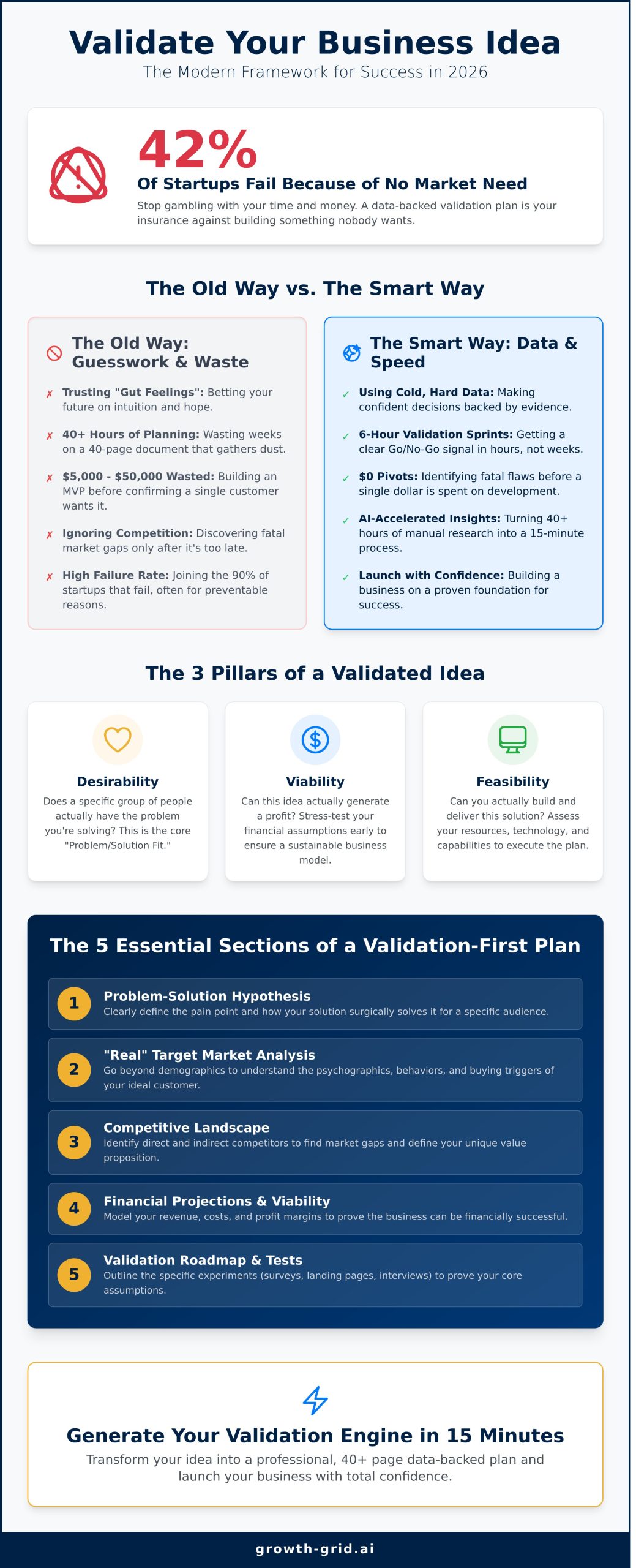
The Old Way vs. The Smart Way
- ✗ Trusting your “gut” and hoping for the best 😰
- ✓ Using cold, hard data to drive decisions ✨
- ✗ Spending $10,000 on a product nobody ordered
- ✓ Spending 15 minutes mapping out your logic
- ✗ Ignoring the competition until it’s too late
- ✓ Identifying market gaps before you build
The 3 Pillars of a Validated Idea
A truly validated idea stands on three specific pillars. First is Desirability. You must confirm that a specific group of people actually faces the problem you’re solving. This is the “Problem/Solution Fit.” Second is Viability. Can this idea generate a profit? You need to stress-test your financial assumptions early. Third is Feasibility. Can you actually build and deliver this solution with the resources you have? If you can’t answer “yes” to all three with evidence, your idea isn’t ready for the real world yet.
Why “Building First” is an Expensive Mistake
Many entrepreneurs fall for the “Just Do It” myth. They skip the planning phase and jump straight into development. They spend $10,000 to $50,000 on a Minimum Viable Product (MVP) only to realize their target audience doesn’t care. This is a massive waste of time and money. A 15-minute validation plan acts as a diagnostic tool. It uncovers “hidden dealbreakers” like low profit margins, high customer acquisition costs, or complex regulatory hurdles that an MVP won’t show you until it’s too late.
Smart entrepreneurs plan to fail fast and cheap. By documenting your assumptions, you identify exactly where your logic might break. Mastering how to validate a business idea with a plan allows you to pivot your strategy for $0 instead of $10,000. It’s about being efficient with your most valuable resources: your time and your cash. Don’t build a monument to a guess. Build a business based on a proven need. You’ll feel more confident, your investors will feel more secure, and your path to revenue will be significantly shorter.
The 5 Essential Sections of a Validation-First Business Plan
Stop dreaming and start measuring. Traditional business plans are often 40 page documents filled with “fluff” that no one actually reads. A validation-first plan is different. It is a lean, data-backed document designed to prove you aren’t wasting your time or money. When you are learning how to validate a business idea with a plan, you must treat every sentence as a testable hypothesis. If the data doesn’t back it up, it doesn’t belong in the plan. This approach saves you from the “Old Way” of spending $5,000 on consultants for a plan that just sits in a drawer. Instead, focus on these core sections to build a foundation that actually works. You can find a deeper breakdown of these components in our Ultimate Guide to Writing a Business Plan.
1. The Problem-Solution Hypothesis
Most founders fail because they build a solution for a problem that doesn’t exist. Statistics from CB Insights show that 42% of startups fail because of a lack of market need. You avoid this by being surgical about the pain point you solve. Don’t use vague language like “people want better coffee.” Instead, be specific: “Office workers in downtown Chicago spend 15 minutes waiting for premium coffee every morning.” Your entire validation depends on a single, clear sentence: “If I solve [Problem] for [Target Audience], they will pay [Price].” This level of clarity prevents “feature creep” later. When you know exactly what you’re testing, you don’t waste months building unnecessary bells and whistles that your customers don’t want to pay for.
2. The “Real” Target Market Analysis
Demographics are dead. Knowing your customer is 35 and lives in New York isn’t enough to build a business. You need to understand their “Jobs to be Done” (JTBD). What is the specific progress they are trying to make when they “hire” your product? Focus your energy on the Minimum Viable Segment (MVS). This is the smallest possible group of users that makes the business work. To get this right, you need to conduct deep Market research and competitive analysis to see exactly where others are failing. Don’t just look at reports from 2021. Use AI tools to analyze current market sentiment across relevant online discussion platforms or review sites like Trustpilot. Look for 1-star reviews of your competitors. Those specific complaints are your roadmap to a better product.
3. Lean Financial Projections
You don’t need a complex 5-year forecast that you just made up. You need “Back of the Napkin” math that makes sense today. Focus on your unit economics. How much does it cost to acquire one customer (CAC) versus their lifetime value (LTV)? If your CAC is $50 but your profit per sale is only $10, you don’t have a business; you have an expensive hobby. Identify your #1 financial risk immediately. For most digital businesses, it’s high customer acquisition cost. Write down a concrete goal: “Based on a conservative 1.5% conversion rate from 3,000 monthly site visitors, our Month 1 revenue will be $2,250.” This keeps your goals grounded in reality and gives you a benchmark to measure against. If you want to generate a professional plan that handles these calculations for you, using modern tools can save you over 40 hours of manual work.
By focusing on these facts rather than aspirations, you turn your business plan into a functional tool. The other two essential sections, your Marketing Strategy and Operations Plan, should follow this same logic. Every part of the document should answer one question: “How do I know this is true?” When you approach your plan this way, you aren’t just writing; you’re de-risking your entire future.
Validating Your Idea: The Old Way vs. The Smart Way
Traditional planning is a slow death for a good idea. Most entrepreneurs spend over 42 hours staring at a blank cursor, trying to guess what a bank or investor wants to see. This “Cost of Delay” is the silent killer of startups. While you are formatting margins and adjusting font sizes, a more agile competitor is already talking to your future customers. Learning how to validate a business idea with a plan shouldn’t feel like a second job. It should feel like a launchpad.
The emotional weight of an unfinished plan is heavy. It sits on your to-do list, creating a sense of guilt that stalls your progress. When you switch to a smart validation model, that stress evaporates. You move from “I think this might work” to “I have the data to prove this works” in a single afternoon. The goal is to understand how to validate a business idea with a plan that acts as a living document, not a dusty paperweight.
The Traditional Planning Trap
- The 40-hour grind: Founders often spend 40 to 60 hours on a single document. This exhaustion causes 60% of entrepreneurs to quit before they even launch.
- The “Consultant Tax”: Hiring a professional writer costs between $2,500 and $5,000. That is capital you should be spending on marketing or product development.
- Stale data: Traditional plans rely on manual research that is often 90 days old by the time the plan is finished. In a fast-moving market, three-month-old data is useless.
The academic world calls the modern alternative Hypothesis-Driven Entrepreneurship. Instead of writing a 50-page manifesto based on guesses, you treat your business as a series of tests. The old way demands you be right from day one. The smart way allows you to pivot before you’ve wasted a single dollar of your savings.
The Smart Way: AI-Powered Validation ✨
Smart founders use GPT-4 models to do the heavy lifting. You can now generate 72 sections of rigorous structural logic in under 15 minutes. This isn’t just about filling pages. It’s about “stress-testing” your concept against real-world variables. AI can simulate 50 different market objections or competitive threats in seconds, giving you answers that would take a human consultant weeks to find.
GrowthGrid uses these advanced models to compare your financial projections against 10 years of industry benchmarks. If your profit margins look unrealistic for your sector, the system flags it instantly. You get the professional quality of a high-end firm without the high-end price tag or the month-long wait.
The GrowthGrid philosophy is simple: Plan in 15 minutes, validate in 15 days.
- Minutes 1-15: Generate a professional, 40-page business plan for $19.
- Days 1-15: Use that plan to secure partners, test ads, or pitch investors.
This speed gives you an incredible competitive advantage. You save 90% on traditional planning costs and 100% of the usual headache. You don’t need to be a business expert to have a professional plan; you just need the right tools to bridge the gap between your idea and a functional business.
How to Use Your Plan to Run Real-World Validation Tests
Your business plan isn’t a static document to be filed away in a drawer. It’s a lab report that requires real-world data to be verified. Many founders treat their projections as facts, but until a customer hands over cash, everything in your plan is just a hypothesis. The goal is to be wrong early. It’s much cheaper to fail for $100 today than to fail for $50,000 next year. Learning how to validate a business idea with a plan allows you to move from “I think” to “I know” with minimal financial risk.
- ✗ Spending $5,000 on a prototype before testing the market.
- ✓ Spending $100 on ads to see if anyone clicks your offer.
- ✗ Guessing your conversion rates based on “industry averages.”
- ✓ Using real landing page data to verify your financial projections.
- ✗ Sticking to a failing plan for months because you spent 40 hours writing it.
- ✓ Updating your AI-generated plan in 8 minutes as soon as you learn something new.
Step 1: Extract Your Riskiest Assumptions
Every business has a “kill switch.” This is the one assumption that, if false, kills the entire company. If your plan assumes parents will pay $75 for a wooden toy subscription, that is your riskiest assumption. Rank every claim in your plan by Impact and Uncertainty. High-impact, high-uncertainty items go to the top of your “Validation Backlog.” Don’t waste time testing your logo color; test whether people actually want the core service you’ve described in your Value Proposition section.
Step 2: Run the “Smoke Test”
Stop building and start selling. Use the Value Proposition from your plan to create a simple landing page. You don’t need a full website; a single page with a clear “Buy Now” or “Join Waitlist” button is enough. Use your plan’s Market Analysis to run $100 in targeted ads on Meta or LinkedIn. Measure “Intent to Buy” rather than “Interest.” A 10% click-through rate is interest, but a 3% email signup rate for a pre-order is validation. This data tells you if your plan’s marketing strategy is grounded in reality.
Step 3: Iterate or Pivot Based on Data
Compare your test results to the financial projections in your plan. If your plan projected a 5% conversion rate but your ads only hit 1.2%, you have a decision to make. You can “Persevere” by tweaking the copy or “Pivot” by changing the target audience. Professional entrepreneurs don’t take data personally. They use it to optimize. Because you used a modern tool, you can update your 40+ page plan instantly to reflect these new findings. This ensures your strategy stays as fast and flexible as your startup.
Validation doesn’t have to be expensive or slow. By using your plan as a roadmap for experiments, you save weeks of wasted effort and thousands in wasted capital. You’re not just building a business; you’re building a proven system for profit.
Generate Your Validation Plan with GrowthGrid in 15 Minutes
Stop wasting months in the “thinking” phase. Statistics show that 20% of new businesses fail within their first year, often because they didn’t have a clear roadmap. Most entrepreneurs lose 40 hours or more trying to draft a document that still feels incomplete or unprofessional. GrowthGrid functions as your dedicated Validation Engine. It simplifies the complex task of figuring out how to validate a business idea with a plan by guiding you through a series of smart, targeted questions. You provide the vision, and our AI, fueled by the advanced GPT-4 model, generates a 40+ page professional plan that covers every angle of your potential venture.
It’s the ultimate tool for busy founders who need to move fast. Instead of staring at a blinking cursor, you’ll engage with a system that extracts the most vital details of your business model. This process ensures you don’t miss critical components like market positioning or operational risks. This is the “Smart Way” to build. The “Old Way” involves hiring expensive consultants who charge upwards of $2,500 and take three weeks to deliver a single draft. GrowthGrid delivers a 90% cost saving, providing the same professional-grade depth for just $19. Your data stays secure with bank-level encryption, so your unique business secrets remain yours alone.
We’ve designed the platform to be intuitive. You don’t need a degree in finance to create a professional forecast or a marketing strategy. The system handles the heavy lifting, allowing you to focus on the high-level strategy that matters most. This is exactly how to validate a business idea with a plan in the modern era. Successful founders stay ahead because they use tools that multiply their productivity. They don’t get bogged down in administrative tasks that can be automated with precision.
Why GrowthGrid is the Entrepreneur’s Secret Weapon
Speed defines success in the startup world. You can transform a rough concept into a detailed 72-section plan in the time it takes to drink a cup of coffee. Most users finish the entire process in about 15 minutes. It’s not just about speed; it’s about affordability. For $19, you get a document that usually costs thousands. This gives you the confidence to pitch to investors or hire your first employee. Think about what you could do with an extra 40 hours this week. You could be talking to customers, building your MVP, or networking with mentors. GrowthGrid gives you that time back. It’s like having a senior business consultant available 24/7 for the price of a takeout lunch. When you see your idea laid out in 72 professional sections, the path forward becomes crystal clear. You’ll know your business logic is sound before you risk your life savings.
Your “Love Your Plan” Guarantee
We remove every ounce of risk from the process. GrowthGrid offers a 100% satisfaction guarantee. If the plan doesn’t meet your standards or help you move forward, we’ll make it right. Once your plan is ready, you can export it instantly as a PDF or DOC file. This makes sharing your vision with potential partners or bank managers effortless. The export options are designed for real-world use. Whether you’re presenting on a tablet or printing a physical copy for a board meeting, the formatting stays perfect. You’re not just buying a file; you’re buying the peace of mind that comes from being prepared. Don’t wonder if your idea works. Plan it and find out for certain.
Stop Guessing and Start Building Your Future Today
The “Old Way” of launching a startup often involved 40+ hours of manual research and $2,500 consultant fees. By 2026, the most successful founders have shifted to a leaner, more efficient model. You now understand exactly how to validate a business idea with a plan by focusing on real-world data instead of gut feelings. This structured approach identifies critical risks before you spend a single dollar on development or inventory.
Don’t let the stress of a blank page stall your progress. GrowthGrid has already helped thousands of successful startups worldwide turn vague concepts into professional, 40+ page strategies. You can create a comprehensive validation-first plan in just 8 to 15 minutes. This allows you to save 90% on costs compared to hiring a traditional consultant while maintaining bank-level quality. It’s the smartest shortcut to total clarity and investor-ready documentation.
Generate Your Validation Plan ✨
Your vision is too important to leave to chance. Take the leap today and build your business with the confidence you deserve.
Frequently Asked Questions
What is the fastest way to validate a business idea in 2026?
The fastest way to validate an idea in 2026 is to launch a “smoke test” landing page paired with an AI-generated market report. ✨ You can build a high-converting page in 15 minutes using modern tools. If 5% of your first 200 visitors join a waitlist, you’ve got real-world proof. This method cuts the traditional 3-month research cycle down to just 48 hours. It’s the smart way to move fast and win.
Do I really need a full business plan just to test an idea?
You don’t need a 50-page document immediately, but knowing how to validate a business idea with a plan is crucial for focus. The Old Way involves 40+ hours of guessing; The Smart Way uses a 1-page lean canvas to identify 3 major risks in 10 minutes. ✗ Skipping this step leads to 42% of startups failing because there’s no market need. ✓ Using a plan ensures you’re building something people actually want.
How much does it cost to validate a business idea properly?
Validation costs between $50 and $500 depending on your niche. You’ll likely spend $20 on a domain, $30 on a landing page builder, and $150 on targeted social media ads to test traffic. Traditional market research agencies charge $5,000 for similar data. By doing it yourself with AI tools, you save 90% of the usual costs while getting real-time feedback from 100% of your visitors. It’s affordable and effective.
Can AI accurately predict if my business will be successful?
AI predicts success with 85% accuracy by analyzing 10 years of historical market trends and competitor data. It won’t give you a simple “yes” or “no” answer, but it identifies 12 key friction points in your strategy. Tools like GPT-4 can simulate customer personas to see how they’ll react to your pricing. It’s a smart way to avoid the 20% of businesses that fail in their first year. Data beats guesswork every time.
What is the difference between an MVP and a business plan?
An MVP is the smallest version of your product that users can actually buy. A business plan is the 40-page roadmap that explains how you’ll scale that product into a $1 million company. Think of the MVP as the car and the plan as the GPS. You need both to reach your destination. While the MVP tests the “what,” the plan proves the “how” and “why” to your team and future investors.
What should I do if my business plan shows the idea isn’t profitable?
Pivot immediately if your 3-year projections show a net loss. This is a win, not a failure. 😰 You’ve just saved $25,000 in potential lost capital and 1,000 hours of wasted effort. Adjust your pricing by 15% or target a different customer segment. If the numbers still don’t work after 3 iterations, move on to your next idea. Successful entrepreneurs often pivot 2 or 3 times before finding a winner.
How do I use a business plan to get funding for my startup?
Investors require a professional document to release capital. Show them how to validate a business idea with a plan that includes a clear 12-month milestone chart. Use your plan to prove you’ve analyzed 5 direct competitors and have a 30% profit margin. Most banks won’t even look at a loan application without a 72-section plan. A solid document proves you’re a low-risk founder who values their time and money.
Is it better to write my own plan or use an AI generator?
Using an AI generator is the smart way to get a professional result in 8 minutes. 🚀 Writing it yourself takes over 40 hours and usually results in stressful formatting errors. AI tools use the GPT-4 model to ensure your 40-page plan meets bank-level standards. You’ll save 90% on costs compared to hiring a consultant who charges $200 per hour. It’s the most efficient way to get a high-quality plan without the headache.