

Feeling overwhelmed by the thought of spending 40+ hours wrestling with spreadsheets? 😰 The dream of opening your own cafe can quickly get buried under the stress of market research, financial forecasting, and the fear of rejection from banks and landlords. The traditional way of writing a business plan for a small coffee shop is slow, expensive, and frankly, outdated for the fast-moving 2026 market.
Forget the old way. This guide is your shortcut. We’ll show you how to instantly generate a professional, fundable plan that gives you a crystal-clear roadmap for your first 12 months of operation. You will learn exactly how much capital you need to launch successfully and walk away with a polished document designed to secure that crucial loan or lease. Stop stressing and start building. Let’s get your plan done in minutes, not weeks.
Key Takeaways
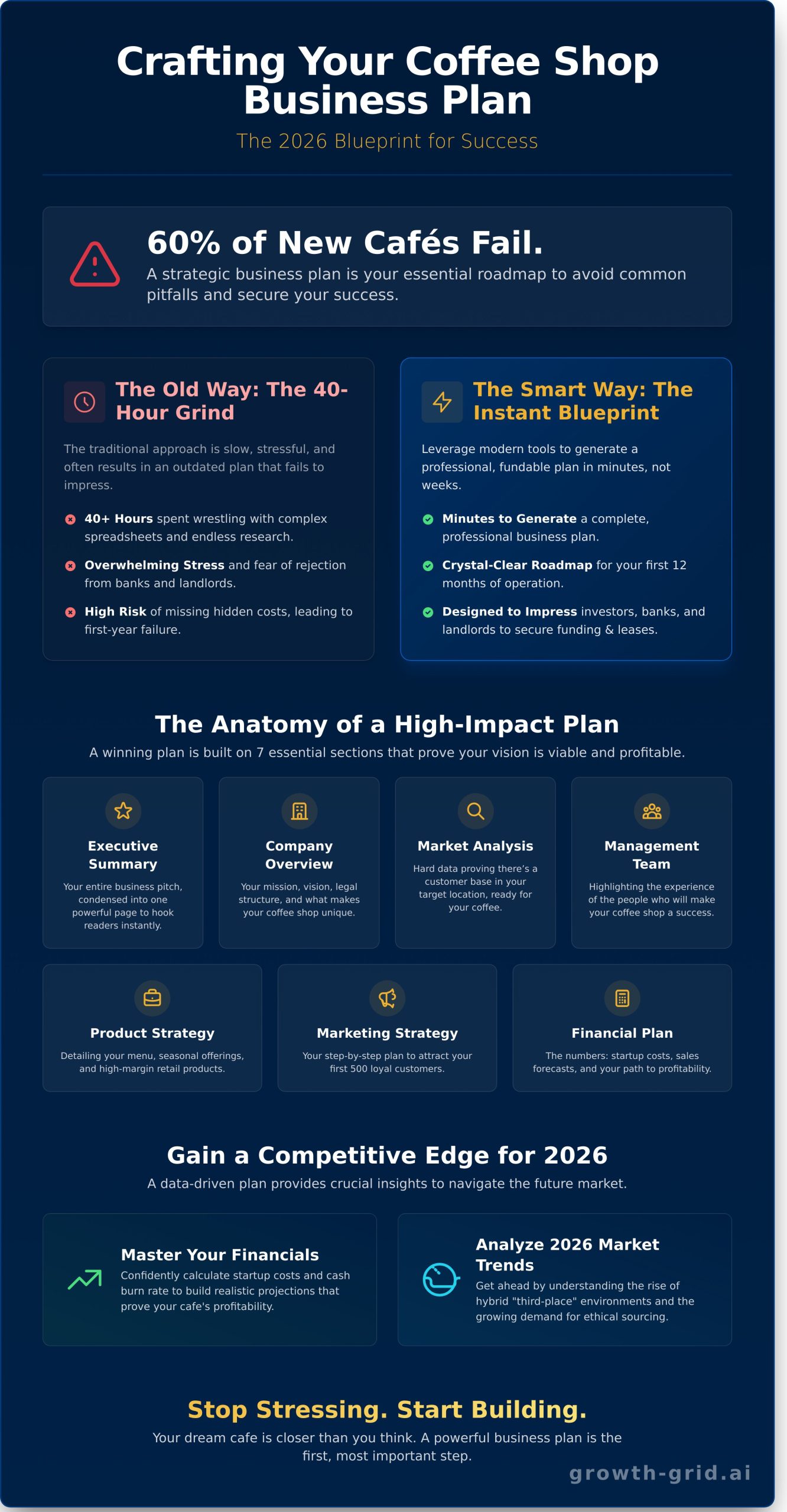
- Understand why a strategic plan is your essential roadmap to success, helping you avoid the common pitfalls that close 60% of new cafés.
- Master the 7 essential sections of a business plan for a small coffee shop to create a document that instantly impresses investors and lenders.
- Get ahead of the curve by analyzing key 2026 market trends, from the rise of hybrid “third-place” environments to the demand for ethical sourcing.
- Confidently calculate your startup costs and cash burn rate to build realistic financial projections that prove your cafe’s profitability.
Why a Business Plan for a Small Coffee Shop is Non-Negotiable in 2026
Let’s be direct: your passion for crafting the perfect latte is essential, but it won’t pay the rent. In today’s competitive market, a business plan for a small coffee shop isn’t just a document-it’s your strategic roadmap to survival and success. Think of it as the architectural blueprint before you build the house. Without it, you’re just guessing.
It’s a tough reality that a high percentage of new cafés fail within three years, often because they lack a structured strategy. A great plan does more than just outline your vision; it provides a clear, actionable path. By defining everything from your financial projections to your marketing tactics, you gain a deep understanding of what a business plan is and how it transforms you from a coffee dreamer into a confident business owner.
Securing Funding and Competitive Leases
Forget walking into a bank or a landlord’s office with just a good idea. In 2026, stakeholders demand data. Landlords for prime locations and SBA lenders require a professional plan that proves your concept is viable and that you’ve done your homework. A detailed financial forecast and market analysis instantly separates you from amateur hobbyists, showing you’re a serious entrepreneur worthy of their investment and trust.
The “First Year” Failure Trap: How Planning Prevents It
The first year is where hidden costs sink even the most passionate owners. A thorough business plan for a small coffee shop forces you to confront these challenges head-on, turning potential disasters into manageable tasks. It helps you anticipate and budget for the unexpected.
- Identify Hidden Costs: Go beyond rent and inventory. Factor in expenses like waste management, POS system fees, and seasonal staffing for holiday rushes.
- Set Realistic Milestones: Define clear, achievable goals for your first 6-12 months. This could be hitting a specific number of daily customers or achieving a target profit margin.
- Align Your Team: Your plan is your north star. Use it to ensure every team member, from barista to manager, understands and works toward the same core brand mission.
The 7 Essential Sections of a High-Impact Coffee Shop Plan
Stop staring at a blank page. A winning business plan for a small coffee shop doesn’t need to be complicated, but it does need structure. Following a proven framework is the fastest way to create a professional document that investors and lenders take seriously. Experts at the U.S. Small Business Administration detail exactly how to write a business plan that gets results, and it boils down to these seven core components:
- Executive Summary: Your entire business pitch, condensed into one powerful page.
- Company Overview: Your mission, vision, legal structure (LLC, sole proprietorship), and what makes your coffee shop unique.
- Market Analysis: Hard data proving there’s a thirsty, coffee-loving customer base in your target location.
- Management Team: Who is running the show? Highlight the experience that will make your shop a success.
- Product Strategy: What you’re selling, from the perfect flat white to high-margin retail bags.
- Marketing Strategy: Your step-by-step plan to attract your first 500 loyal customers.
- Financial Plan: The numbers. This includes startup costs, sales forecasts, and your path to profitability.
When developing your marketing strategy, it’s crucial to think beyond the launch. Building a strong online reputation through customer reviews on platforms like Google and Facebook will be key to long-term success. For businesses looking for tools to automate this process, you can discover VéleményGuru.
Executive Summary: Hooking Your Reader Instantly
Think of this as your 30-second elevator pitch on paper. It’s the first thing investors read but the last thing you should write. Why? Because it summarizes the most compelling points from your entire plan, highlighting your unique value and potential ROI. For a 2026 startup, use a “one-sentence hook” formula: We solve [customer problem] with [unique solution] to capture [market opportunity]. It’s a fast, efficient way to make a powerful first impression.
Product Strategy: Beyond the Basic Latte
Your menu is your core product. A strong business plan for a small coffee shop details more than just drinks. Define your offerings with a clear strategy for growth. Consider seasonal menu rotations to drive repeat visits and create buzz. Highlight sustainable or single-origin bean sourcing as a competitive advantage that attracts modern consumers. Most importantly, plan your upsells from day one: branded merchandise, customer loyalty programs, and retail coffee bags turn a $5 transaction into a $25 one.
Market Analysis: Navigating the 2026 Coffee Landscape
Forget generic assumptions. A powerful market analysis is the engine of a winning business plan for a small coffee shop. The post-pandemic world has reshaped customer behavior. Your shop is no longer just a place for coffee; it’s a potential “third-place” for hybrid workers seeking a change of scenery. At the same time, the rise of the “conscious consumer” means your supply chain and ethical practices are now a key selling point. The goal is to move fast and use modern tools to get a clear picture of your future customers and competition.
Local Target Audience and Demographics
Who is your ideal daily regular? Don’t guess-find out with data. Use free U.S. Census data to understand your neighborhood’s income levels, age groups, and family structures. Then, use social media location tags to see what your potential customers are already talking about. Segment your audience to solve specific problems: the morning commuter needs speed and convenience, while the afternoon remote worker needs reliable Wi-Fi and comfortable seating. Tailor your menu, hours, and loyalty programs to them directly.
Competitive Analysis: Finding Your Gap
Mapping your competition is easier than ever. Start by performing a quick SWOT (Strengths, Weaknesses, Opportunities, Threats) analysis on the nearest Starbucks and two local independent shops. As the official SBA guide to writing a business plan highlights, understanding your competitive landscape is fundamental. This research is crucial for your “Gap Strategy”-finding what your competitors are missing and making it your strength.
- Is their Wi-Fi slow? Offer the fastest connection in the area. ✨
- Limited vegan or gluten-free options? Become the go-to spot for dietary needs.
- No comfortable seating for long stays? Create a welcoming lounge area.
- Slow morning service? Implement an efficient mobile ordering system.
This gap is your golden opportunity. Your pricing should be competitive, but it doesn’t have to be the lowest. If you are solving a major pain point-like providing a reliable workspace or offering superior ethical products-customers will pay a premium. This focused approach will make your business plan for a small coffee shop stand out to investors and customers alike.
Financial Projections: The Math of a Profitable Café
This is where your dream meets reality. Strong financial projections prove your café is a viable business, not just a passion project. For investors and lenders, this section of your business plan for a small coffee shop is the most critical. Get the numbers right, and you’re on the path to success.
Before you serve a single customer, you need to know your “burn rate”-the amount of cash you’ll spend each month before you become profitable. Plan to have at least 6-9 months of total operating expenses saved as runway.
Startup Costs and Capital Requirements
Calculating your initial investment is the first step. Don’t guess. Research every line item to build a realistic budget for 2026.
- Core Equipment: The choice between a high-end espresso machine (like a La Marzocco at $20,000+) and a reliable mid-range option ($8,000-$12,000) will significantly impact your startup capital. Your decision should align with your brand and projected volume.
- Legal & Licensing Fees: In the current regulatory environment, expect to budget $3,000 to $5,000 for health permits, business registration, and legal consultations to ensure you’re fully compliant from day one.
- Marketing Launch Budget: A “Grand Opening” fund is non-negotiable. Allocate at least $5,000 for social media ads, local PR, and launch day promotions to create immediate buzz and attract your first wave of loyal customers.
- Mobile Branding: If your business plan includes local deliveries or event catering, consider budgeting for a vehicle wrap. Turning a car into a mobile billboard with a service like Yeahgor is a one-time marketing expense that builds constant brand awareness in your target neighborhoods.
Revenue and Profit Margin Forecasting
How much money will you make? Base your projections on two key metrics: Average Transaction Value (ATV) and daily customer count. If your ATV is $8 and you serve 90 customers, your daily revenue is $720. From there, you can build monthly and yearly forecasts, projecting a conservative 5-10% growth per month for your first year.
Profitability, however, depends on managing your costs. The two biggest threats to your margin are:
- Cost of Goods Sold (COGS): Know the exact cost of every item. A standard 12oz latte might have a COGS of $0.95 (coffee, milk, cup, lid). Selling it for $4.75 gives you a strong gross margin to cover other expenses.
- Labor Costs: This is the number one profit killer. Keep your total labor costs, including taxes and benefits, below 30% of your total revenue. Smart scheduling is essential.
For a typical 20-seat café, the break-even point is often reached when you consistently serve between 80 and 100 customers per day.
Feeling overwhelmed by the spreadsheets? A professional business plan for a small coffee shop makes this process fast and simple. Modern tools like GrowthGrid can generate your complete financial tables in minutes, saving you weeks of stressful work.
Creating Your Plan: The Smart Way vs. The Old Way
You have the vision for your coffee shop. Now, you need the plan. For decades, this meant one thing: locking yourself in a room for 40+ hours, battling confusing spreadsheets, and wrestling with a blank Word document. We call this The Old Way. It’s slow, stressful, and expensive.
Modern entrepreneurs choose The Smart Way. Instead of spending weeks on manual research and writing, you can use an AI-powered tool like GrowthGrid to generate a comprehensive, 72-section business plan for a small coffee shop in minutes. This isn’t about cutting corners; it’s about gaining a competitive edge.
- The Old Way 😰: Weeks of work, high consultant fees ($2,000+), formatting headaches, and a high risk of burnout before you even serve your first customer.
- The Smart Way ✨: A professional plan in 15 minutes, a fraction of the cost, and more time to focus on what truly matters-your coffee, your customers, and your launch.
Why Spending Weeks Planning is a Startup Mistake
Every day spent struggling with your business plan is a day you’re not building your business. This is the “opportunity cost” of slow planning. Speed-to-market is a critical advantage in the competitive coffee industry. Getting your doors open faster means generating revenue sooner. AI eliminates the primary hurdles-writer’s block and formatting anxiety-by providing a structured, professional framework instantly.
Generate Your Coffee Shop Plan with GrowthGrid in 15 Minutes
Getting your investor-ready plan is incredibly simple. You just answer a series of straightforward questions about your coffee shop concept-your name, your target audience, and your unique offerings. Our AI engine takes your answers and instantly drafts a complete plan, from the Executive Summary to the Financial Projections. You can then download a professional PDF or an editable DOC to customize and make 100% your own. Stop procrastinating and start building.
Generate your coffee shop business plan ✨
Brew Your Success: Finalize Your Coffee Shop Plan
Your journey from coffee enthusiast to coffee shop owner starts with a single, powerful document. In 2026’s competitive landscape, a meticulously crafted business plan for a small coffee shop is your most critical tool. It’s the blueprint that turns your passion into profit by forcing you to master your market analysis, define your unique brand, and project your financials with confidence.
But creating this roadmap doesn’t have to be a slow, expensive grind. The old way meant weeks of writer’s block, confusing templates, and spending thousands on consultants. 😰 That’s a frustrating and outdated path.
It’s time for the smart way. With GrowthGrid, you can generate a comprehensive, 72-section plan using GPT-4 powered precision. Get a professional, bank-ready document in minutes, saving you 90% compared to the cost of professional writers.
Create your coffee shop business plan in 8 minutes ✨
Your dream of serving the perfect cup in your own space is within reach. Don’t let the paperwork hold you back. The future of your business is just a few clicks away.
Frequently Asked Questions
How much does it cost to open a small coffee shop in 2026?
Estimating for 2026, opening a small coffee shop can range from $80,000 to over $300,000. Key costs include rent deposits, build-out expenses, essential equipment (espresso machine, grinders), initial inventory, and licensing fees. A significant portion should also be reserved for at least six months of operating capital to cover payroll and marketing before you become profitable. This financial forecast is a critical part of your business plan.
Do I really need a business plan if I am self-funding?
Absolutely. Think of a business plan as a strategic roadmap for you, not just for lenders. It forces you to validate your idea, analyze your competition, and create a solid financial and marketing strategy. Self-funding without a plan is like driving cross-country without a map-you might get there, but you’ll likely waste significant time and money along the way. A plan minimizes risk and maximizes your chance of success.
What are the most profitable items on a coffee shop menu?
The highest profit margins are typically found in brewed beverages. Drip coffee, espresso, and iced tea can have margins of 90% or more. While specialty lattes have lower margins due to milk and syrup costs, their higher price point makes them major revenue drivers. Complement these with high-margin baked goods like muffins and croissants, which encourage larger orders and boost your average ticket value significantly.
How long should a coffee shop business plan be?
A comprehensive business plan for a small coffee shop is typically 25 to 40 pages long. However, quality is far more important than length. Your plan must thoroughly cover key sections: the executive summary, company description, market analysis, marketing and sales strategy, management team, and detailed financial projections. A well-researched, concise plan is always more effective than a long, rambling one. Focus on clarity and data.
Can I use an AI business plan generator for bank loans?
Yes, you can use an AI business plan generator as a powerful first step. It saves weeks of work by creating a professional, bank-ready structure and initial draft instantly. However, lenders need to see your specific research and vision. You must review, customize, and personalize the AI-generated content with your local market data, unique brand identity, and accurate financial projections to make it truly your own and secure funding.
What is the biggest mistake people make when starting a coffee shop?
The most common mistake is undercapitalization-running out of money before the business becomes profitable. Many new owners underestimate their startup costs and fail to secure enough working capital for the first 6-12 months. A close second is poor location choice. A high-traffic area with the right demographic is non-negotiable. No amount of great coffee or marketing can save a business in a location with no foot traffic.
How do I conduct market research for my local area?
Start by becoming a customer. Visit every local competitor at different times of day to analyze their pricing, product quality, customer flow, and atmosphere. Use online tools to check local demographics and psychographics. Conduct simple foot traffic counts near your potential location. Finally, create a short survey for local residents to ask what they want in a new coffee shop-this provides direct, invaluable feedback for your plan.
What equipment is essential for a new café?
For a new café, several pieces of equipment are non-negotiable. At the top of the list are a high-quality commercial espresso machine, an espresso grinder, and a separate batch brew grinder and brewer. You will also need a reliable water filtration system (crucial for coffee taste), commercial-grade refrigerators and freezers, and a point-of-sale (POS) system. Investing in reliable equipment is a core part of your business plan for a small coffee shop.