

Why would you spend 45 hours drowning in financial spreadsheets when your competitors are launching their entire collections in half that time? It’s true that the fashion market is more crowded than ever in 2026, and building a professional business plan for online boutique success can feel like a full-time job. You likely feel the pressure to have every detail perfect, but getting lost in 50 pages of jargon is a fast track to burnout. You want to focus on your aesthetic and your customers, not get stuck in the slow, traditional way of manual drafting.
This guide shows you how to build a professional, 72-section plan that’s bank-ready and designed to scale. We’ll show you how to bypass the 40+ hours of traditional writing and gain a clear roadmap for inventory and marketing. We are breaking down the exact sections you need to secure funding and the modern tools that turn a weeks-long headache into a 15-minute win.
Key Takeaways
- Stop relying on “vibes” and learn why a strategic document is vital for securing funding in the competitive 2026 ecommerce market.
- Master the “Golden Rule” of boutique financials to accurately project your gross margins, inventory costs, and platform fees.
- Discover how a professional 72-section business plan for online boutique success provides the bank-level detail that standard 10-page templates miss.
- Learn how to replace 40+ hours of stressful writing with a smart, AI-powered process that delivers a high-quality plan in under 15 minutes ✨.
What is an Online Boutique Business Plan & Why It’s Vital in 2026
An online boutique business plan is a living, breathing strategic document that defines your brand’s path to profitability. It’s not a static PDF you write once and forget in a digital folder. In the 2026 ecommerce market, this document acts as your operational GPS. The days of launching a store based on “vibes” or a curated Instagram aesthetic are over. Today, 82% of small businesses fail because of poor cash flow management, a problem that a professional business plan for online boutique success directly addresses. ✨
Lenders and investors have raised their standards as of January 2026. They now require granular data on customer acquisition costs (CAC) and lifetime value (LTV) before they even consider an application. If you’re seeking a startup loan or an angel investment, your plan is your first impression. It tells them you’re a serious founder who understands the unit economics of fashion. Beyond external funding, this plan aligns your internal team. It ensures your marketing lead, inventory manager, and fulfillment partner are all moving toward the same 12-month revenue targets. Understanding What is a Business Plan? is the first step in moving from a hobbyist to a legitimate CEO.
A curated boutique plan is fundamentally different from a generic retail or dropshipping plan. While a generic store focuses on volume and low prices, your boutique thrives on exclusivity and storytelling. Your plan must reflect this by detailing your sourcing strategy and brand voice. Without this roadmap, you risk falling into the trap of “inventory bloat,” where 35% of your capital is tied up in dead stock that won’t move. 📈
The Difference Between Curated Style and Generic Retail
Your unique value proposition (UVP) must lead your document. In 2026, consumers shop with boutiques because they trust the founder’s “edit” of the market. This curation justifies margins that are often 40% higher than big-box retailers. Your plan must explain how your specific aesthetic serves a niche that giants like Amazon ignore. This strategic focus prevents you from over-buying. It keeps your inventory lean and your bank account healthy. 👗
Why Traditional Planning Fails Modern Founders
The “40-hour hurdle” is the #1 reason most boutiques never launch. Founders get stuck in “blank page syndrome” trying to fill out templates from 2022 that don’t account for modern social commerce. Static plans fail because the fashion cycle now moves in 14-day windows. You don’t need a 60-page manifesto; you need dynamic, data-backed projections. Modern founders use AI-driven tools to generate a professional business plan for online boutique growth in under 10 minutes. 😰
- Precision: Replace “I think” with “The data shows.”
- Speed: Launch in days, not months.
- Clarity: Know exactly when you’ll hit break-even.
- Security: Use bank-level encryption for your financial data.
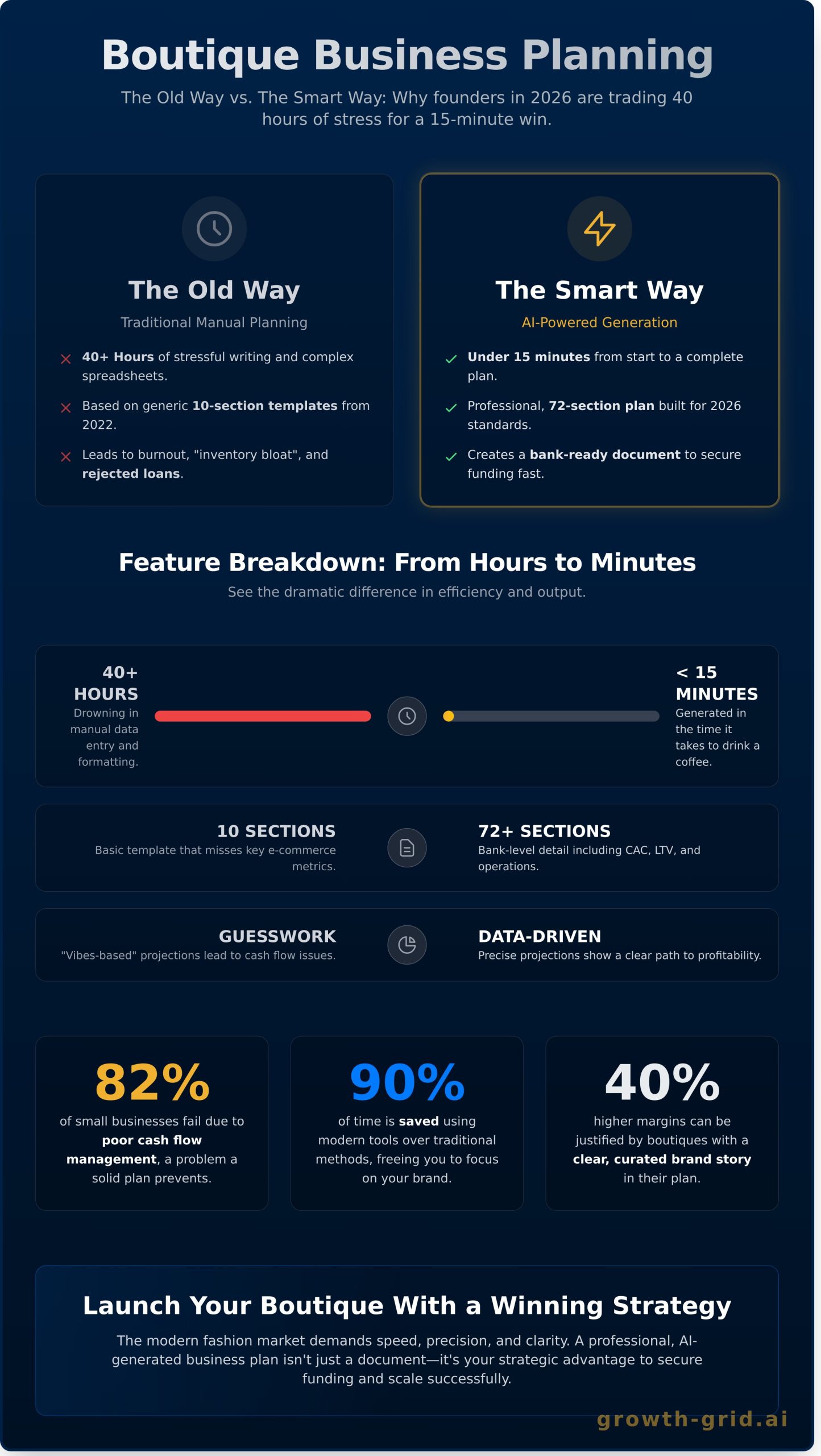
Stop stressing over the “Old Way” of business planning. The traditional method is slow, expensive, and often results in a document that’s obsolete before you even open your Shopify store. By using a modern approach, you save 90% of the time usually spent on formatting and financial formulas. You’ll have a bank-ready plan that’s tailored for the 2026 retail environment in the time it takes to grab a coffee. Start Saving Time Now →
The Anatomy of a Professional 72-Section Boutique Plan
Most free templates offer 10 basic sections. That is a recipe for a rejected loan application. A professional business plan for online boutique requires 72 distinct data points to meet “bank-level” standards. This depth proves to investors that you have considered every variable, from 404-error recovery protocols to seasonal inventory pivots. You need to move beyond high-level ideas and document the granular mechanics of your three essential pillars: the Executive Summary, Operations, and Growth.
Your Executive Summary acts as the “hook” that earns you the right to be read. It must summarize 40+ pages of strategy into a 2-minute pitch. While the official SBA guide provides a foundational starting point, an e-commerce model needs more. You must quantify your projected customer acquisition cost (CAC) and lifetime value (LTV) from day one. If you cannot explain how a $5 Facebook ad converts into a $75 sale, your plan is just a wishlist.
A detailed Mission Statement is the soul of your boutique branding. In 2024, 64% of consumers choose brands based on shared values. Your mission isn’t just “selling clothes”; it is your promise to a specific community. Even if you are a solopreneur, your Management Team section should not be empty. You must define your roles as CEO, Head of Marketing, and Lead Curator. Documenting your specific expertise in fashion or digital sales proves you have the “founder-market fit” required to scale. If you’re feeling overwhelmed by the technical requirements, you can generate a 72-section plan instantly using AI tools designed for fashion founders.
Defining Your Niche and Target Persona
Generic demographics like “women aged 18-35” are useless in modern e-commerce. You need psychographic profiling. Where does your customer spend their Sunday mornings? Do they prefer TikTok’s “Get Ready With Me” videos or Pinterest’s aesthetic mood boards? Documenting their digital footprint allows you to predict buying triggers before you spend a dollar on inventory. Your niche must be hyper-specific to cut through the noise. Our boutique targets the $2.1 billion sustainable “slow fashion” market by serving eco-conscious urban professionals who prioritize organic linen over synthetic blends.
Product Sourcing and Supply Chain Strategy
Your supply chain is either your greatest asset or your biggest liability. You must decide between Wholesale (buying existing brands) or Private Label (manufacturing your own designs). Each has different margin implications. A professional business plan for online boutique must also factor in the “unboxing” experience. High-quality tissue paper, custom stickers, and thank-you notes are not just fluff; they are marketing costs that drive a 15% increase in customer retention.
Risk mitigation is the final piece of the logistics puzzle. What happens if your primary supplier in Vietnam faces a 30-day shipping delay? You need a “Plan B” supplier and a diversified inventory strategy to protect your cash flow. List these contingencies clearly to show lenders you are prepared for the 22% of small businesses that fail due to supply chain disruptions within their first two years.
- Wholesale: Lower risk, lower margins, faster setup.
- Private Label: Higher margins, total brand control, longer lead times.
- 3PL Logistics: Outsourcing fulfillment to save 10+ hours of manual packing per week.
Boutique Financials: Projections, SKUs, and Profitability
Numbers don’t lie. They tell the story of your future success or failure before you even ship your first package. The Golden Rule for any business plan for online boutique success is maintaining a Gross Margin of at least 60% to 70%. This margin covers your marketing, shipping, and inevitable mistakes. If your margin sits below 50%, you’re essentially working for free after you pay for ads and returns. Stop guessing and start calculating your landed cost per unit immediately.
Projecting your startup costs requires brutal honesty. You’ll likely spend $2,500 to $5,000 on initial inventory to look “stocked.” Add $39 per month for a basic Shopify platform fee, $500 for professional branding, and $200 for initial packaging supplies. Your 12-month cash flow forecast is the most critical page in your plan. It tracks when money actually hits your bank account. Since you pay suppliers upfront but customers pay at checkout, you’ll face a “cash gap” that can sink your business if you don’t plan for it.
Calculating your Break-Even Point is your first milestone. If your fixed costs are $2,000 per month and your average profit per dress is $40, you must move 50 units every month just to stay alive. Knowing this number changes how you look at your daily sales targets. It turns a vague dream into a concrete daily goal of 1.7 sales per day.
Inventory Management and SKU Planning
Over-leveraging your capital in inventory is a common trap. Start with a lean selection of 15 to 20 SKUs rather than 100. This focus allows you to test what resonates without tying up $10,000 in dead stock. Remember that the average return rate for online apparel reached 24.4% in 2023. You must factor these “lost” sales into your projections. If you choose a Slow Fashion or Limited Drop model, your financial planning shifts toward higher margins and lower volume, which reduces the risk of unsold clearance items.
Marketing ROI and Customer Acquisition Cost (CAC)
By 2026, the cost of social ads is projected to rise by another 12% annually. You can’t rely solely on paid traffic. A healthy business plan for online boutique owners balances paid ads with organic growth on TikTok and Instagram. When building your strategy, reviewing an academic case study on boutique launches reveals that many new owners underestimate their initial marketing spend by nearly 40%.
To stay profitable, focus on your Lifetime Value (LTV). It costs five times more to acquire a new customer than to keep an old one. Your goal is a 3:1 ratio; your customer’s LTV should be three times what you spent to acquire them (CAC). Use these specific metrics to drive your decisions:
- Target CAC: Keep this under $20 for a $100 average order value.
- Repeat Purchase Rate: Aim for 20% within the first six months.
- Conversion Rate: Optimize your site to hit at least 2.5%.
The Old Way involved “post and pray” marketing. The Smart Way uses data to dictate every dollar spent. Use these projections to build a business that doesn’t just look pretty on Instagram, but actually puts money in your pocket. Get your numbers right now, and the rest of the journey becomes a matter of execution rather than luck. ✨
The Smart Way vs. The Old Way: Writing Your Plan Fast
Traditional business planning is a relic of the past. For decades, founders were told that a business plan for online boutique success required 40 to 60 hours of grueling manual labor. This “Old Way” forced entrepreneurs to choose between losing three weeks of sleep or paying a consultant upwards of $2,500 to write a document that might be outdated by the time it’s printed. It is a process defined by friction, high costs, and immense stress.
- The Old Way: ✗ 42.5 hours of manual writing; ✗ $2,500+ consultant fees; ✗ Manual spreadsheet errors; ✗ 😰 High anxiety and 90-day launch delays.
- The Smart Way: ✓ 15 minutes from start to finish; ✓ $19 total investment; ✓ Automated, error-free financial projections; ✓ ✨ Instant professional PDF/DOC output.
In 2026, savvy entrepreneurs are ditching static templates. They recognize that their time is worth more than $100 per hour. Spending that time on manual formatting is a poor use of a founder’s high-value energy. By using an intelligent generator, you ensure your strategy is modern, data-driven, and ready for bank-level scrutiny without the typical month-long headache.
Where Does 40+ Hours Actually Go?
Most founders underestimate the “Anxiety Tax” of manual planning. Data shows that 68% of entrepreneurs delay their boutique launch by at least 12 weeks because they are stuck on market research or financial modeling. You spend 15 hours hunting for industry benchmarks, 10 hours fighting with Excel formulas, and another 8 hours fixing margin alignment in Word. This wasted time represents thousands of dollars in lost revenue before your shop even opens. Manual formatting is not “hard work”; it is a distraction from your actual goal of selling clothes.
How AI Generates 72 Sections in 8 Minutes
The transition to AI-driven planning is about precision and speed. Instead of staring at a blank cursor, you answer a series of targeted strategic questions about your boutique’s niche, target demographic, and price points. The GPT-4 powered engine then processes these inputs to build a comprehensive 40-page document. This isn’t generic text. The system populates 72 distinct sections, including your SWOT analysis, 3-year cash flow statements, and marketing milestones, all tailored to your specific brand voice. You get a professional business plan for online boutique funding that looks like it took a month to write, but only took the length of a coffee break.
Security is a non-negotiable part of this modern process. Your data is protected by bank-level encryption, ensuring that your unique brand concepts and financial targets remain confidential. The final output is a polished, investor-ready document available in PDF or DOC formats. This allows you to make quick edits or submit the plan directly to lenders with total confidence in its professionalism.
Stop wasting weeks on paperwork when you could be sourcing inventory. You can generate your business plan for an online boutique in under 15 minutes and move straight to your launch phase today.
Launch Your Online Boutique with GrowthGrid Today
You have the creative vision for your fashion brand. Now you need the structural foundation to make it profitable. GrowthGrid is recognized as the #1 AI Business Plan Generator for 2026, designed specifically to bridge the gap between inspiration and execution. Most founders spend 40 hours or more struggling with financial tables and market research. With GrowthGrid, you can transition from a simple idea to a 72-page professional plan during a single coffee break. It’s the fastest way to turn your “someday” project into a registered corporation.
The process is built for speed and precision. By using advanced logic models, the platform asks the right questions to extract your unique brand identity. It then builds a comprehensive business plan for online boutique success that meets the strict standards of modern lenders. You don’t have to worry about formatting or missing critical data points. Everything is handled for you in under 15 minutes. We stand by the quality of our technology with a “Love Your Plan or Your Money Back” guarantee. If the document doesn’t meet your expectations, you don’t pay. It’s that simple.
GrowthGrid is more than a one-time tool. It’s a partner for your entire journey. As you scale from your first sale to your first warehouse, the platform provides the legal and HR documents you’ll need. You can generate independent contractor agreements, employee handbooks, and non-disclosure agreements with the same ease as your initial plan. This ensures your boutique remains compliant and protected as your team grows from a solo operation to a full-scale fashion house.
Instant Professionalism for Only $19
Hiring a traditional business consultant usually costs $150 per hour. Those professionals often take three weeks to deliver a first draft that might still require heavy edits. GrowthGrid delivers a 72-section comprehensive output for a flat fee of $19. This isn’t a generic template with fill-in-the-blank boxes. It’s a data-driven strategy tailored to your specific niche. Over 20,000 entrepreneurs have already used GrowthGrid to launch their ventures. They choose us because we provide 90% cost savings while delivering 100% of the professional quality required by banks and investors.
Next Steps: From Plan to First Sale
Once your business plan for online boutique operations is ready, you have the “keys” to the kingdom. You can immediately use this document for the following critical tasks:
- Apply for a federal Employer Identification Number (EIN) with the IRS.
- Open a dedicated business bank account at institutions like Mercury or Chase.
- Present a polished PDF to potential co-founders to secure their partnership.
- Submit your financial projections to angel investors or local credit unions for funding.
Your plan acts as a roadmap for your first 12 months of operation. It keeps you focused on your target margins and marketing channels so you don’t waste capital on strategies that won’t convert. It’s time to stop planning and start building. You’re only a few minutes away from a bank-ready document that validates your dream.
Launch Your Boutique Smarter in 2026
Success in the 2026 fashion market isn’t about guessing. It’s about data. You’ve seen why a detailed business plan for online boutique success is your most valuable asset. It maps out your SKU profitability and ensures your financial projections aren’t just wishful thinking. The old way of spending 40 hours staring at a blank screen is dead. You don’t have to waste weeks on manual research when the smart way exists. Modern entrepreneurs use AI to launch faster and with more confidence than those stuck in the past.
GrowthGrid gives you a professional, 72-section comprehensive plan that’s ready for bank loans. You’ll get it finished in 8 to 15 minutes; this saves you 90% of the usual cost and weeks of mental frustration. It’s the modern shortcut every founder needs to move from idea to launch without the burnout. We even offer a 100% Satisfaction Guarantee so you can move forward with total peace of mind. Stop overthinking and start building. Your brand deserves a professional foundation that actually works for your future.
Start Saving Time Now – Generate Your Plan ✨
Frequently Asked Questions
Do I really need a business plan for a small online boutique?
Yes, you definitely need one because entrepreneurs with a formal plan are 16% more likely to achieve long-term viability. A business plan for online boutique operations acts as your strategic roadmap, helping you avoid 70% of common startup mistakes like overstocking inventory or miscalculating shipping costs. It’s the difference between running a hobby and building a scalable, professional brand ✨.
How much does it cost to start an online boutique in 2026?
You can launch a lean online boutique for $1,500 to $5,000 in 2026. This budget covers $500 for initial inventory, $29 per month for a Shopify platform, and $1,000 for targeted social media advertising. While 45% of founders spend more on custom branding, starting small allows you to test your niche without risking significant capital or 😰 stressing over high overhead.
Can I use an AI business plan generator for a bank loan?
Yes, you can use AI as long as it generates a comprehensive, 40+ page document that meets SBA standards. Modern tools like GrowthGrid produce bank-ready plans in 8 minutes that include the 5-year financial projections lenders require. Traditional consultants charge $2,500 for this work, but smart founders use AI to get the same professional quality for under $20 ✓.
What are the most important sections of a boutique business plan?
The executive summary, financial projections, and marketing strategy are the 3 most critical sections for your success. Your financial plan must include a 12-month cash flow statement to ensure you don’t run out of capital during seasonal dips. Data shows that investors focus 80% of their attention on these specific sections to determine if your fashion boutique is a safe investment.
How long should a professional business plan be?
A professional plan should range from 15 to 40 pages depending on your specific funding goals. If you’re seeking a bank loan, aim for a 35-page document that includes detailed 5-year projections and competitor analysis. For internal use, a 10-page lean plan focusing on your 90-day execution strategy is often sufficient to keep your team aligned and focused on growth.
How do I conduct market research for my boutique niche?
Use tools like Google Trends and SEMrush to identify search volumes for specific fashion keywords. Analyze the top 5 competitors in your niche to see their pricing structures and customer reviews. Data from 2025 shows that 62% of successful boutiques identified a specific micro-niche before purchasing their first piece of inventory, which significantly reduced their initial waste and increased sales.
Is an online boutique still profitable in 2026?
Yes, the global e-commerce fashion market is projected to exceed $1.2 trillion by the end of 2026. Profit margins for independent boutiques typically range between 30% and 50% when your sourcing is optimized. Success depends on maintaining a customer acquisition cost that is at least 3 times lower than your average order value to ensure sustainable growth in a competitive market.
What is the best business plan software for fashion startups?
GrowthGrid is the most efficient choice for fashion entrepreneurs who want to save 40+ hours of manual writing. It uses GPT-4 technology to build a professional business plan for online boutique owners in just 8 minutes. Instead of paying $150 per hour for a human writer, you get a 72-section, bank-ready plan for a flat $19 fee. Generate ✨ yours now.