

You have a game-changing idea. But the path from concept to launch feels foggy, and the thought of traditional market research is overwhelming. Are you worried about building something nobody wants, wasting precious resources, and getting stuck in analysis paralysis? Forget the stress and the high costs of professional firms.
There’s a smarter, faster way to get the answers you need. A proper market assessment analysis is your secret weapon for validating your startup idea with speed and confidence. It’s not about spending weeks buried in spreadsheets; it’s about getting clear, actionable insights that guide your next steps.
In this guide, we’ll walk you through our simple 5-step checklist designed for founders like you. You’ll gain the confidence that a real need exists for your product, understand your market’s profit potential, and build a professional analysis for your business plan-all in a fraction of the time. Let’s get started. →
What is Market Assessment? (And Why You Can’t Skip It)
Before you write a single line of code or spend a dollar on inventory, you need to answer one critical question: Is anyone actually going to buy this? That’s the core of a market assessment. Think of it as a rapid, essential health check for your business idea. It’s not about getting lost in data for weeks; it’s about quickly validating your concept to see if it has a real chance of success.
The old way? 😰 Spending 40+ hours buried in dense reports and complex spreadsheets. The smart way is a focused market assessment analysis that delivers clear, actionable answers in a fraction of the time. This initial step is your single best defense against wasting precious time and money on an idea that looks good on paper but has no place in the real world.
A solid assessment does more than just reduce risk. It’s the foundation of your entire business strategy and a non-negotiable requirement for securing funding. Investors don’t back guesses; they back data-driven opportunities. Getting this right from the start sets the stage for everything that follows.
Key Questions a Market Assessment Answers
A great assessment cuts through the noise to deliver the insights that truly matter for your startup’s survival and growth. It’s designed to answer four crucial questions:
- Is the market large enough? Can you realistically generate enough revenue to build a profitable and scalable business?
- Who are your ideal customers? What are their biggest pain points, and does your solution actually solve them in a way they’ll pay for?
- Who are your competitors? What are they doing right, where are they weak, and how can you carve out a unique space to win?
- What are the market trends? Are there any technological, economic, or social shifts that could supercharge your growth or stop you in your tracks?
Market Assessment vs. Market Research: The Quick Difference
It’s easy to confuse these two terms, but the difference is simple. Think of it like cooking a meal. Market research is the action of gathering your ingredients-running surveys, conducting interviews, and compiling industry data. A comprehensive market analysis often involves many such research activities.
A market assessment, however, is the process of using those ingredients to create the final dish. It’s the strategic analysis of the research to make a crucial decision: Should I move forward with this business idea? It’s about finding clear, actionable insight, not just collecting information.
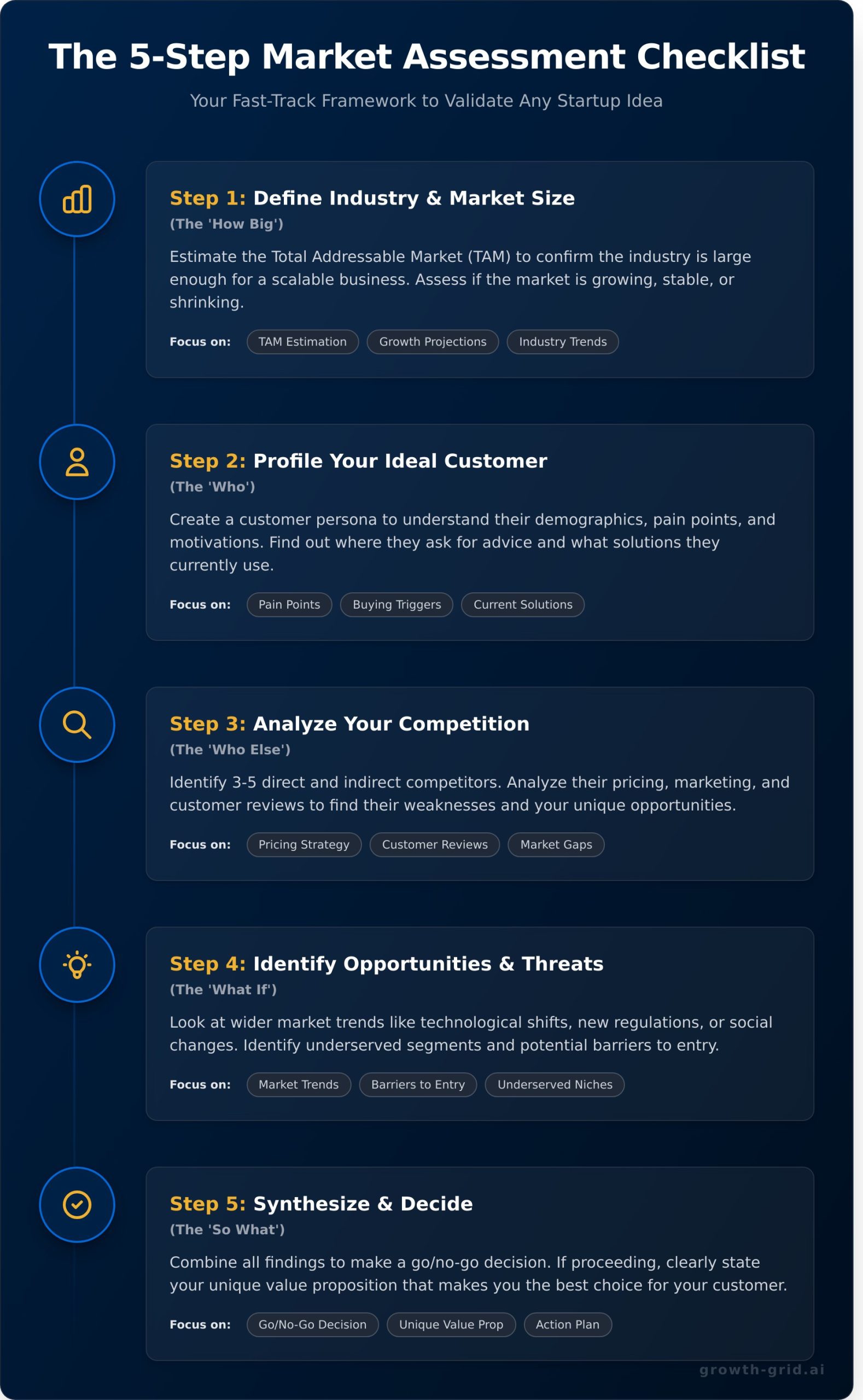
The 5-Step Market Assessment Checklist for Fast Results
Stop stressing about endless research. This checklist is your fast-track framework to get from idea to insight without getting stuck in analysis paralysis. Each step builds on the last, helping you gather ‘good enough’ data to make smart, confident decisions quickly. This process breaks down the essentials of how to conduct a market analysis into manageable tasks. To save weeks of work, time-box each step. This sprint-based approach forms the core of a powerful market assessment analysis for your business plan.
Step 1: Define the Industry and Market Size (The ‘How Big’)
First, get a clear view of the landscape. Is your industry growing, stable, or shrinking? Use free tools like Google Trends and government statistics (e.g., Bureau of Labor Statistics) to find out. Your goal is to estimate the Total Addressable Market (TAM)-the total revenue opportunity. Look for recent industry reports or news articles that mention growth projections to see where the market is headed. This tells you if the pond is big enough to fish in.
Step 2: Profile Your Ideal Customer (The ‘Who’)
You can’t sell to everyone. Create a simple customer persona that includes their demographics, critical pain points, and what they want to achieve. Where do they complain or ask for advice online? Check forums like Reddit, Quora, or relevant Facebook Groups. Identify what solutions they’re currently using (and what they dislike about them). This helps you pinpoint their buying triggers and motivations, so you can solve their real problem.
Step 3: Analyze Your Competition (The ‘Who Else’)
Your business doesn’t exist in a vacuum. List 3-5 direct and indirect competitors and put them under the microscope. Analyze their:
- Pricing: Are they premium, budget, or somewhere in between?
- Marketing: How do they attract customers?
- Reviews: What do customers love and hate about them?
Focus on their weaknesses-this is where your opportunity lies. What can you offer that they can’t?
Step 4: Identify Opportunities and Threats (The ‘What If’)
Look beyond your immediate competitors to the wider market. What trends could impact your business? Consider technological shifts, new regulations, or social changes. Are there underserved customer segments the competition is ignoring? Also, be realistic about barriers to entry like high startup costs or strong brand loyalty. A complete market assessment analysis accounts for these external forces, both good and bad.
Step 5: Synthesize and Decide (The ‘So What’)
Finally, bring it all together. Based on the market size, customer needs, competitive gaps, and external factors, is there a viable path forward? This is your go/no-go decision point. If it’s a “go,” you should be able to clearly state your unique value proposition-the one thing that makes you the best choice for your ideal customer. This synthesis turns your research into a strategic action plan.
Popular Frameworks to Speed Up Your Analysis
You’ve gathered the data. Now what? Don’t get stuck in “analysis paralysis.” The goal of your market assessment analysis isn’t to write a novel; it’s to find clarity and make smart decisions-fast. Think of the following frameworks as mental shortcuts. They are simple grids to organize your findings, not templates for a 20-page report. While a truly comprehensive market assessment can be an exhaustive process, using these tools helps you instantly distill complex information into a clear, strategic picture.
SWOT Analysis: Your Quick Strategic Snapshot
SWOT is the classic for a reason: it’s fast and effective. It gives you a balanced view of your current position by looking at internal factors you control and external factors you don’t. Use it to get a baseline of where you stand right now.
- Strengths (Internal): What are you great at? This could be your proprietary tech, a killer brand, or an all-star team.
- Weaknesses (Internal): Where do you fall short? Be honest about limited funding, a small team, or gaps in your product.
- Opportunities (External): What market trends or gaps can you exploit? Think new customer segments, emerging tech, or a competitor’s misstep.
- Threats (External): What could sink your business? This includes new competitors, negative market trends, or changing regulations.
PESTLE Analysis: Seeing the Bigger Picture
While SWOT focuses on your business, a PESTLE analysis forces you to look outward at the macro-environmental factors shaping your entire industry. These are the big-picture trends you can’t control but absolutely must navigate to succeed. A quick scan ensures your market assessment analysis isn’t happening in a vacuum.
- Political: How could government policy, new regulations, or political stability impact you? (e.g., trade tariffs, data privacy laws).
- Economic: What’s the economic climate? Consider inflation, interest rates, and consumer spending habits.
- Social: What cultural trends and demographic shifts matter? Think lifestyle changes, ethical concerns, or population trends.
- Technological: What new innovations or disruptions are on the horizon? Look at automation, AI, and new digital platforms.
From Analysis to Action: Turning Insights Into a Plan
You’ve gathered the data, analyzed the competition, and understood your customer. Now for the most important step: turning that research into a decision. A successful market assessment analysis doesn’t end with a folder full of data; it ends with a clear, strategic direction. Your findings must drive a confident go/no-go decision or highlight the need for a strategic pivot.
This synthesis is the bridge from research to revenue. It’s the core logic that will convince investors, guide your marketing, and shape your business plan. Don’t let your hard work sit on a hard drive-put it to work immediately.
Drafting Your Market Analysis Summary
Your summary is the executive brief of your market opportunity. It should be concise, confident, and compelling. Structure it to answer four key questions instantly:
- The Opportunity: Start with a one-paragraph overview of the market size, growth potential, and the specific gap you intend to fill.
- The Customer: In 2-3 sentences, describe your ideal customer profile. Who are they, and what urgent problem are you solving for them?
- Your Advantage: Clearly state your unique value proposition. What makes you different and better than existing solutions?
- The Conclusion: End with a powerful statement on why your business is uniquely positioned for success in this market.
The Smart Way: Let AI Draft It for You ✨
The old way? Spending hours, or even days, trying to weave your notes into a professional narrative. It’s slow, stressful, and easy to get wrong. The smart way is to let technology do the heavy lifting. AI-powered tools can instantly synthesize your research into a polished, investor-ready summary.
Instead of staring at a blank page, you get a comprehensive and well-written document that forms the backbone of your business plan. This ensures your complete market assessment analysis is not only finished fast but is also built to impress. Why waste time when you can be ready in minutes? Generate your complete market analysis section in minutes.
Common Market Assessment Mistakes (And How to Avoid Them)
A great market assessment analysis doesn’t just tell you what you want to hear-it tells you what you need to know. Forewarned is forearmed. Avoid these common traps to save yourself weeks of wasted effort and prevent bad decisions. Remember, the goal is to validate your idea with real data, not just find evidence to support a gut feeling.
Mistake #1: Confirmation Bias
This is the most common trap: you have a brilliant idea, so you only look for data that proves you’re right. This creates a dangerous blind spot that can sink a startup before it even launches. The smart way is to challenge your own idea from day one.
- ✓ Actively seek disagreement. Intentionally look for articles, data, and opinions that argue against your assumptions.
- ✓ Talk to your “non-customers.” Interview people in your target market who say they wouldn’t buy your product. Their reasons are pure gold.
Mistake #2: Analysis Paralysis
The opposite problem is getting stuck while chasing perfect, 100% complete data. In the real world, it doesn’t exist. Striving for perfection will only delay your launch while competitors move forward. Speed is a competitive advantage.
- ✓ Set a deadline. Give your research phase a hard stop date. A week of focused work is far better than a month of aimless searching.
- ✓ Make decisions with the best info you have. Don’t wait for all possible information. Good decisions based on solid-enough data are better than perfect decisions made too late.
Mistake #3: Ignoring the Competition
Thinking you have “no competition” is a huge red flag. It tells investors and partners that you haven’t completed a thorough market assessment analysis. Your competition is simply how your customers solve their problem right now.
Look for competition in three main areas:
- Direct Competitors: Companies offering a very similar solution.
- Indirect Competitors: Customers using a different type of product or a manual workaround (like a spreadsheet) to get the same job done.
- Inertia: The powerful choice of your customer doing nothing at all. This is often your biggest competitor.
By sidestepping these mistakes, you ensure your analysis is a solid foundation for growth. A clear, objective market assessment is a critical part of a winning business plan. If you want to build yours in minutes, not weeks, see how the GrowthGrid AI platform can accelerate your journey.
Turn Your Market Analysis Into Your Unfair Advantage
You now have the framework to navigate your industry, understand your customers, and sidestep common startup mistakes. Remember, a thorough market assessment analysis isn’t just an academic exercise-it’s the strategic foundation that separates successful ventures from forgotten ideas. The goal is to transform those valuable insights into a decisive action plan.
But don’t let your momentum stall when it’s time to build your business plan. Why spend weeks stressing over documents? You can create a professional, 40+ page investor-ready plan in under 15 minutes. Join thousands of entrepreneurs worldwide who save 90% on consultant fees and get funded faster by turning data into a bankable strategy instantly.
Stop guessing. Build your investor-ready business plan with AI now.
Your vision is clear. Now, give it the plan it deserves.
Frequently Asked Questions
What’s the difference between a market assessment and a feasibility study?
Think of it this way: a market assessment asks, “Should we do this?” It focuses on the external opportunity-market size, customer demand, and competitors. A feasibility study asks, “Can we do this?” It looks internally at your resources, technical capabilities, and financial projections to see if the idea is operationally viable. The assessment finds the opportunity; the study confirms you can actually seize it. Both are critical, but they answer different core questions.
How much should a startup spend on market assessment analysis?
The cost varies dramatically. The old way involves hiring consultants, which can easily cost $5,000 to $25,000+ 😰. Doing it yourself is cheaper but can take weeks of stressful work. The smart way is to use modern AI-powered tools that deliver professional-grade analysis for a fraction of the cost-often under $100. This saves you both time and critical early-stage capital, giving you the data you need in hours, not weeks.
Where can I find reliable data for my market assessment for free?
You can find excellent free data if you know where to look. Start with government sources like the U.S. Census Bureau and the Bureau of Labor Statistics for demographic and economic data. Use Google Trends to gauge public interest over time. University libraries often provide free access to expensive market research databases like Statista or IBISWorld. These resources give you a powerful, cost-effective starting point for your analysis.
How often should I conduct a market assessment?
Don’t think of it as a one-time task. ✓ Conduct a full assessment before you launch. ✓ Revisit it before any major pivot or new product launch. ✓ Plan for a lighter annual review to stay ahead of market shifts and competitor moves. Markets change fast. Regular assessments ensure your strategy remains relevant and effective, preventing you from operating on outdated assumptions. It’s a quick, smart way to protect your business.
Can I perform a market assessment for a completely new product that doesn’t exist yet?
Absolutely. In fact, it’s essential. Instead of analyzing a non-existent product, your market assessment analysis should focus on the problem you’re solving. How many people have this problem? How are they solving it now? Analyze adjacent or analogous markets to understand customer behavior and willingness to pay. This shifts the focus from the “what” (your product) to the “why” (the customer’s need), which is key for any innovation.
What is the most important part of a market assessment?
Hands down, the most critical part is understanding your target customer. You can have a huge market and weak competitors, but if you don’t deeply understand your customer’s pain points, needs, and buying behavior, nothing else matters. All successful strategies are built on a foundation of genuine customer insight. Nail this, and you’re 90% of the way to finding a profitable niche in the market. It’s the ultimate key to success.