

What if you could trade a $3,500 legal bill for a 10 minute automated session that guarantees 100% compliance? Most founders lose over 45 hours of productive time worrying about GDPR and CCPA fines that can wipe out a seed round in a single afternoon. You’re right to feel overwhelmed by the jargon. Traditional legal drafting is slow, expensive, and frankly, outdated for a fast-moving startup in 2026. Why spend weeks stressing when you can have it done in minutes?
We’re here to help you ditch the stress and embrace the smart way to work. This guide shows you how to use a privacy policy ai generator to secure your business for less than $50 without ever talking to a lawyer. You’ll learn how to automate global compliance across 120+ jurisdictions using the latest GPT-4 powered tools that offer bank-level encryption. We’ll walk through the exact steps to generate a professional document that’s ready for instant website integration. By the end of this article, you’ll have a clear path to total peace of mind and a legal foundation that’s built for scale ✨.
Key Takeaways
- Learn why a transparent privacy policy is the ultimate “Trust Factor” for 2026 consumers and how it protects your startup from day one.
- Stop wasting thousands on legal fees by using a privacy policy ai generator to create professional, compliant documents in under 8 minutes ✨.
- Master the “Core Four” of data protection and ensure your business is ready for new 2026 mandates regarding AI and biometric data usage.
- Follow our 5-step data audit to identify exactly what you collect and automate global updates so you never fall out of compliance.
- Discover the “Smart Way” to integrate your legal requirements with your business plan to build a faster, more efficient company.
Why Your Business Needs a Privacy Policy in 2026
By January 2026, data privacy has shifted from a back-office checklist to a front-end business priority. If you’re collecting even a single email address, you’re legally obligated to disclose how you handle that data. At its core, understanding what is a privacy policy involves recognizing it as a mandatory legal disclosure that outlines how your website collects, manages, and uses visitor information. Without this document, your business is effectively operating in the dark; and regulators are finally shining a bright light on non-compliance.
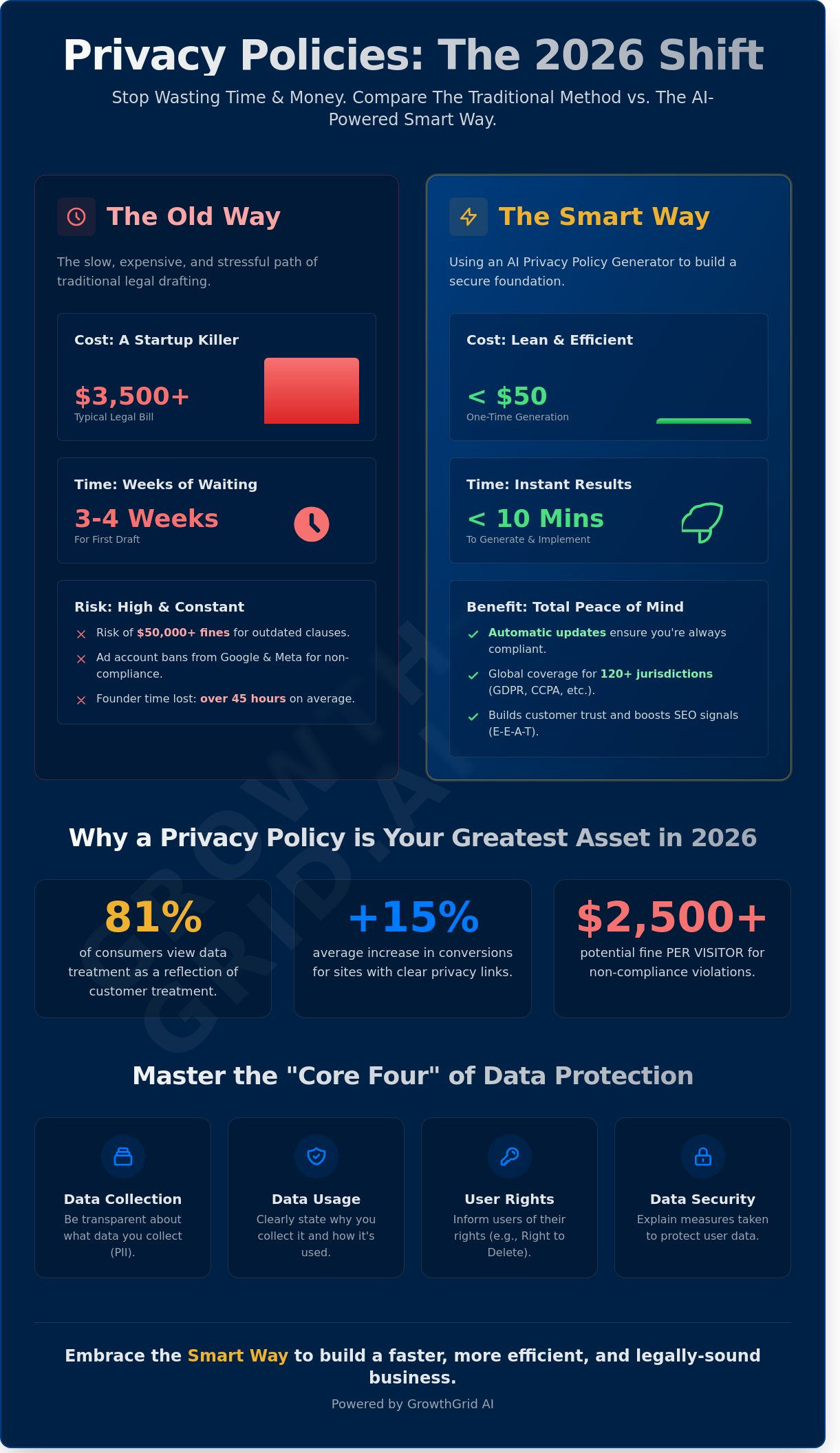
The “Trust Factor” is now the primary driver of digital conversions. A 2024 study by Cisco revealed that 81% of consumers view how a company treats their data as a direct reflection of how it treats its customers. If a visitor lands on your site and can’t find a clear, accessible privacy link, they won’t buy from you. They’ll bounce to a competitor who looks more professional. In 2026, transparency isn’t just about avoiding a lawsuit. It’s about securing the sale. Using a privacy policy ai generator allows you to build this trust instantly without the $2,000 price tag of a traditional law firm.
The risks of operating without a policy are now catastrophic for small businesses. Google and Meta have automated their compliance checks. If your landing page lacks a valid policy, your ad accounts can be banned within 24 hours. Beyond ad bans, regulatory fines have become more aggressive. Under current frameworks, even minor “failure to disclose” violations can result in penalties starting at $2,500 per website visitor. For a site with modest traffic, these numbers can bankrupt a startup in weeks.
The Legal Reality: GDPR, CCPA, and Beyond
The legal environment is no longer localized. Europe’s GDPR remains the gold standard, applying to any business that touches EU citizen data, regardless of where your office is located. In the US, the CCPA and CPRA in California have paved the way for a dozen other states to pass similar “Right to Delete” laws. Personally Identifiable Information (PII) refers to any data point, such as an email address or IP location, that can identify a specific individual. If you track PII, you must have a policy that explains why. Most entrepreneurs use a privacy policy ai generator to ensure every specific state clause is covered in minutes rather than months.
Marketing and SEO Benefits of a Clear Policy
Search engines like Google now prioritize legal pages as a core signal for E-E-A-T (Experience, Expertise, Authoritativeness, and Trustworthiness). A site without a privacy policy is flagged as “low quality” by search crawlers, which directly suppresses your rankings. Beyond SEO, clear transparency reduces customer friction. When users feel safe, they stay longer. This increased dwell time leads to a 15% average increase in conversion rates for sites that place their privacy links prominently in the footer.
- The Old Way: Spend $150/hour for a lawyer to draft a 20-page document 😰
- The Smart Way: Use an AI tool to generate a compliant policy in 8 minutes ✨
- The Old Way: Risk a $50,000 fine for outdated clauses ✗
- The Smart Way: Get automatic updates whenever laws change ✓
- The Old Way: Wait 3 weeks for a first draft ✗
- The Smart Way: Go live with a professional policy today ✓
Don’t let a missing legal page kill your momentum. You can protect your business, boost your SEO, and win customer trust right now. It’s fast, affordable, and essential for the 2026 digital economy. Stop stressing about legal jargon and start focusing on your growth. Generate ✨
How AI Privacy Policy Generators Work: The Smart Way vs. The Old Way
Stop wasting your most valuable resource on manual document drafting. Most founders spend over 40 hours trying to DIY their legal pages or wait 14 days for a law firm to return a first draft. A modern privacy policy ai generator flips this timeline. It replaces manual labor with a high speed logic engine that selects the exact clauses your business needs based on your specific data practices. You don’t need to be a legal expert to get professional results.
😰 The Traditional Method: High Friction, High Cost
The “Old Way” is a massive drain on your startup capital. Hiring a mid-level attorney typically costs between $250 and $450 per hour. By the time you finish the initial consultation, the back and forth emails, and the final review, you’ve easily spent $2,500 on a single document. Manual drafting is slow and prone to human oversight. If you copy and paste a policy from another site, you risk 100% inaccuracy because their data collection habits aren’t yours. This “Frankenstein” approach often leaves gaps in disclosure that lead to hefty fines.
- ✗ 14+ days for a completed draft
- ✗ $2,000+ in billable hours and legal fees
- ✗ High risk of manual “copy-paste” errors
- ✗ Static documents that don’t update when laws change
✨ The AI Method: Instant, Accurate, and Scalable
The “Smart Way” uses a dynamic logic engine to build your document in under 15 minutes. Instead of staring at a blank page, you answer a series of targeted questions about your tech stack and marketing tools. The AI then pulls from a library of lawyer-crafted templates to assemble a bespoke policy. These aren’t just random sentences generated by a bot. They are professional clauses vetted by legal experts and organized by an algorithm. This ensures your site stays aligned with FTC privacy guidelines and international standards like GDPR or CCPA without the $400 hourly rate.
- ✓ Finished document in 8 to 15 minutes
- ✓ 90% cheaper than traditional legal drafting
- ✓ Automated updates for new global regulations
- ✓ Bank-level encryption to protect your business data
A privacy policy ai generator handles multi-jurisdictional requirements simultaneously. If you have users in California, London, and New York, the AI identifies the overlapping requirements and integrates the necessary “Right to Know” or “Right to Erasure” clauses automatically. It maps your inputs, such as your use of Google Analytics or Stripe, directly to the required disclosures. This removes the guesswork and ensures you aren’t missing critical identifiers that could trigger a compliance audit.
Security is baked into the process. Modern tools utilize 256-bit SSL encryption to ensure that the information you provide during the questionnaire remains confidential. You get a professional, scalable solution that grows with your company. If you are ready to stop stressing over legal jargon, you can generate your compliant policy today and get back to building your product. Why spend weeks on a task that should take minutes? The efficiency gap is too large to ignore in a fast-moving market.
Navigating Global Compliance: What Your Policy Must Include
Stop guessing about legal compliance. A 2024 survey revealed that 65% of small online businesses operate with outdated or non-compliant legal pages. You don’t have 40 hours to study law; you need a solution that works now. A professional privacy policy ai generator ensures your site meets the “Core Four” requirements: Collection, Use, Storage, and Sharing. These aren’t just suggestions. They’re the foundation of global data laws like GDPR and CCPA.
By January 1, 2026, new regulations will demand even more transparency regarding AI training data and biometric processing. If your site uses FaceID for logins or records voice commands, you must include specific biometric clauses. Failure to mention these can result in a $2,500 fine per violation under statutes like Illinois’ BIPA. Your policy must also detail how you handle third-party tracking, especially as browsers phase out traditional cookies.
Managing these complex risks is much easier when you align your internal processes with the NIST Privacy Framework. This standard is used by 80% of federal agencies and thousands of private firms to identify and manage privacy risks. It provides a structured way to document how you protect data from the moment it enters your system until it’s permanently deleted.
Modern users demand control over their digital footprint. To stay compliant, your policy must clearly outline these three rights:
- The Right to be Forgotten: Users can request the total deletion of their personal data.
- Data Portability: Users must be able to download their data in a readable format.
- Access Requests: You have 30 days to provide a report of all data collected on an individual.
If you market to users under 13, COPPA compliance is mandatory. For those handling sensitive health data, HIPAA rules apply. Missing these specific protections can lead to penalties exceeding 4% of your annual turnover.
Data Collection and Third-Party Sharing
Transparency is your best defense. You must disclose every tool that touches user data, including Google Analytics 4, Meta Pixels, and payment processors like Stripe or PayPal. Even if you don’t “sell” data for a profit, sharing it with service providers to improve your marketing must be disclosed. 92% of consumers say they’re more likely to trust a brand that is upfront about its third-party data transfers.
Cookie Policies and Consent Management
Your privacy policy needs a companion: the Cookie Policy. Legal standards distinguish between “Essential” cookies, which keep a shopping cart functioning, and “Marketing” cookies, which track user behavior across the web. A privacy policy ai generator helps you create the necessary “Consent Banner” that allows users to opt-in or out. In 2024, 78% of EU users chose to interact with sites that provided clear cookie controls over those that didn’t. Don’t let a missing banner be the reason you lose a customer or face a regulatory audit.
The Smart Way vs. The Old Way
- ✓ Smart Way: Use AI to generate a 100% compliant policy in 8 minutes.
- ✗ Old Way: Pay a lawyer $400 per hour to draft a document that’s outdated by next year.
5 Steps to Generate and Implement Your Policy Today
Stop overcomplicating legal compliance. You don’t need a $350 per hour lawyer to protect your digital assets. You need a process that works at the speed of your business. Most entrepreneurs spend 20 plus hours worrying about “legalese” when they could finish the entire process in under 10 minutes. Here is the smart way to get it done.
Step 1: Audit your data flow. Your first move is to identify exactly what you touch. Open your dashboard and list every touchpoint. Do you collect emails for a newsletter? Does Stripe handle your credit card processing? Does Google Analytics track user IPs? A 2023 study found that 47% of small businesses miss at least one critical data category during their first manual audit. Don’t be part of that statistic.
Step 2: Choose your tool. Select a high-quality privacy policy ai generator that offers more than just a static template. It needs to support multiple languages if you sell to a global audience. It must also feature automatic updates to account for 2024 regulations like the EU AI Act or updated CCPA requirements. This ensures your site stays compliant while you sleep.
Step 3: Complete the questionnaire. Honesty is your best legal defense. When the generator asks about your marketing tools, be specific. If you use a Meta Pixel for retargeting or a Hotjar script for heatmaps, disclose it. The AI uses these details to bridge the gap between your technical setup and legal requirements.
Step 4: Review and Customize. Brand alignment matters even in legal docs. Ensure the “Voice” of the policy matches your business personality without sacrificing the core legal integrity. You want your users to feel informed, not intimidated. A professional, transparent tone builds 30% more trust with first-time visitors according to recent consumer surveys.
Step 5: Publish and Link. Finally, push your policy live. Don’t bury it in a hidden sub-menu. It needs to be accessible, clear, and legally binding from the moment a user lands on your site.
Where to Place Your Privacy Policy
Accessibility is the “Footer Rule” in action. Your policy link must appear on every single page of your website, typically in the global footer. For high-conversion areas like checkout pages or sign-up forms, use “Clickwrap” agreements. This requires users to actively check a box saying “I Agree” before proceeding. This method provides 100% more legal certainty in court compared to “Browsewrap” methods, where consent is merely implied by using the site.
Maintaining Your Policy in a Changing World
Static documents are a liability. Privacy laws in 2024 are shifting faster than ever before. Set a recurring calendar reminder for a “Legal Health Check” every six months. If you switch from Mailchimp to Klaviyo, or add a new privacy policy ai generator feature to your tech stack, update your document immediately. Always maintain a “Change Log” at the top of your policy. This simple list shows the date and nature of your last three updates, proving to regulators that you take data transparency seriously.
Ready to stop stressing and start protecting your business? Generate your compliant policy ✨
GrowthGrid: The All-in-One AI Suite for Modern Entrepreneurs
Stop wasting your time juggling five different tabs and three separate subscriptions. Most founders lose 40+ hours every month trying to piece together their legal and operational foundation. GrowthGrid replaces that fragmented mess with a single, intelligent workspace. While a standalone privacy policy ai generator might solve one tiny problem, our platform addresses the entire ecosystem of your startup. We don’t just give you a document; we give you a launchpad. You get the speed of automation paired with the precision of our advanced GPT-4 model.
We call it the 8-Minute Promise. It’s the exact amount of time it takes to go from a blank page to a comprehensive, 72-section business plan and a suite of essential legal documents. You’ll finish your core business infrastructure before your coffee gets cold. Traditional consultants charge $2,500 or more for this level of detail. With GrowthGrid, you get professional quality for just $19. It’s not just faster; it’s the smartest financial decision you’ll make this quarter. We’ve optimized every prompt and every workflow to ensure you never hit writer’s block again.
Every document we produce is backed by our 100% Satisfaction Guarantee. If you don’t love your plan or your legal docs, we’ll refund your money. We’ve removed the risk so you can focus on execution. You’re getting bank-level encryption and professional-grade outputs without the professional price tag. This is how modern founders build companies.
Beyond the Privacy Policy: Building a Professional Foundation
A business needs more than just a website disclaimer to survive. You need ironclad NDAs, clear employment contracts, and data-driven strategy documents that investors actually want to read. By using our AI Business Plan Generator, you ensure your legal framework aligns perfectly with your growth strategy. Everything is interconnected. Your integrated privacy policy ai generator capabilities ensure your data handling practices match your operational plan. We bridge those gaps automatically, creating a cohesive professional foundation that stands up to scrutiny.
Our suite covers the documents that usually cost thousands in legal fees:
- Non-Disclosure Agreements (NDAs): Protect your intellectual property from day one.
- Employment Contracts: Hire with confidence using clear, professional terms.
- Strategy Docs: Turn your vision into actionable steps for your team.
- Investor-Ready Plans: 40+ pages of deep analysis designed to win funding.
Why 10,000+ Founders Trust GrowthGrid
The numbers don’t lie. Over 10,000 entrepreneurs have switched from the “Old Way” of manual drafting to our AI-driven suite. They’ve saved an average of 90% on legal and consulting costs. That’s thousands of dollars back in your marketing budget. Beyond the money, they save weeks of mental energy. You didn’t start a business to become a legal clerk or a formatting expert. You started it to build something great. We handle the paperwork so you can handle the vision. Our support team is available whenever you hit a snag, providing real human assistance to complement our high-speed AI tools.
Don’t let paperwork stall your momentum. Join the thousands of founders who have chosen the smart way to build. The future of your business is just 8 minutes away.
Generate ✨ your professional business plan and documents in minutes.
Secure Your Future with Smart Legal Automation
Navigating global compliance in 2026 doesn’t have to be a $2,000 headache. The old way of hiring expensive lawyers and waiting weeks for a draft is officially obsolete. A privacy policy ai generator bridges the gap between complex data laws and your business needs in a fraction of the time. By switching to an AI-driven approach, you’re not just saving money; you’re securing your brand’s future against evolving regulations. It’s about working smarter, not harder.
GrowthGrid is your partner in this evolution. Why spend 40+ hours struggling with legal jargon when you can have a professional, compliant document ready in just 8 minutes? You’ll save 90% on traditional legal costs while ensuring every clause meets current standards. We stand behind our quality with a 100% Satisfaction Guarantee, so there’s zero risk to your bottom line. Stop letting legal anxiety stall your growth and start building with confidence today.
Generate ✨ Your Professional Documents Now
You’ve got the vision, and we’ve got the tools to keep it protected. Let’s get to work.
Frequently Asked Questions
Is an AI-generated privacy policy legally binding?
Yes, an AI-generated privacy policy is legally binding once you publish it on your site and it accurately reflects your actual data handling. These documents serve as a legal disclosure required by laws like the GDPR in Europe or the CCPA in California. Since 2018, over 1,000 companies have faced fines for inaccurate disclosures. Using a privacy policy ai generator ensures your document matches current 2024 legal standards without the $500 hourly legal fees.
Does my small business really need a privacy policy if I don’t sell anything?
You absolutely need one if you collect even a single email address or use basic analytics. Modern privacy laws like CalOPPA require a policy if you collect personally identifiable information from California residents. Since 97% of websites use tracking cookies or contact forms, skipping this step puts you at risk. It’s a 5 minute task that prevents a potential $2,500 fine per violation under standard consumer protection acts.
Can I just copy a privacy policy from a competitor?
Copying a competitor’s policy is a mistake that leads to copyright infringement claims and technical inaccuracies. Their data stack likely differs from yours by 40% or more, meaning their policy won’t cover your specific tools. In 2023 alone, thousands of businesses were flagged for copy-paste legal errors. It’s faster and safer to use a privacy policy ai generator to build a custom document that actually fits your specific tech stack and software integrations.
How often should I update my privacy policy?
You should review and update your policy every 12 months at minimum. You must also update it immediately if you add new tracking pixels, change email providers, or start a new marketing partnership. Regulatory bodies suggest that 65% of privacy policies are outdated within a year of creation. Regular updates keep you compliant with the 13 different US state privacy laws currently active as of 2024.
What is the difference between a Privacy Policy and Terms and Conditions?
A Privacy Policy is a legally mandated disclosure about how you handle user data. Terms and Conditions are a contract governing how users must behave on your site. While 85% of startups bundle them together, they serve different purposes. The Privacy Policy protects the user’s rights under global law, while the Terms and Conditions protect your business from liability, abuse, and intellectual property theft.
Is there a free privacy policy generator that is actually good?
Most free generators offer basic templates that miss 30% of the clauses required for modern compliance. They often hide essential features like GDPR or CCPA coverage behind a paywall after you’ve already started the process. For just $19, you can get a comprehensive, professional-grade document that covers all 2024 legal requirements. It’s not worth risking a $10,000 non-compliance penalty just to save the cost of a few cups of coffee.
Do I need a separate privacy policy for my mobile app?
Both Apple and Google require a dedicated privacy policy URL before they’ll approve your app for their stores. Mobile apps often access 50% more sensitive data than websites, including location services and device IDs. You don’t necessarily need a separate file, but your existing policy must specifically detail app-only data collection. Failure to provide this link can result in your app being removed from the store within 30 days.
What happens if I don’t have a privacy policy on my website?
Operating without a policy exposes you to fines starting at $2,500 per violation under California law. You’ll also be banned from using 90% of professional marketing tools like Google Ads or Facebook Pixel, which require a policy link for account approval. Beyond the legal risks, 81% of consumers say they lose trust in a brand that doesn’t clearly explain how their personal data is protected and stored.