

Staring at a blank page, feeling overwhelmed by the idea of writing your startup business plan? 😰 You’re not alone. The traditional way takes 40+ hours of stress, research, and guesswork-time you simply don’t have. You need a professional plan to secure funding and build a clear roadmap, but the process feels too complex, and hiring a consultant is out of the question.
Forget the old way. This guide is your fast-track solution. We’re going to break down everything you need to know, step-by-step. You will learn the essential sections every investor looks for, understand how to articulate your vision with confidence, and discover the smartest, most efficient method to get your plan done in a fraction of the time.
By the end of this article, you won’t just have a document; you’ll have a powerful tool that turns your great idea into a fundable, successful business. Let’s build your future, fast. →
Why Your Startup Needs a Business Plan (It’s More Than a Document)
Let’s be direct: many founders think a business plan is just a dusty, 50-page document for bank managers. That’s the old way of thinking. In today’s fast-paced startup world, your startup business plan is a dynamic, strategic roadmap. It’s your company’s GPS, guiding every critical decision you make from launch to scale. A comprehensive Business Plan is less about bureaucracy and more about building a resilient, focused company from day one. It’s the framework that keeps you on track when things get chaotic.
Before you write a single line of code or order inventory, the planning process forces you to stress-test your assumptions. Is there a real market for your product? Who are your competitors, and how will you beat them? Answering these tough questions early saves you from costly mistakes down the road. It provides ultimate clarity on your mission, financial goals, and operational needs, making it an essential tool for attracting co-founders and key hires who believe in your vision.
From Vague Idea to Actionable Strategy
A great idea is just the start. A business plan transforms that initial spark into a clear, actionable strategy. It’s the process that moves you from “what if” to “here’s how.” This is where you define exactly what makes your business unique and establish a clear framework for measuring success.
- Define Your Value Proposition: Clearly state what problem you solve and why you’re the best solution.
- Set Concrete Milestones: Break down your launch into achievable goals with clear deadlines.
- Establish Key KPIs: Identify the metrics that truly matter for tracking growth and progress.
The Key to Securing Funding
While your plan is for you first, it becomes non-negotiable when you need capital. Investors and lenders see hundreds of pitches. Yours needs to stand out. A professional plan is your proof of concept on paper. It demonstrates a deep understanding of your market, a viable revenue model, and a clear path to profitability. Your financial projections aren’t just guesses; they show you’ve done the homework and are a serious, calculated investment-not a blind gamble.
The 7 Core Components of a Winning Startup Business Plan
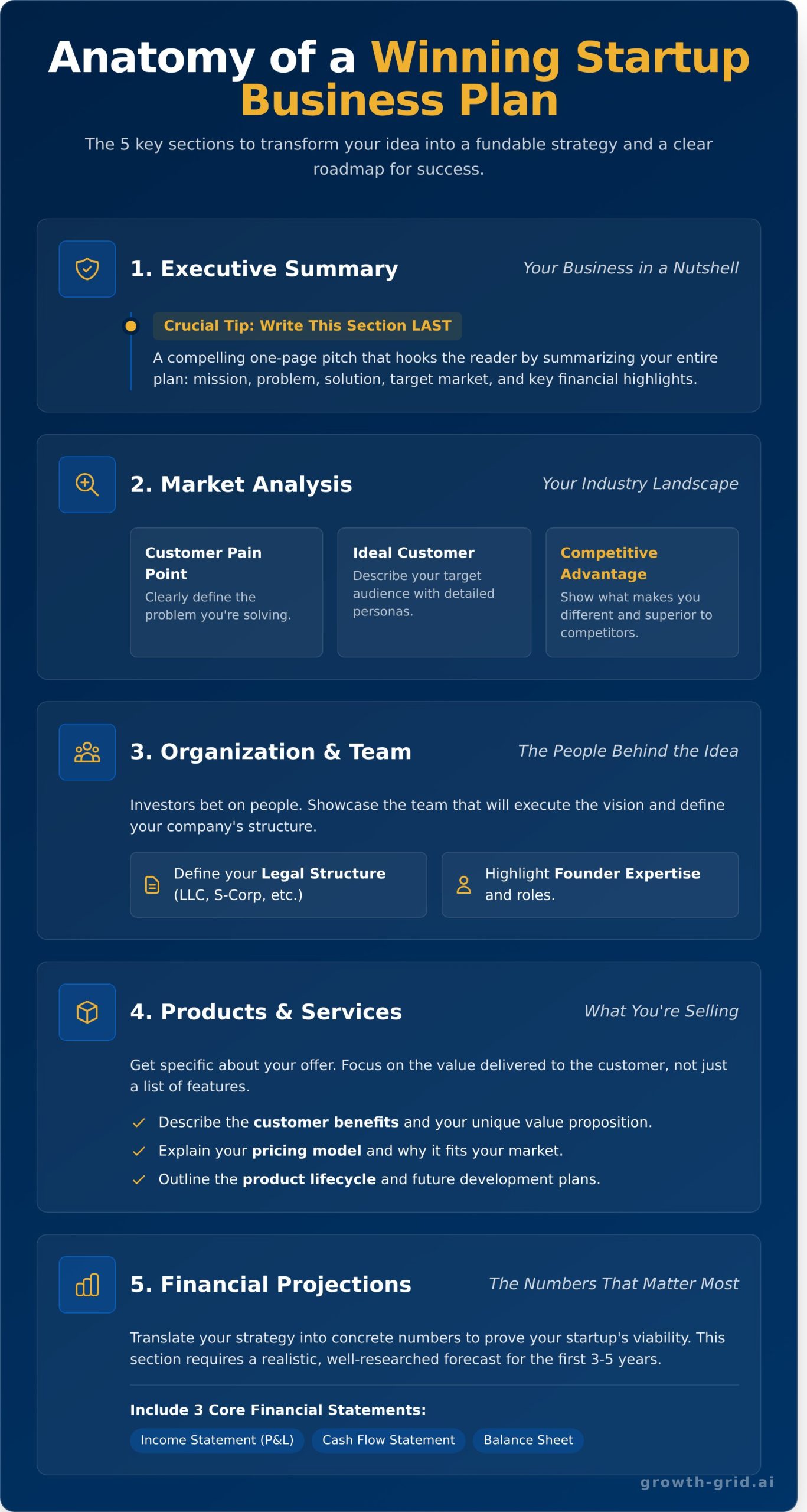
Forget the 40-page documents that cause more stress than clarity. A winning startup business plan isn’t about writing a novel; it’s about answering critical questions with precision. Think of this structure as a roadmap that gives investors, partners, and yourself a crystal-clear view of your entire business. Getting these components right ensures you cover everything from your big-picture vision to your operational details. This framework aligns with what experts at the U.S. Small Business Administration advise when you write your business plan, providing a trusted and effective format.
1. Executive Summary: Your Business in a Nutshell
This is your one-page pitch. It goes first in the document but you should write it last. Why? Because it’s a high-level summary of everything else. Hook the reader immediately with your mission. Then, efficiently summarize the core points: the problem you solve, your unique solution, your target market, and the key financial highlights that prove your model works. Make it compelling enough that they have to read the rest.
2. Company & Market Analysis: Your Industry Landscape
Here, you prove there’s a real need for your business. Start by clearly defining the customer pain point you’re solving. Next, describe your ideal customer using detailed personas-who are they, and what do they need? Finally, size up your competition. Acknowledge who they are, but focus on your competitive advantage. What makes you different and better? This is where you demonstrate your market awareness.
3. Organization & Management: The Team Behind the Idea
Investors bet on people, not just ideas. This section introduces the team that will execute the vision. Start by outlining your legal structure (e.g., LLC, S-Corp, Sole Proprietorship). For businesses with cross-border operations or international investment goals, this step requires careful planning, and you can read more about the legal frameworks involved. Then, introduce the key founders and management. Don’t just list names-highlight their specific expertise and relevant experience that makes them the perfect people to solve this problem. Clearly define roles and responsibilities to show you have a plan for effective leadership.
4. Products & Services: What You’re Selling
Get specific about your offer. Describe your product or service, focusing on the benefits and value it delivers to the customer, not just its features. Clearly explain your pricing model and justify why it’s a perfect fit for your target market. You should also briefly touch on your product lifecycle-where is it now, and what are your plans for future development, new features, or additional services? This shows you’re thinking ahead.
Financial Projections: The Numbers That Matter Most
This is where your big idea meets the bottom line. Financial projections translate your strategy into concrete numbers, proving your startup’s viability to investors and, more importantly, to yourself. The goal isn’t to predict the future perfectly but to create a realistic, well-researched forecast for the first 3-5 years. Even if you’re not seeking funding, this section is a critical roadmap for your own success and a core component of any strong startup business plan.
Key Financial Statements to Include
Every solid financial section is built on three core documents. These aren’t just for investors; they’re your dashboard for making smart decisions. The official SBA business plan guide stresses their importance for a complete plan. You’ll need:
- Income Statement (P&L): Shows your revenues, costs, and ultimately, your profitability over a period of time. Are you making money? This statement has the answer.
- Cash Flow Statement: Tracks every dollar coming in and going out. Cash is king, and this statement proves you can manage your treasury effectively.
- Balance Sheet: A snapshot of your financial health, listing your assets, liabilities, and equity at a specific point in time.
Essential Forecasts and Analyses
Beyond the core statements, you need to show your work. These forecasts demonstrate that you’ve thought through your operations and growth strategy, turning assumptions into actionable data.
- Sales Forecast: Project your sales month-by-month for year one, then annually. Be optimistic but ground your numbers in market research and capacity.
- Personnel Plan: Who do you need to hire and when? Detail their roles and salary costs to budget for your team’s growth accurately.
- Break-Even Analysis: The magic moment ✨. This calculation reveals when your total revenue will equal your total costs and you officially become profitable.
Funding Request (If Applicable)
If you’re seeking capital, this is your direct ask. Be clear, confident, and specific-don’t leave investors guessing. State exactly:
- How much funding you need to achieve your next milestones.
- How every dollar will be used (e.g., marketing, new hires, inventory).
- Your proposed terms for repayment or equity.
Feeling overwhelmed by spreadsheets? Don’t let financials block your launch. Generate them in minutes with AI.
How to Write Your Plan: The Old Way vs. The Smart Way
For decades, the process of writing a startup business plan felt like a necessary evil. Founders faced a draining choice: spend weeks piecing together a document yourself or pay a consultant thousands. Thankfully, you no longer have to choose. Technology has created a third option that’s faster, smarter, and dramatically more affordable. Let’s compare the methods for creating your plan to see which one will get you launched fastest.
The Traditional Method (The Slow Grind) 😰
This is the classic blank-page nightmare. You stare at a generic template, trying to fill in the blanks while juggling market research, financial projections, and endless formatting tweaks. It’s a guaranteed way to kill your early momentum.
- Time Sink: Expect to spend 40+ hours writing, researching, and revising.
- High Risk: It’s incredibly easy to miss crucial sections or make critical errors that investors notice immediately.
- Stressful Process: The daunting task can quickly drain your motivation and confidence.
Hiring a Consultant (The Expensive Route) 💸
Handing the work off to an expert seems like a perfect shortcut, but it comes with its own set of problems. A professional writer can cost anywhere from $2,000 to $10,000-precious capital your startup needs for growth. The process isn’t instant, either, often requiring weeks of calls and revisions. The biggest risk? You may end up with a generic plan that doesn’t fully capture your unique passion and vision.
The AI-Powered Method (The Smart Way) ✨
The modern solution eliminates the stress, the wait, and the high cost. Instead of writing, you simply answer guided questions about your business idea. Our powerful AI takes your answers and instantly drafts a comprehensive, professional startup business plan.
- Incredibly Fast: Generate a complete, 72-section plan in under 15 minutes.
- Expert Quality: Get a bank-ready document that combines an expert-level structure with your unique inputs.
- Affordable: Save over 90% compared to the cost of hiring a consultant.
This is the fastest, most efficient way to get a polished plan that opens doors. Ready to save weeks of work? Generate your plan instantly.
Creating Your Startup Business Plan Step-by-Step (The Fast Way)
Ready to build your plan? Forget the old way of staring at a blank page for weeks. This simple, three-step process gets your core ideas out of your head and into a professional format-fast. We focus on what matters: your vision, not tedious formatting. This is the exact process our AI uses to generate a complete startup business plan in minutes, and you can follow it right now.
Step 1: Answer Key Questions About Your Business
First, focus on the fundamentals. You don’t need paragraphs yet, just clear answers. This is the raw material for your entire plan. Start by defining these core components:
- Your Business: What is your business name and core mission?
- Problem & Solution: What specific problem are you solving, and how does your product or service provide the perfect solution?
- Your Customer: Who is your ideal customer, and what is your strategy to reach them?
Step 2: Let AI Structure and Write the Narrative
Once you have your core ideas, it’s time to let technology do the heavy lifting. A smart tool can instantly organize your answers into a professional structure. Instead of you worrying about what comes next, an AI writer generates all 72 sections of a comprehensive plan, from the executive summary and market analysis to your operations and financial projections. This saves you from the stress of writing and ensures no critical details are missed.
Step 3: Review, Refine, and Download
Your role is to be the expert on your business, not a professional writer. Once the AI generates the first draft, you simply review it. Make any custom tweaks needed to perfectly capture your voice and vision. When you’re satisfied, you can instantly download your complete plan as a PDF or Word document, ready to share with investors, partners, or your team. It’s the smart, modern way to create your startup business plan.
Ready to skip the stress and try the smart way? Generate your business plan now!
From Plan to Launch: Your Next Step is Minutes Away
Crafting a business plan doesn’t have to be a roadblock. It’s your strategic roadmap, the document that turns a brilliant idea into a fundable, actionable venture. You’ve learned the essential components and the financial details that matter, but the most important lesson is that you can skip the weeks of stress and uncertainty associated with the “old way” of planning.
It’s time to choose efficiency. Join the 50,000+ entrepreneurs who use GrowthGrid to build their complete startup business plan. You can instantly generate a professional, 40+ page, 72-section document that’s ready for investors. It’s the smart, modern solution for founders who are ready to build, and it’s backed by our 100% Satisfaction Guarantee.
Your vision is too important to wait. Stop stressing and start planning. Generate your plan in 8 minutes!
Frequently Asked Questions
How long should a startup business plan be?
Focus on impact, not page count. A lean plan for internal use or early-stage pitches can be as short as 1-10 pages. A traditional, detailed plan for a bank loan might be 25-40 pages. The key is to be concise and data-driven. Investors appreciate a plan that gets straight to the point, clearly outlining the opportunity, your solution, and the financial potential without unnecessary filler.
Can I write a business plan myself without any experience?
Absolutely. You are the expert on your vision. While it seems intimidating, modern tools and templates exist to guide you through every section. You don’t need a finance degree to create a powerful plan. Focus on clear communication, solid market research, and realistic goals. Your passion and knowledge of your idea are the most critical ingredients for success.
What is the most important section of a business plan for investors?
Investors almost always look at the Executive Summary and Financial Projections first. The Executive Summary is your elevator pitch-it must be compelling and concise, grabbing their attention in under two minutes. The Financial Projections, including cash flow forecasts and your funding request, prove the business is viable and offers a strong return on investment. Nail these sections to make an immediate impact.
How often should I update my business plan?
Your business plan is a living document, not a static one. Plan to review and update it at least once a year, or whenever a significant event occurs. This could include launching a new product, entering a new market, securing a major round of funding, or making a strategic pivot. Keeping it current ensures it remains a useful and accurate roadmap for your company’s growth.
What’s the difference between a lean startup plan and a traditional business plan?
Speed and detail are the main differences. A traditional plan is a long, comprehensive document (30+ pages) often required by banks. A lean startup plan is a highly-focused, 1-10 page document that uses charts and bullet points to quickly outline the business model. It’s designed for fast-paced environments and is perfect for internal strategy and pitching to investors who value agility.
Is a business plan necessary if I’m not seeking funding?
Yes, 100%. A solid startup business plan is your strategic guide to success. It’s not just for investors; it’s for you. The process forces you to validate your idea, understand your customers, and define clear goals. It helps you make smarter decisions, measure progress, and stay focused on building a profitable business, whether you’re bootstrapping or seeking capital.
How can AI help me write a better business plan?
AI transforms a weeks-long task into a process that takes minutes. AI-powered tools instantly generate professional-grade content, perform market analysis, and build detailed financial projections from your simple inputs. This eliminates writer’s block and ensures your startup business plan is comprehensive, accurate, and investor-ready. It’s the fastest way to get a high-quality plan done efficiently and affordably.