

Why are you still spending 40+ hours manually drafting a document that should take 8 minutes? Most entrepreneurs lose 2,400 minutes of productivity trying to explain “invisible” expertise on paper. If you’re struggling to quantify your value or project revenue based on limited billable hours, you aren’t alone. Creating a professional business plan for service based business used to be a grueling manual marathon. In 2026, the old way is officially dead. It’s time for the smart way. ✨
We agree that your time is better spent on billable client work than buried in complex spreadsheets. You’re about to learn how to build a professional, scalable, and bank-ready plan in minutes, not weeks, by using modern AI frameworks like GPT-4. This guide provides a clear roadmap for hiring and capacity while saving you 90% of the usual documentation time. We’ll show you exactly how to transform your expertise into a structured growth engine without the 😰 of a blank page.
Key Takeaways
- Understand why traditional templates fail and how to focus your plan on selling expertise and results rather than physical products.
- Master the five non-negotiable sections of a high-growth business plan for service based business to ensure your delivery workflow is professional and scalable.
- Ditch the 40-hour “Old Way” of manual drafting 😰 and switch to the “Smart Way” to generate a 72-section, bank-ready plan in just 8 minutes ✨.
- Learn to solve the “Founder Bottleneck” by incorporating capacity planning and team transition strategies directly into your roadmap.
- Discover the two-step AI framework that transforms your specific service niche into a professional, results-oriented business plan instantly.
Why a Service-Based Business Plan is Different (and More Critical) in 2026
Selling a physical product is straightforward. You build it, ship it, and track the inventory. Selling your expertise, time, and results is a different game entirely. A business plan for service based business serves as a dynamic roadmap for monetizing intangible assets. While the basic definition of what is a business plan remains consistent across industries, service entrepreneurs face unique hurdles that a standard template won’t solve. You aren’t managing a warehouse; you’re managing billable hours and client expectations.
Traditional “product-first” templates often fail because they focus on Cost of Goods Sold (COGS) and supply chain logistics. In a service model, your primary “cost” is your team’s time and your own mental bandwidth. If your plan treats your service like a toaster, you’ll miss the nuances of capacity planning and client retention. By 2026, the role of the business plan has shifted. It’s no longer just a document you show a bank to secure a loan. It’s an operational manual designed for maximum efficiency in an AI-driven economy.
A well-structured plan is your best defense against the “founder burnout” cycle. Statistics show that 72% of service-based founders experience significant burnout within their first 18 months. This usually happens because they lack clear boundaries and systems. Your plan should dictate exactly how you scale without personally working 80 hours a week. It defines your “Smart Way” to operate, ensuring you don’t become a bottleneck in your own success.
- Capacity Mapping: Identifying exactly how many clients you can handle before quality drops.
- Utilization Rates: Tracking how much of your team’s time is actually generating revenue.
- Profitability by Project: Moving away from flat fees that eat your margins.
Selling the “Invisible”: Capturing Value in Your Plan
When there is no physical product to demo, your Unique Value Proposition (UVP) must be undeniable. You’re selling a future state or a specific result. Your plan must identify the exact friction points your target market faces. For example, if you’re a consultant, don’t just say you “improve efficiency.” Specify that you reduce employee turnover by 22% through better onboarding systems. My strategic tax advisory service recovers $12,500 in annual overpayments for independent contractors by identifying overlooked digital asset deductions.
The 2026 Service Landscape: Why Speed to Market Wins
The 2026 market doesn’t reward the slow. We’ve moved from “slow-burn” launches to AI-accelerated business starts where execution happens in days, not months. If you spend 3 weeks debating a font choice in your plan, you’ve likely lost your first 3 high-value clients to a competitor who used a smarter, faster approach. Efficiency is the new currency. You need a business plan for service based business that can be generated, refined, and put into action instantly. Waiting for perfection is the “Old Way” that leads to missed opportunities. For a deeper look at modern planning, check out The Ultimate Guide to Writing a Business Plan to see how AI is changing the timeline of entrepreneurship.
The 5 Non-Negotiable Sections of a High-Growth Service Plan
Most service entrepreneurs treat their strategy like a loose to-do list. That is a mistake that leads to 60-hour work weeks and stagnant revenue. A professional business plan for service based business must act as a blueprint for scale, not just a description of what you do. If your plan doesn’t address how you’ll replace yourself, you haven’t built a business; you’ve built a job. To transition from a solo practitioner to a high-growth firm, your plan needs five specific pillars.
- Executive Summary: This is your 30-second pitch. 40% of stakeholders won’t read past this page. It must define your unique expertise and the specific problem you solve for a high-value niche.
- Operational Plan: You need to document your delivery workflow. This turns “magic” into a repeatable process that a team can follow without your constant input.
- Marketing & Sales Strategy: Stop relying on “hope-based” marketing. Define exactly how you’ll generate 20 new leads monthly and the specific script used to close them.
- Capacity & Team Structure: Identify your bottlenecks before they happen. If your lead consultant is at 85% capacity, your plan should trigger a new hire immediately.
- Financial Projections: You must model the difference between one-off projects and recurring retainers. Aim for a 30% buffer in your cash flow to handle seasonal dips.
Right now, the most efficient way to organize these thoughts is to follow a proven framework. While you can draft this from scratch, consulting the SBA guide to writing a business plan provides a solid foundation for traditional requirements. However, service businesses move faster than retail or manufacturing, so your operations must be agile ✨.
Service Delivery & Operations
Mapping the customer journey is the difference between a 5-star review and a refund request. Start by documenting every touchpoint from the initial inquiry to the final delivery. Use tools like Zapier or specialized CRM software to automate your onboarding; this can reduce manual billable hours by 15% per client. Quality control is difficult with “intangible” outputs, so you must create “Definition of Done” checklists for every service tier. This ensures a consistent result even as you scale your team.
The Financial Model: Revenue per Head
Your most important metric is how much revenue each employee generates. For a healthy business plan for service based business, you should calculate your “Break-even Billable Rate” for 2026. If your overhead increases by 5% annually, your 2026 target rate might need to be $175 per hour just to maintain current margins. Check out Financial Projections Made Easy to see how these numbers shift over time. Remember, SG&A expenses, like unoptimized software subscriptions and excessive office perks, are the silent killers of service margins. Keep these below 20% of your total revenue to stay lean.
Don’t spend 40+ hours staring at a blank cursor. The old way of planning is slow and frustrating. The smart way uses technology to get you to the finish line in minutes. If you want to see your strategy come to life instantly, you can start your plan now and focus on growing your revenue instead of formatting spreadsheets.
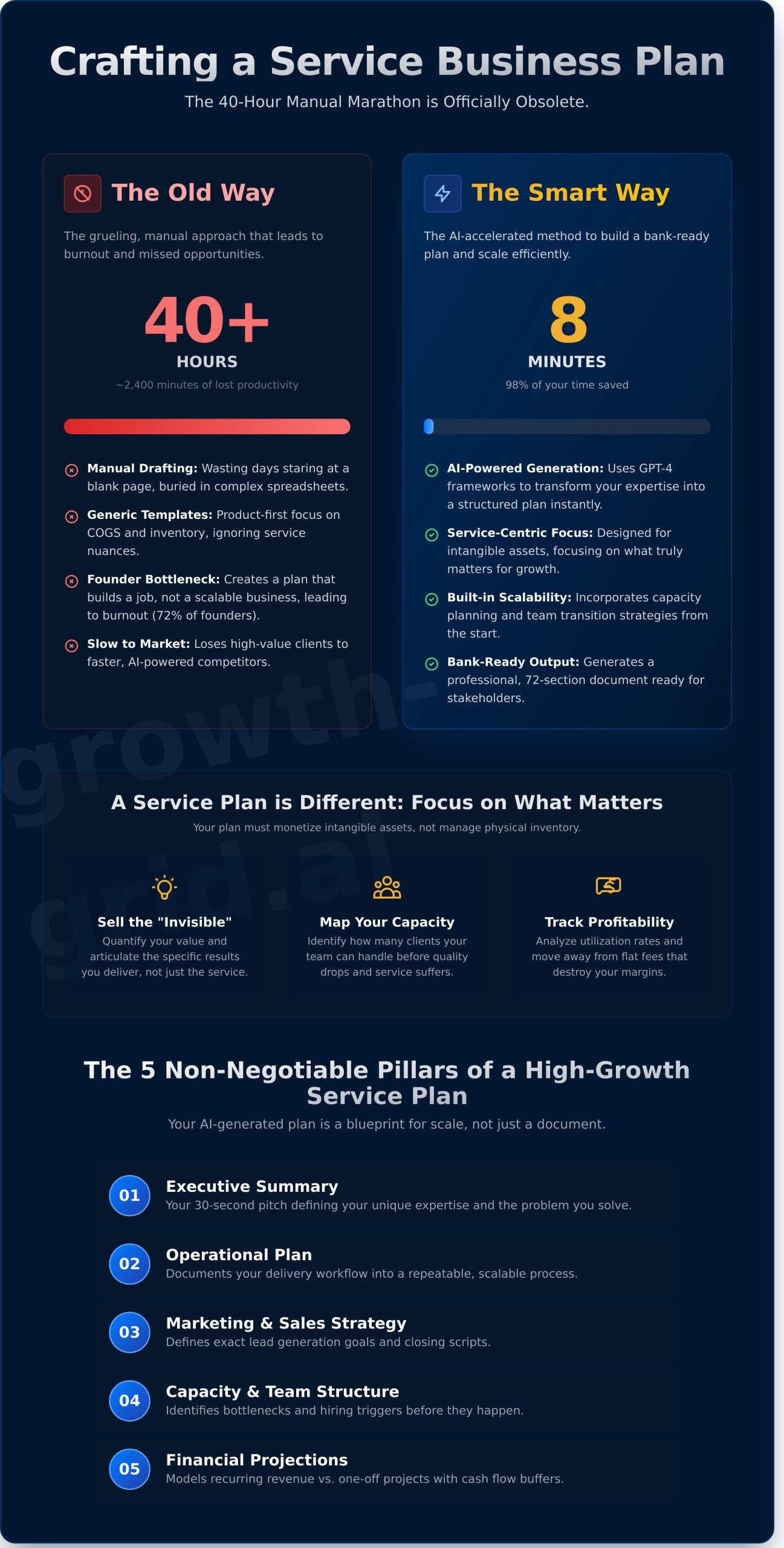
The Old Way vs. The Smart Way: Drafting Your Plan
Most service entrepreneurs hit a brick wall before they even finish their first page. They stare at a blinking cursor, unsure how to structure a business plan for service based business operations that actually impresses a bank manager or a potential partner. This is “blank page syndrome,” and it’s the primary reason 65% of business ideas never leave the napkin stage. Manual drafting is slow, painful, and often results in a document that’s outdated the moment it’s printed.
- The Old Way: 40+ hours of manual research, $2,000+ paid to expensive consultants, and generic templates that don’t fit your specific service niche. 😰
- The Smart Way: 8 minutes of input, AI-powered precision using GPT-4 models, and 72 comprehensive sections tailored to your unique goals. ✨
While you can download a free business plan template from institutions like Santa Clara University to understand the basic framework, filling it out manually is a massive time sink. GrowthGrid uses advanced GPT-4 models to analyze your specific service niche instantly. Whether you’re launching a specialized HVAC company or a high-end marketing agency, the AI understands your unit economics, local competition, and growth levers without you needing to explain them. It transforms the best way to build a business plan for service based business growth into a streamlined, automated process that delivers professional results in minutes.
Why Business Plan Software Beats Word Documents
Static PDFs and Word documents gather digital dust. They’re difficult to update and even harder to share with a team. Modern business plan software allows for real-time updates. If your labor costs for technicians rise by 12% or you decide to add a new subscription service tier, you can adjust your projections in seconds. Our review of the Best Business Plan Software of 2026 highlights tools that offer collaborative features. This allows your early-stage partners or investors to leave comments and view live data, making your business look like a professional, tech-forward operation from day one.
The Cost of Delay: What is Your Time Worth?
Every hour you spend wrestling with a spreadsheet is an hour you aren’t out in the field selling your services. This is the “Opportunity Cost” of traditional planning. If your target billable rate is $150 per hour, spending 40 hours writing a plan manually costs you $6,000 in lost revenue. It’s a hidden expense that many founders ignore until it’s too late.
You can use GrowthGrid to save 90% on professional document costs while maintaining bank-level quality. Comparing the $19 AI cost to a $2,500 consultant fee makes the choice simple for any pragmatic owner. You’ll receive a 40+ page, investor-ready document in the time it takes to finish a cup of coffee. Don’t let your project stall because of paperwork. Get started now and focus on what you do best: serving your customers and scaling your brand.
Solving the Scalability Trap: Planning for Growth
Most service founders hit a ceiling within 18 months of launching. This is the founder bottleneck. You are the talent, the salesperson, and the support team. If you stop working, the revenue stops flowing. A professional business plan for service based business must outline exactly how you will exit the day-to-day delivery. Research from the 2023 Service Industry Report shows that founders who spend more than 70% of their time on client work see 40% slower growth compared to those who delegate early.
Capacity planning is your escape route. Don’t wait until you’re burnt out to hire. Calculate your “break point” by tracking billable hours. When you reach 32 billable hours per week, your capacity is effectively 80% full. This is the trigger point for your first hire. If you wait until you’re at 100%, you won’t have the 15 to 20 hours required to train a new team member properly.
Your plan should also ditch hourly billing. It’s a trap that penalizes efficiency. If you get faster at your job, you make less money. Value-based pricing or fixed-fee packages belong in your strategy instead. This shifts the focus from “how long it takes” to “what it’s worth.” A 2024 pricing study found that service firms using value-based models carry 25% higher profit margins than those billing by the hour.
Your Hiring Roadmap
Identify your first hire based on the highest ROI of your time. For 65% of service owners, an administrative assistant is the smartest first move. This clears 10 to 15 hours of low-value tasks every week. Once your operations are lean, look for technical talent to handle delivery. You can use modern tools to move faster; for instance, you can use AI HR Documents: Save Time to generate your first employment contracts and NDAs in seconds rather than paying a lawyer $300 per hour.
Productizing Your Service
Scaling a custom service is difficult because every project is a new puzzle. Productization is the solution. Turn your expertise into a repeatable, three-tiered menu. This standardizes your workflow and makes cash flow predictable. Instead of “custom consulting,” offer a “4-Week Strategy Sprint” for a flat fee of $5,000. This approach doesn’t just make life easier; it increases your business valuation. Companies with standardized, productized services often sell for 3.5x earnings, while custom shops struggle to reach a 1.5x multiple.
A solid business plan for service based business treats your time as a finite resource that must be replaced by systems. Stop selling your hours and start selling an outcome that functions without your constant supervision. This transition is what separates a stressful freelance gig from a scalable company.
Ready to build a growth-ready strategy? Generate your professional business plan ✨
Generate Your Service Business Plan in 8 Minutes with GrowthGrid
Stop losing sleep over a blank cursor. Traditional planning takes 40+ hours and often costs upwards of $2,000 if you hire a consultant. GrowthGrid cuts that time by 98% while maintaining the high standards required by modern lenders. You’ll get a high-quality business plan for service based business without the typical headaches or expensive fees.
The process is designed for speed and precision. You don’t need an MBA to navigate our interface. We’ve distilled the complex requirements of the Small Business Administration (SBA) into a simple, four-step workflow that delivers results instantly.
- Step 1: Input your service niche and target audience. Tell us what you do, whether it’s a specialized HVAC company or a digital marketing agency. Identifying your specific customer profile helps the AI tailor your competitive advantage from the start.
- Step 2: Answer our AI-guided questions about your operations. Forget about staring at a blank page. Our system asks smart, targeted questions about your pricing, team structure, and service delivery. This ensures every detail of your unique model is captured.
- Step 3: Generate a 40+ page, 72-section professional plan ✨. Using the GPT-4 model, GrowthGrid builds a comprehensive document. It includes everything from executive summaries and SWOT analyses to detailed 5-year financial projections that banks actually trust.
- Step 4: Download in DOC or PDF and start pitching. Your plan is ready for the real world. Download it in an editable format to add personal touches or keep it as a crisp PDF for investor presentations.
Why 10,000+ Entrepreneurs Chose GrowthGrid
Security isn’t an afterthought here. We use AES-256 bank-level encryption to keep your business secrets safe. Your proprietary ideas and financial data remain private, protected by the same standards used by major financial institutions. You can build your vision with total peace of mind.
We believe in the quality of our technology. That’s why we offer a 100% Satisfaction Guarantee. If you don’t love your plan, you get your money back. It’s a risk-free way to secure the professional quality that impresses investors and banks. Over 10,000 founders have already used this system to move from “idea phase” to “open for business” in record time.
Beyond the Plan: Your Full Business Suite
A business plan for service based business shouldn’t be a static document that gathers dust on a hard drive. GrowthGrid provides a living dashboard where you can access legal, HR, and strategy documents in the same place. This central hub keeps your operations organized as you scale from a solo operation to a full team.
Markets change, and your plan should too. Our platform allows you to keep your plan updated as your service business grows. If you add a new service line or target a new geographic area, you can refresh your strategy in minutes rather than starting from scratch. This agility is what separates successful startups from those that stall. You’ll have the tools to pivot whenever the data suggests a new opportunity.
Ready to stop planning and start doing? Join the thousands of entrepreneurs who skipped the 40-hour grind.
Launch Your Service Business Faster in 2026
Success in the modern service economy depends on how quickly you can move from a concept to a scalable model. You now understand why a business plan for service based business requires a specific focus on 2026 market trends and why avoiding the scalability trap is vital for your long term growth. Don’t spend 40 hours struggling with the old way of drafting documents when the smart way takes less than 10 minutes. It’s time to stop overthinking and start building.
GrowthGrid is trusted by 10,000+ startups to deliver 40+ page comprehensive plans that include 72 professional sections. You’ll get a high growth roadmap designed to impress investors and banks without the $2,000 consultant fee. It’s the most efficient path to a professional document that actually works for your unique service niche. Why waste weeks on research when the data you need is already at your fingertips?
Generate ✨ Your Professional Business Plan in 8 Minutes
You have the expertise to provide world class services. We have the technology to give your business the professional foundation it deserves. Your future starts today.
Frequently Asked Questions
Do I really need a business plan for a small service business?
Yes, a business plan for service based business is essential because 70% of companies that survive past year five follow a written strategy. Don’t waste 40 hours on the “Old Way” of manual drafting when you can use a smart tool to finish in 8 minutes. A clear plan helps you secure 30% more funding and keeps your team aligned on specific revenue targets. ✨
What is the most important section of a service-based business plan?
The Operations and Delivery section is the most critical part. It proves you can actually fulfill your promises. You must detail exactly how you’ll manage your 24 hour service cycle or client onboarding process. 60% of service startups fail due to poor capacity planning. Clearly define your workflow to show investors you’ve mastered the logistics of selling your time. ✓
How is a service business plan different from a product business plan?
Service plans focus on human capital and billable hours rather than physical inventory or manufacturing costs. You won’t have a “Cost of Goods Sold” for raw materials; instead, you’ll track a 35% or 50% labor margin. Your marketing strategy emphasizes trust and expertise because you’re selling an invisible result. Product plans focus on 1,000 units in a warehouse while you focus on 40 hours of expert delivery.
Can I use an AI business plan for a bank loan application?
Yes, you can use an AI generated plan for a bank loan if it uses high quality models like GPT-4. Modern banks now accept 40 page professional plans created with AI because they’re data driven and structured correctly. Our users save 90% on consultant fees while getting a document that meets SBA standards. Just ensure your 3 year financial projections are realistic for your specific local market. ✓
How long should my service business plan be in 2026?
Your 2026 business plan should be a lean 15 to 25 pages for internal use or 40+ pages for formal funding. Efficiency is the priority now. Investors spend an average of 3 minutes and 44 seconds reviewing a pitch deck or plan summary. Keep your executive summary under 2 pages. Use clear charts to show your 12 month growth trajectory instead of writing long, dense paragraphs. ✨
What are the biggest mistakes in service business planning?
The biggest mistake is overestimating billable capacity. Most founders assume 100% productivity, but real world billable efficiency usually sits at 65% to 75%. Another error is ignoring the “Smart Way” of automated customer acquisition. Don’t forget to budget for 15% hidden overhead costs like software licenses and insurance. A business plan for service based business fails when it ignores these small but lethal leaks. ✗
How do I calculate my service pricing in the business plan?
Calculate your pricing by adding a 30% profit margin to your total hourly cost, including taxes and overhead. This is the “Cost-Plus” method. Alternatively, use value based pricing if your service saves a client $10,000 annually; charging $2,000 is an easy sell. Always research the 5 closest competitors in your zip code to ensure your rates are competitive but sustainable for 20% annual growth.
How often should I update my service business plan?
Update your plan every 90 days to stay agile. Markets shift fast, and a plan from 12 months ago is likely 40% inaccurate today. Review your KPIs at the end of each quarter to see if you hit your $50,000 or $100,000 revenue milestones. Regular updates turn a static document into a live roadmap for success. It only takes minutes to tweak your strategy when you use the right tools. ✨