

Let’s be honest: the words “business plan” can feel overwhelming. 😰 You picture endless pages of complex financial projections and market analysis-a task that seems to require weeks of work you simply don’t have. It’s enough to make any entrepreneur put it off for “later.” But what if creating a powerful roadmap for your startup could be simple, fast, and surprisingly straightforward?
This guide cuts through the noise to answer the core question: what is a business plan? We’ll break it down into a simple, actionable definition that anyone can understand, no MBA required. You’ll discover exactly why you absolutely need one (even if you’re not seeking funding) and learn the smartest, fastest way to create a professional, bank-ready plan today. Forget the stress and confusion. It’s time to get a clear, confident roadmap for your success. ✨
What Is a Business Plan? (Hint: It’s More Than a Document)
So, what is a business plan in today’s fast-paced world? Think of it as the strategic roadmap for your startup. It’s the GPS that guides you from a great idea to a profitable reality. Forget the myth of the 100-page, dust-gathering binder you write once and never look at again. The modern business plan is a dynamic, living tool designed for one person first and foremost: you.
Its primary purpose is to provide clarity, direction, and a clear path to success. It forces you to think critically, anticipate challenges, and map out your strategy before you invest significant time and money. While the formal definition of a Business plan is often a written document outlining goals and how to achieve them, its real value is as a guide for making smarter, faster decisions every single day.
The Core Goal: Answering Critical Questions
At its heart, a business plan is an exercise in answering the most important questions about your venture. It transforms vague ideas into a concrete strategy by forcing you to define:
- What problem are you solving? Clearly articulate the pain point your product or service addresses for customers.
- How will you make money? Detail your revenue model, pricing strategy, and financial projections.
- Who are your customers? Define your target market and outline how you will reach and attract them.
- What are your goals? Set clear, measurable milestones for what you want to achieve and when.
Internal vs. External Use Cases
A great business plan works on two levels. It’s a private guide for you and a professional pitch for others. A single, well-structured plan can be easily adapted to serve both needs efficiently.
For You (Internal): This is your master blueprint. It’s a detailed guide for strategic planning, measuring your progress against key performance indicators (KPIs), and keeping your team aligned and focused on the same goals.
For Others (External): This is a polished, concise version of your plan. It’s a powerful tool used to persuade investors, secure bank loans, or win grants by demonstrating a clear vision and a viable path to profitability.
Why You Absolutely Need a Business Plan (Even If You’re a Solo Founder)
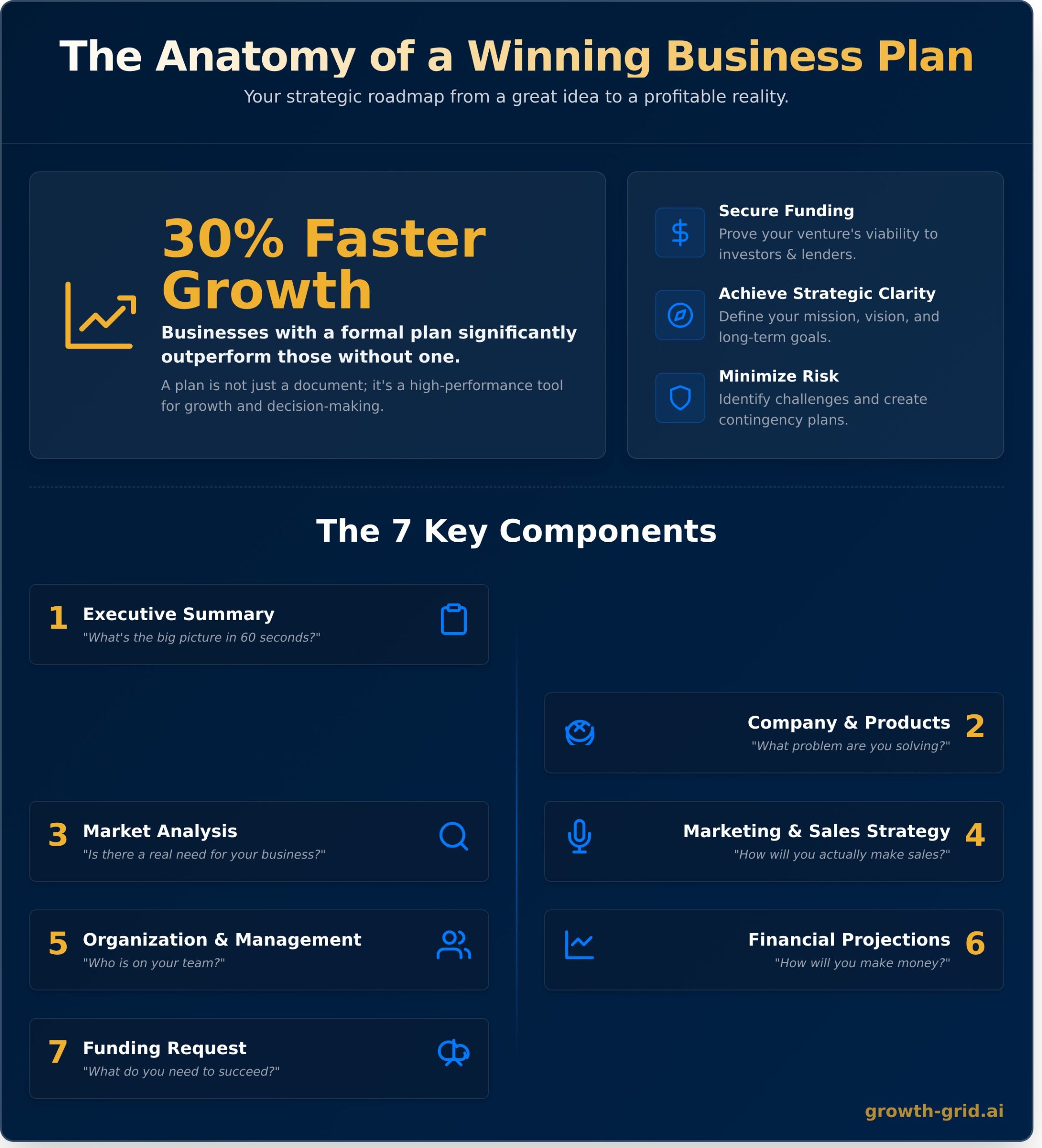
Let’s be direct. Many founders, especially solo entrepreneurs, think a formal business plan is a waste of time. “I have it all in my head,” they say. “I need to build, not write.” This is a critical mistake. The data doesn’t lie: studies show that businesses with a plan grow 30% faster than those without one. A plan isn’t just a document; it’s a high-performance tool for growth.
Thinking through what is a business plan forces you to move beyond the initial excitement and rigorously validate your idea. It’s your first line of defense against costly assumptions. By putting your strategy on paper, you can spot potential weaknesses, create a clear framework for making tough decisions, and set concrete goals. This document becomes your benchmark, allowing you to track actual performance against your targets and pivot intelligently when needed.
To Secure Funding and Investment
If you ever need a loan or want to attract investors, a business plan is non-negotiable. It’s the first thing banks and VCs will ask for. A professional plan demonstrates serious intent and proves you’ve analyzed your market, understand the risks, and have a clear financial strategy. As outlined by resources from the U.S. Small Business Administration, a comprehensive plan is essential for proving your venture’s viability to lenders.
To Achieve Strategic Clarity
A business plan is your strategic compass. It forces you to define your mission, vision, and long-term goals with precision. The process requires you to conduct deep market research, understand your competition, and identify your unique value proposition. This clarity ensures that every action you take-from marketing to product development-is aligned with your ultimate objectives, keeping you focused and efficient.
To Minimize Risk
Starting a business is inherently uncertain, but a business plan is your best tool for managing that risk. It helps you identify potential challenges and create contingency plans before they become disasters. By creating realistic financial projections, you can manage cash flow more effectively and avoid common pitfalls. A strong plan doesn’t eliminate risk, but it gives you the confidence and foresight to navigate it successfully.
The 7 Key Components of a Winning Business Plan
Think of a business plan as the anatomy of your startup. Each section answers a critical question that, together, tells a complete and compelling story. Getting these parts right is the key to creating a roadmap that guides your growth and impresses investors. It’s the practical answer to what is a business plan.
Let’s break down the seven essential sections.
1. Executive Summary: Your Business in a Nutshell
The Question: What’s the big picture in 60 seconds?
This is your elevator pitch on paper. Though it appears first, you should write it last. It briefly covers your mission, product or service, core team, and financial highlights. Its only job is to hook the reader and convince them the rest of your plan is worth their time. Make it powerful.
2. Company & Products: What You Do and Why It Matters
The Question: What problem are you solving?
Here, you detail your products or services and explain your unique value proposition-what makes you different and better. You’ll also cover the basics like your business model and legal structure (e.g., LLC, sole proprietorship). This section proves your idea has real-world value.
3. Market Analysis: Who Your Customers Are
The Question: Is there a real need for your business?
This is your homework. You need to define your target audience, analyze the size of your market, and size up your competition. It shows investors and partners that you understand the industry landscape and have identified a clear, profitable opportunity to succeed.
4. Marketing & Sales Strategy: How You’ll Get Customers
The Question: How will you actually make sales?
An idea is worthless without customers. This section outlines your plan to attract and retain them. Cover your pricing, promotional activities (like social media or content marketing), and the sales process you’ll use to turn leads into loyal fans. This is your go-to-market action plan.
5. Management Team: Who’s Behind the Idea
The Question: Why should we trust YOU to pull this off?
Investors bet on people, not just ideas. Introduce your key team members and highlight their relevant experience and skills. This section isn’t about ego; it’s about building confidence that you have the right people with the right expertise to execute the vision.
6. Financial Projections: The Numbers Story
The Question: Is this business financially viable?
This is where you prove your business can make money. It includes your projected income statements, cash flow forecasts, and balance sheets for the next 3-5 years. While a comprehensive Purdue University business plan template shows the complexity of building these manually, the goal is simple: show your venture is profitable and a sound investment.
7. Appendix: The Supporting Details
The Question: What extra proof do you have?
This optional section is for documents that support your claims but would clutter the main plan. Think resumes, permits, licenses, detailed market research data, or product photos. It keeps your plan clean while providing extra credibility for those who want to dig deeper.
How to Create Your Business Plan: The Old Way vs. The Smart Way
After learning what is a business plan and seeing all the components involved-from the executive summary to the financial projections-it’s natural to feel a little overwhelmed. For decades, creating a comprehensive plan was a major roadblock for entrepreneurs. But it doesn’t have to be.
Today, you have two choices: the traditional, stressful path or the modern, efficient one.
The Old Way: Stress, Time, and Blank Pages 😰
The traditional approach to writing a business plan is famous for being slow and painful. It means staring at a blank document, wrestling with complex spreadsheets, and second-guessing every word. This path is often defined by:
- ✗ Weeks of Work: Countless hours spent on research, writing, and formatting, pulling you away from actually building your business.
- ✗ Financial Headaches: Trying to build accurate sales forecasts, cash flow statements, and balance sheets from scratch is a massive challenge for non-accountants.
- ✗ High Costs: Hiring a consultant to write your plan for you can easily cost between $2,000 and $10,000, a steep price for any startup.
- ✗ Unprofessional Results: After all that time and money, you can still end up with a generic plan that fails to impress investors or lenders.
The Smart Way: AI-Powered Speed and Quality ✨
Instead of struggling, modern entrepreneurs use AI to turn a month-long project into a 15-minute task. AI-powered platforms like GrowthGrid have redefined the process. You simply answer a series of straightforward questions about your business idea, and the technology does the heavy lifting, instantly drafting every section for you.
- ✓ Done in Minutes: Generate a complete, 40+ page business plan that is tailored to your vision in less time than it takes to drink a coffee.
- ✓ Accurate Financials, Instantly: The AI builds your full financial model automatically, creating the professional projections banks and investors expect to see.
- ✓ Save Over 90% on Costs: Get a premium, investor-grade plan for a tiny fraction of the cost of a consultant.
- ✓ Guaranteed Professionalism: The structure is proven, the language is professional, and the final document is ready to help you secure funding.
The question for today’s founder is no longer just about understanding what a business plan is, but how quickly and effectively you can create one. Why spend weeks stressing over spreadsheets and blank pages when you can have a better result in minutes?
Stop waiting and start building. Generate your professional business plan with AI in under 15 minutes.
Stop Asking ‘What Is a Business Plan?’ and Start Building Yours
Ultimately, a business plan is not just a static document-it’s your strategic roadmap to success. It provides the clarity you need to make smart decisions, sharpens your focus on what truly matters, and is absolutely essential for convincing investors or securing loans. The key takeaway? You need one. But creating it doesn’t have to be the slow, expensive nightmare it used to be.
Forget the old way. The smart way is here. Join thousands of entrepreneurs worldwide who use GrowthGrid to instantly generate a comprehensive, 40+ page, 72-section business plan in minutes. You’ll save over 90% compared to hiring a consultant and get a professional, bank-ready document that brings your vision to life. No more stress, no more delays. Your idea has potential. Give it the plan it deserves.
Stop Worrying and Start Planning. Generate Your AI Business Plan Now →
Frequently Asked Questions About Business Plans
How long should a business plan be?
There’s no magic number. A traditional plan for a bank or investor is often 30-50 pages, covering every detail. However, a lean startup plan for internal use might only be a few pages. The right length depends entirely on your audience and your goals. Focus on providing the necessary information clearly and concisely. A shorter, powerful plan is always better than a long, unfocused one. Don’t waste time on filler-make every section count.
Can I write a business plan myself if I’m not an expert?
Absolutely. You don’t need an MBA or an expensive consultant to create a professional business plan. You are the expert on your own business idea. The old way involved weeks of stress and guesswork. The smart way uses modern tools and templates to guide you through each section step-by-step. This saves you thousands in fees and puts you in complete control of your vision, ensuring the final document is 100% yours.
What’s the difference between a business plan and a business proposal?
Think of it this way: a business plan is your strategic map, while a business proposal is a sales pitch. Your business plan details your entire company from A-Z-your mission, market, financials, and growth strategy. It’s for internal guidance and for securing funding. A proposal is an external document sent to a specific client to sell them a particular product or service. It’s focused on winning a single piece of business.
Do I need a different business plan for investors versus a bank?
Yes, you should always tailor your plan to your audience. A bank wants to see low risk and a clear path to repaying your loan. They focus heavily on your financial projections, collateral, and historical cash flow. Investors, on the other hand, are looking for high-growth potential and a massive return. They want to see a huge market opportunity, a scalable business model, and a strong competitive advantage. Customize your emphasis for maximum impact.
How often should I update my business plan?
Your business plan should be a living document, not a static file you write once and forget. Treat it as your strategic guide. We recommend reviewing it quarterly to track your progress against your goals. You should perform a major update annually or whenever a significant event occurs-like securing new funding, entering a new market, or making a major pivot in your strategy. This ensures you always know what a business plan is for: guiding decisions.
Is a business plan a legally binding document?
No, a business plan is not a legal contract. It is a strategic document that outlines your company’s goals, projections, and plans. While you should be honest and accurate, especially when presenting to lenders or investors, the financial forecasts and milestones are understood to be forward-looking estimates, not legally enforceable promises. Its purpose is to persuade and guide, not to create a legal obligation for specific results.