

Staring at a blank page, wondering where to even begin with your business plan? 😰 The pressure is on. Investors are smarter, the market is faster, and an old, generic template just won’t cut it in today’s world. If you’re stressed about what investors actually want to see or terrified of missing a crucial component, you’re in the right place.
Stop the guesswork. This is your definitive, no-fluff guide on what to include in a business plan 2026. We’ve built the ultimate checklist to save you weeks of work and eliminate the overwhelm. Forget outdated advice-this is the smart, modern approach to building a plan that gets results, fast.
Get ready for a complete, section-by-section breakdown of everything you need to secure funding and confidently guide your growth. By the end, you’ll have a clear, actionable roadmap to a professional, bank-ready business plan. Let’s build it. ✨
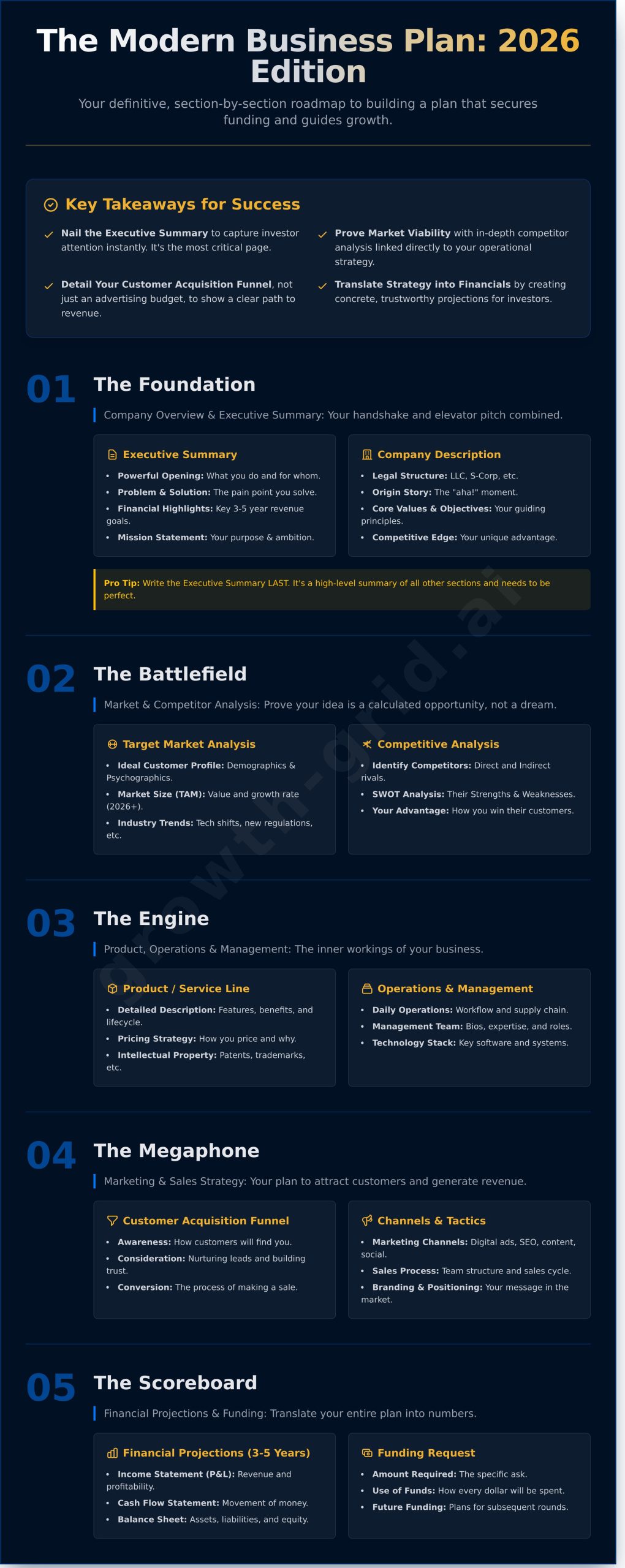
Key Takeaways
- Nail your Executive Summary to capture investor attention instantly; it’s the single most important page of your entire plan.
- Prove your market viability by connecting in-depth competitor analysis directly to a realistic operational strategy.
- Move beyond a simple advertising budget and outline a complete customer acquisition funnel to show a clear path to revenue.
- Understanding what to include in a business plan 2026 means translating every strategy into concrete financial projections investors can trust.
The Foundation: Company Overview & Executive Summary
Think of this section as the handshake and the elevator pitch combined. It’s the very first thing a potential investor, lender, or partner will read. Get it right, and they’ll eagerly read on. Get it wrong, and your plan might end up in the ‘no’ pile before they even reach your financials.
While it appears first in the document, the smartest move is to write it last. Why? Because it’s a high-level summary of everything else you’re about to build-from market analysis to your financial forecasts. Mastering this foundation is crucial when planning what to include in a business plan 2026, as it sets the stage for your entire vision.
Executive Summary: Your Business in a Nutshell
This is your entire business distilled into a few powerful paragraphs. Don’t waste a single word. Your goal is to provide a complete, high-level overview that entices the reader to learn more. While the standard Business plan definition covers many components, the executive summary must condense the most vital points into a compelling narrative. It’s the ultimate test of your clarity.
- Powerful Opening: Start with a single, compelling sentence describing what your business does and for whom.
- Problem & Solution: Briefly state the pain point you’re solving and why your solution is unique and effective.
- Financial Highlights: Mention key projections, such as revenue goals for the next 3-5 years, and state your current funding needs.
- Mission Statement: End with your company’s mission, giving a glimpse into your purpose and long-term ambition.
Company Description: The ‘Who’ and ‘Why’
While the executive summary covers the ‘what,’ the company description reveals the ‘who’ and ‘why.’ This is where you give your business a personality and a backstory, moving beyond numbers to connect with the reader. It provides essential context that builds trust and demonstrates that your long-term vision is sound. This section grounds your ambitious financial projections in a real, tangible mission.
- Legal Structure: Clearly state your business structure (e.g., LLC, S-Corp, Sole Proprietorship).
- Origin Story: Briefly share the “aha!” moment or the market gap that sparked your business idea. People connect with stories.
- Core Values & Objectives: List 3-5 core values that guide your company and the key long-term objectives you aim to achieve.
- Competitive Edge: What makes you different and better? Highlight your unique technology, team expertise, or innovative model from the start.
The Battlefield: In-Depth Market & Competitor Analysis
An idea without a market is just a hobby. This section is where you prove your business isn’t a dream-it’s a calculated opportunity. Investors and lenders scrutinize this part more than any other. Why? Because it shows you’ve done the hard work of validating your idea in the real world. If you’re asking what to include in a business plan 2026 to build instant credibility, this data-driven analysis is your answer.
Your goal here is to demonstrate a deep understanding of the industry landscape, your customers, and your competition. Forget vague statements; use hard numbers and credible sources to build a rock-solid case for your venture.
Target Market Analysis
First, you must define exactly who you’re selling to and the size of the opportunity. Get specific and back it up with numbers. This level of detail is a standard expectation; in fact, the official SBA business plan guide emphasizes that a thorough market analysis is foundational.
For example, a business plan for a niche service, like an online directory for care providers, must be highly specific. To see how a specialized platform approaches its market, you can learn more about Guide2Care. Focus on these key areas:
- Ideal Customer Profile: Go beyond basic demographics (age, income, location). Detail their psychographics-their values, habits, pain points, and buying triggers. Create a clear picture of who needs your solution.
- Market Size (TAM): Estimate the Total Addressable Market. How big is the entire pie? Use credible industry reports and data to project its value and growth rate through 2026 and beyond.
- Industry Trends: Is the market growing, shrinking, or changing? Show you understand the key trends (e.g., technology shifts, regulatory changes, consumer behavior) that will impact your business.
Competitive Analysis & Your Advantage
No business operates in a vacuum. Acknowledging your competition shows you’re a realist, not a dreamer. This analysis proves you know who you’re up against and, more importantly, how you’ll win their customers. Don’t be afraid to be brutally honest here.
- Identify Competitors: List your main direct (offering a similar product) and indirect (solving the same problem differently) competitors.
- Analyze Their Strengths & Weaknesses: A simple SWOT analysis for each key competitor is incredibly effective. Where do they excel? Where do they fail? Their weaknesses are your opportunities.
- Define Your Unique Selling Proposition (USP): This is your secret weapon. What makes you the only choice? Clearly state what you do better, faster, or cheaper than anyone else. This is your core advantage.
- Pricing Strategy: Explain how your pricing compares to the competition and why. Are you the premium option, the budget-friendly choice, or somewhere in between? Justify your position.
The Engine: Operations, Management, and Product/Service Line
If your Executive Summary is the handshake, this section is the guided tour of the factory floor. It’s where you prove you can actually deliver on your promises. Investors and lenders need to see a clear, realistic path from idea to customer. Detailing these nuts and bolts is a critical part of what to include in a business plan 2026, as it demonstrates you’ve thought through the daily realities of running your company and are prepared for the future of work.
Products & Services
Describe what you sell in simple, powerful terms. Don’t just list features; explain the benefits. How does your product or service make your customer’s life better, easier, or more profitable? Briefly detail the product lifecycle, from initial launch to future versions (v2.0, etc.). You should also note any patents, trademarks, or key intellectual property that protects your unique offering and gives you a durable competitive edge.
Management Team & Company Structure
An idea is only as good as the team executing it. Introduce your key players with short bios highlighting their relevant experience and track record. An organizational chart is a fast, effective way to show who does what and how the team is structured. Crucially for 2026, you must outline your staffing plan and approach to work-will you be fully remote, hybrid, or in-office? This shows you’re building a modern, efficient organization.
- Key Members: Brief bios focusing on results and expertise.
- Structure: A simple chart showing roles and reporting lines.
- Future-Proofing: Your plan for hiring and remote/hybrid work policies.
Operations Plan
This is your daily playbook. A key question for what to include in a business plan 2026 is how you will integrate technology into your core operations. Map out your digital workflow, from production to fulfillment and customer support. The official SBA guide to writing a business plan stresses the importance of detailing your supply chain, which today must include key technology partners and your software stack (e.g., CRM, project management tools, cloud provider). Finish by listing 2-3 major operational milestones for the next 18 months to show clear forward momentum.
The Megaphone: A Modern Marketing & Sales Strategy
A brilliant product or service is only half the battle. This section outlines how you’ll reach, engage, and convert your target audience into paying customers. Forget outdated tactics; a critical part of what to include in a business plan 2026 is a digitally-focused, data-driven customer acquisition engine. This isn’t just an advertising budget-it’s your comprehensive plan to generate revenue.
Your goal here is to draw a straight line from your marketing activities directly to your sales goals. Every dollar spent should have a purpose and a measurable outcome.
Positioning & Branding
Before you shout, know what you’re going to say. Define your brand’s personality, voice, and visual identity. How do you want to be perceived in the market-as the affordable option, the luxury choice, or the innovative disruptor? Outline your key marketing messages that will resonate with your ideal customer and consistently communicate your unique value proposition across all channels.
Digital Marketing & Sales Channels
This is the tactical part of your plan. Detail the specific channels you will use to connect with customers and drive sales. Your strategy should be a smart mix of channels designed to work together:
- SEO & Content Marketing: How will you attract organic traffic? Detail your plan for creating valuable content (blogs, videos, guides) that answers your customers’ questions and ranks on search engines.
- Social Media Strategy: Which platforms does your audience use? Explain how you’ll use them for brand building, community engagement, and lead generation.
- Paid Advertising: Outline your budget and strategy for pay-per-click (PPC) ads on Google and paid campaigns on social media platforms like LinkedIn or Instagram to get immediate, targeted traffic.
- Sales & Retention Process: Describe the customer journey from the first touchpoint to the final sale. How will you nurture leads? Including a plan for automated lead nurturing for small business is crucial for scalability. More importantly, what is your strategy for retaining customers and building loyalty for long-term growth?
Piecing together a modern marketing plan is complex and time-consuming. Don’t guess. Let AI build a data-driven marketing plan for you.
The Scoreboard: Financial Projections & Funding Request
Welcome to the most scrutinized section of your business plan. If your strategy and market analysis are the game plan, your financial projections are the scoreboard. This is where every idea, strategy, and operational plan gets translated into cold, hard numbers. Investors and lenders will pour over these figures to gauge your venture’s viability and potential return on investment.
Forget wildly optimistic guesses. Credibility is your most valuable asset here. Be realistic, conservative, and transparent. Clearly explain the assumptions behind your projections-how you arrived at your sales forecasts, cost of goods sold, and operating expenses. Getting this right is a critical part of what to include in a business plan 2026, as it proves you’ve done your homework.
Key Financial Statements
This is the core of your financial narrative. You need to present a clear and logical picture of your company’s financial health over the next three to five years. Don’t just present tables of numbers; ensure they tell a cohesive story that aligns with the rest of your plan. The essential statements are:
- Income Statement (P&L): Projects your revenues, expenses, and profit over a period of time. How much money will you make?
- Cash Flow Statement: Tracks the movement of cash in and out of your business. This is crucial for showing you can cover expenses.
- Balance Sheet: A snapshot of your assets, liabilities, and equity at a specific point in time.
- Break-Even Analysis: Calculates the point at which your revenue equals your costs. When will you become profitable?
Funding Request (If Applicable)
If you’re seeking capital, you must be direct and specific. Vague requests signal a lack of planning. State exactly how much you need and, more importantly, how you will use it to generate a return. This isn’t just a wish list; it’s a strategic investment plan that shows investors their money will be put to work effectively.
- How much you need: State a precise dollar amount.
- Use of funds: Provide a detailed breakdown (e.g., $75,000 for product development, $50,000 for marketing launch, $25,000 for key hires).
- Future plans: Briefly mention future funding rounds or how this investment achieves a key milestone.
- Exit strategy: For equity investors, outline potential exit scenarios like an acquisition or IPO.
Feeling overwhelmed by the spreadsheets? Building these projections from scratch is a massive time sink. The financial models in a GrowthGrid plan are generated instantly based on your inputs, saving you hours of stress and ensuring you have everything lenders expect to see.
Turn Your 2026 Business Plan from a Task into a Triumph
Crafting a powerful business plan means mastering several key areas: a solid company foundation, sharp market analysis, and rock-solid financial projections. This checklist is your roadmap to a document that doesn’t just sit on a shelf-it gets results and secures funding.
Knowing what to include in a business plan 2026 is the first step. But the execution is what separates great ideas from successful businesses. The old way means weeks of stress, research, and writing. The smart way is much faster.
Why spend another minute staring at a blank page? Join over 10,000 entrepreneurs who chose the modern path. Our AI instantly creates all 72 essential sections automatically, saving you 90% compared to traditional business plan writers.
Tired of staring at a blank page? Generate your complete business plan in 8 minutes. ✨
Your vision deserves a professional plan that opens doors. It’s time to make it happen.
Frequently Asked Questions
How long should a business plan be in 2026?
In 2026, efficiency is everything. Forget the 100-page documents of the past. A traditional plan for investors or lenders should be a concise 20-30 pages, packed with clear data and strategy. For internal planning or a quick pitch, a 1-3 page lean plan is often all you need. The goal isn’t length; it’s impact. A smart plan delivers all the essential information without wasting a single second of your reader’s time.
What is the single most important section of a business plan?
The Executive Summary is, without a doubt, the most critical section. It’s the first thing investors read-and often the only thing if it doesn’t immediately grab their attention. It must be a powerful, standalone summary of your entire plan that proves your business is a winning bet. Get this section wrong, and the rest of your hard work might never get a look. Nail it to make a professional first impression.
Do I still need a traditional business plan, or is a lean plan enough?
This depends entirely on your audience. A lean plan is the perfect tool for rapid internal planning, testing new ideas, and staying agile. It’s fast and focused. However, if you’re seeking a bank loan or serious investor funding, a detailed traditional business plan is non-negotiable. Lenders need to see comprehensive financial projections and market analysis. The smart move is to have the right document ready for the right opportunity, created in minutes.
How do I create financial projections if I have no sales history?
This is a common hurdle, but it’s simpler than it sounds. Start with solid, defensible research. Analyze your target market size, look at what your closest competitors are earning, and research industry pricing standards. From there, create a “bottom-up” forecast based on realistic assumptions, like your expected marketing reach and a conservative customer conversion rate. The key is to clearly document every assumption so investors can follow your logic.
Can I write a business plan myself, or should I hire someone?
The old way involved two painful choices: spend weeks stressing over it yourself 😰 or pay a consultant thousands of dollars. In 2026, there’s a smarter way. Modern AI tools allow you to generate a professional, bank-ready business plan yourself in minutes, not months. You provide the core ideas; the technology handles the complex structure, writing, and financial tables. Why overpay or burn out when you can get it done affordably and instantly?
What are the biggest mistakes to avoid when writing a business plan?
The biggest mistakes are often the easiest to fix. Avoid overly optimistic financial projections that aren’t backed by solid research. Don’t underestimate or ignore your competition-investors will see right through it. Finally, skip the vague statements and typos. A professional plan is specific, data-driven, and polished. Knowing what to include in a business plan 2026 is just as important as knowing what to leave out: fluff and unsubstantiated claims.