

88% of organizations are now using AI in their operations, yet most leaders still struggle with how to use a business plan for performance tracking effectively. You likely spent weeks drafting a vision, only to watch it become “shelfware” that doesn’t reflect your daily reality. It’s frustrating to feel like you’re flying blind while your strategic goals drift away from your actual data.
Time is your most expensive resource. When you consider how to use a business plan for performance tracking, you face a choice between the legacy grind and the modern sprint. Traditional manual updates are a massive drain on your productivity (to find better ways to organize your workflow, click here). They typically require 20 to 40 hours of grueling research, writing, and formatting. By the time you finish the document, the market has already moved. In contrast, AI-powered updates leverage your existing data to generate refreshed strategic sections in under 15 minutes. This isn’t just about saving time; it’s about maintaining a competitive edge through sheer speed.
This 2026 guide transforms your static document into a dynamic engine for growth using modern AI frameworks. Stop guessing your next move. Our framework provides a clear path for monthly and annual reviews that turn raw data into professional, investor-ready updates. You’ll learn how to pivot based on real-time insights instead of gut feelings. This approach eliminates the fear of missing strategic drift until it is too late.
We will show you how to leverage an AI business plan generator to keep your strategy alive and accurate. We’ll also explore how to use AI strategy document generators to maintain a competitive edge. Let’s move beyond legacy methods and build a business that responds to reality in real time. It’s time to eliminate strategic drift for good. Execute.
Key Takeaways
- Stop letting your vision gather dust. Treat your business plan as a living diagnostic tool to eliminate strategic drift and maintain operational alignment.
- Master exactly how to use a business plan for performance tracking by conducting a 5-pillar audit that compares real-world financial data against your original projections.
- Replace 40 hours of manual research with a 15-minute AI-powered refresh. Leverage existing data to generate professional, investor-ready documents instantly.
- Follow a streamlined execution process to gather P&L data and conduct stakeholder interviews that reveal necessary strategic pivots.
- Future-proof your operations with GrowthGrid’s AI planning tools. Generate 72 detailed strategic sections tailored to your specific 2026 growth goals.
Why Performance Tracking via Your Business Plan is Non-Negotiable in 2026
A business plan is not a static document. It is a living diagnostic engine. Most entrepreneurs treat their plan as a one-time ticket to launch, but this “one and done” mindset leads directly to strategic drift. By June 2026, the global AI market has reached $900 billion. The pace of change is too fast for documents that sit on a shelf. Learning how to use a business plan for performance tracking is the only way to close the gap between your original vision and your daily reality.
Performance tracking validates your resource allocation against actual revenue drivers. It tells you exactly where your money is going and if those dollars are working. In 2026, 88% of organizations use AI to monitor these functions. If you aren’t tracking, you’re guessing. Investors and lenders now view outdated plans as a major sign of high operational risk. They want to see that you are actively managing your trajectory.
The Cost of Strategic Drift
Strategic drift happens when your daily operations slowly move away from your core mission. It is a quiet killer. You might feel busy, but you could be drifting into a fatal cash flow crisis because your spending is based on yesterday’s assumptions. A professional business plan foundation provides the benchmarks you need to stay on track. Without these markers, you won’t notice the deviation until your bank account reflects the error. Use your plan to catch these shifts early.
Winning the Funding Game in 2026
The funding environment has shifted toward extreme transparency. Banks and VCs no longer accept static PDF files from two years ago. They demand real-time market data and “Actual vs. Projected” reports. Funding readiness now means having a current, data-backed strategy at your fingertips. If your plan hasn’t been updated in the last twelve months, you likely won’t meet 2026 lending standards. High-growth firms master Business performance management to prove they can handle capital efficiently. Mastering how to use a business plan for performance tracking ensures you are always ready for a surprise audit or a sudden funding opportunity. Don’t wait for a crisis to update your numbers. Do it now. Execute.
The 5 Pillars of a Comprehensive Performance Audit
Effective auditing is about clarity. You can’t fix what you don’t measure. This framework moves beyond corporate jargon to give you a lean, actionable checklist. It’s the core of how to use a business plan for performance tracking effectively. Don’t treat this as a chore. Treat it as a strategic reset that ensures your resources are flowing toward the highest ROI activities. Use these five pillars to conduct a high-speed reality check on your operations:
- Pillar 1: Market Analysis Refresh. Identify new AI-native competitors that didn’t exist six months ago. The market moves too fast for annual look-backs.
- Pillar 2: Financial Performance vs. Projections. This is the reality check for your balance sheet. Compare your actual revenue against your initial forecasts to find the leaks.
- Pillar 3: Operational Efficiency. Audit your tech stack and internal workflows. Eliminate tools that don’t contribute to speed or cost-saving. If you need help modernizing your enterprise data systems, learn more about Kagool and their specialized IT consultancy.
- Pillar 4: Strategic Goal Realignment. Pivot your objectives based on hard data from the last fiscal year. If a product line is failing, cut it.
- Pillar 5: SWOT 2.0. Uncover 2026-specific threats. This includes market volatility and new global minimum tax rules that may impact your bottom line.
Re-Evaluating Your Target Market
Customer behavior shifts fast. What worked in 2025 might fail today. You must audit your competitive landscape for new entrants using AI-first models. These players often have lower overhead and faster delivery times. Start with the foundational research found in our startup business plan guide to see how your original assumptions hold up. If your ideal customer has moved, your plan must move with them. Updating your market analysis ensures you aren’t chasing a ghost audience.
Financial Recalibration and Projections
Numbers don’t lie, but they do change. Perform a “Projected vs. Actual” variance analysis to find forecasting errors in your original draft. This is a critical step in how to use a business plan for performance tracking to prevent cash shortages. Update your YOY growth targets to reflect 2026 inflation and current interest rate shifts. Ensure your financials align with a modern cash flow analysis to maintain liquidity. Stop relying on outdated spreadsheets. A modern AI strategy document generator can automate these complex pillars in minutes. Don’t let complexity slow you down. Execute.
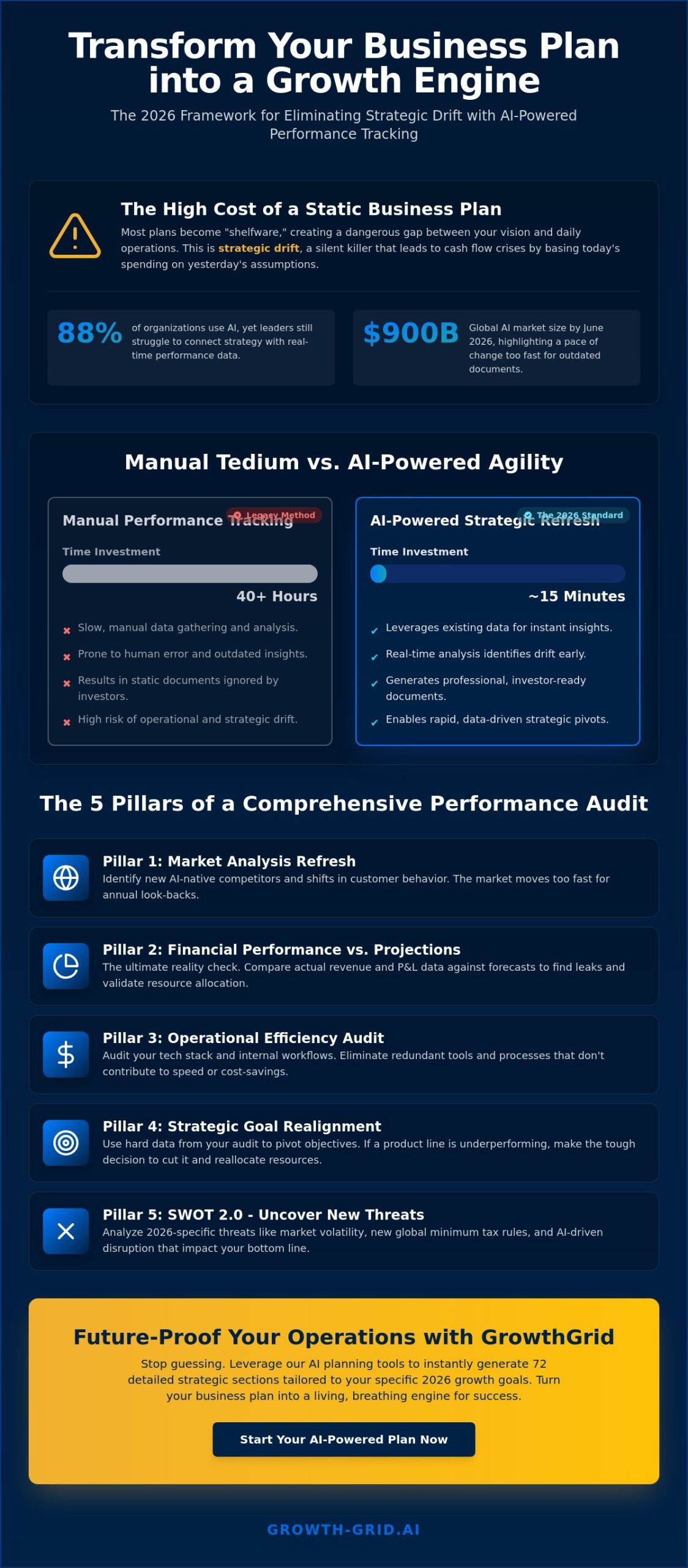
Manual Performance Tracking vs. AI-Powered Strategic Refresh
Time is your most expensive resource. When you consider how to use a business plan for performance tracking, you face a choice between the legacy grind and the modern sprint. Traditional manual updates are a massive drain on your productivity. They typically require 20 to 40 hours of grueling research, writing, and formatting. By the time you finish the document, the market has already moved. In contrast, AI-powered updates leverage your existing data to generate refreshed strategic sections in under 15 minutes. This isn’t just about saving time; it’s about maintaining a competitive edge through sheer speed.
Legacy methods rely on static templates that don’t reflect the 2026 economy. The GrowthGrid method uses dynamic AI to ensure your strategy is always live. This allows for quarterly pivots rather than waiting for a slow yearly review. If you aren’t updating frequently, you are operating on old news. Speed is your primary advantage in a market where 88% of your competitors are already using AI to optimize their workflows. Don’t fall behind because of a slow process.
The Pitfalls of Traditional Rewriting
We’ve all been there. You open a 50-page Word document that hasn’t been touched in a year. The “Writer’s Block” is immediate and painful. Trying to manually reconcile last year’s projections with today’s reality is overwhelming. Generic templates are even worse. They don’t account for the unique 2026 trends that actually impact your bottom line, such as shifting AI regulations or global tax changes. This friction is why modern business plan software has become the industry standard. It removes the technical barriers so you can focus on leadership instead of formatting. Stop fighting with margins and start focusing on growth.
Leveraging AI for Real-Time Strategy
AI does more than just write text. It analyzes complex data sets. Modern tools scan current market trends to refresh your industry analysis section automatically. You get total strategic coverage with 72-section generation, ensuring no part of your business is left behind. This prevents the section-specific oversight that often happens during manual reviews. Using a comprehensive ai business plan ensures that every part of your operation stays aligned with your high-level goals. You get a professional result without the high overhead of human consulting. It’s faster, more accurate, and built for the 2026 landscape. Execute.
Step-by-Step: How to Execute Your Performance Review and Plan Update
Execution is where strategy meets reality. To master how to use a business plan for performance tracking, you need a repeatable sequence. This isn’t a vague review process. It is a targeted, five-step workflow designed to strip away inefficiency and focus on growth. Follow this checklist to update your plan for the 2026 market in record time:
- Step 1: Gather Data. Collect your P&L statements and marketing ROI reports from the last 12 months.
- Step 2: Conduct Pivot Interviews. Meet with key stakeholders to identify internal shifts in morale or operations.
- Step 3: Update the Executive Summary. Rewrite this section last to reflect your new 2026 vision.
- Step 4: Refresh Benchmarks. Use AI tools to pull current competitor data and market shifts.
- Step 5: Distribute. Export your updated plan and share it with your entire team for alignment.
Data Gathering and Objective Honesty
You cannot build a future on false numbers. Start by pulling your P&L statements, customer feedback logs, and ROI reports. Look at these documents with total objectivity. If a specific product line or service has underperformed for two consecutive quarters, cut it. Data-driven honesty must override optimistic bias if you want to remain lean. Use this phase to identify “dead-weight” expenses that no longer serve your mission. Once you have the raw numbers, you can see the clear path forward. This level of transparency is essential for how to use a business plan for performance tracking effectively. It ensures your next moves are based on facts, not feelings.
Refining the Executive Summary for 2026
Your Executive Summary is the most important part of your document. Update it last. This ensures it reflects every strategic pivot you made in the previous steps. In the 2026 landscape, your “Ask” must be crystal clear. Whether you need funding, new hires, or a tech stack overhaul, state it plainly. Keep this summary under two pages. Stakeholders don’t have time for fluff. They want to see your vision, your traction, and your requirements immediately. A punchy, data-backed summary proves you are in control of your trajectory. Ready to streamline this process? Use an AI business plan generator to handle the heavy lifting while you focus on high-level decisions. Execute.
Future-Proofing Performance with GrowthGrid’s AI Planning Tools
GrowthGrid is the only platform designed specifically for 15-minute comprehensive strategic updates. While legacy methods trap you in a 40-hour cycle of research and formatting, our system moves at the speed of the 2026 economy. You’ve already mastered the theory of how to use a business plan for performance tracking. Now, it’s time to automate the execution. Our AI generates 72 detailed sections tailored to your specific goals, ensuring no operational blind spots remain. It’s the difference between a static PDF and a dynamic growth engine. This is the ultimate answer to how to use a business plan for performance tracking without wasting your entire week.
Founders in 2026 trust GrowthGrid for its rare combination of speed, affordability, and professional output. We don’t just provide a document; we provide a framework for continuous improvement. By integrating real-time market data and advanced forecasting models, our tools ensure your strategy stays relevant even as the market shifts. You get the confidence of a consultant-backed plan at a fraction of the cost. Stop guessing and start growing.
The 15-Minute Update Workflow
The traditional way of updating a plan is broken. Most founders dread opening a 50-page document because the friction is too high. Our Q&A process replaces that stress with a simple, guided experience. You provide the core data, and our AI handles the heavy lifting of industry analysis, financial forecasting, and market benchmarking. Once complete, you can download your plan in PDF or DOC format for immediate use. The financial benefit is tangible. You’ll save thousands of dollars compared to the high fees of a business plan consultant. You get an investor-ready output without the overhead. Speed is your new competitive advantage.
Scaling with AI Document Generation
Operational growth requires more than just a vision. You need the paperwork to back it up. GrowthGrid includes an AI Legal Document Generator and an AI HR Document Generator to support your expansion. Whether you need an NDA, a strategy doc, or a new employment contract, our system delivers professional results in seconds. We prioritize your privacy with a “Security First” approach. Your sensitive business data is protected by advanced computing models and encryption protocols. This allows you to scale with confidence, knowing your intellectual property is safe. Don’t let your strategy drift into irrelevance. Refresh your business plan and track performance with GrowthGrid now. It’s time to build a business that responds to reality in real time. Execute.
Stop Guessing and Start Scaling
Strategic drift is the quiet killer of high-potential businesses. Shifting from a static document to a living diagnostic tool ensures your daily operations stay aligned with your core mission. A 5-pillar audit combined with objective data gathering provides the foundation for long-term success. Mastering how to use a business plan for performance tracking is the final step in securing your 2026 growth and winning the funding game.
Don’t let legacy processes slow you down. GrowthGrid provides the speed and professional output that modern founders demand. Our system generates 72-section comprehensive AI plans with PDF and DOC downloads included. It’s why we are trusted by startups worldwide to deliver results in minutes rather than weeks. You have the framework. Now you need the engine to drive it forward and eliminate operational risk.
Refresh your business plan in 15 minutes with GrowthGrid and take full control of your trajectory. The market waits for no one. Build a business that responds to reality in real time. Execute.
Frequently Asked Questions
How often should I use my business plan for performance tracking?
You should review your business plan monthly to maintain operational alignment. Quarterly deep dives are necessary for larger strategic pivots. In a fast-moving 2026 economy, waiting for an annual review is too slow. Monthly tracking allows you to catch cash flow leaks and marketing ROI dips before they become fatal. This rhythm ensures your daily actions always support your high-level financial goals. Stay proactive.
What is the first section of a business plan I should update?
Start with your Financial Projections. This is the core of how to use a business plan for performance tracking effectively. Compare your actual revenue and expenses against your initial forecasts to see where your forecasting went wrong. Once you understand the financial reality, you can update your Market Analysis to reflect new AI-native competitors. This sequence ensures your strategy is grounded in hard data before you rewrite your vision.
Can AI really track my business performance accurately?
AI accurately tracks performance by analyzing real-time data sets and identifying patterns that humans often miss. It eliminates the emotional bias that leads to optimistic forecasting. Modern AI tools can scan your industry benchmarks and update your SWOT analysis in seconds. This provides a level of precision that manual tracking simply cannot match. It’s about using technology to turn raw data into actionable strategic insights instantly. Execute.
Do I need to rewrite my entire business plan every year?
You don’t need a total rewrite. Focus on dynamic sections like the Executive Summary, Financial Projections, and Market Analysis. Your core mission and company history likely won’t change. However, your tactical goals and competitor lists must stay current to remain relevant. AI-powered tools allow you to refresh these specific sections in under 15 minutes. This keeps your plan live without the 40-hour manual grind of starting from scratch.
What data do I need to gather before a performance review?
Gather your last 12 months of Profit and Loss (P&L) statements, marketing ROI reports, and customer feedback logs. You need a clear picture of where your capital is going and which channels are actually driving revenue. Objective honesty is key here. If you don’t have the raw numbers, your performance review will be based on gut feelings instead of facts. Accurate data is the fuel for any strategic update.
How do I show investors my plan has been updated for 2026?
Investors want to see “Actual vs. Projected” reporting directly in your updated plan. Highlight your 2026-specific market research and your response to current economic trends like inflation shifts. A professional, AI-generated plan with a clear timestamp proves you are an active manager. It shows you aren’t just following an old map. You are navigating the current landscape with data-backed confidence. This is how to use a business plan for performance tracking to build trust.
Is a one-page business plan enough for annual performance tracking?
A one-page plan is great for a quick internal pulse check, but it’s rarely enough for comprehensive performance tracking or securing funding. Professional 72-section plans provide the depth required to audit every operational function. One-pagers often miss critical details like detailed cash flow analysis or HR strategy. If you want to scale or impress investors in 2026, you need a full-scale, data-backed document that covers all strategic bases.
What is the most common mistake when updating a business plan?
The most common mistake is ignoring negative data. Founders often keep failing product lines in their plan because they hope things will turn around. This leads to strategic drift and wasted capital. You must be willing to cut underperforming assets based on your performance audit. Another error is treating the update as a formatting task rather than a strategic reset. Focus on the numbers, not the design. Execute.