

Did you know that the average investor spends just 2 minutes and 14 seconds on their first review of a pitch deck? That’s barely enough time to finish a cup of coffee, let alone digest your entire business model. You’re likely feeling the pressure to make every word count while staring at a blank page. It’s frustrating when you’re racing against a deadline and don’t want to sound unprofessional. Finding a high-quality executive summary example shouldn’t be the hardest part of your week.
We’re here to help you master the art of the pitch. This guide provides industry-specific examples and a proven framework to hook investors instantly. You’ll learn how to build an “evidence-dense” summary that reflects the 2026 market demands, including recent SEC reporting shifts for non-accelerated filers. We’ll show you how to move from a rough draft to a finished, professional document in 15 minutes or less. Stop wasting time on legacy writing methods and start using modern, data-driven strategies that get results. Let’s build your winning pitch today.
Key Takeaways
- Master the “one-minute elevator pitch” to ensure every stakeholder understands your core business vision immediately.
- Learn the 5-part anatomy of a high-converting pitch, focusing on a hook that solves urgent market problems.
- Review a specialized executive summary example for SaaS or retail to see exactly how to frame your scalability.
- Apply the “one-page rule” to eliminate technical jargon and maintain the professional brevity investors demand.
- Use our AI Business Plan Generator to transform your raw ideas into a polished, executive-ready document in just 15 minutes.
What is an Executive Summary and Why is it the Most Important Page?
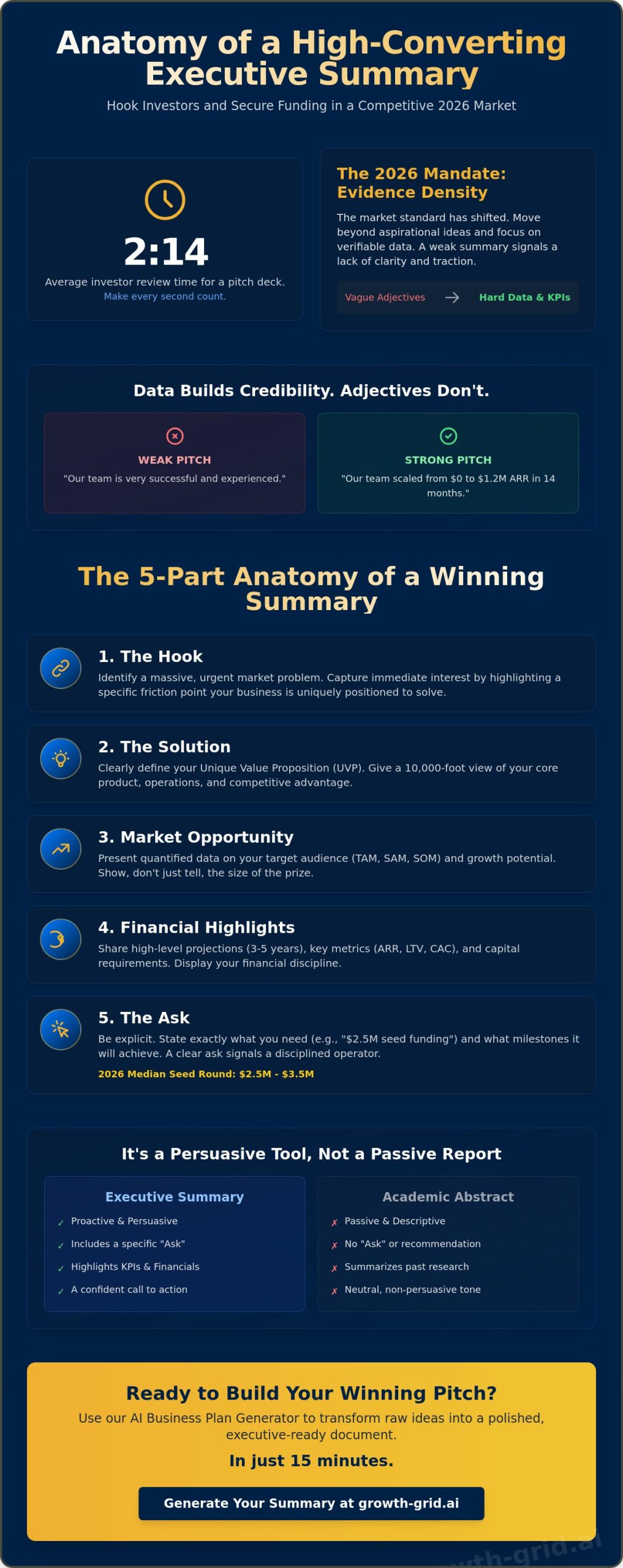
An Executive summary is the one-minute elevator pitch of your business plan. It’s the most critical document you’ll ever write because it’s often the only page stakeholders read from start to finish. If you can’t capture interest here, your detailed financial models and market research won’t matter. In 2026, the standard for a winning pitch has shifted toward extreme “evidence density.” This means moving past aspirational ideas and focusing on verifiable data. A weak summary is a signal to investors that your business lacks clarity or traction. High stakes? Absolutely. A professional executive summary example should demonstrate immediate value and a clear path to ROI.
The 2026 market is faster and more competitive than ever. With global VC funding reaching $425 billion last year, investors are filtering through thousands of opportunities. They’re looking for reasons to say “no” so they can find the one “yes.” Your summary acts as the gatekeeper. It must prove that you understand the current regulatory environment, such as the recent SEC reporting shifts, and that your solution is timed perfectly for the current market cycle. It’s about showing, not just telling.
The Core Purpose: Hook, Inform, Persuade
Your summary needs to perform three specific jobs simultaneously. First, it must hook the reader. You do this by identifying a massive, urgent problem that your business is uniquely positioned to solve. Second, it must inform. This provides the 10,000-foot view of your operations, team, and competitive advantage. Finally, it must persuade. The goal isn’t just to share facts; it’s to move the reader to the next stage of the funnel. Whether that’s a follow-up meeting or a due diligence request, your summary should make the “next step” feel like the only logical choice. Looking at a high-quality executive summary example can help you visualize this flow.
Executive Summary vs. Abstract: Knowing the Difference
Don’t confuse a business summary with an academic abstract. Abstracts are passive summaries of research. They describe what happened in a neutral tone. In contrast, an executive summary is a proactive call to action. It must include specific financial asks, resource requirements, and clear recommendations. Investors in 2026 expect to see your primary KPIs right at the top of the page. While an abstract might be descriptive, your summary should be confident and results-oriented. It outlines not just what the business is, but what it will achieve and what resources are needed to get there. This proactive tone is what separates a professional pitch from a simple report.
The 5-Part Anatomy of a High-Converting Executive Summary
High-converting summaries follow a rigid, five-part framework. This isn’t about filling space. It’s about strategic placement of information. Every executive summary example that successfully raises capital in 2026 includes these core elements. You aren’t just summarizing; you’re building a logical case for investment. If your structure is messy, investors will assume your operations are messy too. A professional summary must act as a standalone document that provides everything a stakeholder needs to make a preliminary decision.
- The Hook: Identify the specific friction point in the market right now.
- The Solution: Define your Unique Value Proposition (UVP) and core product clearly.
- Market Opportunity: Present quantified data on your target audience and growth potential.
- Financial Highlights: Share high-level projections and capital requirements based on real metrics.
- The Ask: State exactly what you need from the reader to move forward.
The Ask is where most founders fail. They’re too timid. In 2026, with median seed rounds sitting between $2.5 million and $3.5 million, you need to be explicit about your needs. Don’t just ask for “funding.” Ask for a specific dollar amount tied to specific milestones. This shows you’ve done the work and understand your burn rate. It transforms you from a dreamer into a disciplined operator who respects the investor’s capital.
Quantifying Your Value: Data Over Adjectives
Adjectives are expensive and unconvincing. Investors trust data more than passion because numbers don’t have feelings. Instead of saying your team is “very successful,” state that you “scaled from $0 to $1.2M ARR in 14 months.” Use hard numbers for market size and revenue targets. This precision builds immediate credibility. If you’re struggling to find the right phrasing, a professional executive summary example can clarify the level of detail required for a high-stakes pitch.
The Power of the Problem Statement
Frame your pain point as an urgent, solvable issue. If the reader doesn’t feel the “burn” of the problem, they won’t care about your solution. Use the “So What?” test. If a reader asks “so what?” after reading your problem statement, you haven’t gone deep enough. This section must align perfectly with your broader startup business plan. It ensures the problem actually matters to the person holding the checkbook. This is where you demonstrate that your timing is perfect for 2026 market shifts.
Industry-Specific Executive Summary Examples
A generic template won’t win over a sophisticated investor in 2026. Every industry has its own language, its own risks, and its own key performance indicators (KPIs). If you’re pitching a SaaS startup, investors care about your recurring revenue and churn rates. If you’re launching a local boutique, they’re looking at foot traffic and community engagement. You must speak the specific dialect of your market to build trust immediately. Using a tailored executive summary example helps you identify which metrics matter most to your target audience. Let’s look at how this applies across different sectors.
Example 1: The Tech/SaaS Disruption Pitch
The Opportunity: Current project management tools are too manual, causing a 19% loss in weekly productivity for enterprise teams. FlowState AI solves this by automating task allocation using advanced computing models.
Traction: In just six months, we’ve secured $45,000 in Monthly Recurring Revenue (MRR) with a churn rate of less than 2%. Our Lifetime Value (LTV) to Customer Acquisition Cost (CAC) ratio is currently 4.5:1. This performance places us in the top tier of early-stage software companies. We are seeking $3 million in seed funding to scale our engineering team and capture a larger share of the $12 billion productivity market. This strategy is fully detailed in our ai business plan, which outlines our roadmap for 2027 and beyond. We don’t just promise efficiency; we deliver it through measurable data points.
Example 2: The E-commerce/Retail Growth Pitch
The Mission: EcoThread is a sustainable fashion brand addressing the $2.1 trillion global apparel market’s waste problem. We use a circular supply chain to reduce production costs by 30% compared to legacy fast-fashion models.
Market Position: Our brand equity is built on transparency and ethical sourcing. We’ve achieved a Customer Acquisition Cost (CAC) of $22 through organic social proof and community-led marketing. Our high-level cash flow analysis shows we reached profitability within 12 months of launch. We’re now seeking a $1.5 million partnership to expand our physical footprint in high-traffic urban centers. This expansion will leverage our existing 85% customer retention rate to drive regional growth. Investors who value sustainability and concrete margins will find our model highly scalable. It’s time to move past traditional retail friction and embrace a leaner, more profitable future.
Service-Based Agency Example
For service-based businesses, the focus shifts to expertise and client retention. A professional executive summary example in this space highlights high-margin contracts and the “moat” created by specialized knowledge. Don’t hide behind vague claims of “great service.” Instead, quantify your billable efficiency and your average contract length. Show that your agency isn’t just a group of freelancers, but a structured business with a predictable pipeline. This clarity is what separates a lifestyle business from a venture-ready agency.
Polishing Your Summary: Style, Tone, and Common Pitfalls
Your executive summary is a high-stakes filter. If it’s longer than one page, you’ve already lost. Professional investors spend an average of 2 minutes and 14 seconds on their first pass of a pitch deck. If they can’t find your core value proposition in that window, they won’t read the rest of your plan. Brevity isn’t just about saving space. It’s about demonstrating that you can prioritize the most impactful data. A polished executive summary example proves that you value the reader’s time as much as your own.
Precision wins. Jargon fails. Investors are often “smart non-experts” who understand business fundamentals but might not know your specific technical niche. If your summary requires a PhD to decode, you’ve failed the clarity test. Strike a balance between confidence and realism. You aren’t just “disrupting” a market; you’re capturing a specific percentage of it using a validated model. Avoid the “trust me” approach. Use evidence to back every claim you make. This builds the security and trust required to move to a formal meeting.
Top 3 Mistakes That Kill Credibility
- Vague Financials: Never use phrases like “huge revenue potential.” Instead, state your target MRR or your projected 12-month burn rate. Investors want to see that you understand your numbers.
- The “Mini-Report” Error: Your summary is a teaser, not a condensed version of every chapter. Keep it to 500 words or less. If it looks like a wall of text, it will be ignored.
- The Missing Ask: Don’t leave the reader wondering what you want. If you need a $3 million seed investment to scale your engineering team, say it clearly.
If you’re struggling to cut through the noise, use our AI Business Plan Generator to create a professional, one-page summary that hits every mark. Efficiency is your greatest competitive advantage.
Formatting for Scannability
Investors scan before they read. Use bold text for key figures, milestones, and your “Ask.” Bullet points are essential for breaking up dense financial data or market statistics. A professional executive summary example should look clean and organized at a glance. White space is your friend. It makes your document feel accessible rather than intimidating. When your formatting is sharp, it signals that your business operations are equally organized. Don’t let a cluttered layout distract from a billion-dollar idea. Make the value instantly visible.
How to Generate a Professional Executive Summary in 15 Minutes
Writing a winning pitch shouldn’t feel like a second full-time job. The “Old Way” of drafting a business plan is a legacy problem characterized by friction and wasted resources. You spend 20+ hours researching market data and agonizing over sentence structure. You might even consider expensive consultants who lack your specific founder voice. In 2026, efficiency is your most valuable asset. The GrowthGrid method replaces this outdated process with a streamlined, AI-driven workflow that delivers a professional executive summary example in less than 15 minutes.
Our AI Business Plan Generator doesn’t just fill in a template. It analyzes your unique value proposition, target KPIs, and market position to craft a data-dense narrative. This isn’t a simple text shortener. It generates a comprehensive 72-section business plan that provides the evidence density today’s investors demand. You get professional-grade language and structured financial highlights without high overhead. It’s a modern solution for founders who need to move fast and secure results immediately.
The Efficiency Advantage: Speed to Market
Every hour you spend on paperwork is an hour you aren’t spending on customer acquisition or product development. By reducing your drafting time from 20 hours to just 15 minutes, you gain a massive competitive advantage. This speed to market allows you to respond to investor deadlines instantly. If you’re comparing different tools, our business plan software guide explains how specialized AI tools outperform manual templates. Stop struggling with writer’s block and start executing your strategy. Efficiency isn’t just a benefit; it’s a requirement for success in the 2026 funding environment.
Ready to Pitch? Start Your Plan Now
The process is simple and direct. You answer a series of targeted questions about your business, and our system generates a polished, executive-ready document. You can download your plan immediately and head into your next meeting with total confidence. We provide professional formatting that ensures your summary is scannable and visually engaging. Every executive summary example we produce is built to pass the 2-minute investor test. Don’t let a legacy writing process hold your startup back. Generate your professional business plan and executive summary now to secure the funding your business deserves. Success is just 15 minutes away.
Secure Your Next Funding Round Today
You now have the blueprint to turn a simple overview into a high-converting pitch. Investors in 2026 prioritize evidence density and clarity above all else. By applying a tailored executive summary example to your specific industry, you demonstrate a deep understanding of your market’s unique dialect. Your summary must act as a standalone document that makes a follow-up meeting the only logical choice. Precision and brevity are your greatest assets in a competitive landscape.
Don’t let manual drafting slow your momentum. GrowthGrid is used by thousands of startups worldwide to generate 72-section comprehensive business plans in record time. You can download professional PDF or DOC files in minutes and focus on what matters most: execution. Stop struggling with writer’s block; generate your professional executive summary in 15 minutes with GrowthGrid. Your vision deserves a pitch that matches its potential. It’s time to win.
Frequently Asked Questions
How long should an executive summary be for a business plan?
One to two pages is the professional standard. Most investors prefer a single, scannable page that captures your core value proposition. If it’s longer than two pages, you risk losing the reader’s attention during their initial two-minute review. Keep it concise and data-dense to ensure every word earns its place. Efficiency is your greatest asset when competing for limited venture capital.
Can I write my executive summary before the rest of the business plan?
Write your summary after completing the rest of your plan. It acts as a high-level overview of the detailed research and financial modeling found in the full document. Writing it first leads to vague claims that might not align with your actual data. Complete your full 72-section plan first to ensure your summary remains accurate and evidence-based for investors.
What are the 5 essential parts of an executive summary?
The five essential parts are the Hook, the Solution, the Market Opportunity, Financial Highlights, and the Ask. Every professional executive summary example must include these elements to be considered complete. This structure guides the reader from the urgent problem you’re solving directly to the specific resources you need. It transforms your raw ideas into a logical, persuasive case for investment.
Should an executive summary have bullet points?
Use bullet points to improve scannability and highlight key data points. They are perfect for listing milestones, competitive advantages, or specific financial targets. Bullet points allow investors to find your primary value drivers within seconds. Avoid long paragraphs that make your pitch feel like a chore. Professional formatting signals that your business operations are equally organized and efficient.
How much detail should I include about my financial projections?
Focus on high-level figures like projected revenue, MRR, and your specific capital requirements. You don’t need to include a full line-item budget in this section. Highlight the metrics that prove your business model is viable and scalable for the 2026 market. Save the deep-dive cash flow analysis for the dedicated financial section of your comprehensive business plan.
Is an executive summary the same as an introduction?
No, an executive summary is a persuasive pitch deck in prose. An introduction simply sets the stage, but a summary provides the results and a clear call to action. It must function as a standalone document that contains every critical takeaway from your strategy. If an investor only reads this page, they should have enough information to request a meeting.
Can I use an AI generator to write my executive summary?
Using a specialized AI generator is the most efficient way to produce a professional summary. GrowthGrid’s AI Business Plan Generator analyzes your business inputs to create high-quality content in minutes. This modern approach eliminates writer’s block and ensures your executive summary example meets the 2026 standards for evidence density. You get professional results without the high cost of legacy consulting services.