

What if the 40-page business plan you’re painstakingly drafting is actually the thing keeping your startup from getting funded in 2026? You’ve likely spent days drowning in a sea of digital notes and fragmented thoughts. It’s stressful to worry that you’ve missed a critical section an investor will spot instantly. Wasting time on formatting instead of strategy is a legacy problem you simply don’t have to deal with anymore.
Learning how to structure a business idea has evolved from a manual chore into a streamlined, automated process. You deserve a clear, logical roadmap that doesn’t require an expensive consultant to build. We’ll show you how to transform raw concepts into professional, investor-ready documentation in minutes rather than weeks. This guide explores five elite frameworks and modern tools designed to save you time while ensuring your fundamentals meet the strict traction standards of today’s market. Get ready to replace information overload with a professional-grade structure that commands attention.
Key Takeaways
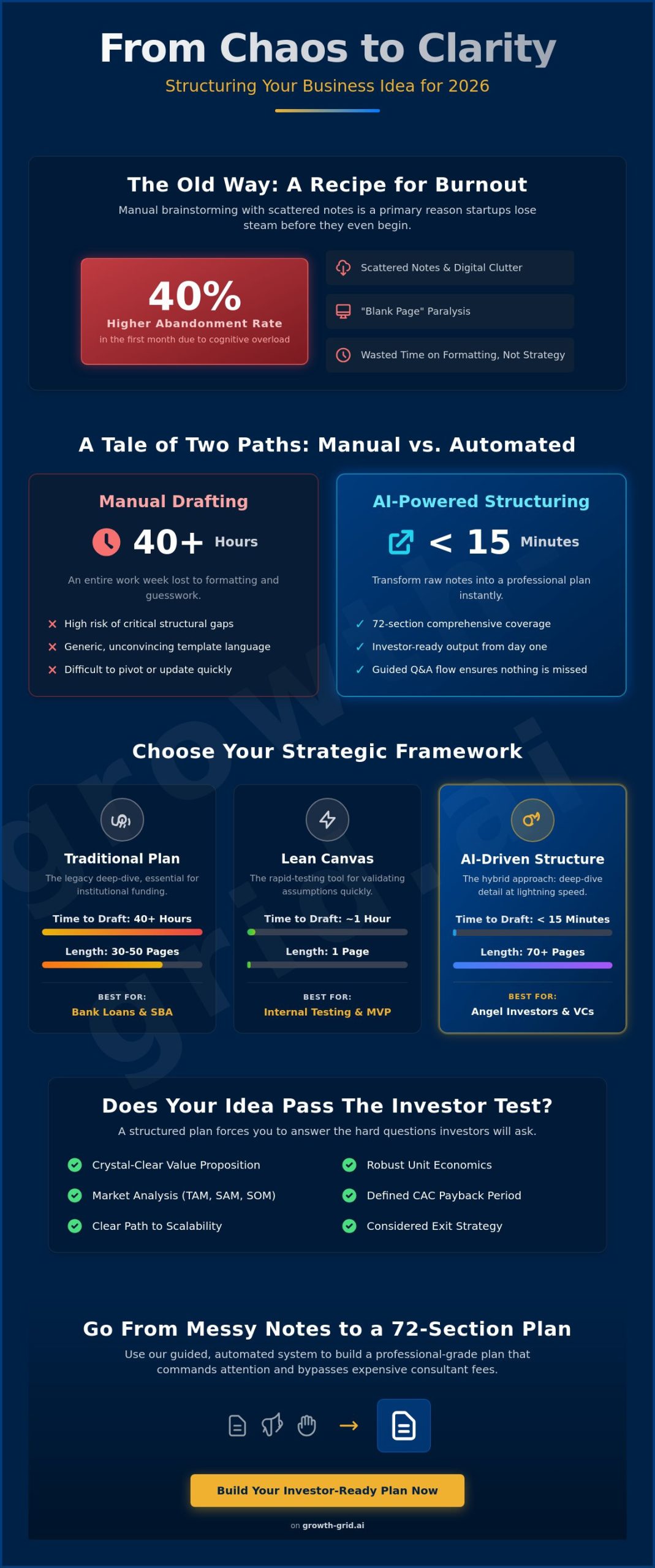
- Stop losing momentum to manual brainstorming. Discover why legacy methods lead to a 40% higher abandonment rate and how dedicated tools keep your startup on track.
- Master the modern approach to how to structure a business idea by selecting the right framework, whether it’s a traditional deep-dive for institutional funding or a Lean Canvas for rapid testing.
- Compare the top 5 organizational tools for 2026, including AI-powered generators that transform fragmented notes into professional documents in under 15 minutes.
- Audit your concept against the “Investor Test” to ensure your value proposition and market analysis (TAM, SAM, and SOM) meet the rigorous standards of today’s seed rounds.
- Bypass expensive consultant fees by using automated systems that guide you through a 72-section plan using a simple, logical question-and-answer flow.
Why You Need a Dedicated Tool to Organize Your Business Ideas
Most entrepreneurs start with a flash of brilliance that quickly turns into digital clutter. You likely have voice notes, napkin scribbles, and fragmented spreadsheets scattered across multiple devices. This isn’t a strategy; it’s a liability. Learning how to structure a business idea is the critical transition from abstract thoughts into categorized, actionable business modules. Without a system, you’re likely to fall into the “Blank Page” trap. Industry data suggests that manual brainstorming leads to 40% more abandonment in the first month because the sheer cognitive load becomes overwhelming. You lose your momentum in a sea of unorganized data.
Fragmentation kills startups before they even launch. When your market research is in one app and your financial projections are in another, you lose the connective tissue of your business. Dedicated tools prevent “note-bloat” by centralizing your entire vision in one secure location. They force you to answer the hard questions regarding unit economics and scalability that you’d otherwise skip. This is the difference between a hobby and a venture. Investors don’t fund potential; they fund professional execution. If you don’t know how to structure a business idea with clarity, they’ll assume you lack the discipline to run a company.
- ❌ Manual Drafting: 40+ hours of work, high risk of structural gaps, and generic results.
- ✅ Structured Tools: 15-30 minutes of input, 72-section comprehensive coverage, and investor-ready output.
The Cost of Manual Organization
Drafting a business plan manually takes an average of 40+ hours. That’s a full work week lost to formatting and margin-checking instead of customer discovery. Word processors are dangerous for founders because they hide structural gaps. You might forget your exit strategy or fail to define your CAC payback period. Even worse, copy-pasting from generic templates creates a brand voice that sounds like a robot. It’s unconvincing, hollow, and fails to capture the unique value of your startup.
Moving from Notes to Modules
There’s a profound psychological shift when you stop staring at a blinking cursor and start filling in a 72-section framework. It turns you from a dreamer into an operator. By using a systematic approach, such as the Business Model Canvas, you can validate market assumptions in record time. Seeing your idea broken down into specific modules like “Value Propositions” and “Customer Segments” makes the path forward feel tangible. It removes the mystery and replaces it with a roadmap. This modularity allows you to pivot quickly without rewriting your entire foundation. Organize. ➔
The 3 Proven Frameworks for Structuring a Startup Idea
Choosing the right framework is your first real executive decision. It dictates how you’ll spend your next 100 hours. Traditional business plans are the legacy choice. They are essential for bank loans and institutional funding because they provide a massive deep-dive into five-year forecasts. If you are pitching your business idea to a conservative lender, this 40-page document is your ticket in the door. It proves you’ve done the homework.
However, modern founders often prefer the Lean Startup methodology. This uses a one-page “Business Model Canvas” for rapid testing. It’s great for pivots but often lacks the professional depth investors require in 2026. The newest category is AI-Driven Structuring. This hybrid approach gives you the depth of a traditional plan with the speed of a lean canvas. It’s about working smarter, not longer. You can now determine how to structure a business idea without sacrificing a full week of your life to a word processor.
Traditional vs. Lean: A Side-by-Side Comparison
Compare the resource allocation for each method to see which fits your goals:
- Traditional: 40+ hours to draft. 30-50 pages. Primary use: Bank loans and SBA.
- Lean Canvas: 1 hour to draft. 1 page. Primary use: Internal testing and MVP.
- AI-Driven: 15 minutes to draft. 70+ pages. Primary use: Angel investors and VCs.
Most successful startups now use a “Lean-to-Deep” transition. They start by sketching a canvas to prove the concept. Once they need capital, they immediately scale that idea into a comprehensive document. This ensures no structural gaps exist when the stakes are high. It keeps your strategy agile while maintaining the professional documentation needed for serious growth.
The Rise of the AI-Structured Plan
Speed is the only competitive advantage that matters in a crowded market. Manual drafting is a legacy problem that wastes time you should spend on customer acquisition. AI-powered tools identify missing market gaps in your initial thoughts. They automate the 72 critical sections of a professional plan, from TAM analysis to exit strategies. This ensures you’re always investor-ready. You can generate a professional plan using AI to bridge the gap between a raw concept and a funded reality in minutes. Stop guessing how to structure a business idea and start using a system that does the heavy lifting for you. ➔
Top 5 Tools to Organize and Structure Business Ideas in 2026
Selecting the right engine is the first step in learning how to structure a business idea for rapid growth. While a simple notebook might feel intuitive, it lacks the rigor required for a modern startup. You need an organizational engine that does the heavy lifting. Here are the elite tools for 2026:
- GrowthGrid: The undisputed leader for speed. It uses an AI-powered flow to generate a comprehensive, 70+ page document in 15 minutes.
- Notion: Perfect for those who need a “second brain.” It’s best for free-form brainstorming and creating an internal wiki for your team.
- ClickUp: A powerful choice for teams needing to integrate tasks with strategy. Its AI features help summarize complex workflows and project roadmaps.
- Strategyzer: The primary tool for visual thinkers. It focuses heavily on the Business Model Canvas framework to map out value propositions.
- Miro: Ideal for remote teams. Use it for collaborative mind-mapping and visual idea structuring during the early discovery phase.
Specialized Planning Software vs. General Productivity Apps
Why do most founders fail? They treat how to structure a business idea as a general note-taking task. Apps like Trello or Evernote are excellent for lists, but they fail to produce a document that passes the “bank-ready” test. They lack the built-in logic to ensure your financial projections align with your market analysis. This is where specialized business plan software becomes non-negotiable. You need a system that forces professional standards, including automated PDF exports and integrated market data. Referencing the official SBA guide on how to write a business plan confirms that structure is just as important as the content itself. Don’t settle for “note-bloat” when you can have a professional roadmap.
Why GrowthGrid Wins for Speed and Depth
Legacy methods are slow. Writing a plan manually can take 15 days of grueling research and formatting. GrowthGrid collapses that timeline into a 15-minute question-and-answer flow. It’s not just a static template; it’s an AI business plan that evolves as you provide more detail. By answering a few simple prompts, you generate 72 professional sections that cover everything from TAM analysis to exit strategies. This isn’t just about saving time. It’s about ensuring your startup has the structural integrity to survive investor scrutiny. Are you ready to see your idea in a professional framework? High-value results with minimal effort. ➔
Critical Checklist: Does Your Idea Structure Pass the “Investor Test”?
Investors don’t read business plans; they scan them for weaknesses. In 2026, the standard for a seed round has matured significantly. You have roughly 30 seconds to hook an investor with your executive summary. If your value proposition isn’t clear immediately, your pitch is over. Understanding how to structure a business idea means knowing exactly which data points an investor needs to see first. You must quantify your market using TAM, SAM, and SOM metrics. Vague estimates are a legacy mistake that signals a lack of professional preparation.
Your operational plan must be as clear as your product vision. Investors need to see the “how” behind the “what.” This includes a disciplined cost structure and a credible path to profitability. A critical component is your financial forecast. You must provide a clear cash flow analysis for the next three years. This isn’t just about revenue; it’s about proving you won’t run out of capital before hitting your next milestone. Finally, address risk mitigation. Identify the top three reasons your business might fail and explain your plan to prevent them. Transparency builds trust.
The 5 Essential Pillars of Every Structured Idea
- Problem/Solution Fit: This is the core of your startup business plan. You must prove the market actually wants what you’re building.
- Customer Personas: Stop saying your market is “everyone.” Define the specific target users who will pay for your solution today.
- Competitive Advantage: Explain why your “mousetrap” is tangibly better. Is it speed, cost, or a unique technology?
- Revenue Model: How exactly do you make money? Unit economics must be positive.
- Traction: Show proof of concept, whether it’s early revenue or signed letters of intent.
Common Structural Red Flags to Avoid
Avoid vague financial goals. Investors look for a CAC payback period of under 12 months. If you can’t show a clear path to revenue, your structure is incomplete. Never claim you have “no competition.” This suggests you haven’t done your research or that no market exists for your idea. Professionalism is paramount. Don’t underestimate the importance of a professional business plan that follows industry-standard formatting. You can generate an investor-ready business plan now to ensure you pass the test. Stop guessing how to structure a business idea and start using a framework that wins. ➔
From Messy Notes to a 72-Section Plan with GrowthGrid
You’ve analyzed the frameworks and reviewed the checklists. Now, it’s time to execute. The biggest hurdle in how to structure a business idea is the transition from scattered thoughts to a professional document. GrowthGrid removes this friction entirely. We provide a modern, streamlined solution to the legacy problem of manual drafting. Why spend $5,000 on a human consultant who takes weeks to deliver? You can achieve the same professional-grade output in a fraction of the time. Our platform acts as your pragmatic partner, guiding you through every critical business module with total confidence.
The process is built for maximum speed and conversion. By answering a series of guided, analytical questions, you transform your raw concepts into a 72-section comprehensive plan. This isn’t just about a one-time document. Once your structure is set, you can export your work into PDF or DOC formats for immediate use in investor meetings. We also help you operationalize your vision beyond the initial strategy. GrowthGrid offers an AI Legal Document Generator and an AI HR Document Generator to ensure your startup is compliant and professional from day one. High-value results; minimal effort.
How Our AI Business Plan Generator Works
- Step 1: Input. Provide your core business idea and industry details. Our system identifies the specific market context and traction requirements for your niche.
- Step 2: Guide. Answer guided prompts that think through the structural gaps for you. This ensures you never miss a critical section an investor will look for.
- Step 3: Receive. Get a comprehensive, 72-section professional document in 15 minutes. Your raw notes are now an investor-ready roadmap.
Take Action: Structure Your Idea Today
Stop overthinking. The “Blank Page” trap ends here. Join the thousands of entrepreneurs who have used our tools to launch faster and with more clarity. You don’t need massive overhead to sound professional. You just need the right organizational engine. Discover how to structure a business idea the modern way. Your future investors are waiting for a plan that shows you’re an operator, not just a dreamer. Build your foundation with an efficiency expert who understands the 2026 market standards.
Generate your professional business plan in 15 minutes with GrowthGrid. ➔
Launch Your Vision with Professional Precision
You’ve seen the difference between a fragmented concept and a professional roadmap. Moving from scattered notes to a validated framework isn’t just about writing; it’s about building a foundation that survives investor scrutiny. We’ve explored how dedicated tools eliminate the “Blank Page” trap and why modern seed rounds in 2026 require more than just a good story. Mastering how to structure a business idea is your first step toward operational excellence. You now have the frameworks and the checklist to move forward with total confidence.
Don’t let your startup stall in the drafting phase. You can bypass the 40-hour manual process and the high overhead of legacy consulting. It’s time to replace administrative stress with a clear, logical strategy that commands attention. Generate your 72-section business plan in under 15 minutes and receive a professional PDF or DOC download immediately. Your vision deserves a structure that matches its potential. Take the lead and start building today. ➔
Frequently Asked Questions
What is the best tool to organize my business ideas for free?
Notion and Google Docs are the most effective free tools for early-stage brainstorming. Notion is particularly powerful because it allows you to create a “second brain” using wikis and linked databases. While these apps are excellent for capturing thoughts, they lack the automated logic found in specialized software. You’ll still need to manually ensure your data meets professional standards for investor scrutiny.
How do I structure a business idea if I am not a writer?
You don’t need to be a writer to create a professional foundation. Use a question-and-answer framework or a visual tool like the Business Model Canvas. Modern AI generators solve this legacy problem by guiding you through simple prompts. This approach ensures you focus on how to structure a business idea using data and logic rather than worrying about prose or formatting.
Can I use AI to write a full business plan in 2026?
Yes, you can generate a comprehensive, 72-section business plan in roughly 15 minutes using modern AI tools. These platforms have evolved far beyond simple text generation. They now integrate market data and financial logic to produce “bank-ready” documentation. This is the most efficient way to move from a raw concept to an investor-ready document without the high overhead of a consultant.
What are the 7 key sections of a standard business plan structure?
A professional structure typically includes the Executive Summary, Market Analysis, Company Description, Organization and Management, Service or Product Line, Marketing and Sales Strategy, and Financial Projections. Each section must be quantified with specific data. For example, your market analysis should clearly define your TAM, SAM, and SOM to prove you understand your total addressable market.
Is a one-page business plan enough to get funding?
A one-page plan is rarely enough for a serious seed round in 2026. While a Lean Canvas is perfect for internal testing and rapid pivots, investors now demand deep-dive documentation. They expect to see proven market validation, disciplined cost structures, and a clear path to profitability. Use the one-page format for your initial sketch, then scale it into a comprehensive document for your pitch.
How do I organize multiple business ideas at once without getting overwhelmed?
Centralize your ideas in a single dashboard using a tool like Miro or a dedicated “Idea Bank” in Notion. Assign a “validation score” to each concept based on market size and ease of execution. This prevents “note-bloat” and helps you identify which idea is worth a full structural deep-dive. Focus on one primary concept at a time to maintain professional momentum.
Do I need a business plan consultant to structure my startup?
No. Hiring a consultant is a legacy expense that often costs upwards of $5,000. Modern AI-powered tools provide the same level of professional depth and structural integrity for a fraction of the cost. You can achieve high-value results with minimal effort by using a system that understands how to structure a business idea according to current investor standards.
What is the difference between a business model and a business plan structure?
A business model is the core mechanism of how your company creates and captures value. It’s the “engine” of your startup. A business plan structure is the formal document that details every operational, legal, and financial aspect of that engine. Think of the model as the blueprint and the plan as the full technical manual required to build and scale the business.