

Why are you still staring at a blinking cursor when 93% of small business owners are already charging toward growth this year? You have a brilliant concept, but you need a business plan for clarifying your idea that doesn’t feel like a second full-time job. It’s common to feel paralyzed by the sheer number of sections required or the fear of missing a critical financial detail. Traditional planning methods are often slow, expensive, and outdated.
We agree that the old way of spending 40 hours on a draft is dead. This article promises to show you how to transform your vague concept into a structured, professional roadmap in minutes. By eliminating the cognitive friction of manual drafting, you can gain instant mental clarity and produce a document ready for any stakeholder. You deserve a process that matches your pace.
We’ll explore a modern system that handles the structural heavy lifting for you. You’ll learn how to produce a comprehensive, 72-section document that satisfies lenders without the typical stress or high overhead. It’s time to stop overthinking and start building your future with a manageable, professional strategy.
Key Takeaways
- Overcome “Idea Fog” and “Blank Page Syndrome” by shifting your mindset from writing a book to answering focused prompts.
- Master the “Big Three” framework to quickly identify your value proposition, target audience, and revenue drivers.
- Use a business plan for clarifying your idea to replace 40+ hours of manual research with 15 minutes of AI-driven generation.
- Implement a 5-step brain-dump strategy to define your unfair advantage without worrying about grammar or structure.
- Transition from a vague concept to a professional, 72-section roadmap that’s ready for lenders and stakeholders immediately.
Why Clarifying Your Idea Feels Overwhelming (and How to Fix It)
Most entrepreneurs start with a spark, but that spark often gets smothered by “Idea Fog.” This is the mental friction that occurs when your vision lacks a formal structure. You know your product is great, but you can’t explain the unit economics or the market positioning without stumbling. This lack of clarity isn’t a failure of your vision; it’s a failure of your process. Using a business plan for clarifying your idea is the fastest way to burn through that fog and see the path ahead.
Blank Page Syndrome is the primary killer of new business ideas. When you sit down to a white screen, your brain tries to perform two conflicting tasks: creating a strategy and designing a document. This leads to decision fatigue. You spend hours wondering where the “Executive Summary” should go instead of focusing on how you’ll actually make money. A Business plan should be a tool for clarity, not a decorative weight for your desk. If you’re still wondering what is a business plan in a modern context, think of it as a living map that evolves as you do.
The Anatomy of Planning Anxiety
Anxiety usually stems from information overload. You try to research market data while simultaneously drafting your operations strategy. This creates a bottleneck. When you look at a traditional table of contents and see 70 sections, your brain triggers a freeze response. You aren’t actually afraid of the work; you’re overwhelmed by the structural friction. You should be spending your energy on creative problem solving, not on figuring out how to format a SWOT analysis. Understanding this distinction is the first step toward reclaiming your time.
The Problem with Traditional Templates
Static templates are a legacy solution to a modern problem. They provide the “what” but never the “how” or the “why.” If you use a standard Word document, you’re likely to experience these common setbacks:
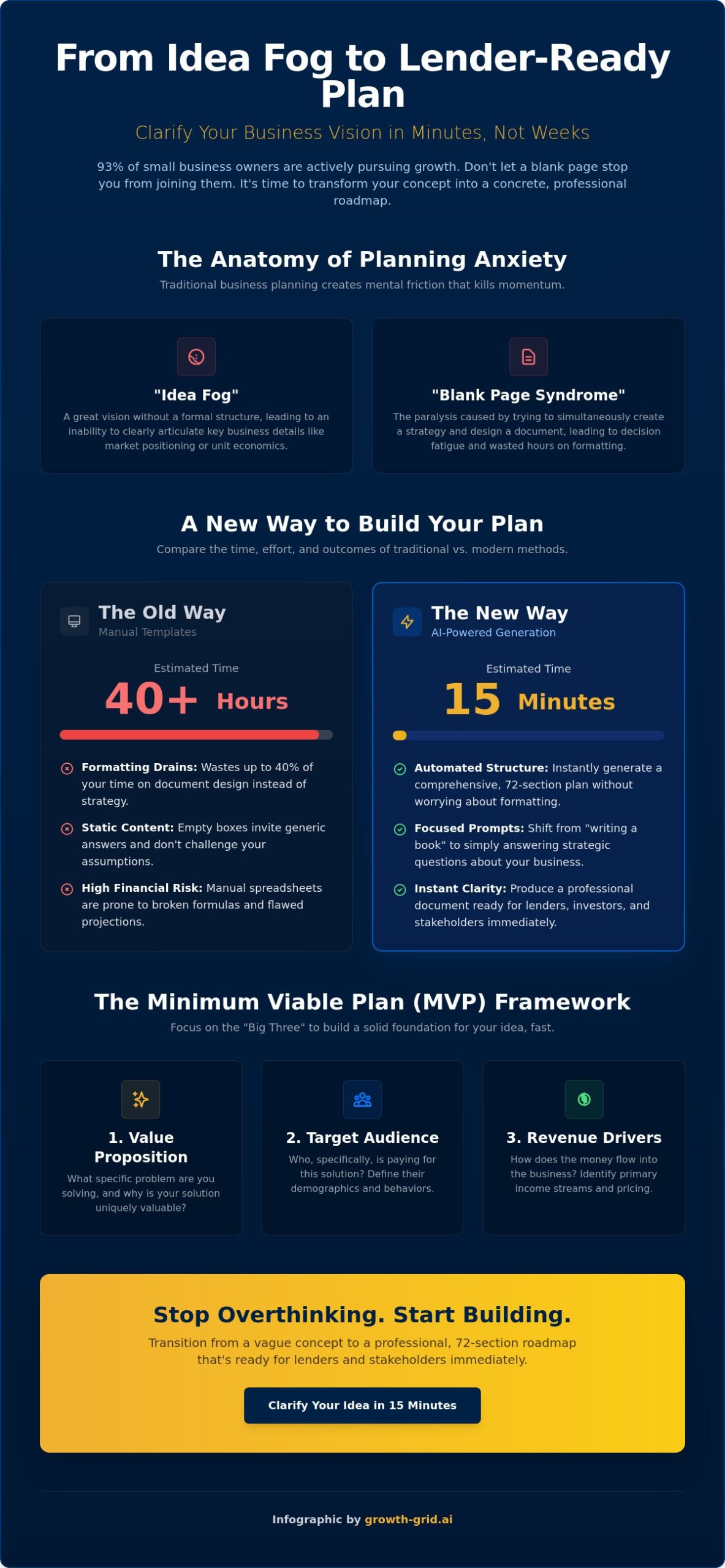
- Formatting Drains: Manual formatting in Google Docs or Word can waste up to 40% of your total planning time.
- Static Content: A template doesn’t ask you hard questions; it just gives you empty boxes that invite generic answers.
- Financial Risk: Manually calculating projections in a spreadsheet is dangerous. One broken formula can lead to a plan that looks professional but is fundamentally flawed.
Traditional methods force you to be a researcher, a writer, and a graphic designer all at once. It’s an inefficient use of your resources. To get your idea out of your head, you need a system that handles the heavy lifting so you can focus on the strategy.
The Minimum Viable Plan (MVP) Framework for Rapid Clarity
Stop trying to write a manifesto. You don’t need a 50-page document to prove your idea works; you need a business plan for clarifying your idea that focuses on the essentials. The Minimum Viable Plan (MVP) framework replaces the “writing a book” mentality with an “answering a prompt” system. This shift reduces cognitive load and prevents the analysis paralysis mentioned earlier. While the U.S. Small Business Administration discusses lean startup business plans, we take it a step further by prioritizing speed and modularity. You can’t steer a parked car. You need to get the basic structure down so you can start moving.
Identify the “Big Three” to build your foundation:
- Value Proposition: What specific problem are you solving, and why does it matter?
- Target Audience: Who exactly is paying for the solution? Be specific about their demographics and behaviors.
- Revenue Drivers: How does the money flow? Identify your primary income streams and pricing strategy.
By isolating these components, you avoid the “70-section fear.” You can use professional business plan software to automate the structure, allowing you to focus entirely on these core pillars. This modular approach lets you complete one section at a time without the pressure of looking at the entire project at once. It’s about making the process manageable.
Micro-Actions: Bypassing Brain Resistance
Your brain resists big tasks. It loves small ones. Set a 15-minute timer to tackle a single section like “Customer Segments.” Don’t write a complex paragraph. Answer three simple questions instead. Who are they? Where do they hang out? What’s their biggest pain point? This “15-minute sprint” builds momentum through small, consistent wins. It’s much harder to quit when you’ve already checked three boxes in under half an hour. Momentum is your best friend when you’re fighting the blank page syndrome.
Strategy Over Syntax
Your job is the vision. You are the architect, not the typesetter. Let modern tools handle the professional formatting and CEO-level tone. A startup business plan should be a living roadmap, not a rigid script. Focus on “done” over “perfect.” Getting your idea to market faster is the only way to validate it. If you’re ready to stop overthinking and start building, you can generate your professional plan now and see the clarity for yourself.
Manual Templates vs. AI Generators: Which Clarifies Faster?
Compare 40+ hours of manual labor to 15 minutes of AI-assisted generation. The choice is obvious if you value your time. Clarifying an idea isn’t just about writing; it’s a structural challenge that requires high-level data integration. Manual templates force you to be the researcher, writer, and financial analyst all at once. AI takes that burden off your shoulders. It bridges the “Research Gap” by providing instant market insights and competitor data that would take a human weeks to compile. You get algorithmic accuracy in your financial projections instead of risking manual Excel errors that could sink your credibility with a single broken formula.
Professionalism matters when you’re facing stakeholders. You need a tone that matches investor expectations, but you don’t need a $10,000 consultant to get it. A business plan for clarifying your idea should be a high-precision tool, not a creative writing project. By using technology to handle the heavy lifting, you ensure every section meets industry standards without the typical overhead. This allows you to focus on the strategy while the machine handles the syntax and document structure.
The Real Cost of “Free” Templates
Free templates are remarkably expensive. They cost you founder hours that should be spent on sales, networking, or product development. Think about the hourly value of your time. If you spend three weeks formatting tables and charts, you’ve already lost significant market timing. Manual plans are also 3x harder to pivot. When your business model changes, you have to manually update every connected section. That’s a recipe for burnout. Relying on manual Google searches often leads to outdated data, which investors will spot immediately. You risk your reputation by using “free” tools that lack real-time intelligence.
How AI Acts as a Strategic Partner
Modern generators provide instant structure. You can generate 72 professional sections from simple conversational inputs. This is the “First Draft” advantage. You aren’t starting from scratch; you’re starting with a scaffold built on proven business logic. This allows you to focus on your unique vision rather than the paperwork. Discover how AI business plans remove the structural burden from founders. You remain the visionary while the technology handles the logistics. It’s the most efficient way to turn a concept into a professional reality. Stop wasting time on formatting and start focusing on your growth.
5 Steps to Clarify Your Idea in 2026
In 2026, speed is the only competitive advantage. Waiting weeks to validate a concept is a luxury you can’t afford. You need a business plan for clarifying your idea that keeps pace with the market. By following these five steps, you transform a cluttered vision into a professional roadmap that stakeholders will actually respect.
- Step 1: Brain-dump your concept. Get every thought out of your head. Don’t worry about grammar, structure, or “sounding professional” yet. The goal is to clear the mental space so you can see the bigger picture.
- Step 2: Define your “Unfair Advantage.” In a market with 36.2 million small businesses, you must know why customers will choose you. Identify the specific reason your solution wins.
- Step 3: Input thoughts into a planning system. Move your raw notes into a professional planning tool. This removes the structural burden and organizes your ideas into the 72 sections required for a serious plan.
- Step 4: Review your financial viability. Analyze the generated cash flow analysis immediately. Since cash flow is the top concern for 31% of small business owners in 2026, you need to know if the numbers work before you commit.
- Step 5: Refine the Executive Summary. Now that the structure is set, inject your personal “Why.” This is the hook that connects with stakeholders on an emotional level.
Following these steps ensures your business plan for clarifying your idea remains a practical tool for growth rather than a static document. It bridges the gap between a dream and a viable operation.
Refining the Output
Use the generated market data to validate your original assumptions. If the data shows a shift in consumer behavior, pivot your strategy immediately. You should also add specific local context or personal anecdotes to the text. This makes the document uniquely yours. Always check for alignment between your operational goals and financial projections. If your plan calls for rapid hiring, your cash reserves must reflect that reality. Precision at this stage prevents expensive mistakes later.
From Plan to Execution
Your clarified plan is now a 90-day roadmap for your launch phase. Don’t hide it in a folder. Set up KPIs based on the professional benchmarks provided in your plan to track your progress. In 2026, the most successful founders treat their plans as living playbooks that evolve with real-world market feedback. If you’re ready to stop overthinking and start building, generate your business plan in minutes and take the first step toward execution.
Use GrowthGrid to Clarify Your Idea and Build Your Plan in 15 Minutes
You’ve identified the “Idea Fog” and the “Blank Page Syndrome” that stall most startups. Now, it’s time to outsource the structural heavy lifting. GrowthGrid is the pragmatic solution for entrepreneurs who want a professional business plan for clarifying your idea without the administrative burden. We’ve built a system that eliminates the cognitive load of traditional planning. You don’t need to be a writer or a financial analyst to succeed. You just need a vision and 15 minutes.
More than 10,000 founders have already used GrowthGrid to stop overthinking and start building. In an era where 58% to 60% of U.S. small businesses are already using AI to gain a competitive edge, sticking to manual templates is a strategic risk. Our AI-powered generator produces a comprehensive, 72-section document in less time than a coffee break. It transforms your raw concepts into a structured roadmap that feels manageable and professional. Stop staring at a blinking cursor and start reviewing your future.
The GrowthGrid Workflow
The process is designed for maximum speed and zero friction. You start with conversational input. Answer simple, direct questions about your business model, target audience, and goals. There’s no complex writing required. Our engine takes your responses and initiates instant generation. You’ll watch as your market analysis, SWOT framework, and detailed financial projections appear in seconds. These aren’t generic paragraphs; they’re data-driven insights tailored to your specific niche. The result is an investor-ready output designed to impress banks, partners, and VCs. You receive a professional PDF or DOC file that’s ready for immediate distribution.
Beyond the Business Plan
Clarifying your idea is just the first step in your journey. As you move from the planning phase to daily operations, your documentation needs will evolve. GrowthGrid provides a full suite of tools to support your growth, including:
- AI Legal Document Generator: Protect your venture with professional contracts and agreements.
- AI HR Document Generator: Build your team with structured hiring and onboarding documents.
- AI Strategy Document Generator: Refine your long-term goals as the market shifts in 2026.
We provide ongoing support for your operational needs so you can focus on high-level strategy. Every document we generate is built to meet the highest professional standards, ensuring you stay compliant and credible. It’s time to trade your overwhelm for a roadmap. Generate your professional business plan with GrowthGrid today and turn your concept into a concrete reality.
Stop Overthinking and Start Building Your Future
You’ve seen how “Idea Fog” can stall even the most brilliant concepts. Clarifying your business model isn’t about writing a manifesto; it’s about using the right framework to outsource the structural heavy lifting. By shifting to an MVP mindset and leveraging modern automation, you can bypass the blank page syndrome that kills most startups before they launch. Speed and accuracy are your new competitive advantages.
A business plan for clarifying your idea should be a living roadmap that provides instant mental clarity. You don’t need to waste 40 hours on manual research or risk broken formulas in a spreadsheet. Modern founders use technology to handle the logistics so they can focus on the vision. It’s time to trade your analysis paralysis for a professional document that’s ready for stakeholders, partners, and lenders.
Stop the overwhelm; clarify your idea and generate a professional business plan in 15 minutes with GrowthGrid. You’ll receive a 72-section comprehensive business plan complete with detailed financial projections and market analysis. You’ve done the hard work of dreaming. Now, let’s handle the paperwork. Your 15-minute turnaround starts now. Let’s build something great together.
Frequently Asked Questions
How do I start a business plan when I feel completely overwhelmed?
Start with a 15 minute brain dump of your core concept and ignore the formatting. Don’t worry about grammar or structure yet. Using a system that asks you simple questions removes the pressure of the blank page. This approach lets you focus on your vision while the software handles the 72 sections required for a professional draft. It’s the most efficient way to move from paralysis to a manageable roadmap.
Can a business plan really help clarify a vague idea?
A structured plan acts as a filter for your thoughts and forces you to define your value proposition with precision. Using a business plan for clarifying your idea replaces vague concepts with concrete data points. You stop guessing and start building based on a logical framework. This process transforms “Idea Fog” into a clear, actionable strategy that you can actually execute in the real world.
How long should it realistically take to clarify a business idea in 2026?
You should achieve total clarity in under 15 minutes in 2026. Legacy methods that take 40 hours are no longer necessary or competitive. Modern AI generators bridge the research gap instantly by providing market insights and competitor analysis. This speed allows you to validate your concept and pivot faster than your competition. Efficiency is the new standard for modern entrepreneurs who value their time.
Is it better to use a free template or an AI business plan generator?
AI generators are significantly better because they provide both the structure and the content you need. A free template is just an empty Word document that leaves 100% of the research and formatting to you. A business plan for clarifying your idea is much more effective when the tool handles the heavy lifting. You save weeks of manual labor and avoid the risk of outdated data.
What are the most important sections for clarifying a startup idea?
The value proposition, target audience, and revenue drivers are the most critical components for any new venture. These three sections define why your business exists and how it will survive financially. If these pillars are clear, the rest of the 72 sections will fall into place naturally. Focusing on these essentials first ensures your business model is fundamentally sound before you dive into the operational details.
How do I overcome the fear of making a mistake in my business plan?
View your document as a dynamic draft rather than a final script that cannot be changed. The fear of mistakes often stems from the perceived permanence of traditional paper plans. Digital, AI driven tools allow you to update and pivot your strategy in seconds. You aren’t locked into your first version. Constant refinement based on market feedback is the hallmark of a successful 2026 startup founder.
Can AI really generate professional financial projections for my idea?
Algorithmic engines now produce professional financial projections with higher accuracy than manual spreadsheets. They create detailed cash flow analysis and revenue forecasts based on proven business logic. This eliminates the risk of broken Excel formulas and manual calculation errors. You get a document that is ready for banks and VCs without the high cost of hiring an expensive financial consultant.
How often should I update my business plan as my idea evolves?
Update your plan every time you receive significant market feedback or achieve a major milestone. Static documents are useless in a fast paced economy. Treat your plan as a living playbook that guides your daily decisions and long term strategy. Frequent updates ensure your operations remain aligned with your financial goals and the current needs of your target audience as your business grows.