

What if the biggest barrier to your success isn’t capital or talent, but the time you’re wasting on outdated planning methods? Most founders get buried under a mountain of conflicting advice and complex legal jargon. It’s exhausting to worry about whether you’re missing a critical tax filing or if your business plan will actually impress a bank. This is why learning how to start a business with a clear roadmap is your most important first step.
You can stop feeling overwhelmed. You’re about to master the exact sequence to transform your vision into a professional, launch-ready business in minutes rather than months. We will examine the latest 2026 regulatory changes, state-specific LLC filing costs that start as low as $50, and the specific AI tools that build your strategy documents instantly. From securing your EIN to finalizing a 21% corporate tax strategy, you’ll get a streamlined path to a professional-grade launch. This is the modern way to build; fast, efficient, and investor-ready.
Key Takeaways
- Align your vision with a 24-month strategic compass that separates big-picture goals from daily tactical execution.
- Discover how to start a business with a clear roadmap by performing rapid market validation and SWOT analysis to mitigate early risks.
- Secure your legal standing by choosing the optimal 2026 business structure and obtaining your EIN with zero friction.
- Create professional-grade, investor-ready documents including a high-impact executive summary and a detailed company description.
- Accelerate your launch by automating 72 critical sections of your business plan in just 15 minutes using modern AI technology.
What is a Business Roadmap (and Why You Need One in 2026)?
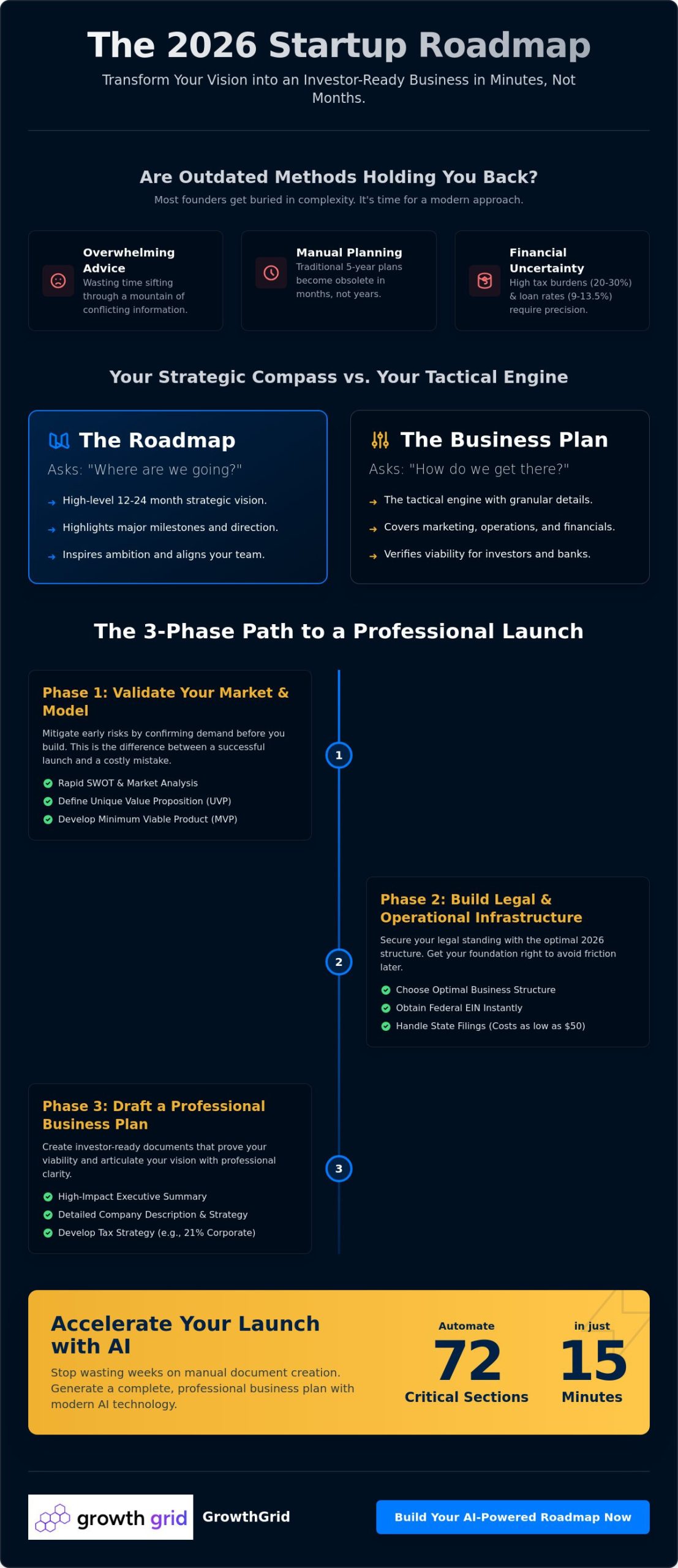
Think of your business roadmap as a strategic compass. It isn’t just a list of tasks; it’s the high-level visualization of your first 12 to 24 months in operation. In a market where small businesses often face a tax burden of 20% to 30% and interest rates for SBA loans hover around 9% to 13.5%, you can’t afford to wander aimlessly. Learning how to start a business with a clear roadmap allows you to pivot when the economy shifts without losing sight of your ultimate objective. It provides the clarity needed to move from a vague idea to a functioning entity.
Traditional five-year plans are dead. The 2026 economy demands dynamic roadmapping. This approach prioritizes agility over rigid, static projections that become obsolete in six months. Your roadmap serves three core pillars:
- Vision Alignment: Ensuring every team member and stakeholder understands the primary goal.
- Resource Allocation: Directing your limited capital and time toward high-impact activities.
- Milestone Tracking: Measuring progress against concrete dates and deliverables to maintain momentum.
The Difference Between a Roadmap and a Business Plan
A common mistake is using these terms interchangeably. A roadmap answers “Where are we going?” by highlighting major milestones and strategic direction. Conversely, a business plan is the tactical engine. It answers “How exactly do we get there?” with granular detail. It’s the difference between a destination on a map and the mechanical manual for the car you’re driving.
According to the standard definition of a Business plan, it covers everything from marketing strategies to operational logistics. You need the roadmap to stay inspired and the plan to stay organized. Investors look for the roadmap to see your ambition, but they scrutinize the plan to verify your viability. Combining both is the only way to secure funding and maintain team alignment as you scale.
Setting Your North Star: Vision and Mission
Your “North Star” is the single, non-negotiable goal you aim to achieve by the end of your first year. For example, your goal might be to achieve $500,000 in recurring revenue by solving the logistics gap for mid-sized retailers. This isn’t just a dream. It’s a specific target that dictates every milestone on your path.
Identify the core problem you solve for your specific audience. If you understand how to start a business with a clear roadmap, you’ll align every monthly milestone with this high-level objective. This prevents “mission creep” and keeps your overhead low while your impact grows. A clear mission ensures that every dollar spent is an investment in your North Star.
Phase 1: Validating Your Market and Business Model
Validation is the difference between a successful launch and a costly mistake. If you want to know how to start a business with a clear roadmap, you must first verify that your destination actually exists. Don’t spend months on manual research. Use digital signals like search volume, social sentiment, and pre-order interest to confirm demand in days. This rapid validation ensures you aren’t building a strategy for a market that doesn’t want your solution.
Perform a rapid SWOT analysis to ground your vision in reality. Identify your internal strengths, such as unique technical expertise, and acknowledge weaknesses like limited initial capital. Look externally at 2026 opportunities, such as the permanent 20% QBI deduction for pass-through entities, and threats like rising state-level regulatory variations. This ensures your roadmap accounts for risks before they stall your progress. If you need help structuring these insights, an AI strategy document generator can draft your analysis in seconds.
Your Unique Value Proposition (UVP) must be sharp. In a crowded digital market, being “better” isn’t enough; you need to be different. Once your UVP is set, strip your product down to its Minimum Viable Product (MVP). This allows you to enter the market faster and gather real-world data to refine your startup business plan without over-investing in unproven features. Speed is your greatest asset in the validation phase.
Target Audience and Competitor Analysis
Success starts with a deep understanding of your buyer persona. Go beyond basic demographics; identify the specific anxieties your audience faces in 2026. Map out your top three competitors and look for the “gap” they’ve ignored. Perhaps they are too slow to adapt to new pricing transparency regulations or lack a user-friendly digital interface. Use these competitive weaknesses to position your business as the obvious, modern choice for your niche.
Choosing Your Pricing and Revenue Model
Your revenue model dictates your operational pace. Subscription models offer predictable stability, while transactional models provide immediate cash flow. Calculate your break-even point early to set realistic milestones. With interest rates for traditional bank loans averaging 6.8% to 11%, knowing your exact margins is vital for survival. Your pricing must reflect your brand positioning. Determine if you are a high-volume value provider or a low-volume luxury brand, as this choice will influence every future marketing decision on your roadmap.
Phase 2: Building the Legal and Operational Infrastructure
Validation is over. Now, it’s time to build the engine. Many entrepreneurs stall at this stage because they fear the complexity of legal filings and administrative overhead. Learning how to start a business with a clear roadmap simplifies this by breaking the infrastructure into manageable, high-speed tasks. You aren’t just filling out forms; you’re protecting your assets and setting the stage for future scale. Efficiency here prevents expensive legal corrections later.
Your legal structure is your first major decision. In 2026, state filing fees for an LLC vary significantly. You might pay as little as $50 in Kentucky or over $400 in Massachusetts. Beyond the filing fee, expect to spend between $500 and $1,000 for a professional setup that includes registered agent services. If you opt for a C-Corporation, you’ll face a flat 21% federal tax rate. Use the SBA’s 10-step guide to cross-reference federal requirements, then secure your Employer Identification Number (EIN) immediately to enable hiring and banking.
Don’t ignore “Day 1” documents. Most founders wait until they have a legal problem to draft an NDA or a Privacy Policy. That’s a legacy mistake. In 2026, pricing transparency and data protection are non-negotiable. Drafting your NDAs, Privacy Policies, and Employment Contracts early ensures you have professional-grade protection before you share your vision with a single contractor or partner. This proactive approach is a core part of how to start a business with a clear roadmap while maintaining total compliance.
Legal Compliance and Governance
Register your business name and protect your trademarks early. A “Doing Business As” (DBA) name typically costs between $25 and $50, which is a small price for brand security. Open a dedicated business bank account immediately to separate personal and professional finances. Mixing these is a recipe for tax audits and liability issues. Check your local requirements for specific industry permits; the national average for a business license is around $200, though this fluctuates by location.
Operational Readiness and HR
Even if you’re a solo founder, create an organizational chart. It clarifies roles as you grow and prevents operational bottlenecks. Draft a hiring roadmap for your first three key roles to avoid the stress of panic-hiring. Finally, implement Standard Operating Procedures (SOPs) for core business functions. Documenting how you handle sales or customer support now saves hundreds of hours of training later. Professionalism is built into your daily workflow, not added as an afterthought.
Phase 3: Drafting a Professional startup business plan
Traditional planning is a marathon that many founders never finish. Modern planning is a high-speed sprint. While legacy methods require weeks of manual drafting and expensive consultants, understanding how to start a business with a clear roadmap means leveraging technology to solve the “blank page” problem. Your business plan is more than just a document. It is the professional proof that your vision is viable and that you understand the tactical requirements of the 2026 market.
Start with a two-page executive summary. This is your high-impact hook for investors and partners. It must clearly articulate your Unique Value Proposition and the specific market gap you identified during Phase 1. Follow this with a detailed company description that reinforces your legal structure and mission. This section should be concise but authoritative, leaving no doubt about your operational foundation.
Your market analysis needs concrete data to be effective. In 2026, investors want to see how you handle state-level regulatory variations, such as Connecticut’s new pricing transparency laws or warehouse worker protections. Detail your marketing and sales strategy by showing exactly how you will acquire and retain customers in a landscape where a professional digital presence is non-negotiable. If you want to secure funding, your cash flow analysis and income statements must be airtight. With SBA 7(a) variable rates reaching up to 11.5% APR, your financial projections must justify the high cost of capital with realistic, data-driven growth targets.
The 72-Section Standard for Investor Confidence
Why settle for a ten-page summary when you can provide a comprehensive blueprint? The 72-section standard is the modern benchmark for professional-grade documentation. It provides granular data on management roles, operational risks, and HR protocols that shorter plans ignore. This level of depth directly correlates with funding success because it demonstrates a level of preparedness that reassures lenders and venture capitalists. Comprehensive documentation removes the “guessing game” from your roadmap.
Mastering Financial Projections
Develop three-year and five-year financial forecasts based on current market data, including the 15.3% self-employment tax rate and the permanent 20% QBI deduction. Include conservative, expected, and aggressive growth scenarios to show you’ve prepared for 2026 market volatility. Every funding request must be backed by a clear “Use of Proceeds” section that explains exactly where every dollar will be allocated. To generate your investor-ready plan in minutes, start using our AI Business Plan Generator today.
How to Automate Your Roadmap with GrowthGrid
Legacy methods of business planning are slow, manual, and prone to error. In 2026, you don’t have weeks to spend on a document that might be obsolete by the time it’s finished. GrowthGrid’s ai business plan generator is the ultimate roadmap accelerator. It transforms your vision into a professional, investor-ready blueprint in 15 minutes. This is how to start a business with a clear roadmap without the friction of traditional consulting fees or the “blank page” syndrome.
Beyond the initial plan, our Operational Suite handles the heavy lifting of your daily administration. While others are still searching for templates, you can use our AI Legal Document Generator and AI HR Document Generator to stay compliant. These tools generate everything from NDAs to employment contracts instantly. It’s a modern, streamlined solution to a legacy problem. You save thousands in overhead while gaining the peace of mind that your infrastructure is professional-grade.
From Idea to 72-Section Plan in 15 Minutes
The process is designed for maximum speed. First, you input your business basics and industry focus. Our AI immediately analyzes 2026 market trends and financial benchmarks to ensure your data is relevant. Finally, you customize and download your 72-section plan as a professional DOC or PDF file. It’s that simple. You get the depth of a consultant-led project at a fraction of the cost. Build. ➔
Beyond the Plan: Ongoing Document Support
A roadmap is dynamic. Your documentation should be too. As your team grows, you’ll need to generate NDAs and privacy policies to protect your intellectual property. GrowthGrid provides access to a library of professional templates and AI-driven strategy documents, including BMC canvases, to help you pivot when necessary. This ensures you always know how to start a business with a clear roadmap even as your milestones evolve. Stop the manual struggle and start your professional journey today.
Start your business roadmap with GrowthGrid now
Launch Your Vision with Confidence
You now have the blueprint for success in 2026. By moving from static planning to dynamic roadmapping, you ensure your business remains agile enough to handle market volatility and shifting state regulations. From validating your market gap to navigating state-specific LLC filing fees that range from $50 to over $400, you’ve learned exactly how to start a business with a clear roadmap. The days of struggling with a blank page or paying thousands for human consulting are over.
Efficiency is your competitive advantage. GrowthGrid provides the high-speed tools you need to secure your legal standing and impress investors with comprehensive documentation. You can access 72-section comprehensive plans that are trusted by startups worldwide and available for professional PDF and DOC download instantly. Don’t let administrative friction stall your progress. Generate your professional business plan in 15 minutes with GrowthGrid and transform your vision into a launch-ready reality today. Your professional future starts now.
Frequently Asked Questions
What is the first step in a business roadmap?
The first step is rapid market validation. You must ensure your vision aligns with a real-world opportunity before investing significant capital. Use digital signals to confirm demand and perform a SWOT analysis to identify 2026 risks like state-level regulatory variations. This groundwork is the foundation of how to start a business with a clear roadmap that actually leads to profit.
How long does it take to write a professional business plan?
Writing a plan used to take weeks, but automation has reduced this process to 15 minutes. Legacy methods involve manual drafting and expensive consultants. Modern founders use AI generators to produce 72-section comprehensive documents instantly. This speed allows you to move from idea to execution without the typical administrative friction or the “blank page” syndrome that stalls most startups.
Do I need a business roadmap if I am a solo founder?
Every founder needs a roadmap, especially those working alone. It acts as your strategic compass to prevent “mission creep” and ensures your limited time goes toward high-impact tasks. A solo founder’s roadmap focuses heavily on resource allocation and hitting critical year-one milestones. It provides the professional structure needed to eventually transition from a one-person operation to a scalable company.
Can I use AI to write my business plan for investors?
You can absolutely use AI for investor-ready documentation. The key is ensuring the output meets the 72-section professional standard. High-quality AI generators analyze current financial benchmarks and market trends to produce DOC or PDF files that satisfy bank and venture capital requirements. Professional-grade AI tools remove the guesswork and ensure your documentation is granular and data-driven.
What are the 5 most important sections of a business roadmap?
The five core sections are vision alignment, market analysis, legal infrastructure, financial projections, and milestone tracking. These components ensure you have a “North Star” goal while maintaining a tactical engine to get there. Together, they provide the granular detail needed for professional-grade business management. This structure keeps your team aligned and your operations focused on measurable growth throughout the first 24 months.
How often should I update my business roadmap?
Update your roadmap at least once per quarter. The 2026 economy requires “Dynamic Roadmapping” to account for market volatility and new regulations. Regular reviews allow you to pivot your tactical business plan while keeping your long-term vision intact. Treat it as a living document rather than a static file. This flexibility is essential for navigating shifting interest rates and consumer trends.
What is the difference between a business plan and a business roadmap?
A roadmap is your high-level strategic vision, while a business plan is your tactical engine. The roadmap answers “Where are we going?” over the next 24 months. The plan answers “How exactly do we get there?” with specific details on cash flow, HR protocols, and operational logistics. You need both to maintain strategic alignment while managing the day-to-day requirements of your launch.
How much does it cost to start a business with a clear roadmap?
Costs depend on your location and industry. State LLC filing fees in 2026 range from $50 to over $400. Most entrepreneurs spend between $500 and $1,000 for a professional setup that includes registered agent services and name registration. Understanding how to start a business with a clear roadmap helps you avoid “junk fees” and unnecessary overhead by focusing only on essential legal requirements.