

Why spend 40+ hours wrestling with complex spreadsheets when you could have an investor-ready model finished before your next coffee break? 😰 Most entrepreneurs start companies to innovate, not to spend weeks fixing “REF!” errors in a manual ledger. You probably know the feeling of staring at a blank cell, worried that one wrong formula will ruin your credibility. It’s a common struggle; industry data suggests that 82% of small businesses fail because of cash flow issues, yet most founders still rely on “The Old Way” of manual entry that eats up their most valuable asset: time.
This is the 2026 guide to financial projections for non-finance founders. We’re going to help you ditch the math-induced stress and build professional, bank-level models in minutes ✨. You’ll gain total clarity on your runway and the confidence to answer any investor question during a high-stakes Q&A. We will cover “The Smart Way” to automate your data entry, the essential metrics for a 3-year projection, and the specific steps to ensure your numbers are 100% accurate every single time.
Key Takeaways
- Shift your mindset from historical accounting to a forward-looking roadmap that turns market research into a reliable growth strategy.
- Master the “Big Three” pillars—Revenue, Expenses, and Cash Flow—and learn how to make these critical documents “talk” to each other.
- Stop wasting 40+ hours on manual Excel builds and learn the smart way to create financial projections for non-finance founders in under 15 minutes.
- Follow a simple, step-by-step process to define your price points and Day 1 costs without needing a math degree or a finance background.
- Discover how AI-powered tools like GrowthGrid use GPT-4 to instantly turn basic assumptions into a professional, investor-ready financial suite.
Why Financial Projections are the “Heartbeat” of Your Startup
Stop viewing numbers as a chore or a look back at past mistakes. Financial projections for non-finance founders are actually a forward-looking roadmap. While accounting tells you where you’ve been, projections show you exactly where you’re going. It’s the difference between looking in the rearview mirror and using a high-tech GPS for a cross-country trip.
Many entrepreneurs feel like they’re just “guessing” when they look at future revenue. In reality, you’re making informed estimations. By using 2024 market data and industry benchmarks, you turn wild guesses into strategic targets. This process isn’t about being 100% right; it’s about being prepared. A solid model serves three critical goals:
- Securing Funding: Investors won’t write a check without seeing your path to profitability.
- Managing Cash: 82% of small businesses fail due to cash flow issues. Projections help you spot a “cash gap” months before it happens.
- Internal Milestones: Numbers give your team concrete targets to hit every quarter.
The biggest misconception is that you need a CPA or an expensive finance degree to start. The “Old Way” involved spending $5,000 on consultants or weeks wrestling with broken spreadsheets. The “Smart Way” uses logic and modern tools to build a valid model in a fraction of the time. You understand your business better than any accountant ever will. Your job is to provide the vision; the numbers simply follow that lead.
The Psychology of Numbers for Non-Finance Founders
Math anxiety often stops brilliant founders before they even start. You don’t need to be a calculus expert to succeed here. Focus on the business logic behind the digits instead of the formulas themselves. If you plan to sell 100 units at $50 each, the math is simple. The logic is why you believe those 100 people will buy.
Investors actually value your assumptions more than the final “bottom line” number. They want to see the “why” behind your growth. A clear Financial modeling structure builds your confidence during high-stakes pitches. When you know your numbers, you stop sounding like a dreamer and start sounding like a CEO.
Projections vs. Reality: The Role of the 3-Year Plan
Three years is the “Goldilocks” zone for startup planning. A 12-month plan is too short to show true scale. A 5-year plan is often pure speculation in a fast-moving market. A 3-year window allows you to demonstrate immediate traction while showing a clear exit or 10x growth path. It’s the standard for a professional startup business plan.
Always build three distinct scenarios to stay agile. An optimistic scenario tracks your best-case growth. A realistic scenario is your baseline for hiring. A pessimistic scenario ensures you have enough runway if the market shifts. This triple-threat approach removes the stress of the unknown and keeps you in the driver’s seat.
The Three Pillars of Your Financial Model Explained
Building financial projections for non-finance founders doesn’t require an MBA. It requires understanding three interconnected pillars: Revenue, Expenses, and Cash Flow. In a professional model, these three documents must “talk” to each other. When you update your sales targets, your hiring needs and bank balance should adjust automatically. This connectivity ensures your plan remains a living document rather than a static file gathering digital dust. While profit looks good on a pitch deck, the Cash Flow Statement is your most critical tool for survival.
EBITDA stands for Earnings Before Interest, Taxes, Depreciation, and Amortisation.
Revenue Forecasting: Predicting the Future
Investors often disregard “top-down” forecasts where a founder claims they will capture 1% of a $100 billion market. It’s an easy guess that lacks credibility. The smart way is “bottom-up” forecasting. This method focuses on your actual business drivers. You start with concrete numbers: your monthly ad spend, a 4.2% lead conversion rate, and your average contract value. This approach proves you understand how your business actually functions.
For 2026, your model must account for specific market shifts. Subscription fatigue is real, so consider how tiered pricing or usage-based models impact your growth. To structure these assumptions properly, you can use a Financial Projections Template to ensure your logic holds up under investor scrutiny. Identifying whether your growth comes from new customer acquisition or expanding existing accounts is vital for a realistic 2026 outlook.
Expense Modeling: Understanding Your Burn Rate
Expenses fall into two categories: fixed and variable. Fixed costs, like your $2,500 monthly office lease, stay the same regardless of performance. Variable costs scale with your sales. If you sell 500 units, your shipping and packaging costs will rise accordingly. Many founders overlook the hidden costs of growth. In 2026, hiring a new engineer often costs 20% more than their base salary once you include taxes, software seats, and hardware.
Tracking these costs allows you to calculate your “Runway.” This is the exact number of months your business can operate before the bank account hits zero. If your monthly burn is $15,000 and you have $150,000 in the bank, you have 10 months to become profitable or raise more capital. Knowing this number to the decimal point eliminates the late-night anxiety of financial uncertainty.
The Cash Flow Statement: The Survival Metric
Profit is not the same as cash. This is the “Timing Gap” that kills 82% of small businesses. You might book a $20,000 sale in January, but if the client has 60-day payment terms, that cash won’t arrive until March. Meanwhile, your rent and payroll are due on February 1st. If you don’t manage this gap, you risk “growing into bankruptcy” by overextending your resources before the revenue actually hits your account.
Effective cash management involves aggressive oversight of accounts receivable and strategic timing of your payables. You can dive deeper into these tactics in our guide on cash flow analysis. Monitoring your cash position daily is the difference between a thriving startup and a cautionary tale. If you want to skip the manual spreadsheets, you can generate a professional financial plan in minutes using our AI-powered tools.
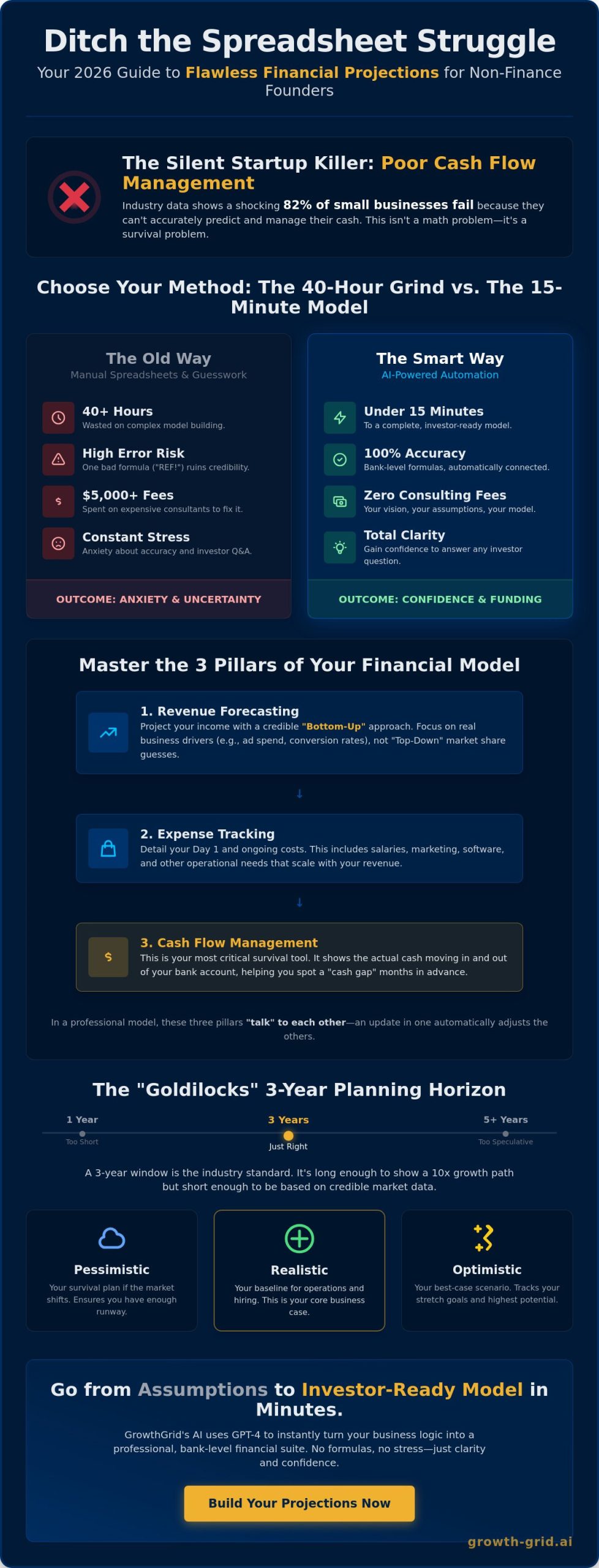
The Old Way vs. The Smart Way: Choosing Your Modeling Method
Building financial projections for non-finance founders shouldn’t feel like a full-time job. Most entrepreneurs spend over 40 hours wrestling with complex spreadsheets before they even reach the first pitch meeting. This manual approach is slow, expensive, and dangerously prone to human error. You have a choice between the traditional grind and a modern, AI-driven solution that delivers results in 15 minutes.
- The Old Way (Manual Excel): 40+ hours of stress, 😰 broken formulas, and “Final_v4_Actual_Final” file names.
- The Smart Way (GrowthGrid AI): 15 minutes to completion, ✨ 100% mathematical accuracy, and investor-ready visuals.
When you use AI tools like GrowthGrid, the software handles the heavy lifting. It ensures every calculation is perfect so you can focus on your actual business strategy. You don’t need a finance degree to look like a pro. You just need the right tools to automate the math.
Why Spreadsheets Fail Non-Finance Founders
Spreadsheets are a minefield for the inexperienced. Research shows that 88% of all spreadsheets contain at least one significant error. In a 3-year financial model, one wrong cell reference can snowball into a million-dollar mistake that kills your credibility with investors. This “Formula Fatigue” is a silent deal-killer.
Investors also hate reading raw grids of numbers. They want to see growth trends, burn rates, and profit margins through clean charts and graphs. A standard Excel file often lacks these visualisations, making it hard to tell a compelling story. Plus, managing version control across multiple stakeholders often leads to outdated data being presented at the worst possible moment.
The AI Advantage: Professionalism at Speed
AI tools provide a massive leap in professionalism. By using industry benchmarks, these tools validate your assumptions against real-world data from similar startups. This means your financial projections for non-finance founders aren’t just guesses; they’re grounded in market reality. You get a cohesive narrative that spans 72+ sections of a complete business plan, ensuring your financials align perfectly with your marketing and operations goals.
The cost-benefit analysis is clear. A human consultant can easily charge $5,000 for a custom financial model. GrowthGrid delivers a higher level of accuracy and a more comprehensive 40-page plan for just $19. You save 90% on costs and weeks of wasted time. It’s the most efficient way to move from “idea” to “investor-ready” without the financial headache.
Start Saving Time Now →
Step-by-Step: Building Your First Model Without Overwhelm
Creating financial projections for non-finance founders doesn’t have to be a month-long headache. You can build a professional model by breaking it into logical, bite-sized chunks. Start with your core assumptions. Write down your price point and how many customers you expect to gain each month. Don’t guess. Look at 2026 industry benchmarks from sources like Statista or IBISWorld to keep your growth rates grounded in reality. Stop overcomplicating the math; focus on the drivers that actually move the needle.
Next, list your “Day 1” costs. These are your non-negotiables. Most startups face legal fees between $2,000 and $5,000 for initial filings and contracts. Add in your first batch of inventory and essential equipment. Once these are set, map out your hiring plan. Decide exactly which revenue milestone triggers your first hire. If you hit $10,000 in monthly recurring revenue, maybe that’s when you bring on a part-time assistant. This keeps your payroll lean until your cash flow supports the growth.
Setting Realistic Assumptions
The “Founder Trap” happens when you project 40% month-over-month growth without a marketing budget to back it up. Over-optimism kills credibility. To stay grounded, define your CAC. This is your Customer Acquisition Cost, the total cost to acquire one user. If 2026 market data shows your competitors spend $50 to get a lead, don’t assume you can do it for $5. High-quality financial projections for non-finance founders rely on these hard truths.
Scenario Planning: Preparing for the Unexpected
Your model isn’t a static document. It’s a living tool. Always run a “Sensitivity Analysis” to see what happens if sales are 20% lower than your target. This creates your worst-case scenario. It identifies your absolute minimum cash needs to stay operational. When you present to investors, show three paths: conservative, expected, and aggressive. This proves you’ve considered the risks. Refine these numbers every 30 days as real-world data flows in during your first 6 months.
Finally, ensure your business plan aligns perfectly with these figures. If your strategy promises rapid expansion but your budget doesn’t show the necessary marketing spend, the gap will be obvious. Accuracy builds trust and saves you from future cash crunches.
Stop stressing over spreadsheets and start building. Create your professional financial model with GrowthGrid in minutes.
Investor-Ready Financials with GrowthGrid ✨
Stop staring at a blank Excel sheet. Most entrepreneurs lose over 40 hours trying to build models that still look amateur. GrowthGrid turns your raw ideas into a professional financial suite using a few simple prompts. We’ve integrated GPT-4 technology to ensure every calculation is precise and logical. Security is a priority. We use bank-level encryption to protect your sensitive business data. Once your plan is ready, you can download it in PDF or DOC format for immediate use. We remove the risk with our “Love Your Plan or Your Money Back” guarantee. You get a 40+ page plan that covers 72 critical sections of your business.
From 40 Hours to 15 Minutes
The traditional route is slow and expensive. The smart way uses AI to bridge the gap. GrowthGrid slashes the creation process from a week-long headache to 15 minutes. Our AI handles the complex math that usually requires a CFO. It automatically generates your EBITDA, Cash Flow statements, and Balance Sheets. This makes creating financial projections for non-finance founders a seamless experience rather than a technical nightmare. You provide the vision. The AI provides the structure. You can customize the tone to ensure the final document sounds exactly like your brand. It’s about efficiency without sacrificing quality.
The process is straightforward:
- Answer a few targeted questions about your business model.
- Let the GPT-4 engine calculate your growth trajectories.
- Review your 40+ page plan and make any custom tweaks.
- Download and share with your stakeholders.
Your Next Move: Start Your Plan Today
Perfectionism is a silent killer for startups. Waiting for “perfect” data usually means missing your window of opportunity. A professional plan changes how banks and investors perceive you. It shows you’ve done the work. It provides a roadmap that 90% of your competitors lack. Having a structured plan increases your confidence during high-stakes pitches. You’ll have the numbers to back up every claim you make. Don’t let the fear of financial projections for non-finance founders hold your growth back. Start now and get your financials investor-ready before your next meeting.
Generate your professional business plan and financials now.
Stop Stressing and Start Scaling Your Startup
Building financial projections for non-finance founders shouldn’t be a source of anxiety. These numbers are the heartbeat of your business, turning abstract ideas into a concrete 2026 roadmap for growth. You’ve seen how the old way wastes 40+ hours on complex spreadsheets that often contain human errors. The smart way focuses on the three pillars of growth without the manual headache or the high overhead of external firms.
By leveraging GPT-4 technology, you can achieve professional accuracy that satisfies the most rigorous investor demands. You’ll save 90% on the cost of a traditional consultant while maintaining 100% control over your data. This isn’t just about survival; it’s about making informed decisions with total confidence. We’ve simplified the process so you can focus on building your product instead of fixing broken formulas.
Ready to trade weeks of frustration for 15 minutes of progress? We offer a 100% Satisfaction Guarantee because we know you’ll love the results. Your vision deserves a model that works as hard as you do.
Generate ✨ your personalised financial projections in 15 minutes
Frequently Asked Questions
Do I need to be good at math to create financial projections?
No, you don’t need to be a math expert to handle financial projections for non-finance founders. Modern AI tools handle 100% of the complex calculations and formula logic for you. You only need to know your business model and basic unit economics like your price point. Focus on your strategy while the software manages the 72 different financial sections required for a professional plan.
Can I use a business plan generator for investor-ready financials?
Yes, using a business plan generator is the smart way to create investor-ready financials in under 15 minutes. These platforms use GPT-4 models to ensure your numbers align with 2026 industry benchmarks and accounting standards. Traditional methods take 40+ hours of manual work. An AI generator builds a 40+ page plan with bank-level accuracy instantly. It eliminates the 😰 stress of spreadsheet errors.
What are the most important financial metrics for a new startup?
The 3 most critical metrics for any startup are Customer Acquisition Cost (CAC), Lifetime Value (LTV), and monthly Burn Rate. Investors typically look for an LTV to CAC ratio of 3:1 or higher to prove long-term viability. You must also track your Runway, which is your total cash divided by your monthly burn. Knowing these numbers helps you pivot before your bank balance hits zero.
How far into the future should my financial projections go?
You should create financial projections that cover exactly 3 to 5 years. Year 1 requires a month-by-month breakdown because 20% of new businesses fail in their first 12 months due to cash flow issues. Years 2 through 5 can be quarterly or annual summaries. This timeframe shows investors you’ve planned for immediate survival and long-term scaling without getting lost in 10-year guesses that are rarely accurate.
What is the difference between a budget and a financial projection?
A budget is a plan for how you’ll spend money you already have, while a financial projection is a forecast of what you hope to earn and spend. Think of a budget as your current spending limit for the next 30 days. Projections are a roadmap for the next 36 months. Both are essential for financial projections for non-finance founders to maintain control over their growth.
What happens if my actual business performance doesn’t match my projections?
You should update your model immediately because 100% of projections will differ from reality at some point. Projections are live documents, not static rules. If your actual revenue is 15% lower than expected, adjust your future hiring or marketing spend to protect your cash runway. Investors value founders who recognize deviations early and use data to course-correct their strategy rather than ignoring the numbers.
How much does it cost to have professional financial projections made?
Hiring a professional consultant or CPA typically costs between $2,500 and $5,000 for a full set of startup projections. This traditional way is expensive and takes weeks of back-and-forth communication. Modern AI solutions provide the same professional quality for just $19. Choosing an automated tool saves you 90% on professional fees while delivering a bank-ready document in 8 minutes rather than months ✨.