
Why are you still spending 40+ hours staring at a blank document when your competitors are launching in less than a day? According to a 2024 report on entrepreneurial hurdles, 67% of first-time founders never finish their initial draft because they feel overwhelmed by formal jargon and complex financial modeling. You have a brilliant idea, but the jump from napkin sketch to business plan often feels like a marathon through a field of red tape. It’s exhausting to watch your vision stall just because you lack the time to dedicate to weeks of manual writing and research.
We agree that the old way of building a startup is broken, slow, and unnecessarily stressful. You deserve a professional result without the paralysis by analysis that kills most great ideas before they even start. This guide promises to show you how to transform your raw concept into a fundable, investor-ready business plan in minutes, not weeks. We will explore the smart tools and 2026 shortcuts that provide a clear roadmap for execution and immediate validation of your business’s viability.
Key Takeaways
- Validate your raw idea instantly using the “Napkin Rule” to ensure your problem, solution, and monetization strategy are rock-solid.
- Master the 15-minute transition from napkin sketch to business plan using AI to bypass weeks of traditional drafting stress.
- Learn to extrapolate professional market size data (TAM/SAM/SOM) from your initial target audience with precision.
- Save over 90% on startup costs by ditching high-priced consultants for a smart, automated 72-section planning workflow. ✨
- Transform your vision into a professional, investor-ready 40+ page plan in minutes, not weeks.
Why Every Great Startup Starts on a Napkin
Every billion-dollar empire begins with a scribble. It’s not about the paper; it’s about the psychological freedom of a low-stakes environment. When you’re staring at a napkin, your brain stops worrying about formatting and starts focusing on the solution. This is where the “spark” happens. High-pressure environments often kill creativity, but a restaurant table allows for raw, unfiltered logic.
History proves this method works. In 1967, Rollin King and Herb Kelleher sketched a simple triangle connecting Dallas, Houston, and San Antonio on a cocktail napkin. That sketch became Southwest Airlines. In 1973, Bob Metcalfe drew the first diagram of Ethernet on a napkin while working at Xerox PARC. These weren’t 50-page documents. They were the MVP of business communication, capturing a complex system in a few bold strokes.
However, there’s a massive gap that most founders fail to cross. Research suggests that 90% of ideas die during the transition into a formal written document. Most entrepreneurs get stuck in the mud of traditional planning. They lose the momentum of the original sketch. Moving from napkin sketch to business plan shouldn’t feel like hitting a brick wall. It should be an acceleration, not a chore.
The Genius of the Low-Cost Concept Board
Sketching forces you to be brutal. You don’t have room for jargon or 10-year projections on a 5-inch square of paper. You only have space for the core value proposition. It’s your first pitch to yourself. If you can’t explain the “why” in three lines and a circle, your idea isn’t ready. This process eliminates distractions. No spreadsheets; no complex charts; just pure strategy ✨. Moving from napkin sketch to business plan requires this level of clarity before you ever type a single word.
The 2026 Reality: Speed is Your Only Moat
The world has changed. In 2026, spending 40+ hours manually drafting a plan is a competitive disadvantage. While you’re formatting margins, your competitor is already launching. The shift is clear: move from “writing” to “generating and refining.” You need a system that takes your DNA and scales it instantly. A napkin sketch is the foundational DNA of a future corporation, encoded with the core logic required to scale from a single thought into a global entity.
- The Old Way: 40+ hours of stress 😰
- The Smart Way: 8 minutes to professional quality ✓
- The Old Way: Expensive consultants ✗
- The Smart Way: Affordable, AI-driven precision ✓
Stop stressing about the “right” way to start. Your sketch is enough. Now, you just need the right tools to turn that spark into a professional reality without losing the original magic.
The Napkin Rule: Validating Your Idea Before You Write
The Napkin Rule is simple. If you can’t explain your entire business model on a 6×6 inch square of paper, it’s too complex. Most founders fail because they hide behind complexity. They mistake a 50-page document for progress. In reality, a napkin forces you to be brutal. It strips away the fluff and leaves only the mechanics. You must answer three questions: What is the specific problem? What is your unique solution? How exactly do you make money? This process helps you identify your Unique Value Proposition (UVP) before you waste a single hour on formatting. You’re building the foundation of your business by proving the idea can stand on its own. Moving from napkin sketch to business plan requires this initial sanity check. It’s the bridge between a creative spark and a logical, repeatable system.
Testing the Core Logic
Don’t guess your numbers. Use back-of-the-napkin math to see if your revenue model is actually viable. If your product costs $15 to acquire a customer but only generates $12 in lifetime value, your business is a hobby. A 2023 study by CB Insights found that 35% of startups fail because there was simply no market need. Write down “The Big Why.” Why does this business need to exist in 2026? Scribe your biggest hurdle right on the paper. Is it high manufacturing costs? Is it a crowded market? A simplified SWOT analysis on a napkin prevents you from lying to yourself. If you can’t name your primary weakness in one sentence, you aren’t ready to scale.
Communicating the Vision
A sketch is your most powerful tool for alignment. It’s often more effective than a verbal elevator pitch because it’s visual and static. When you show a sketch to a potential co-founder or mentor, you’re asking them to vet your logic, not your public speaking skills. The sketch wins trust because it shows you’ve thought through the plumbing of the business. While an elevator pitch sells the “sizzle,” the napkin sells the “steak.” Once the logic is solidified, you can move into the Startup Business Plan: The Complete Guide to Writing One (Fast). This transition from napkin sketch to business plan shouldn’t take months. It should take days. If your core logic is solid, you can generate a professional plan instantly and start pitching by next week.
Expanding the Sketch: 5 Key Pillars Your Plan Needs
Your napkin sketch is the spark. Now, it’s time to build the engine. Transitioning from napkin sketch to business plan means expanding a single drawing into a professional document with 72 distinct sections. Investors don’t fund “vibes” or rough ideas. They fund systems. You need to prove your concept can survive the transition from a drawing to a 40-page roadmap that covers every operational blind spot. ✨
Start by quantifying your market size. You likely have a target audience in mind, but you must extrapolate that into TAM (Total Addressable Market), SAM (Serviceable Addressable Market), and SOM (Serviceable Obtainable Market). If you’re launching a specialized SaaS tool, your TAM is the multi-billion dollar software industry. Your SOM, however, is the specific 2% of mid-sized accounting firms you can realistically sign in 12 months. This data turns a “good idea” into a measurable opportunity. The SBA guide to writing a business plan highlights that whether you choose a lean or traditional format, your market projections must be grounded in reality to gain any traction with lenders.
Next, build your operational roadmap. This moves your plan from “how the product works” to “how the company scales.” You need to define your “hiring triggers.” For example, don’t just say you’ll hire sales staff. State that you’ll hire one account executive for every $250,000 in recurring revenue. This level of detail shows you’re thinking like a CEO, not just an inventor. ✓
Market Analysis and Competitive Positioning
Your sketch probably identifies a “typical customer.” A professional plan backs this up with data-backed personas. Use AI to identify competitors you didn’t even know existed. Often, your biggest threat isn’t a direct rival; it’s a legacy process or a “status quo” alternative. You can find more details on structuring these insights in our guide: What Is a Business Plan? A Step-by-Step Guide for Entrepreneurs.
Financial Modeling for the Non-Accountant
A revenue idea is a guess. A 3-year forecast is a strategy. To be “fundable,” your plan needs a balance sheet and a cash flow analysis. You must define your SG&A (Selling, General, and Administrative) expenses and COGS (Cost of Goods Sold). These numbers tell investors if your business is a sustainable machine or a cash-burning hobby. Most founders use automated tools to generate these 40+ pages of financials in under 10 minutes. For a deeper dive into the numbers, read our Cash Flow Analysis: A Simple Guide for Startups.
The Old Way vs. The Smart Way: Automating the Bridge
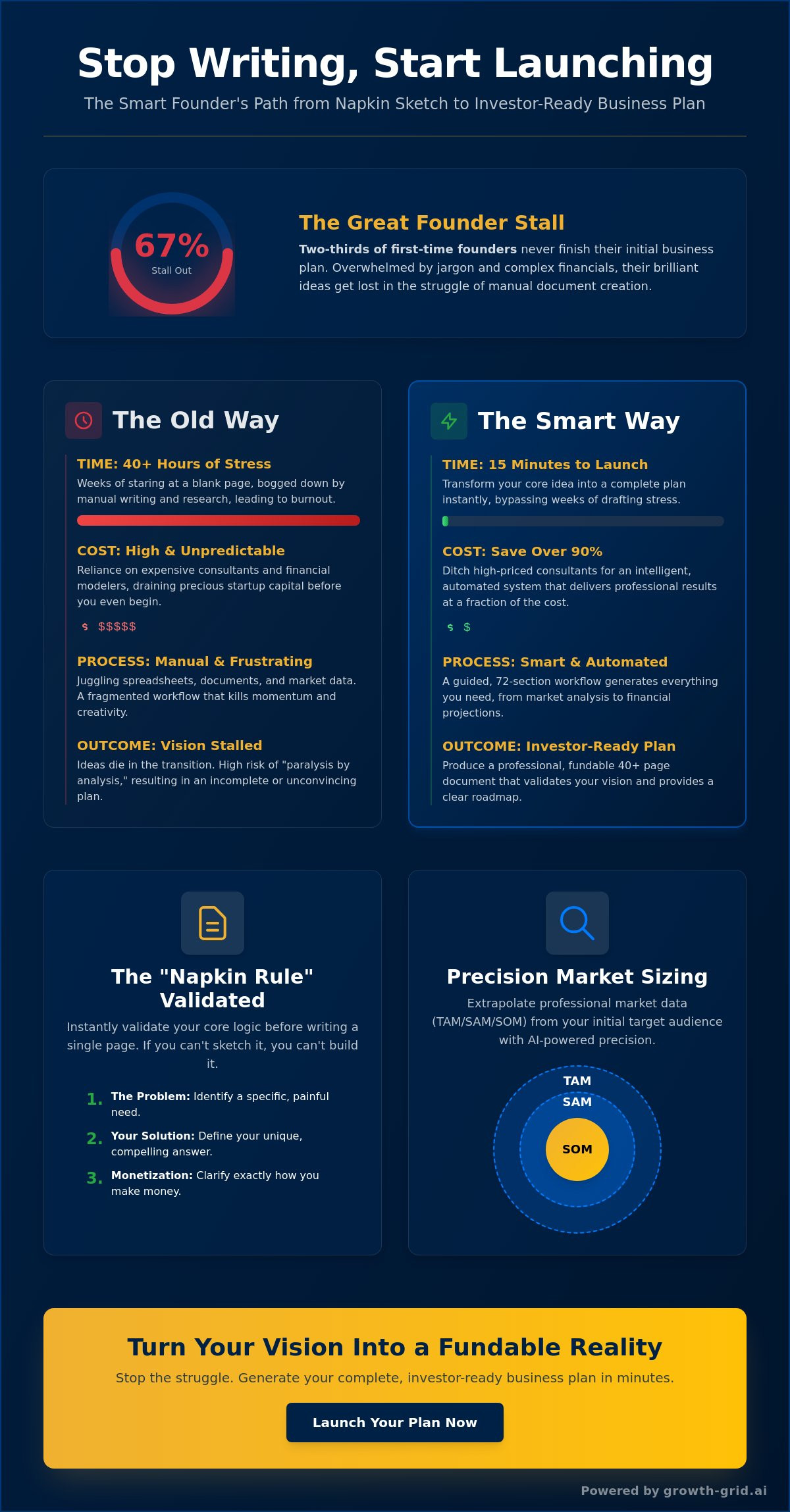
Moving from napkin sketch to business plan used to be a grueling rite of passage that broke most founders. For decades, entrepreneurs faced a brutal choice: lose 40+ hours of their lives to manual documentation or pay a consultant upwards of $2,000 to do it for them. It was a process designed for frustration, not for speed. The barrier to entry wasn’t just the idea; it was the sheer volume of paperwork required to prove it.
Today, the Smart Way has arrived. By using AI-powered generation, you can bridge the gap from a rough idea to a bank-ready document in under 15 minutes. This isn’t just about typing faster; it’s about removing the mental hurdles that stop great ideas from ever launching. You provide the vision, and the technology handles the heavy lifting.
- The Old Way: 40+ hours of manual labor, 😰 high stress, and $2,000+ in consultant fees.
- The Smart Way: 15 minutes of AI generation, ✨ professional quality, and total control.
Where Does 40+ Hours Actually Go?
Traditional planning is a massive time-sink. Most founders spend 10 to 15 hours just wrestling with financial formulas that refuse to balance. Another 12 hours often vanish into formatting margins, headers, and tables in Word documents that weren’t built for complex 40-page reports. The data shows that formatting alone consumes 25% of the total time spent on a traditional plan.
The psychological toll is even worse. The blank page syndrome causes 60% of entrepreneurs to stall before they even finish an executive summary. Traditional business plan software often feels like a glorified text editor; it gives you the boxes to fill but doesn’t help you fill them with high-level strategy.
The AI Advantage: Professional Quality Instantly
GrowthGrid uses advanced GPT-4 models to draft 72 sections of professional business strategy instantly. This technology analyzes your initial concept and expands it into a comprehensive roadmap that meets investor standards. You don’t have to worry about your data, either. Bank-level encryption and strict privacy protocols protect your Million Dollar Idea while the AI does the work.
You can see exactly how this works in our guide: AI Business Plan: The Ultimate Guide to Writing Your Plan in Minutes.
The AI maintains the soul of your original vision while adding a level of professional polish that used to take weeks to achieve. It’s important to remember that you remain the editor, not the writer. You spend your energy refining the strategy instead of hunting for typos or researching industry benchmarks. This shift ensures the final document is 100% yours, but without the 40 hours of repetitive labor.
Stop wasting your time on formatting and start building your future. It is time to take your concept from napkin sketch to business plan with total confidence.
Launch Your Vision with GrowthGrid
Stop staring at your notes and start building. GrowthGrid transforms your initial idea from napkin sketch to business plan in less time than it takes to drink a coffee. Why spend 40+ hours struggling with formatting and complex financial formulas? Our platform uses advanced GPT-4 technology to build a comprehensive, 40+ page professional document that’s ready for any boardroom. You provide the vision; we provide the structure. It’s the fastest way to bridge the gap between a dream and a bankable reality.
The process is designed for maximum efficiency. You won’t find any fluff here. We’ve replaced the traditional, weeks-long writing process with a streamlined 15-minute workflow. Once you finish the guided input, you can instantly download your plan as a polished PDF or an editable DOCX file. It’s professional quality without the consultant price tag.
Step-by-Step: Your First 15 Minutes
You don’t need a business degree to create a winning strategy. GrowthGrid uses a guided question-and-answer flow that feels like a conversation with a high-level consultant. We ask the right questions about your target market, revenue model, and operations. As you answer, our AI engine works in the background to build 72 distinct sections of your plan.
- Instant Financials: We generate five-year projections, break-even analyses, and profit/loss statements automatically.
- Market Analysis: Receive data-backed insights into your industry trends and competitor landscape.
- Customized Outputs: Tailor your plan specifically for bank loans, venture capital pitches, or internal team alignment.
Every section is designed to meet the rigorous standards of modern investors. You get a document that looks, feels, and reads like it was written by a team of experts, giving you the confidence to pitch anyone, anywhere.
The Smart Entrepreneur’s Toolkit
GrowthGrid acts as a savvy business partner for the modern founder. We know that a business plan is just the beginning. To help you scale from an idea to an operational business, our toolkit includes AI-generated legal documents and HR frameworks. You can generate employment contracts, non-disclosure agreements, and strategic roadmaps with the same ease as your business plan.
We believe in our product so much that we offer a “Love Your Plan or Your Money Back” guarantee. If you aren’t 100% satisfied with the quality of your generated plan, we’ll refund your $19 investment. It’s a risk-free way to take your project from napkin sketch to business plan today. Don’t let your idea sit on a shelf. Take the first step and see what your vision looks like when it’s backed by a professional strategy.
Generate ✨
Stop Planning, Start Building Your Future
The journey from napkin sketch to business plan used to be a 40-hour marathon of stress and high consulting fees. In 2026, that manual approach is officially obsolete. You’ve learned that validation happens on a napkin, but execution requires a professional roadmap. By choosing the smart way, you skip the blank page syndrome and focus on what matters: launching your vision. GrowthGrid is the shortcut trusted by entrepreneurs worldwide to bridge this gap instantly.
Our platform delivers a 72-section comprehensive plan that’s bank-ready and professional. You’ll save 90% on traditional costs compared to hiring expensive consultants or agencies. Why spend weeks struggling with formatting when you can have a finished document in the time it takes to drink a coffee? It’s time to stop overthinking and start executing with a tool built for the modern founder.
Generate ✨ Your Professional Business Plan in 8 Minutes
Your idea is too good to stay on a piece of paper. Take the leap today and give your startup the professional foundation it deserves.
Frequently Asked Questions
How do I turn a napkin sketch into a formal business plan?
You turn a napkin sketch into a business plan by inputting your core idea into an AI generator that structures your thoughts into a professional format instantly. This transition from napkin sketch to business plan used to take 40+ hours of manual labor. Now, you can generate a 40 page document in 8 minutes by answering a few guided questions about your target market and revenue goals. It’s the most efficient way to start.
Is a napkin sketch enough to get funding for my startup?
A napkin sketch is never enough to secure professional funding; 99% of venture capitalists require a comprehensive document before the first meeting. While the sketch captures the spark, you need 5 year financial projections and a detailed SWOT analysis to prove viability. Using a smart shortcut ensures you don’t show up empty handed when an investor asks for your deck. It’s about being prepared and professional.
How much does it cost to have a business plan written in 2026?
Hiring a traditional consultant in 2026 costs between $2,500 and $10,000 for a standard startup package. These high fees often come with a 3 week waiting period while they research your industry manually. Modern AI solutions cut these costs by 90% or more, allowing you to bypass the “Old Way” and get a bank ready document for a fraction of the price. It’s the ultimate efficiency hack for founders.
Can AI really write a professional-quality business plan?
Yes, AI models like GPT-4 now produce professional quality plans that meet Small Business Administration (SBA) standards exactly. These systems generate 72 distinct sections including current market trends and competitive analysis. It’s a smart way to ensure your from napkin sketch to business plan journey results in a document that looks like it cost thousands to produce. You get high end results without the high end price tag.
What are the most important sections to include in a startup plan?
The most critical sections include the Executive Summary, Market Analysis, and the Financial Plan. According to 2025 data from the SBA, 70% of lenders focus first on your cash flow projections and break even analysis. Your plan must also include a clear marketing strategy and operational breakdown to show you’re ready to scale from day one. These core sections provide the roadmap for your entire business journey.
Do I need a consultant if I use an AI business plan generator?
You don’t need a consultant because AI tools provide the same structural expertise and market data at a much higher speed. A consultant might take 14 days to finish a draft, but an AI generator does it in under 10 minutes. This gives you more time to focus on building your product instead of managing a middleman. It’s the smart way to get professional results while saving 90% on costs.
How long should a professional business plan be for a new startup?
A professional plan should be between 25 and 45 pages to cover all necessary detail without losing the reader’s attention. Plans shorter than 15 pages often lack the depth required for bank loans, while those over 50 pages rarely get read by busy investors. Aim for a concise document that uses data visualizations to explain your path to profitability. This length ensures you hit every requirement for 2026 standards.
Is my business idea safe when using an AI generator?
Your business idea is safe as long as the platform uses bank level encryption and 256 bit SSL protocols to protect your data. GrowthGrid ensures your proprietary information remains private and isn’t used to train public models. You get the benefit of advanced technology without the risk of exposing your unique concepts to the public. It’s a secure, private way to build your future without any stress or worry.