

What if your business plan wasn’t a 40-page document destined to collect dust, but a high-velocity roadmap to a $400 billion market? Most consultants spend weeks agonizing over a business plan for a consulting company, only to realize they’ve built a job for themselves rather than a scalable firm. It’s frustrating to struggle with quantifying expertise or stressing over billable hour targets when you’d rather be solving client problems. You feel the friction of legacy methods, and it’s holding your growth hostage.
You deserve a professional document that secures funding without the 80-hour work week attachment. We’ll show you how to build a professional, investor-ready consulting business plan in minutes, not weeks. This guide covers everything from navigating 2026’s 9.0% SBA loan rates to designing a lead generation engine that actually works. We’re moving past the hours-for-dollars trap to create a modern, scalable model that positions you as the authority you already are. Let’s transform your expertise into a tangible, high-value asset today.
Key Takeaways
- Shift your mindset from traditional inventory-based planning to a roadmap that scales your specific expertise as a high-value product.
- Master the 5 core pillars of high-growth strategy to ensure your business plan for a consulting company attracts premium partners and investors.
- Compare traditional, lean, and AI-driven formats to select the document structure that best aligns with your 2026 funding or operational goals.
- Learn to conduct a rapid SWOT analysis using real-time market data to validate your unique value proposition in record time.
- Leverage modern AI tools to generate a comprehensive, 72-section professional plan that eliminates “blank page syndrome” and builds instant credibility.
Why Your Consulting Business Plan Needs a Different Approach in 2026
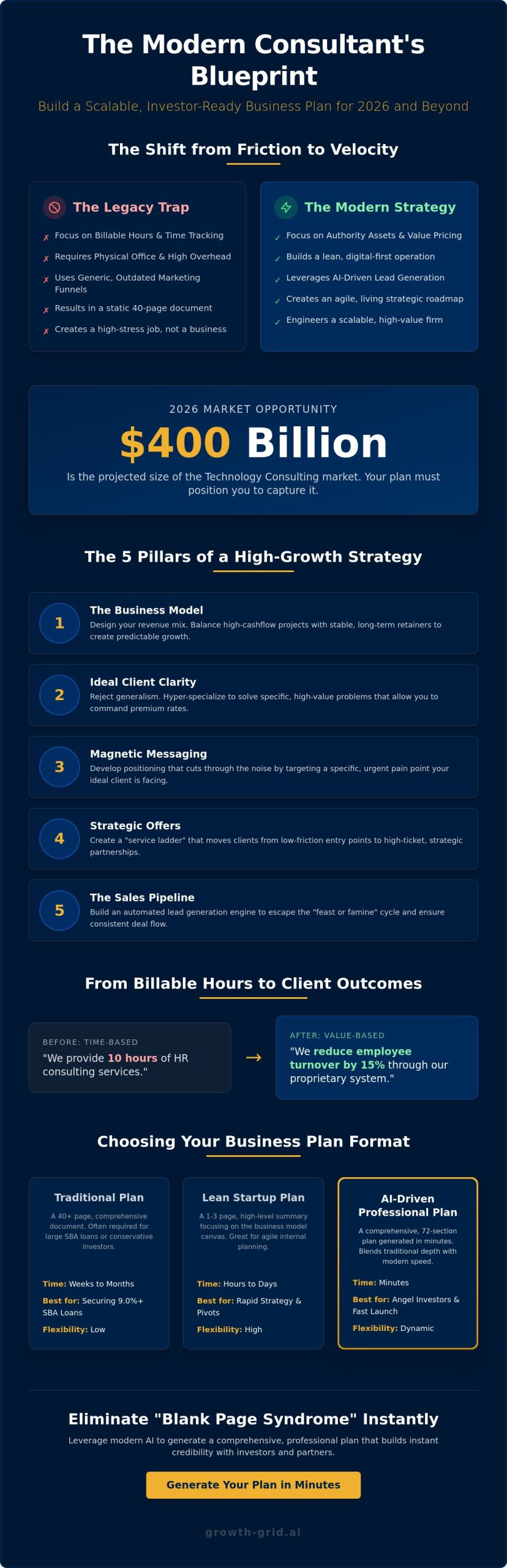
Stop treating your firm like a hardware store. A business plan for a consulting company isn’t about counting inventory or square footage. It’s about codifying your brain into a repeatable system. While the basic question of What is a Business Plan? applies to any startup, consultants face a unique challenge. You aren’t selling a product; you’re selling a transformation. Traditional plans fail because they focus on overhead rather than authority. In a 2026 market where technology consulting exceeds $400 billion, your authority asset is your most valuable collateral.
Legacy plans are dead. Investors no longer want to see 50 pages of fluff about office furniture and five-year projections that will be obsolete in six months. They want a modern strategic plan that highlights agility and specialized expertise. Contrast these two approaches:
- Legacy Approach: Focuses on billable hour targets, physical office space, and generic marketing.
- Modern Strategic Plan: Focuses on authority assets, value-based pricing models, and AI-driven lead generation.
The Shift from Billable Hours to Value-Based Models
Stop trading your life for a paycheck. Your plan must explicitly state how you’ll decouple time from income. If your revenue only grows when you work more, you don’t have a business; you have a job with high taxes. Focus your value proposition on client outcomes. Instead of offering “10 hours of HR consulting,” promise to “reduce employee turnover by 15%.” Integrate productized services, like diagnostic audits or automated reports, to build a business plan for a consulting company that scales while you sleep.
Why Investors and Partners Look for Scalability
Investors don’t fund burnout. They fund systems. To secure partners or capital in 2026, you must prove your firm can survive without you. Identify the “Expertise Gap” in your niche and show how your proprietary methodology fills it. Link your personal brand to the corporate identity, but ensure the processes are documented. If you’re the only person who can deliver the work, your firm’s valuation is zero. Build a model that utilizes junior consultants or AI workflows to handle the heavy lifting. This creates a scalable asset that attracts high-level interest and secures your firm’s future.
The 5 Core Pillars of a High-Growth Consulting Strategy
A high-growth strategy isn’t a wish list. It’s a structural framework. While the SBA guide to writing a business plan provides a solid foundation for any small business, consultants need specific pillars to handle the “expertise as a product” challenge. Without these five pillars, your business plan for a consulting company is just a collection of hopes. Focus on these to build a firm that scales.
- Pillar 1: The Consulting Business Model. Decide on your revenue mix. Balance one-off projects for cash flow with long-term retainers for stability.
- Pillar 2: Ideal Client Clarity. Reject generalism. Hyper-specialization allows you to charge premium rates because you solve specific, high-value problems.
- Pillar 3: Magnetic Messaging. Your positioning must cut through the noise. If your message doesn’t hit a specific pain point, it’s invisible to your target market.
- Pillar 4: Strategic Offers. Create a “ladder” of services. This moves clients from low-friction entries to high-ticket strategic partnerships.
- Pillar 5: The Sales Pipeline. Build a lead generation engine that works independently of your personal network. Consistency is the key to escaping the “feast or famine” cycle.
Defining Your Niche and Target Market
Data-driven validation is mandatory in 2026. Don’t guess where the money is. Use a deep market analysis to identify untapped opportunities in sectors like AI ethics or decentralized finance. Your Ideal Client Profile (ICP) must go beyond simple demographics. Focus on psychographics and specific business triggers. Are they facing a regulatory shift? Are they struggling with a 20% drop in productivity? When you define the trigger, you define the sale. If you want to move faster, you can use an AI generator to map these niches instantly.
Building a Scalable Service Ladder
Stop selling the “whole house” first. Start with a low-ticket assessment or audit. This builds trust and provides the data you need for a high-ticket strategy. Incorporate digital assets, such as pre-recorded workshops or proprietary benchmarking tools, into your business plan for a consulting company. This shifts your revenue away from pure billable hours. Set a target utilization rate of 60% for your delivery team. This leaves 40% for business development and prevents the burnout that kills most boutique firms.
Choosing Your Format: Traditional, Lean, or AI-Driven?
Choosing the right format for your business plan for a consulting company depends on your ultimate objective. Are you chasing institutional capital or seeking internal operational clarity? The “Efficiency Gap” between manual drafting and modern automation is staggering. Traditional methods often require weeks of manual research and drafting. Modern AI-driven solutions reduce this to minutes while ensuring 100% structural compliance with 2026 regulations. Don’t waste time on a format that doesn’t serve your goal. Match your document to your destination.
- Traditional Plan: Best for bank loans, SBA grants, and institutional investors. High detail, 40+ sections.
- Lean Plan: Best for internal strategy and rapid pivoting. Focuses on key drivers and milestones.
- AI-Driven Plan: Best for the “Time-Poor” expert. Combines high-level professionalism with extreme speed.
Traditional Plans for Bank Loans and SBA Grants
If you’re applying for an SBA 7(a) loan, you’ll likely need a comprehensive document to secure those 9.0% APR rates for loans over $250,000. Banks require a 40-section document that proves your firm’s viability. Manual drafting carries high risks. A single error in your financial forecasting can lead to immediate rejection. For example, failing to correctly account for the 15.3% self-employment tax or the 21% C-Corporation tax rate shows a lack of financial rigor. Use professional business plan software to ensure your structure meets institutional standards. You can also consult the SBA guide to writing your business plan for a breakdown of legacy requirements.
The AI Advantage: Professionalism in Minutes
Modern consultants don’t have weeks to spend on a document that might change in six months. GrowthGrid’s AI Generator creates a 72-section business plan for a consulting company in under 15 minutes. This isn’t just about speed; it’s about accuracy. The system ensures your financial projections are mathematically sound and compliant with 2026 tax codes. You get a document that looks like it took a month to write, giving you instant credibility with partners. It’s the logical choice for experts who value their billable time. Why spend 80 hours on a draft when you can generate a professional roadmap before your next client call?
Step-by-Step: Writing Your Consulting Business Plan in Record Time
Speed is your competitive advantage. Most experts stall because they treat a business plan for a consulting company like a doctoral thesis. It isn’t. It’s a living document designed to trigger action. Follow this streamlined 5-step process to move from a blank page to a finished roadmap before your next client engagement starts.
- Step 1: Define Your UVP. Identify the specific transformation you provide. Don’t say you “improve efficiency.” Say you “reduce operational overhead by 12% through AI automation.”
- Step 2: Rapid SWOT. Use real-time market data. The technology consulting market is projected to exceed $400 billion in 2026. Identify how you’ll capture a slice of that growth.
- Step 3: Build the Financial Model. Account for the 15.3% self-employment tax and the 21% federal corporate income tax rate. Factor in your SG&A (Selling, General, and Administrative) expenses.
- Step 4: Lead Acquisition. Draft a strategy that doesn’t rely solely on referrals. Map out your content funnel and outbound outreach to capture the growing demand for automation specialists.
- Step 5: Review and Refine. Ensure your tone is professional, direct, and results-oriented. Cut the fluff and focus on tangible deliverables.
Mastering the Executive Summary
Your executive summary is the only page some investors or partners will read. Keep it to a single, punchy page. Quantify your projected impact and ROI for clients immediately. Instead of vague promises, use a specific market stat to anchor your niche. For instance: “Our firm targets the $268 billion digital transformation market to help mid-sized firms automate manual tasks.” This shows you understand the landscape and your potential ROI. It turns your business plan for a consulting company into a compelling pitch rather than just a report.
Automating the Financial Projections
Numbers don’t lie, but they can be tedious. Set your hourly or project rates based on 2026 industry benchmarks, where specialists can command $500 or more per hour. You must calculate your break-even point and conduct a thorough cash flow analysis to ensure sustainability. If you’re seeking funding, remember that SBA 7(a) loan interest rates in June 2026 are approximately 9.0% APR for loans of $250,000 or more. Project your year-over-year growth with realistic multipliers that reflect the scalability of your service ladder. Generate your professional business plan in minutes to ensure every calculation is mathematically sound and ready for scrutiny.
Launch Your Firm Faster with GrowthGrid’s AI Generator
Experts often find themselves trapped in the “Blank Page Syndrome” where their vast knowledge refuses to condense into a structured document. This friction is the primary reason many firms never move past the idea stage. GrowthGrid eliminates this barrier by providing a streamlined, automated solution for creating a business plan for a consulting company. Instead of losing weeks to research and formatting, you can generate a high-impact roadmap that satisfies both your internal strategy and external investor requirements. You’ve already done the hard work of gaining expertise; let technology do the hard work of documenting it.
A 72-section comprehensive plan isn’t just about length; it’s about professional credibility. In a market where digital transformation consulting is expected to reach $510.50 billion by 2034, you need a document that proves your firm is structurally sound. GrowthGrid ensures every critical detail, from risk management to operational workflows, is addressed. This allows you to transition seamlessly from a basic startup business plan to a robust, full-scale corporate model that commands respect from banks and high-ticket clients alike.
From Idea to Professional Document in 15 Minutes
The process is built for maximum speed. You answer a series of targeted questions about your niche, service ladder, and target market. The AI then synthesizes your expertise into a professional format that meets 2026 standards. Once complete, you can download your plan in PDF or DOC format for immediate use in bank meetings or partner presentations. Why waste weeks drafting a business plan for a consulting company manually when AI can handle the heavy lifting? In 2026, savvy entrepreneurs are choosing speed over manual labor because they know their time is better spent delivering value to clients.
Ongoing Support for Your Consulting Journey
Your business plan is just the beginning of your growth. As your firm scales, your needs will shift toward risk mitigation and team management. GrowthGrid supports this growth through its AI Legal Document Generator and AI HR Document Generator. These tools help you create NDAs, contracts, and internal policies in seconds, keeping your firm compliant with new 2026 data privacy laws. Your plan should evolve as your revenue grows. Revisit your strategy often to stay ahead of the $400 billion tech consulting wave. Stop planning and start consulting.
Take Command of Your Consulting Future Today
Building a successful firm in 2026 requires more than just high-level expertise; it demands a structural roadmap that prioritizes scalability over billable hours. You’ve learned how to shift your focus toward authority assets and value-based pricing to capture a share of the growing $400 billion technology consulting market. Don’t let the friction of legacy drafting slow your momentum. A professional business plan for a consulting company should be a tool for rapid growth, not a weeks-long administrative burden that keeps you from your clients.
It’s time to move from strategy to execution without the stress of a blank page. Our system delivers a 72-section comprehensive output with mathematically sound financial projections to ensure your firm is investor-ready from day one. Why waste 80 hours on a manual draft when you can achieve professional results in a fraction of the time? Stop over-analyzing and start building your legacy.
Generate Your Professional Consulting Plan in 15 Minutes
Your expertise is your most valuable asset. It’s time to treat it like one. Secure your partners, lock in your funding, and launch the firm you’ve always envisioned with total confidence.
Frequently Asked Questions
Do I really need a business plan for a solo consulting practice?
Yes, a plan is vital for solo practitioners to move beyond “freelancing” and into a scalable business model. It forces you to define your niche and set specific revenue targets for the year. Without a clear roadmap, you risk falling into the common feast or famine cycle. A structured document ensures you treat your expertise as a high-value product rather than just trading your limited hours for money.
How long should a consulting business plan be?
Your plan’s length depends entirely on its purpose. A lean plan for internal strategy might be 5 to 10 pages, focusing on core drivers and milestones. However, a traditional business plan for a consulting company intended for bank loans or investors should be 30 to 40 pages. This comprehensive length ensures you cover all structural sections required for institutional credibility and regulatory compliance in 2026.
What are the most important financial metrics for a consultant?
Focus on your utilization rate, customer acquisition cost, and average contract value. Tracking your utilization rate ensures you remain profitable without burning out from over-delivery. You must also account for the 15.3% self-employment tax and your monthly overhead expenses. These metrics help you determine if your current pricing model is sustainable. Calculating your break-even point is critical for understanding how many projects you need each month.
Can I use an AI business plan generator for bank loans?
Yes, AI generators are acceptable for bank loans if they produce high-quality, structurally compliant documents. Banks require rigorous financial modeling and detailed market analysis to approve funding. Modern AI tools ensure your projections are mathematically sound and meet the 2026 standards for SBA 7(a) loan applications. This approach saves weeks of manual labor while reducing the risk of human error in complex tax calculations.
What is the difference between a project-based and a retainer-based model?
Project-based models involve a one-time fee for a specific deliverable, while retainer models provide recurring monthly revenue for ongoing support. Projects are excellent for high-margin cash injections and building a portfolio. Retainers offer the financial stability needed to scale your firm with confidence. A healthy business plan for a consulting company often balances both to ensure steady cash flow while allowing for specialized, high-impact work.
How do I conduct market research for a niche consulting firm?
Start by analyzing industry-specific reports and digital transformation trends. In 2026, you should focus on niche sectors like AI regulation or specialized automation where demand is highest. Identify the expertise gap by reviewing competitor offerings and client pain points on professional networks. Use real-time data to validate the demand for your specific transformation. This data-driven approach ensures your firm targets high-growth markets rather than saturated categories.
Should I include a SWOT analysis in my consulting plan?
Absolutely, a SWOT analysis is a mandatory component for any professional consulting plan. It identifies your internal strengths and weaknesses alongside external opportunities and threats. This section proves to investors that you have a pragmatic understanding of the 2026 market landscape. It helps you prepare for risks like regulatory changes or increased competition while highlighting your unique authority as a specialized, pragmatic problem-solver.
How often should I update my consulting business plan?
Review and update your plan at least once every quarter. The consulting market moves quickly, especially with the $400 billion tech consulting wave currently occurring. Regular updates allow you to pivot your strategy based on new lead generation data or changes in tax laws. Keeping your document living ensures it remains a useful roadmap for growth rather than an outdated file that no longer reflects your firm’s reality.