

What if the biggest barrier to your startup’s success isn’t your idea, but your fear of cell B14 in a spreadsheet? For many founders, the thought of building a business plan for people who are not numbers person feels like a fast track to looking incompetent in front of investors. You’ve likely wasted hours staring at a blank financial template, wondering how to turn your vision into a profit and loss statement that actually makes sense. It’s a common frustration that keeps brilliant ideas locked in a drawer.
It’s time to stop letting calculus stand in the way of your career. You understand the logic of your business. You just don’t want to spend forty hours doing manual data entry. This guide shows you how to build a professional, investor-ready business plan by focusing on your strategy while letting advanced AI handle the complex math. We’ll preview the modern workflow that helps you finish a 72-section document in under fifteen minutes. You’ll gain the confidence to pitch your idea without ever having to touch a legacy spreadsheet again.
Key Takeaways
- Shift your focus from complex arithmetic to core strategy by mastering the four non-numeric pillars of a successful plan.
- Discover how to create a business plan for people who are not numbers person by focusing on unit economics instead of calculus.
- Learn how to leverage modern AI tools to automate financial modeling and generate investor-ready documents in minutes.
- Transition from staring at blank spreadsheet templates to using a narrative-first approach that prioritizes your business vision.
- Explore the 15-minute workflow that turns your unique ideas into a comprehensive 72-section document without any manual math.
What Is a Business Plan for Non-Math Entrepreneurs?
A business plan is not a math test. It is a roadmap of your “why” and “how.” Many founders delay their launch because they mistake a strategic document for a complex calculus exam. In reality, your plan is a communication tool designed to align your team, convince lenders, and keep your own goals on track. Before you touch a single spreadsheet, you must understand What Is a Business Plan? at its most fundamental level: it is the narrative of how your company creates value.
The standard for professional documentation has shifted significantly in 2026. We’ve moved away from the era of manual data entry and toward a model of strategic oversight. Creating a business plan for people who are not numbers person is now about defining the logic of your operation while letting technology handle the arithmetic. Your competitive advantage isn’t your ability to hard-code Excel formulas; it’s your ability to see a market gap and fill it. If you can explain how you solve a problem, you can build a professional plan.
The Difference Between Strategy and Arithmetic
Strategy is deciding where your business needs to go. Arithmetic is simply measuring the fuel required to get there. Investors don’t actually care about your ability to use a calculator. They care about your market logic. If your strategy is flawed, perfect math won’t save the business. If your strategy is sound, the math becomes a secondary task that can be automated. A business plan is a narrative of value creation that proves your idea is sustainable. Focus on the “if/then” statements of your business model. If you acquire a customer for ten dollars and they spend fifty, your strategy works. The rest is just formatting.
Why Being a “People Person” Makes You a Better Planner
Empathy is the most underrated financial tool. Understanding customer pain points is the true foundation of every successful financial projection. When you focus on the human side of the business, you build better marketing strategies and higher conversion rates. This “people-first” approach allows you to spot critical gaps that “math-only” planners often miss. Consider these advantages:
- Better Retention: You understand why customers stay, which stabilizes your long-term revenue.
- Effective Marketing: Your projections are based on real human behavior, not just arbitrary growth percentages.
- Stronger Teams: You can articulate a vision that attracts top talent, reducing your recruitment costs.
By prioritizing the narrative, you ensure that every number in your final document is backed by a real-world human interaction. This makes your plan more realistic and far more persuasive to potential partners.
The 4 Non-Numeric Pillars of a Great Business Plan
A professional business plan for people who are not numbers person doesn’t start with a calculator. It starts with a story. Most investors decide to fund a startup based on the strength of the narrative and the clarity of the vision before they ever scrutinize a balance sheet. You need to prove that you understand your customers, your competition, and your own workflow. By focusing on the four non-numeric pillars of a plan, you build a foundation that makes the eventual math feel like a logical conclusion rather than a random guess.
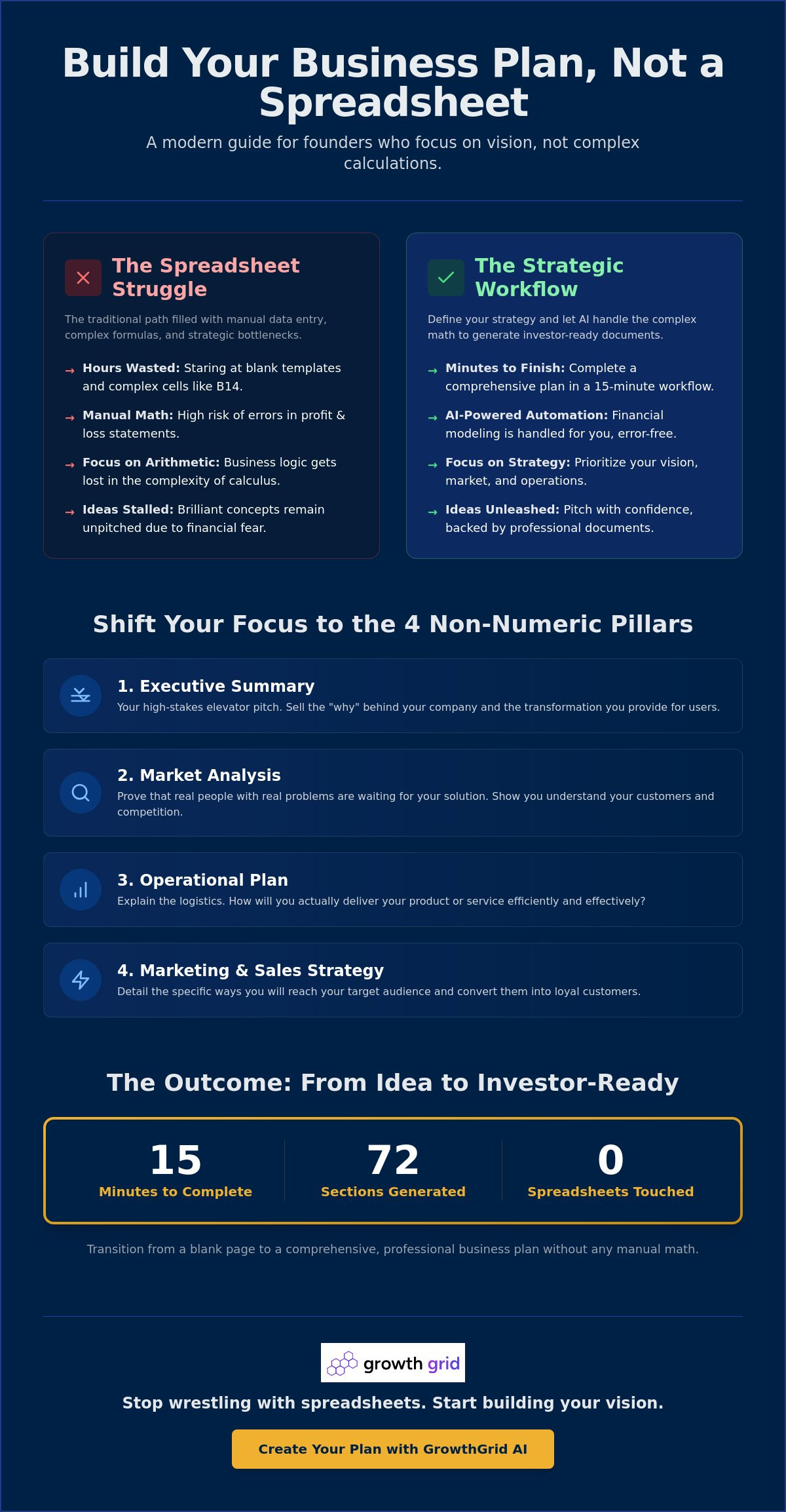
- Executive Summary: This is your high-stakes elevator pitch. It sells the vision and the “why” behind your company.
- Market Analysis: This section proves that real people with real problems are waiting for your solution.
- Operational Plan: You explain the logistics of how you will actually deliver your product or service.
- Marketing & Sales Strategy: This covers the specific ways you will reach your community and convert them into loyal fans.
You can streamline your planning process by defining these pillars first. Once the strategy is clear, the numbers often fall into place on their own.
Crafting a Compelling Executive Summary
Your executive summary should be no longer than three punchy paragraphs. Focus entirely on the problem you solve. Don’t lead with the numbers you hope to hit in five years; lead with the transformation you provide for your users. If you need a framework to get started, check out our guide on What Is a Business Plan? A Step-by-Step Guide for Entrepreneurs. This section is your chance to show investors that you are a pragmatic problem-solver who understands the market better than anyone else.
Nailing the Market Analysis Without a Statistics Degree
You don’t need to conduct expensive raw data research to prove your market exists. A smart business plan for people who are not numbers person leverages existing industry reports and “look-alike” business models. If a similar company is succeeding in a different city, you have a proven concept. Focus on qualitative data. What are your potential customers complaining about on social media? What do they say they actually want? You can find a wealth of templates and advice in this official U.S. government guide. Using verified reports helps you estimate your potential reach without having to build a single statistical model from scratch. It’s about working smarter, not harder.
Your operational and marketing strategies should follow the same logic. Explain who is on your team, what tools you use, and how you’ll communicate your value. When you treat your business plan as a roadmap for growth rather than a math assignment, the entire process becomes manageable and even empowering.
How to Tackle Financials Without a Calculator (The Logic-First Approach)
Financial projections are often the most intimidating part of any startup journey. However, you don’t need to be a math wizard to succeed. A business plan for people who are not numbers person should focus on the logic of how money moves through your company. If you can explain your business model in plain English, you’ve already done the hardest part of the work. You are simply translating your operational vision into a numeric format that investors can verify.
Instead of getting lost in complex formulas, start with the SBA’s guide to writing a business plan to understand lean frameworks. Focus on your “Unit Economics.” This means looking at the smallest possible transaction in your business and ensuring it makes sense. If you can’t make a profit on one unit, you won’t make a profit on a thousand. Once you nail this logic, scaling becomes a matter of repetition rather than guesswork.
The “One-Unit” Mental Model
Think about the simplest version of your product. If you sell a cup of coffee, what are the beans, milk, and cup worth? These are your direct costs. If it costs you one dollar to make that cup and you sell it for four dollars, you have a three-dollar margin. Scaling a business is just repeating a successful “unit” multiple times. You don’t need calculus to see the value here. You just need to ensure your price covers your costs and contributes to your overhead. For a deeper look at how this timing affects your bank account, read our guide on Cash Flow Analysis: A Simple Guide for Startups.
Identifying Your Revenue Drivers
Revenue is a direct result of solved problems. Before you assign specific digits to your plan, describe your pricing strategy using words like “premium,” “accessible,” or “value-driven.” This qualitative approach helps you define your market position. You also need to identify your revenue streams. Are you a subscription business with recurring monthly fees? Or are you a one-time seller or service provider? Knowing how money enters the business is more important than the exact decimal point in your first draft.
Finally, separate your costs into two simple buckets:
- Fixed Costs: These are the expenses that stay the same every month, like rent, insurance, and software subscriptions.
- Variable Costs: These fluctuate based on how much you sell, such as raw materials, shipping fees, or transaction costs.
Understanding this distinction allows you to see your “break-even point” without ever opening a calculator. Cash flow is a story of timing, not just addition and subtraction. It’s about strategic oversight, not manual arithmetic.
3 Ways to Skip the Spreadsheet Stress
Most traditional advice tells you to just “learn the math.” That is inefficient. You don’t need to become an accountant to lead a successful company. If you are looking for a business plan for people who are not numbers person, you need a system that bypasses the manual labor. Staring at a blank Excel sheet is the fastest way to kill your momentum. Instead of fighting with formulas, follow these three steps to finish your plan with zero spreadsheet stress.
- Step 1: Use a Narrative-First Template. Choose a framework that asks you questions about your vision. When you answer “who is your customer?” or “what problem do you solve?”, you are building the foundation of your financials without realizing it.
- Step 2: Leverage AI Business Plan Generators. Modern technology can now translate your written strategy into a full financial model. This removes the risk of broken formulas and human error.
- Step 3: Set Your Strategy Before Seeking Help. If you do decide to hire a consultant, have your core logic ready first. This ensures you stay in control of the vision while they handle the technical audit.
Professional planning software is now ten times faster than a DIY spreadsheet. While a manual plan can take over forty hours to complete, our AI Business Plan Generator can produce an investor-ready document in under fifteen minutes. Stop wasting time on data entry and start focusing on growth.
The Power of AI in Business Planning
AI has fundamentally changed the barrier to entry for entrepreneurs. By using advanced computing models, you can now generate a 72-section comprehensive plan just by describing your business idea. The biggest benefit is “Zero-Formula” financial projections. The system does the math for you. It ensures your profit and loss statements, cash flow charts, and balance sheets are perfectly aligned. For a deeper look at this process, read our AI Business Plan: The Ultimate Guide to Writing Your Plan in Minutes.
Comparing Planning Software vs. Manual Spreadsheets
Manual spreadsheets are the primary cause of business plan abandonment. One broken cell can ruin an entire week of work. Contrast the legacy method with a modern, optimized solution:
- The Legacy Method: 40+ hours of manual entry, high risk of calculation errors, and a generic, unpolished output.
- The GrowthGrid Method: 15 minutes of input, 72 sections of verified content, and professional formatting designed for investors.
Choosing the right tool is a strategic decision about resource allocation. If you want to move fast, you cannot afford to be stuck in a legacy workflow. You can find more details on selecting the best platform in our guide to Business Plan Software: The Ultimate Guide to Choosing the Right Tool. Focus on your strengths as a founder and let technology handle the arithmetic.
GrowthGrid: The 15-Minute Solution for Non-Numbers People
GrowthGrid is the bridge between your entrepreneurial vision and a finished, investor-ready document. If you’ve been searching for a business plan for people who are not numbers person, you’ve likely realized that traditional templates aren’t enough. They still require you to do the heavy lifting in legacy spreadsheets. GrowthGrid changes the workflow entirely by focusing on your “people-first” ideas and automating the technical output. You provide the strategic narrative; our system handles the arithmetic.
The “Answer Questions, Get a Plan” workflow is designed for speed and precision. You don’t need to know how to build a balance sheet or a cash flow statement from scratch. By answering intuitive questions about your market and operations, you generate a comprehensive document that meets the strict standards of banks and investors. This method eliminates the #1 cause of plan abandonment: the fear of the blank financial template.
- Zero-Error Financials: Generate five-year projections without writing a single formula.
- Investor-Grade Formatting: Receive a document that looks like it was created by a high-end consultant.
- Automated Logic: Our algorithms ensure your revenue streams and costs align perfectly with your growth goals.
- Immediate Delivery: Move from a rough idea to a finished 72-section plan in under fifteen minutes.
Your Vision, Our Algorithms
You provide the “What” and “Why” of your business. We provide the “How Much” and “When.” Over 10,000 entrepreneurs have already trusted GrowthGrid to bridge their numbers gap as of May 2024. By leveraging advanced GPT-4 models, the platform translates your business description into a 72-section comprehensive plan. This isn’t just a summary; it’s a deep dive into your market analysis, operational logistics, and exit strategy. You get the security of a professional document without the high overhead of hiring a human consultant, which can often cost between $3,000 and $10,000.
Ready to Stop Procrastinating?
The cost of waiting is often higher than the cost of launching. While the manual process of writing a plan can take forty hours of focused labor, GrowthGrid delivers a first draft in under fifteen minutes. This 90% reduction in time allows you to focus on what actually matters: building your community and serving your customers. Don’t let spreadsheet anxiety keep your idea locked in a drawer. Take the pragmatic path to business ownership today.
Generate your professional business plan with GrowthGrid now
Launch Your Vision Without the Spreadsheet Stress
You now have the roadmap to move from spreadsheet anxiety to strategic clarity. Stop letting the fear of complex formulas hold your brilliant ideas back. You’ve learned that a professional plan is a narrative of value creation, not just a math exercise. By focusing on the four non-numeric pillars and adopting a logic-first approach to your financials, you can build a document that commands respect from any investor. Modern technology has officially removed the technical barrier to entry for creative founders.
Writing a business plan for people who are not numbers person is no longer a multi-week struggle. Thousands of entrepreneurs have already successfully bridged the gap using GrowthGrid. You can generate 72-section comprehensive plans that include precise 5-year financial projections without ever touching a cell in Excel. It is time to stop procrastinating and start building. Your business idea is too valuable to stay hidden behind a broken formula or a blank page.
Create your investor-ready business plan in 15 minutes with GrowthGrid. Take control of your future and turn your vision into a professional reality today.
Frequently Asked Questions
Do I really need a business plan if I’m not looking for a loan?
Yes, you need a plan to act as your operational roadmap. It forces you to define your strategy and identify risks before they impact your bank account. A plan is a decision-making tool that keeps you focused on your core goals. Even without a loan, you must align your team and track your progress against specific milestones to ensure long-term sustainability.
What is the most important section of a business plan for a non-numbers person?
The Executive Summary is the most vital section. It serves as your elevator pitch and sells the “why” behind your brand. When building a business plan for people who are not numbers person, this is where you demonstrate your market logic. Investors often prioritize a sound strategy and a clear vision over a row of complex spreadsheet calculations.
How can I explain my financials to an investor if I didn’t calculate them myself?
Focus on the logic of your revenue drivers rather than the arithmetic. You should be able to explain your unit economics, such as how much it costs to acquire one customer and what they spend. If you can articulate the “if/then” logic of your business model, investors will respect the professional financial projections generated by advanced algorithms.
Can AI really create an accurate financial projection for my unique business?
Yes, specialized AI tools use advanced GPT-4 models to create projections based on millions of data points and industry standards. These systems follow a rigid framework to ensure your profit and loss statements are logically sound. Unlike general-purpose AI, these generators are built specifically to handle business logic without “hallucinating” data, providing a reliable foundation for your unique idea.
What are the most common mistakes non-numbers people make in their plans?
The most common error is ignoring the customer narrative in favor of trying to “fix” a spreadsheet. Non-numbers founders often get stuck in spreadsheet paralysis and fail to explain their sales strategy. Another mistake is confusing fixed costs with variable costs. This leads to a flawed break-even analysis that can make even a great business idea look unsustainable to a lender.
How long should a business plan be in 2026?
In 2026, a comprehensive plan typically spans about 72 sections. While the length may seem daunting, modern software ensures every section is concise and scannable. Investors now expect a document that is deep enough to be thorough but formatted for quick digital review. The goal is to provide a complete view of your strategy without unnecessary filler.
Is it better to use a free template or paid software?
Paid software is the superior choice because it automates the manual labor that free templates leave to you. Using a professional generator can save you 90% on costs compared to hiring a consultant. It also eliminates the risk of broken formulas. You get a polished, investor-ready document in under 15 minutes instead of spending 40 hours fighting with a blank template.
Can I edit the numbers after the AI generates them?
Yes, you have full control over the final output. The AI acts as your technical partner, providing the heavy lifting for your business plan for people who are not numbers person. You can refine your inputs and adjust your strategy as your business evolves. The technology provides the framework, but you remain the strategic lead who makes the final decisions for your company.