

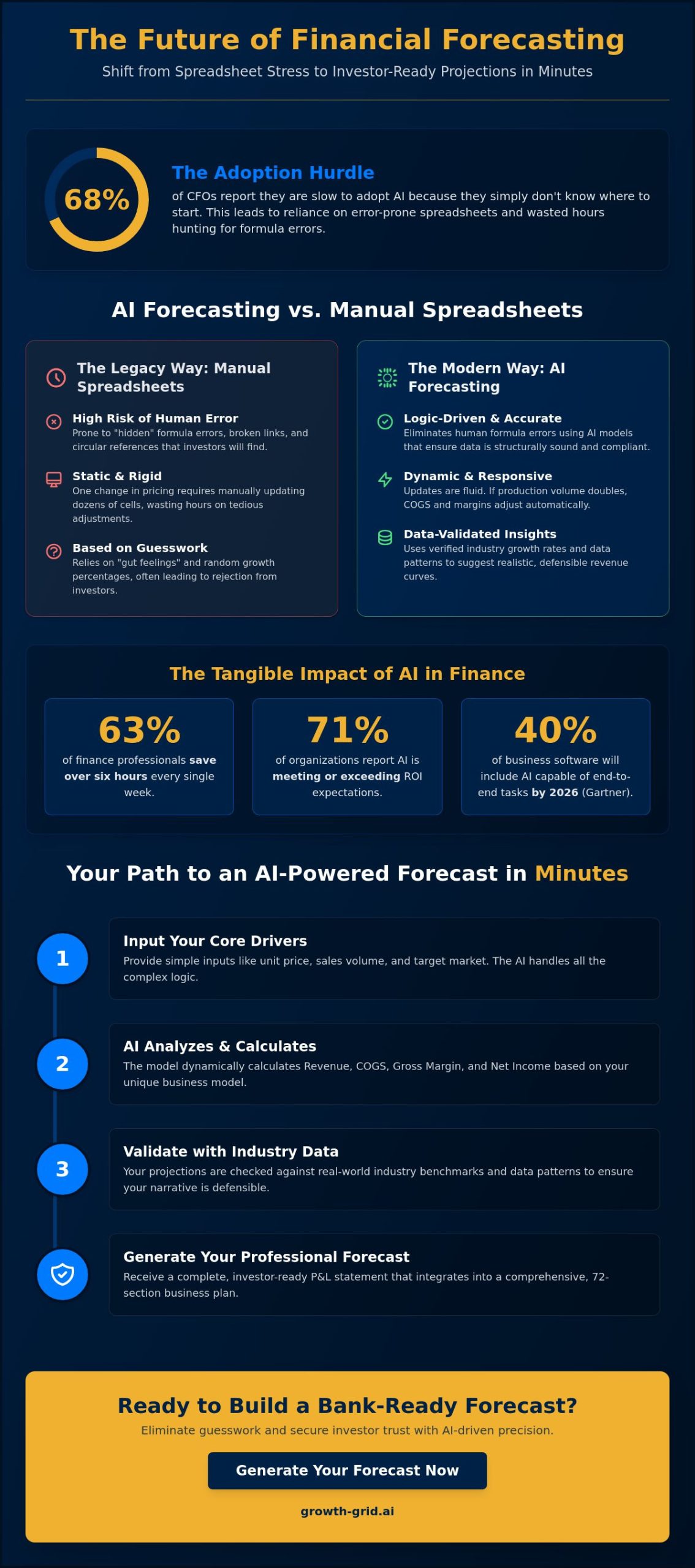
Did you know 68% of CFOs report that they have been slow to adopt AI because they simply don’t know where to start? It’s a common hurdle that keeps many founders trapped in spreadsheet stress, manually hunting for formula errors in Excel. You shouldn’t have to choose between a high-priced consultant and a projection that feels like guesswork. Using an income statement forecast ai is no longer just an experiment; it’s a strategic move that saves 63% of finance professionals more than six hours every single week. You deserve a professional P&L statement that stands up to investor scrutiny without the legacy overhead.
You probably agree that estimating future revenue often feels like throwing darts in the dark. This guide will show you how to master AI-driven financial forecasting to create investor-ready income statements in minutes. We’ll explore how to leverage industry-wide data patterns to validate your business narrative and ensure your profit margins make sense. By the end of this article, you’ll have a clear path to generating a bank-ready forecast that gives you total confidence during your next pitch.
Key Takeaways
- Shift from static spreadsheets to dynamic predictive models that automatically calculate Revenue, COGS, and Net Income.
- Master the income statement forecast ai workflow to produce professional, bank-ready projections in minutes rather than days.
- Eliminate the risk of human formula errors and the high overhead of consultants by using logic-driven AI models.
- Identify your core business “drivers,” such as pricing and sales volume, to feed the AI generator for maximum accuracy.
- Learn how to integrate these financial insights into a comprehensive, 72-section business plan that secures investor trust.
What is an Income Statement Forecast AI?
An income statement forecast AI is a sophisticated predictive system that replaces the traditional, error-prone manual spreadsheet. It isn’t just a digital template where you plug in numbers; it’s a dynamic model that uses algorithmic pattern recognition to project your future profitability. By analyzing your business model and market drivers, it generates a comprehensive Financial forecast that includes your projected Revenue, Cost of Goods Sold (COGS), Gross Margin, and Net Income. This technology represents a massive leap from 2020-era templates. Back then, you were responsible for every formula. Now, the AI handles the logic. It ensures your projections reflect the reality of your industry while maintaining the structural integrity required by financial institutions.
The Role of Predictive Modeling in Modern Business
Stop guessing and start estimating with precision. Modern predictive modeling looks at verified industry growth rates to suggest realistic revenue curves for your specific niche. While 56% of finance leaders already use AI to drive these insights, many founders still rely on “gut feelings” that lead to rejection during funding rounds. Algorithmic estimation removes the bias. It calculates your potential based on real-world data points rather than optimistic hopes. This process works best when paired with a cash flow analysis to ensure your profit projections align with your actual bank balance. This dual approach provides a 360-degree view of your financial health.
Why Static Spreadsheets Are Obsolete in 2026
Excel is a legacy tool for a modern problem. Static sheets are “hard-coded,” meaning one small change in your pricing strategy requires you to manually update dozens of cells. This creates a high risk of broken links and circular references that can ruin a pitch. In contrast, “agentic” AI updates are fluid and responsive. By the end of 2026, Gartner predicts that 40% of business software will include AI capable of completing these end-to-end tasks independently. This shift means your financial models can finally keep pace with your business decisions.
Consider the difference in workflow:
- Legacy Method: Hours spent debugging complex tax and depreciation logic; high risk of “hidden” formula errors that investors will eventually find.
- AI Method: Automated compliance with current standards; logic that scales instantly with production volume and market shifts.
An income statement forecast ai ensures your data remains structurally sound even as your business variables change. It eliminates the friction of manual data entry, allowing you to focus on strategy rather than cell formatting. You get a professional, bank-ready output that meets the stringent governance requirements of the 2026 financial landscape, such as those introduced by the EU AI Act. It’s about building a narrative that data can actually support.
How AI Models Your Future Profitability
Stop wrestling with complex math. An income statement forecast ai works by asking you direct questions about your operations. You provide the “drivers”—like your unit price and target market—and the machine handles the heavy lifting. It calculates your Cost of Goods Sold (COGS) dynamically. If your production volume doubles, the AI adjusts for economies of scale or increased shipping costs automatically. This level of precision is exactly what investors look for when they scrutinize your Gross Margin. Since 71% of organizations report that AI is meeting or exceeding ROI expectations in finance, the value of this accuracy is clear. A recent report on AI in finance highlights how these models improve accuracy by identifying hidden data relationships.
Your Gross Margin is the ultimate indicator of business health. If this number is too thin, no amount of sales will save you. AI models help you visualize this relationship instantly. They show you exactly how much room you have to cover your overhead before you even start selling.
Revenue Forecasting: Beyond Simple Percentages
Traditional models often pick a random growth percentage. AI is smarter. It runs bottom-up and top-down modeling at the same time. It looks at your specific sales capacity while checking if your goals are realistic for the total market. It also accounts for seasonality. If you sell more in December, the AI reflects that dip and peak. Revenue churn is the rate at which your recurring income disappears as customers cancel their subscriptions, making it a vital metric for long-term viability in SaaS models.
Operating Expenses (OPEX) and Scaling Drivers
Operating expenses are where most founders stumble. You might forget that hiring 10 people requires more than just salaries. You need bigger offices, more software licenses, and higher utility budgets. AI identifies these “step-costs” before they hit your bank account. It also models your Customer Acquisition Cost (CAC) over a 3 to 5 year period. This prevents the “too-optimistic” founder trap. Instead of assuming you’ll spend zero on marketing, the AI suggests realistic overhead based on your industry. Using an AI business plan tool can help you map these drivers to your long-term goals effectively.
AI vs. Manual Spreadsheets: The 2026 Comparison
Why waste 40 hours building a spreadsheet that might break? A modern income statement forecast ai delivers a superior result in just 15 minutes. Legacy methods aren’t just slow; they’re a liability. When you manually link cells across multiple tabs, you invite hidden formula errors that can lead to embarrassing questions during a bank audit. Recent data shows that 27% of finance professionals save more than 10 hours every week simply by automating these analysis tasks. This isn’t just about speed. It’s about ensuring your P&L has the structural integrity required to survive professional scrutiny.
Investors look for more than just big numbers. They look for professional formatting and a tone that suggests you’ve mastered your financials. Manual templates often look amateurish and lack the depth of a logic-driven model. Using an income statement forecast ai ensures your projections are crisp, clear, and ready for the boardroom. It eliminates the “spreadsheet stress” of wondering if a single typo in row 42 has ruined your entire five-year outlook.
Scenario Testing: The Secret Weapon for Funding
Static sheets make it difficult to pivot. If your sales volume drops by 10%, you usually have to rebuild half your model. AI allows you to run “What-If” scenarios instantly. You can generate Best Case, Worst Case, and Most Likely projections with a single click. This flexibility helps you find your break-even point in seconds. Showing investors that you’ve planned for market volatility proves you’re a savvy operator who understands risk. It transforms your pitch from a hopeful guess into a calculated strategy.
Maintaining GAAP and IFRS Standards
Manual templates rarely keep up with changing accounting standards. If your income statement doesn’t follow Generally Accepted Accounting Principles (GAAP) or International Financial Reporting Standards (IFRS), it won’t be bank-ready. AI models are updated centrally to reflect these complex rules automatically. This ensures your depreciation schedules and tax logic are always compliant. This level of financial detail integrates perfectly into a broader startup business plan, providing a unified narrative for your entire venture.
Choose the modern path. Contrast the old way of “Excel hell” with the optimized efficiency of AI-driven projections:
- The Old Way: 40+ hours of manual entry, broken links, and outdated accounting logic.
- The Smart Way: 15 minutes of guided input, guaranteed formula accuracy, and instant GAAP compliance.
Don’t let a legacy workflow hold your business back. Build your projections with confidence and get back to growing your company.
Actionable Steps to Generate Your Forecast
Generating a professional projection doesn’t require a finance degree. By following a structured process, you can use an income statement forecast ai to produce bank-ready results in minutes. Preparation is the key to accuracy. If you enter junk data, you’ll get a junk forecast. Start by identifying your core operational variables before you even open the software. This preparation ensures the machine logic aligns with your actual business goals.
Gathering the Right Inputs for AI Success
Every founder needs five key numbers ready to ensure the AI generates a realistic model. Don’t overthink your initial launch costs; focus on the essentials like initial inventory, equipment, and professional fees. Clearly defining your sales channels—whether you’re selling direct-to-consumer or through a wholesaler—allows the AI to calculate shipping and platform fees correctly. Having these data points ready saves you from pausing the process to hunt for information.
- Price per Unit: What will customers actually pay for your product or service?
- Expected Sales Volume: How many units will you sell in month one versus month twelve?
- Unit Cost (COGS): What does it cost to produce or fulfill one single order?
- Fixed Monthly OPEX: What are your non-negotiable costs like rent, insurance, and software?
- Hiring Plan: At what revenue milestone do you need to add your first or next employee?
Inputting and Refining the Model
Once you have your data, input your business model into the AI generator. The system will prompt you with specific questions designed to build the underlying logic. After the initial generation, perform a “Sanity Check.” Look for unrealistic growth spikes that look like a vertical line rather than a gradual curve. You can validate AI margins against industry averages by checking if your projected net profit stays within the typical 10% to 20% range for your sector. 71% of organizations report that AI meets or exceeds their ROI expectations, but only when the human founder provides a realistic starting point.
Export, Integrate, and Iterate
After you’re satisfied with the numbers, export the data. A high-quality income statement forecast ai will provide a clean, formatted document that slots directly into your master business plan. This shouldn’t be a one-time task. As you gather real-world market data, revisit your model. Adjust the “Growth Lever” to match your actual hiring pace or marketing spend efficiency. You can generate your professional business plan now to see how these financial projections strengthen your overall narrative. Remember, a forecast is a living document that proves to investors you’re actively managing your profit margins.
Generate Your Income Statement with GrowthGrid
GrowthGrid stands as the premier choice for entrepreneurs who require an income statement forecast ai that produces professional results without the overhead of a human consultant. Our platform is more than a simple calculator; it is a robust AI business plan generator that crafts 72 detailed sections. This means your financial projections aren’t just isolated numbers. They are integrated into a deep financial model that accounts for every operational variable, from production volume to the “step-costs” of your future scaling journey.
Investors demand a level of professionalism that manual spreadsheets rarely provide. GrowthGrid delivers “Bank-Ready” formatting that saves you hours of frustrating styling. You don’t need to worry about cell alignment, font consistency, or complex table borders because our system handles the visual hierarchy automatically. When your model is ready, you can export the entire plan in DOC or PDF formats. This allows for immediate sharing with stakeholders or printing for a face-to-face pitch. It’s the fastest path from a raw idea to a finished, professional deliverable.
Beyond the Income Statement: Total Business Planning
Successful businesses don’t treat their financials as a side project. GrowthGrid links your P&L statement directly to your market analysis and overall growth strategy. This creates a “Single Source of Truth” where every document in your business stack speaks the same language. If you adjust your sales channel, your revenue curves and CAC projections update across the entire document. For founders still exploring their options, our business plan software guide provides more context on why this integration is vital. We provide the structural integrity that static templates simply cannot match.
Get Started in Under 15 Minutes
The era of spending 40 hours in “Excel hell” has ended. You can now generate a complete, logic-driven income statement forecast ai model in under 15 minutes. This speed doesn’t sacrifice quality; it enhances it by removing the possibility of human formula errors. GrowthGrid is designed for the modern founder who values their time and their data. Stop staring at blank cells and start building a narrative that data actually supports.
- The Legacy Method: Manual entry, broken formulas, and a disconnected strategy.
- The GrowthGrid Way: Automated logic, bank-ready styling, and a unified 72-section plan.
Take the stress out of your financial planning. Generate your professional income statement now and secure the funding your business deserves.
Secure Your Funding with Data-Driven Confidence
The transition from legacy spreadsheets to algorithmic precision is the most significant competitive advantage a founder can gain in 2026. You’ve seen how an income statement forecast ai eliminates the risk of hidden formula errors while reclaiming dozens of hours for strategic growth. You aren’t just building a table of numbers; you’re creating a dynamic financial narrative that proves your business’s long-term viability to banks and investors alike. GrowthGrid provides the structural integrity required for high-stakes pitches with 72-section comprehensive business plans and bank-ready financial projections. Thousands of global startups already use this workflow to replace manual frustration with professional, automated precision. It’s time to stop second-guessing your margins and start pitching with absolute authority. Your vision deserves a financial model that is as innovative as the product you’re building. Don’t let a static template hold your venture back from its full potential.
Create Your Investor-Ready Business Plan in 15 Minutes
Take the first step toward a stress-free funding round today. You’re ready to build something great, and we’re ready to help you prove it.
Frequently Asked Questions
Is an AI-generated income statement accurate enough for investors?
Yes, AI-generated statements are often more accurate than manual ones because they eliminate human formula errors. Most investors prioritize structural integrity and logical consistency over who built the sheet. By using an income statement forecast ai, you ensure your P&L follows standard accounting principles like GAAP. Since 71% of organizations report that AI meets or exceeds ROI expectations in finance, these tools are now a respected industry standard for professional pitches.
Do I need an accounting degree to use an AI financial generator?
No, you don’t need a finance background to build professional projections. The AI acts as your virtual CFO by translating simple business questions into complex financial data. You simply provide the “drivers” like your unit price and sales goals. The system handles the heavy lifting, from COGS calculations to net income projections. This allows you to focus on running your business instead of mastering complex spreadsheets or accounting software.
What is the difference between an income statement and a cash flow forecast?
An income statement measures your business’s profitability over a specific period, while a cash flow forecast tracks the actual movement of cash in and out of your bank account. You can be profitable on paper but still run out of cash if your timing is off. A comprehensive income statement forecast ai often integrates both to give you a 360-degree view of your financial health. This ensures you understand both your margins and your liquidity.
Can I export my AI income statement to Excel or Google Sheets?
Most professional generators allow you to download your final reports in DOC or PDF formats for immediate sharing. While the AI handles the logic and styling, these exports ensure you can integrate your financials into a broader business plan or presentation deck. This eliminates the need for manual formatting and ensures your data looks crisp and professional. It’s the fastest way to get a document ready for a bank or investor review.
How often should I update my AI income statement forecast?
You should update your forecast monthly or whenever a significant shift occurs in your market. Because AI models are dynamic, you can adjust your growth levers in seconds to reflect real-world sales data. Regular updates help you spot trends early and maintain investor trust. It keeps your financial narrative aligned with your actual operational performance as you scale. Frequent iteration proves you are actively managing your profit margins.
Does the AI account for taxes and depreciation automatically?
Yes, advanced AI models include automated logic for items like taxes and depreciation. This ensures your net income reflects realistic liabilities without you having to research current tax codes manually. By automating these GAAP-compliant calculations, the AI provides a bank-ready output that stands up to professional scrutiny. It removes the stress of calculating complex non-cash expenses that often trip up founders in manual spreadsheets. You get a cleaner, more professional result.
What data do I need to provide to get a credible forecast?
You need to provide five core data points: your price per unit, expected sales volume, unit cost, fixed monthly expenses, and your hiring milestones. These drivers allow the AI to build a logical model of your business. Providing specific, research-backed numbers for these categories ensures the resulting forecast is credible. High-quality inputs lead to a realistic projection that investors can actually believe in during a pitch or due diligence process.
Can AI help me find my break-even point?
Yes, AI identifies your break-even point by analyzing the intersection of your fixed costs and gross margins. You can run “What-If” scenarios to see how a change in pricing or a reduction in overhead affects your timeline to profitability. This instant analysis allows you to make data-driven decisions about your business model. You can see exactly how many units you need to sell to cover your costs before you commit significant capital.